Geffrey Whitney, A choice of emblemes (Leiden, 1586)
Emblem 2
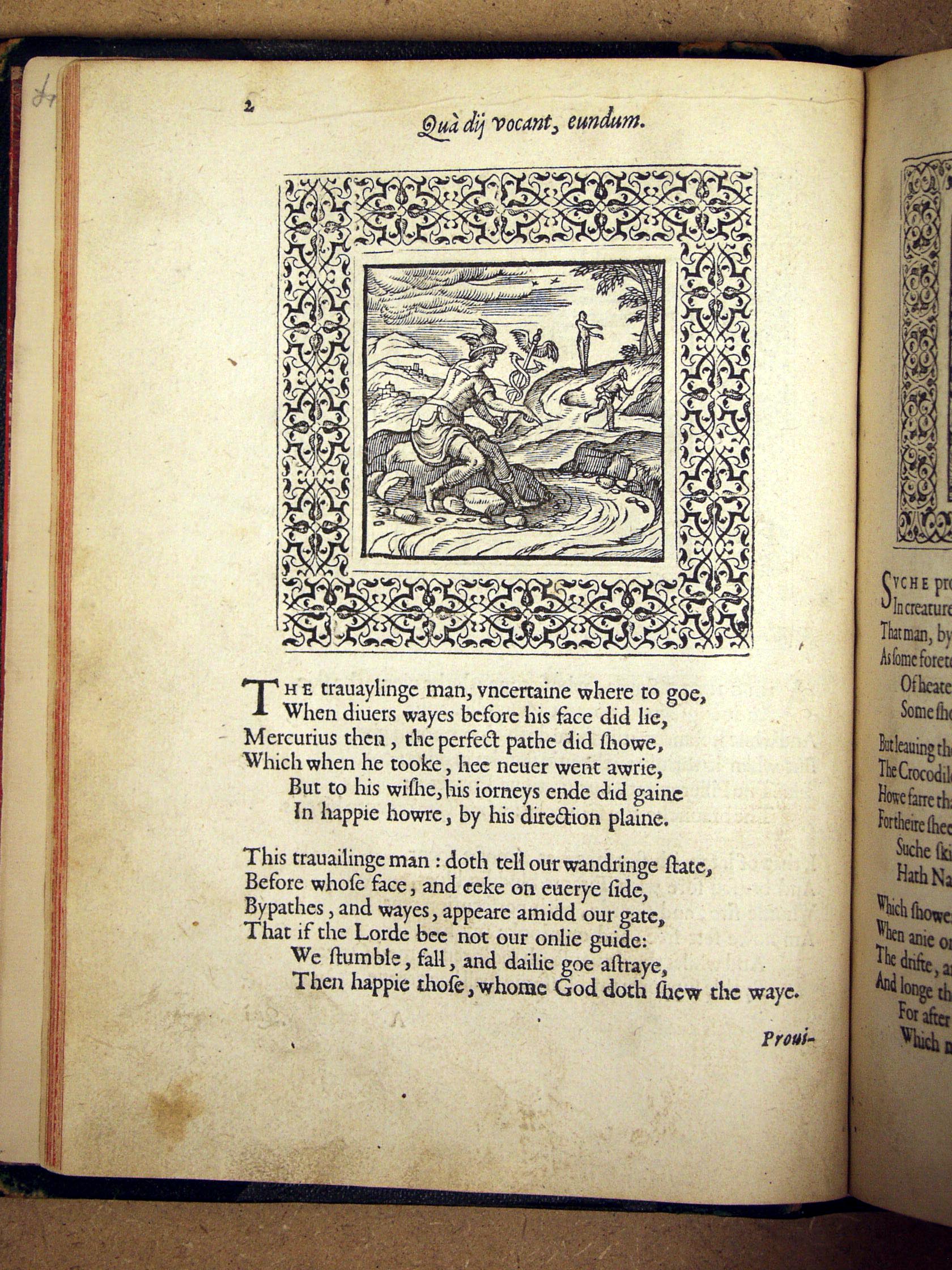
Mercury pointing at a three-forked road

Quà dij vocant, eundumLatin
Where the gods call, we must go.
- Interpretation
- Mercury and travellers (Where the gods call, we must go)
- Interpretation (German)
- Führung durch Gott
Description of the imageAI-generated
Within an elaborate foliate woodcut border, a square landscape scene: Mercury, wearing a winged cap and short tunic and holding the winged caduceus with entwined serpents, kneels on rocky ground at the left and stretches out his arm to point along a winding road. The road forks through hilly country with a stream or path curving in the foreground; a walled town with towers appears on a hill in the far left distance, and tall trees rise at the right. On a rise in the background a small figure stands upon a column or pedestal with arms outstretched, and below it a traveller with a staff moves along the track. Clouds and a few stars fill the sky.
Subscriptio
TranscriptionAI-generated
THE trauaylinge man, vncertaine where to goe, When diuers wayes before his face did lie, Mercurius then, the perfect pathe did showe, Which when he tooke, hee neuer went awrie, But to his wisshe, his iorneys ende did gaine In happie howre, by his direction plaine. This trauailinge man : doth tell our wandringe state, Before whose face, and eeke on euerye side, Bypathes, and wayes, appeare amidd our gate, That if the Lorde bee not our onlie guide: We stumble, fall, and dailie goe astraye, Then happie those, whome God doth shew the waye.
TranslationAI-generated
The travelling man, uncertain where to go, when various ways lay before his face, Mercury then showed him the right path, which when he took, he never went astray, but to his wish he gained his journey's end at a happy hour, by his plain direction. This travelling man tells of our wandering condition: before our face, and also on every side, byways and roads appear amid our path, so that if the Lord be not our only guide, we stumble, fall, and daily go astray. Then happy are those whom God shows the way.
Notes and related emblems
- Related emblem in another book: embmne_mig1591_emblem008
Iconclass
11A23God's perfections11R3the course of life symbolized25F(+342):25F(+154)animals (+ wings of an animal)❧animals (+ symmetrically placed ornamental animals, divided by a (human) figure or an object)25F3(+53)birds (+ postures, positions of animal(s))25F42(+154)snakes (+ symmetrically placed ornamental animals, divided by a (human) figure or an object)25G11groups of trees25G3(+21)trees (+ stem, trunk)25H11mountains25H1124boulder, stone25I12prospect of city, town panorama, silhouette of city26Aclouds31A2352(+61)sitting on an elevation (+ forward)31A2512(+931)arm stretched forward (+ indicating, pointing at)31AA2512(+931)arm stretched forward - AA - both arms or hands (+ indicating, pointing at)31A2512(+933)arm stretched forward (+ holding something)31A25552(+931)index finger forwards, pointing, indicating (+ indicating, pointing at)31A2621(+53)one leg in front of the other (+ sitting)31A27112running31A2753rotating, twisting (movement of the human body)31B6212looking downwards31D14(+72)adult man (+ two persons)41D211(+81)dress, gown (+ men's clothes)41D221(+81)head-gear (+ men's clothes)41D233(+81)gear for legs and feet (+ men's clothes)41D263walking-stick, staff, cane44B192sceptre, staff (symbol of sovereignty)46C116cross-roads, bifurcation46C513'en route', traveller under way54E2(+4)Guidance (+ emblematical representation of concept)57A23(+4)Calling, Vocation, Mission (+ emblematical representation of concept)86(QUA DII VOCANT, EUNDUM)proverbs, sayings, etc. (QUA DII VOCANT, EUNDUM)92B5(story of) Mercury (Hermes)92B572Herm: pillar with the head of Mercury, patron of travellers92B58(CADUCEUS)caduceus (staff with two snakes, attribute of Mercury)92B58(PETASUS)attributes of Mercury: petasus, a winged sun hat
Suggested Iconclass codesAI-generated
Additional codes proposed for this emblem, not (yet) part of the indexing.
92B57specific aspects, allegorical aspects of Mercury; Mercury as patronhighThe scene shows Mercury in his allegorical role as patron and guide of travellers, pointing out the road, which matches 'specific aspects, allegorical aspects of Mercury; Mercury as patron'.
92B58(CADUCEUS)caduceus (staff with two snakes, attribute of Mercury)highMercury explicitly holds the winged caduceus with entwined serpents, exactly the 'staff with two snakes, attribute of Mercury'.
92B58attributes of MercurymediumMercury is characterized by his attributes — winged cap and caduceus — fitting the general 'attributes of Mercury'.
92B571Hermes Psychopompos: Mercury as guide of the soulslowMercury acting as a guide showing the way to a traveller echoes the Psychopompos guide-role, though here it is a living wayfarer rather than souls.
Relationships to the Adagia of ErasmusAI-generated
Suggested relationships between this emblem and adages in Erasmus’ Adagia.
- III vii 95 Triceps Mercurius – thematic inventiomedium
Erasmus explains the three-headed Mercury as the god who is 'index viae', with inscriptions on each head showing where each road leads; the emblem's picture shows exactly this Mercury-as-roadpointer (with a herm-like figure on a column in the background) directing a traveller at a fork in the road.
- I ii 48 In trivio sum – thematic inventiomedium
The adage describes the traveller who reaches a place where roads meet and hesitates which to take, used of minds in doubt; the emblem's subscriptio presents precisely the 'trauaylinge man, vncertaine where to goe, when diuers wayes before his face did lie.'
- I i 48 Tota erras via – thematic inventiolow
Erasmus's essay derives the proverb from travellers who stray from the road and lists the proverbial metaphors 'monstrare viam', 'reducere in viam'; the emblem turns this into the moral that without a divine guide we 'dailie goe astraye'.
Sources
Record ID: embstma_1667_emblem002
This emblem on the Iconclass site: https://iconclass.org/view/embstma_1667_emblem002
Copy: University Library, Glasgow, Stirling Maxwell 1667