Geffrey Whitney, A choice of emblemes (Leiden, 1586)
Emblem 15
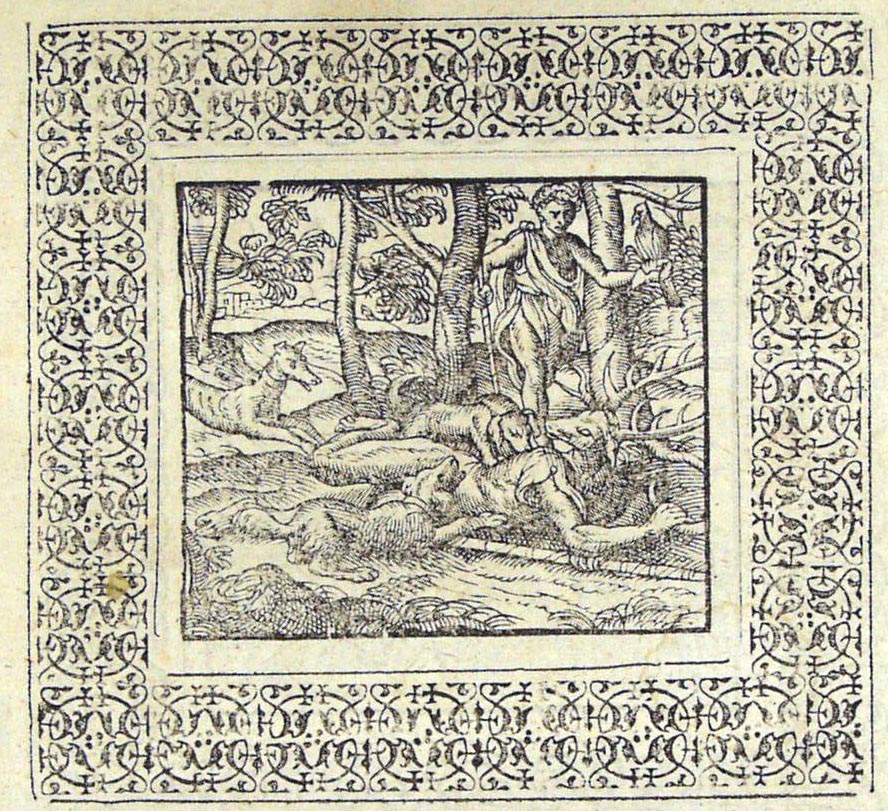
Actaeon devoured by the dogs of Diana; a man approaches with a falcon on his hand
Voluptas aerumnosaLatin
Sorrowful pleasure
- Interpretation
- Actaeon and his hounds (Sorrowful pleasure)
- Interpretation (German)
- Verderbliche Leidenschaften
Description of the imageAI-generated
A woodcut within a wide ornamental interlace border. In a wooded landscape with tall tree trunks and foliage, a bare-legged young man in a short tunic stands beneath the trees, raising his arms; antler-like branches rise behind his head. At his feet a pack of hounds leaps and tears at a prostrate human figure lying on the ground; more dogs run in from the left, and a stream or bank crosses the foreground.
Subscriptio

TranscriptionAI-generated
ACTÆON heare, vnhappie man behoulde, When in the well, hee sawe Diana brighte, With greedie lookes, hee waxed ouer boulde, That to a stagge hee was transformed righte, Whereat amasde, hee thought to runne awaie, But straighte his howndes did rente hym, for their praie. By which is ment, That those whoe do pursue Theire fancies fonde, and thinges vnlawfull craue, Like brutishe beastes appeare vnto the viewe, And shall at lenghte, Actæons guerdon haue: And as his houndes, soe theire affections base, Shall them deuowre, and all their deedes deface.
TranslationAI-generated
Behold here Actaeon, unhappy man, who, when he saw bright Diana in the pool, grew too bold with greedy looks, so that he was straightway transformed into a stag; amazed at this, he thought to run away, but at once his hounds tore him to pieces for their prey. By which is meant that those who pursue their foolish fancies and crave unlawful things appear to the eye like brutish beasts, and shall at length have Actaeon's reward: and as his hounds did, so shall their base affections devour them and deface all their deeds.
CommentaryAI-generated
5 passages · original left, translation right (click to fold)
Cornibus in Ceruum mutatum Actæona sumptis, Membratim proprij diripuere canes.
Ita dis placitum, voluptati vt mœror comes consequatur.
Actaeon, changed into a stag when he had taken on horns, was torn limb from limb by his own dogs. So it has pleased the gods, that sorrow should follow as the companion of pleasure.
Ouid. lib. 3. Metamorph.
Ovid, book 3 of the Metamorphoses.
Horatius 1. Epist. 12. Sperne voluptates, nocet empta dolore voluptas.
Horace, Epistles 1.12. Scorn pleasures: pleasure bought with pain does harm.
Anulus, in picta poësi.
Anulus, in the Picta poesis.
Plautus in Amphit.
Plautus, in the Amphitryo.
Notes and related emblems
- Related emblem in another book: embmne_sam1569_emblem091
Iconclass
25F24(STAG)(+33)hoofed animals: stag (+ head of an animal)25F33(FALCON)predatory birds: falcon25G11groups of trees25I12prospect of city, town panorama, silhouette of city31A2511(+933)arm raised upward (+ holding something)31A2512(+933)arm stretched forward (+ holding something)31A2513(+933)arm stretched sidewards (+ holding something)31A2711walking31B6212looking downwards31A4511monsters with animal head31A4524(+1)monsters ~ hoofed animals (+ head or (parts of) face)34B11(+949)dog (+ audible means of communication of animal(s): roaring, crying, singing, barking, mewing, neighing, chirping, etc.)34B11(+951)dog (+ fighting animals; aggressive relations)34B11(+952)dog (+ movements of animal(s))32A8041D263walking-stick, staff, cane41D92woman (showing herself) undressed, quasi-nude43C1(+4111)sports, games ~ animals (+ spear)43C1(+421)sports, games ~ animals (+ hunting with dogs)43C1(+4241)sports, games ~ animals (+ hunting with falcon, hawk; falconry)43C11482hunting horn56BB1(+4):11S716Pain, Sorrow, Sadness; 'Dolore', 'Dolore di Zeusi' (Ripa) (+ emblematical representation of concept)❧voluptuousness, pleasure, 'Voluptas' ~ one of the seven gifts of the body86(VOLUPTAS AERUMNOSA)proverbs, sayings, etc. (VOLUPTAS AERUMNOSA)92C3(story of) Diana (Artemis)97C11Actaeon as a stag is devoured by his own dogs
Suggested Iconclass codesAI-generated
Additional codes proposed for this emblem, not (yet) part of the indexing.
97C11Actaeon as a stag is devoured by his own dogshighThe correlate 'Actaeon as a stag is devoured by his own dogs' exactly matches the horned youth whose prostrate body is torn by a pack of hounds.
97C1Actaeon changed into a stag: as punishment for seeing her bathe, Diana changes Actaeon, the hunter, into a stag (Ovid, Metamorphoses III 193)highThe correlate describing Actaeon the hunter changed into a stag fits the antler-like branches rising behind the young man's head and the commentary's 'changed into a stag when he had taken on horns'.
83(OVID, Metamorphoses III:232-252)Actaeon is killed by the dogsmedium'Actaeon is killed by the dogs' corresponds to the depicted mauling of the figure on the ground, and the commentary explicitly cites Ovid, Metamorphoses book 3.
83(OVID, Metamorphoses III:206-231)Actaeon is pursued by his houndslow'Actaeon is pursued by his hounds' may apply to the additional dogs running in from the left, though the main action shown is the killing rather than the chase.
Relationships to the Adagia of ErasmusAI-generated
Suggested relationships between this emblem and adages in Erasmus’ Adagia.
- I i 66 Capra contra sese cornua – thematic inventiomedium
The emblem's Latin distich turns on the horns Actaeon takes on ('Cornibus in Ceruum mutatum Actæona sumptis') being the instrument of his destruction by his own hounds, exactly the moral of Erasmus' fable-adage in which the goat laments 'I grew those horns for my own destruction.'
- I i 50 Suo iumento sibi malum accersere – thematic inventiolow
The emblem belongs to the commonplace of self-procured ruin (one's own dogs / one's own base affections devour one), the Loci heading 'Malum accersitum aut retortum'; the explicit citation of Plautus' Amphitruo in the commentary touches the same comedy from which Erasmus draws this adage, though the quoted line itself is the 'voluptati ut maeror comes' verse.
- I vi 52 Nostris ipsorum alis capimur – thematic inventiolow
Like the eagle shot with an arrow feathered from its own plumage, Actaeon is destroyed by what is his own — his hounds and his own base affections — the emblem's stated moral that men's passions 'shall them deuowre'.
- III iii 8 Pyraustae gaudes gaudium – thematic inventiolow
Erasmus' adage on the moth whose momentary delight in the flame is its death matches the emblem's motto 'Voluptas ærumnosa' and the Horatian tag 'nocet empta dolore voluptas' — pleasure that lures to destruction.
Sources
Record ID: embstma_1667_emblem015
This emblem on the Iconclass site: https://iconclass.org/view/embstma_1667_emblem015
Copy: University Library, Glasgow, Stirling Maxwell 1667