Guillaume de La Perrièrre, Le Theatre Des Bons Engins (Lyon, 1545)
Emblem 5
A tennis player looks up at a ball lying on a wall
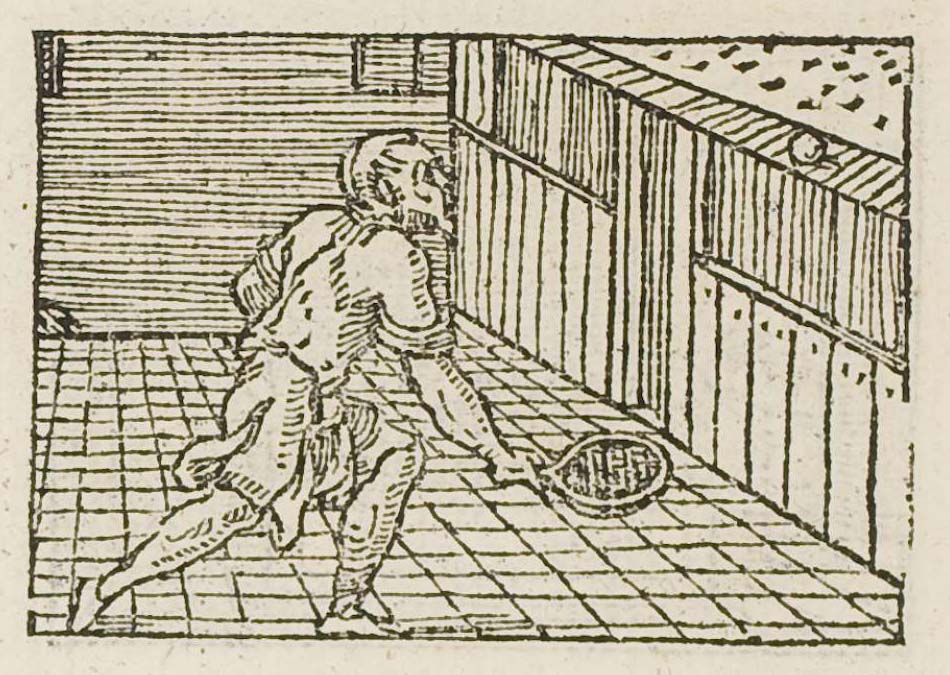
C'est grand abus de laisser son bon heur.
Emblem V. It is a great mistake to let go of one's good fortune.AI-generated
Description of the woodcutAI-generated
A woodcut set inside a tennis court (jeu de paume) with a tiled floor, wooden galleries and a sloping penthouse roof at the right. A single bearded man in a short doublet, hose and cap stands in the middle of the court, bending forward and turning his head upward toward a small ball in the air near the gallery wall; he has dropped or let go of his racket, which lies on the ground behind him to the right. Dark shading marks a window or opening at the upper right.
Subscriptio

TranscriptionAI-generated
Qvi prend le bond, & laisse la volee,Ne fut iamais tenu pour bon ioueur.Qui prend le mont, & laisse la valee,Ne fut iamais tenu pour bon coureur.C'est grand abuz de laisser son bon heur,Pour vn espoir de promesse incertaine:Car mespriser vne chose certaineN'est pas le faict d'vn saige entendement,Folle entreprinse & gloire trop haultaineFont tomber l'homme en maint encombrement.
TranslationAI-generated
He who takes the bounce and lets the volley go by was never held to be a good player. He who takes the hill and leaves the valley was never held to be a good runner. It is a great mistake to let go of one's good fortune for the hope of an uncertain promise: for to despise a sure thing is not the act of a wise mind. Foolish undertakings and too lofty a desire for glory make a man fall into many a hindrance.
Iconclass
86(C'EST GRAND ABUS DE LAISSER SON BON HEUR)proverbs, sayings, etc. (C'EST GRAND ABUS DE LAISSER SON BON HEUR)43C8grounds, fields and accomodations for sports, games and physical performances31D14adult man43C4151tennis, lawn-tennis43C4151(+41)tennis, lawn-tennis (+ equipment, outfit (sports, games, etc.))54FFFortune and Misfortune (opposing concepts)54F122Vicissitudes of Life
Suggested Iconclass codesAI-generated
Additional codes proposed for this emblem, not (yet) part of the indexing.
43C4153'jeu de Paume'highThe correlate '"jeu de Paume"' exactly matches the depicted tennis court with its galleries and penthouse roof named in the description.
43C415ball games in which ball is hit with racket (or hand)highThe scene shows a player with a racket and a ball in the air, matching 'ball games in which ball is hit with racket (or hand)'.
43C41ball gamesmediumAs the generic 'ball games' category it covers the tennis play depicted, though the more specific racket/jeu de paume codes are preferable.
54F12Luck, Fortune, Lot; 'Fato', 'Fortuna', 'Fortuna aurea', 'Fortuna buona', 'Fortuna pacifica overo clemente', 'Sorte' (Ripa)low'Luck, Fortune, Lot' corresponds to the fortune theme the commentary search terms point to, the tennis ball serving as an image of fortune's uncertain bounce.
11R5(personifications of) 'Vanitas', the vanity of human life; Fragilità humana, Fugacità delle grandezze & della gloria mondana, Meditatione della morte, Opera vana, Piacere vano, Vana gloria, Vanità (Ripa)lowPersonified 'Vanitas', the vanity of human life, matches the commentary's vanity/human-life terms interpreting the game as an emblem of life's futility.
Relationships to the Adagia of ErasmusAI-generated
Suggested relationships between this emblem and adages in Erasmus’ Adagia.
- IV ii 66 In terra pauperem – thematic inventiomedium
Erasmus glosses this adage as teaching that 'a secure fortune, even a modest one, is to be preferred to uncertain ones even if they are greater' — exactly the emblem's moral that it is folly to abandon one's certain 'bon heur' for 'vn espoir de promesse incertaine'.
- II iv 5 Spem precio emere – thematic inventiomedium
The adage describes accepting a certain loss in pursuit of an uncertain gain; the subscriptio's 'laisser son bon heur / Pour vn espoir de promesse incertaine' states the same folly, with the same contrast of spes versus res certa.
- I iii 40 Rem factum habere – thematic inventiomedium
Erasmus explains that 'promises are far from certain, but you may put your trust solely in what has been kept and fulfilled' — the emblem's claim that 'mespriser vne chose certaine / N'est pas le faict d'vn saige entendement' in favour of a 'promesse incertaine' rests on the same commonplace.
- II iv 85 Mea est pila – thematic inventiolow
The adage derives from the ball game in which only the best player gets and keeps possession of the ball; the emblem's tennis-court picture and its maxim about the player who 'prend le bond et laisse la volee' use the same ball-game image of winning or forfeiting one's advantage.
- I v 1 Multa cadunt inter calicem supremaque labra – thematic inventiolow
Erasmus' warning that 'it is so little safe to trust in things to come that we are scarcely certain even of what we hold in our hands' underlies the emblem's counsel not to release a sure good for a future promise.
Sources
Record ID: embhab_162-3-eth-b_emblem005
This emblem on the Iconclass site: https://iconclass.org/view/embhab_162-3-eth-b_emblem005
Page in the digital copy of the Herzog August Bibliothek: http://diglib.hab.de/drucke/162-3-eth-b/start.htm?image=00018