Jacob Cats, Spiegel (The Hague, 1632)
Emblem 7
Cupid at a table with a group of musicians; in the background a man, leaning on a staff, looks at a sleeping woman
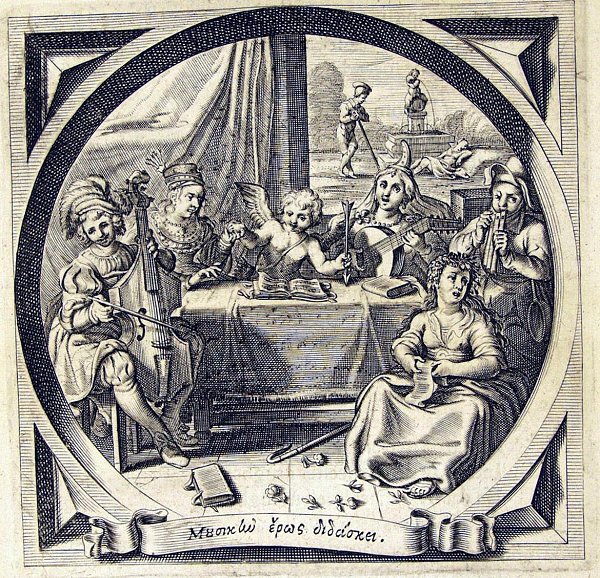
Amor docet MusicamLatin
Love teaches music.AI-generated
Description of the imageAI-generated
Inside an oval frame set in a rectangular border, a group of musicians is gathered around a table covered with a cloth on which lie open music books. At the left a man in a plumed cap sits playing a bass viol with a bow; behind him a young woman in a crown-like head-dress stands singing with a raised hand. In the centre a winged Cupid stands at the table holding arrows in both hands, one pointed upward. To the right a woman with a feathered head-dress plays a lute while singing; behind her another woman in a cap blows a wind instrument (recorder/pipe). In the foreground right a seated woman in a long gown sings from a scroll or holds a small object in her lap. A flute or recorder and scattered flowers lie on the tiled floor, with a closed book at lower left. Through a window at the back a garden is seen with a fountain surmounted by a statue, a man walking with a staff, and birds. Below the oval a banderole carries a Greek inscription.
Subscriptio


TranscriptionAI-generated
Eerlicke Vryagie GHy, die op dese prente siet, Maer weet daer van de meyning niet, En vraegt wat dese kleyne Guyt, Wat Venus Iongen hier beduyt; Ick bidde staet een weynigh stil, En hoort eens wattet seggen wil. Daer is een spreuck van langer handt Gekomen uyt het Griecken-landt, Die seyt, dat Liefde singen leert, En plompe sinnen omme-keert, Dat is geseyt, dat soete min, Brengt alle soete dingen in. Siet hierom ist dat Venus kint Sich hier als in een schoole vint, Een schoole daermen geestigh queelt, En hondert soete deuntjens speelt, Een schoole daermen plompaers slijpt, En daer de groene jonckheyt rijpt; Maer 'tis een meester sonder plack, Want hy leert kunsten met gemack, Sijn pijl, die door de werelt sweeft, Die ist die dese krachten heeft: Want soo daer is een slechte duyf, Die naeu en kent haer doucken-huyf, Die in haer gaen, en al haer doen Is raeu en uyttermaten groen, Indien sy desen meester krijght, En dat hy in haer boesem sijght, Gewis daer is geen twijffel aen, Hy leert haer voor den spiegel staen, Hy leert hoe sy haer dom gelaet, Sal stellen op de rechte maet, Sal stellen anders alsse plach, Eer sy by hem ter schoolen lach. Is elders oock een raeuwe gast, Die op geen heussche seden past, En niet ter werelt anders weet Als hoemen pap en soppen eet, En daerom, t'huys en over straet, Gelijck een klunten henen gaet, Genaeckt hy maer eens dese school, Sijn hart ontfonckt gelijck een kool, Sijn hoet staet anders alsse plagh, Sijn kraegh soo titsigh alsse magh, Sijn knevels geestich op-geset, Sijn gantsche kleedingh wonder net; Hy leert daer niemant op en gist, En dat hy noyt te vooren wist, Hy leert ontsluyten sijnen mont, Die eerst gelijck vernagelt stont, Hy leert, en al met goet verstant, De beste woorden van het lant, Hy leert voor al oock soeten sangh, En al met vreugden, sonder dwangh, Hy krijght een rap, een buyghsaem lijf, Al stontet eertijts bijster stijf, Int kort', een plompaert wort beleeft Soo haest hy maer een vrijster heeft. Soo leert dan Liefde wijf en man, Dat niemant anders leeren kan.
TranslationAI-generated
Honourable courtship You who look upon this print, but do not know its meaning, and ask what this little rogue, what Venus' boy signifies here: I pray you, stand still a little while, and hear what it means to say. There is a saying come long ago out of the land of Greece, which says that Love teaches singing and turns clumsy minds about; that is to say, that sweet love brings in all sweet things. See, this is why Venus' child is found here as in a school: a school where people sing wittily and play a hundred sweet tunes, a school where clods are polished and where green youth ripens; but it is a master without a rod, for he teaches the arts with ease. His arrow, which flies through the world, is what has these powers. For if there is a plain dove [simple girl] who hardly knows her own linen cap, whose bearing and whole conduct is raw and exceedingly green, if she gets this master, and he slips into her bosom, surely there is no doubt: he teaches her to stand before the mirror, he teaches how she shall set her dull countenance in the proper measure, shall set it otherwise than it used to be before she went to school with him. Is there elsewhere too a raw fellow who cares for no courteous manners and knows nothing in the world but how one eats porridge and sops, and therefore, at home and in the street, walks along like a bumpkin: let him but once approach this school, his heart kindles like a coal, his hat sits otherwise than it used to, his collar as smart as may be, his moustaches wittily turned up, his whole clothing wonderfully neat; he learns there what no one would guess, and what he never knew before; he learns to unlock his mouth, which before stood as if nailed shut; he learns, and all with good understanding, the finest words of the land; above all he learns sweet singing too, and all with joy, without compulsion; he gets a nimble, supple body, though formerly it stood exceedingly stiff. In short, a clod becomes polite as soon as he has a sweetheart. Thus Love teaches woman and man what no one else can teach.
CommentaryAI-generated
2 passages · original left, translation right (click to fold)
Lat. Amor docet Musicam.
Recte August. dixit de Amore divino. Amor magnus doctor est, atque omnes Philosophiæ partes implet.
Ital. Chi ha l'amor nel petto, ha gli speroni a i fianchi.
l'Amour est un grãd maistre d'escole. Tout est gaillart ou qu'il s'en vole. Franç.
l'Amour est un grand maistre. Il faict le lourdau gentil estre.
Nullus adeò ignavus est quem amor non inflammet ad virtutem ac divinum reddat, ut par viro forti evadat: nam quod Homerus vim furoremque divinum à Deo quibusdam heroibus inspiratum ait, id Amor præstat amantibus. Lat. Plato.
Philip. Beroal. Da mihi hominem incultum, ab amore cultissimus efficitur, da rusticum ac rudem, ab amore fiet ingeniosus ac elegans. quid plura? segnities, somnus omnis, lethargicus marcor, ac squallor ex amoris contubernio eliminatur.
Syrach. c. 36. 24. La beauté de la femme resiouit la face, & surpasse tous les desirs de l'homme.
Hinc autor quidã Gallus. Celuy qui voit de loing venir celle qu'il aime, il redresse le collet de sa chemise, agence le bonnet sur sa teste, retrouche ses moustaches, redresse son manteau sur les espaules, se leue sur la pointe de ses pieds, monstre un visage joyeux, & semble qu'il se renouvelle de tout pour se rendre agreable aux yeux sa Dame.
Lat. Pro conclusione; addamus varias Amoris descriptiones, à sapientissimis traditas, ut inde eius natura ignorantibus innotescat.
Amorem beatus ille Dionisius definit, esse virtutem unitivam.
Augustinus, appetitum rei, propter se ipsum.
Bernardus ordinatam & vehementem voluntatem ad bonum.
Alij Theologi, Conjunctionem amantis cum amato.
Nonnulli, Desiderium possidendi, utendi, fruendi, opinati boni & pulchri.
Plerique, Spem irretitam, timori conjunctam.
Tullius dixit amorem esse, benè velle.
Seneca, Vigorem animi, & excessum mentis.
Dantes, Inclinationem animi in rem concupitam.
Marius AEquicola, Desiderium boni quo illud nobis semper adesse, & possidere cupimus.
Peripatetici, Argumentum benevolentiæ propter apparentem venustatem.
Academici, Desiderium fruendæ pulchritudinis.
Theophrastus, Animæ otiosæ affectum.
Epictetus deniq;, Otiosi pectoris molestiam, in puero pudorem, in virgine ruborem, in juvene ardorem, in fœmina furorem.
Latin: Love teaches music.
Rightly did Augustine say of divine Love: Love is a great teacher, and fills up all the parts of philosophy.
Italian: He who has love in his breast has spurs at his flanks.
French: Love is a great schoolmaster. All is merry wherever he flies.
Love is a great master; he makes the lout become genteel.
Latin, Plato: No one is so slothful that love does not inflame him to virtue and make him divine, so that he turns out the equal of a brave man; for what Homer says of the force and divine frenzy inspired by God into certain heroes, that Love supplies to lovers.
Philippus Beroaldus: Give me an uncultivated man—by love he is made most refined; give me a rustic and rude one—by love he will become clever and elegant. What more? Sloth, all drowsiness, lethargic languor and squalor are driven out by keeping company with love.
Sirach ch. 36:24: The beauty of a woman gladdens the face, and surpasses all the desires of man.
Hence a certain French author: He who sees from afar the woman he loves coming straightens the collar of his shirt, arranges the cap on his head, twirls his moustaches, settles his cloak on his shoulders, raises himself on the tips of his toes, shows a joyful face, and seems to renew himself entirely to make himself pleasing in the eyes of his Lady.
Latin: By way of conclusion, let us add various descriptions of Love handed down by the wisest men, so that from them its nature may become known to those who are ignorant of it.
That blessed Dionysius defines Love as a uniting power.
Augustine, as the appetite for a thing for its own sake.
Bernard, an ordered and vehement will toward the good.
Other theologians, the joining of the lover with the beloved.
Some, the desire of possessing, using, enjoying a supposed good and beautiful thing.
Most, a hope entangled and joined with fear.
Tully (Cicero) said love is to wish well.
Seneca, vigour of spirit and an excess of mind.
Dante, an inclination of the soul toward the thing desired.
Mario Equicola, the desire for a good which we wish always to be present with us and to possess.
The Peripatetics, a proof of goodwill on account of apparent beauty.
The Academics, the desire to enjoy beauty.
Theophrastus, an affection of an idle soul.
Epictetus finally, the trouble of an idle breast: in a boy shame, in a maiden blushing, in a youth ardour, in a woman frenzy.
l'Amour est un grand maistre Il faict le lourdau gentil estre.
Love is a great master; he makes the lout be genteel.
Iconclass
25G411cut flowers; nosegay, bunch of flowers31A232:41D263leaning figure❧walking-stick, staff, cane31A25432(+0)leading someone by the hand or wrist (+ variant)31AA2361lying on the back with uplifted upper part of the body - AA - female human figure31BB1sleeping; unconsciousness - BB - out of doors41A651garden fountain41A711table41D221(CAP)head-gear: cap48C7312viola, violoncello; double bass48C7323lute, and special forms of lute, e.g.: theorbo48C7351flute, aulos, tibia48C741printed edition of musical score48C755vocal music, singing48C7561:48C75instrumental popular music❧making music; musician with instrument49M32book49MM32book - MM - book open52D3(+4)Eloquence; 'Eloquenza', 'Fermezza & Gravità dell'Oratione' (Ripa) (+ emblematical representation of concept)56F2(+4)(personifications and symbolic representations of) Love; 'Amore (secondo Seneca)' (Ripa) (+ emblematical representation of concept)86(ΜΟΥΣΙΚΗΝ ΕΡΩΣ ΔΙΔΑΣΚΕΙ)proverbs, sayings, etc. (ΜΟΥΣΙΚΗΝ ΕΡΩΣ ΔΙΔΑΣΚΕΙ)86(AMOR DOCET MUSICAM)proverbs, sayings, etc. (AMOR DOCET MUSICAM)92D18(ARROW)attributes of Cupid: arrow(s)92D18(QUIVER)attributes of Cupid: quiver
Relationships to the Adagia of ErasmusAI-generated
Suggested relationships between this emblem and adages in Erasmus’ Adagia.
- IV v 15 Musicam docet amor – direct mottohigh
The emblem's Greek banderole 'Μουσικὴν ἔρως διδάσκει' and Latin motto 'Amor docet Musicam' reproduce Erasmus's adage IV v 15 verbatim; the Dutch subscriptio even explains that 'there is a saying come long ago out of the land of Greece, which says that Love teaches singing', and the commentary's Plato/Beroaldus material on love turning the rustic into an elegant man matches Erasmus's own exposition of this adage.
- II vi 18 Αμουσοι – thematic inventiolow
The adage 'strangers to the Muses' (uncultured = unmusical) supplies the contrasting term implied in the emblem: the 'plompaert'/'raeuwe gast' who is ἄμουσος until Love schools him, a word Erasmus himself uses in the verse form of 'Musicam docet amor' ('κἄντις ἄμουσος ᾖ τὸ πρὶν').
Sources
Record ID: embstma_1288_emblem007
This emblem on the Iconclass site: https://iconclass.org/view/embstma_1288_emblem007
Copy: University Library, Glasgow, Stirling Maxwell 1288