Jacob Cats, Spiegel (The Hague, 1632)
Emblem 44
An old man is warning a young man for prostitutes, because they will destroy him like caterpillars destroy a cabbage
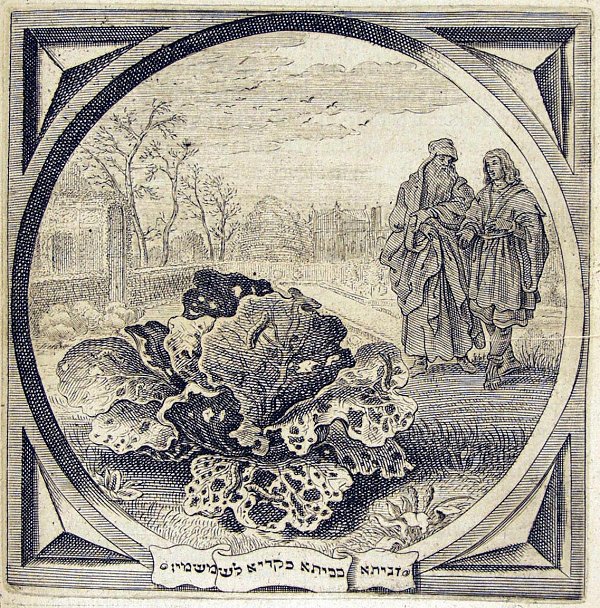
Een rupse op een kool, Een hoere in een huysDutch
A caterpillar on a cabbage, a whore in a house.AI-generated
Description of the imageAI-generated
Within a circular frame set in a rectangular border with hatched corner spandrels, a garden landscape is shown. In the foreground, filling the lower half of the roundel, is a large open cabbage plant whose broad, curling leaves are riddled with holes; a caterpillar is visible creeping on one of the upper leaves. Behind the cabbage a path runs through a walled garden with trees, hedges and the roofs of houses and a church in the distance, with birds in the cloudy sky. At the right, two standing figures walk along the path: an older bearded man in a long cloak and cap, who holds the edge of his mantle and gestures, speaking to a younger long-haired man in a long coat beside him. Below the roundel a scroll or cartouche carries a line of Hebrew/Aramaic lettering.
Subscriptio


TranscriptionAI-generated
Ghy die oyt hebt gesien wanneer de koolen groeyen, En dat het gul gewas is veerdigh om te bloeyen, Wat dan de rupse doet ontrent het weeligh kruyt, Gaet let op haer bedrijf, en treckter leeringh uyt: Waer oyt het vuyl gespuys maer eens en heeft gekropen Daer is het innigh mergh in haesten uyt-gesopen, En waer het leelick dier den beck maer in en druckt Daer is in korter tijdt het leven uyt-geruckt: Haer vroylick groen begint van stonden aen te quelen, Vermits het niet en houdt als slechts de bloote stelen, De wasdom is gedaen, de jeught die is te niet, Soo dat het yder deert, al die het maer en siet; Hier dient nu, teere jeught, met sinnen overwogen Wat leer-stuck over langh hier uyt de Wijse togen; Een hoer in eenigh huys die is de rups gelijck, Sy maecktet al beroyt, al wasset eertijts rijck, Al watse maer genaeckt dat is terstont gegeten, Daer is van stonden aen het leven uyt-gebeten, Al zijn de renten veel, al is de winste groot Het smelt noch altemael, het smelt in haren schoot. Schout hoeren, teere jeught, schout hoeren, rijpe mannen, En wilt het vuyl gespuys uyt uwen huyse bannen, Haer aert en gants bedrijf is met de rupsen een, Een hoer in eenigh huys is etter in het been.
TranslationAI-generated
You who have ever seen when the cabbages are growing, and when the lush plant is ready to flower, what the caterpillar then does about the luxuriant herb — go, observe its doings, and draw a lesson from it: wherever that foul vermin has once crept, the inner marrow is quickly sucked out, and wherever the ugly creature has only thrust in its beak, there in a short time life is torn away: its cheerful green at once begins to languish, since nothing is left but the bare stalks; growth is over, the youth is gone, so that it grieves everyone who merely sees it. Here, tender youth, must now be thoughtfully weighed what doctrine the Wise have long ago drawn from this: a whore in any house is like the caterpillar; she makes everything bare, though it was once rich. Whatever she merely touches is immediately eaten up; straightway the life is bitten out of it. Though the rents be many, though the profit be great, it all melts away nonetheless, it melts in her lap. Shun whores, tender youth; shun whores, grown men, and banish that foul vermin from your houses; their nature and whole doing is one with the caterpillars': a whore in any house is pus in the bone.
CommentaryAI-generated
1 passages · original left, translation right (click to fold)
Franç. Qui tient putain & asne meine Ne sera jammais hors de peine. Lat. Scribatur portis Meretrix est janua mortis. Gula, ira, invidia, superbia, sacrilegia, latrocinia, cædes, eo die nata sunt, quo meretrix professionem fecit. Ital. Chi ha un piè in bordello, ha l'altro nel hospitale. Nederl. Die sijné eené voet int hoer-huys set, set den anderen int gast-huys. Spaens. Huespeda hermosa, mal para la bolsa. .i. Franç. Belle hostesse un mal pour la bourse. Franç. Pour estranger les mastins, il faut tuer la chiene. Die hoeren aen hanght krijgt motten en wormten, en verdort. Syr. 19. 2. Weest niet geerne by lichte vrouwen, want gelijck uyt de kleederen motten komen, also koomt van haer veel booses. Syr. 42. 12. Nederl. Wie een hoere trout, is een schelm, of salver een worden. De hoeren zijn als het voghel-lijm, watter ontrent koomt laeter van sijn veren. Ital. I cavalli cavaro, i cani tirano, è le puttano rivano. Chi asino caccia è puttana mena Non esce mai di pena. Lat. Mulier melle mollior Non virgo sed vorago, Quo nitentior, eo nocentior, Quæ dum fovet, sibi favet; Quæ dum ridet, rodit, radit, Idque lactanter & latenter. Die hoeren lept, of esels drijft, Tis vreemt soo hy in ruste blijft. Nederl. Een rupse op een kool Een hoere in een huys. Lat. Qui nutrit scortum perdit substantiam suam. .i. Tout ce que nourit & entretient la vie. Iaq. Olivier au traité des Femmes. Lat. Subdolæ pellicis suavium, morsus aspidis surdæ. Hoogd. Weiber aug ist ein feur-spiegel. Franç. Les putains vuident la bourse d'argent & l'esprit de raison. Vid. in mensa Theophilosophica de mulierib. multa hujusmodi. Æneas Sylvius Epist. de medel. illicit. amor. Quid meretrix, nisi juventutis expilatrix, virorum rapina, patrimonij devoratrix, honoris pernicies, pabulum diaboli, janua mortis, inferni supplementum, discrimen vitæ, mors blanda, mel felleum, dulce venenum, pernicies delicata, malum spontaneum? Meretrix, fundi calamitas apud Terent. vocatur. Eun. act. 1. sc. 1. Quasi dicat grandinem crassiorem quæ calamos comminuat, nam quod nos capere oportet (ait Servius) hæc intercipit. Certè vix unquam sese attollit ista seges, quam illa calamitas semel depressit. Theocritus in Messoribus puellam depastricem alieni patrimonij Locustam appellat, quæ messem destinatam agricolis intercipere consuevit. Multo enim minus nocet armatus mars, quam nuda Venus. Matth. Tympius mensâ Theologo-philosophica cap. 29. de libidine. Pour l'amour de la femme paillarde vient on au morceau du pain. Prov. 6. 26 Meretricem ego item reor esse mare, id est, quod das, devorat, nec unquam abundat &c. Plaut. Truc. Plaut. Truc. Meretrix meum herum miserum suâ blanditiâ intulit in Pauperiem, privavit bonis, luce, honore atque amicis. Ovid. Sola viro mulier spolijs exultat ademptis, Sola locat noctes, sola locanda venit. Vid. insignes versus Anaxilæ apud Mart. Delrio Adagial. lib. sacris Vet. testament. cap. 23. part. 2.
French: He who keeps a whore and drives an ass will never be out of trouble. Latin: Let it be written on the gates: a harlot is the gateway of death. Gluttony, anger, envy, pride, sacrileges, robberies, murders were born on the same day on which the harlot took up her trade. Italian: He who has one foot in the brothel has the other in the hospital. Dutch: He who sets one foot in the whorehouse sets the other in the hospital. Spanish: A beautiful hostess, bad for the purse. i.e. French: A fair hostess, an evil for the purse. French: To drive off the mastiffs one must kill the bitch. He who clings to whores gets moths and worms, and withers away. Sirach 19:2. Do not willingly keep company with loose women, for just as moths come out of clothes, so much evil comes from them. Sirach 42:12. Dutch: Whoever marries a whore is a scoundrel, or will become one. Whores are like birdlime: whatever comes near it loses its feathers. Italian: The horses dig, the dogs pull, and the whores ruin. He who drives an ass and leads a whore never gets out of trouble. Latin: A woman softer than honey, not a maiden but an abyss; the more glittering, the more harmful; while she caresses, she favours herself; while she laughs, she gnaws and scrapes, and that both boastfully and secretly. Dutch: He who courts whores or drives asses — it is a wonder if he stays at peace. Dutch: A caterpillar on a cabbage, a whore in a house. Latin: He who feeds a harlot destroys his own substance, i.e. everything that nourishes and sustains life. Jacques Olivier in his treatise on Women. Latin: The kiss of a crafty concubine is the bite of a deaf asp. German: A woman's eye is a burning-glass. French: Whores empty the purse of money and the mind of reason. See many such things in the 'Theophilosophical Table' on women. Aeneas Sylvius, Letter on the remedy for illicit love: What is a harlot but the plunderer of youth, the plundering of men, the devourer of a patrimony, the ruin of honour, the fodder of the devil, the gate of death, the supplement of hell, the peril of life, a flattering death, gall-like honey, sweet poison, dainty destruction, a self-chosen evil? A harlot is called 'the calamity of the farm' in Terence (Eunuch, act 1, scene 1), as if to say, coarser hail that shatters the stalks, for what we ought to take (says Servius) she intercepts. Certainly that crop scarcely ever raises itself again once that calamity has beaten it down. Theocritus in the 'Reapers' calls a girl who devours another's patrimony a Locust, since she is accustomed to intercept the harvest destined for the farmers. For armed Mars harms far less than naked Venus. Matthaeus Tympius, Theologico-philosophical Table, chapter 29, on lust. French: For the love of a wanton woman one comes to a morsel of bread. Proverbs 6:26. I likewise think a harlot is the sea: that is, whatever you give, it devours, and is never full, etc. Plautus, Truculentus. Plautus, Truculentus: A harlot by her blandishment brought my poor master into poverty, deprived him of goods, of light, of honour and of friends. Ovid: Woman alone exults in the spoils taken from a man; she alone hires out nights, she alone comes to be hired. See the notable verses of Anaxilas in Martinus Delrio, Adagia from the sacred books of the Old Testament, chapter 23, part 2.
Iconclass
86(EEN RUPSE OP EEN KOOL, EEN HOERE IN EEN HUYS)proverbs, sayings, etc. (EEN RUPSE OP EEN KOOL, EEN HOERE IN EEN HUYS)
Suggested Iconclass codesAI-generated
Additional codes proposed for this emblem, not (yet) part of the indexing.
25G4(CABBAGE)plants and herbs: cabbagehighThe correlate 'plants and herbs: cabbage' matches the large open cabbage plant with broad holed leaves filling the foreground.
25F711(CATERPILLAR)insects: caterpillarhighThe correlate 'insects: caterpillar' matches the caterpillar creeping on the cabbage leaf, the pivot of the proverb 'a caterpillar on a cabbage, a whore in a house'.
41A635fenced or walled garden; 'Hortus Conclusus'mediumThe correlate 'fenced or walled garden' matches the depicted walled garden with path, hedges and trees in which the scene takes place.
33C5prostitutionmediumThe correlate 'prostitution' is the overarching moral subject of the commentary, which warns throughout about harlots consuming a man's substance.
33C52whore, prostitutemediumThe correlate 'whore, prostitute' corresponds to the figure of the harlot that the entire commentary is devoted to, allegorized by the caterpillar devouring the cabbage.
Relationships to the Adagia of ErasmusAI-generated
Suggested relationships between this emblem and adages in Erasmus’ Adagia.
- III i 85 Morsus aspidis – essay quotemedium
The emblem's Latin commentary includes the proverb 'Subdolæ pellicis suavium, morsus aspidis surdæ' ('the kiss of a crafty concubine is the bite of a deaf asp'), which reproduces Erasmus's headword and matches the verse quoted in his essay, 'Ἰὸς πέφυκεν ἀσπίδος κακὴ γυνή' (a wicked woman is an asp's venom) — the same equation of the dangerous woman with an incurable serpent's bite.
- I ii 92 Cupidinum crumena porri folio vincta est – thematic inventiolow
Erasmus explains the adage as applying to those who ruin themselves financially through erotic passion; the emblem's whole moral ('Les putains vuident la bourse d'argent', 'Belle hostesse un mal pour la bourse', 'it all melts in her lap') is the same commonplace of the lover's purse emptied by a harlot, though no textual borrowing is visible.
- I x 32 Largitio non habet fundum – thematic inventiolow
The emblem's Plautine tag 'Meretricem ego item reor esse mare ... quod das, devorat, nec unquam abundat' expresses the same bottomless-vessel image (Erasmus compares the pierced jar of the Danaids) for wealth poured out without limit on pleasure.
Sources
Record ID: embstma_1288_emblem044
This emblem on the Iconclass site: https://iconclass.org/view/embstma_1288_emblem044
Copy: University Library, Glasgow, Stirling Maxwell 1288