Jacob Cats, Spiegel (The Hague, 1632)
Emblem 45
A young man draws back his hand from the dish with coals offered by a young woman; behind her a masked man is playing a lute
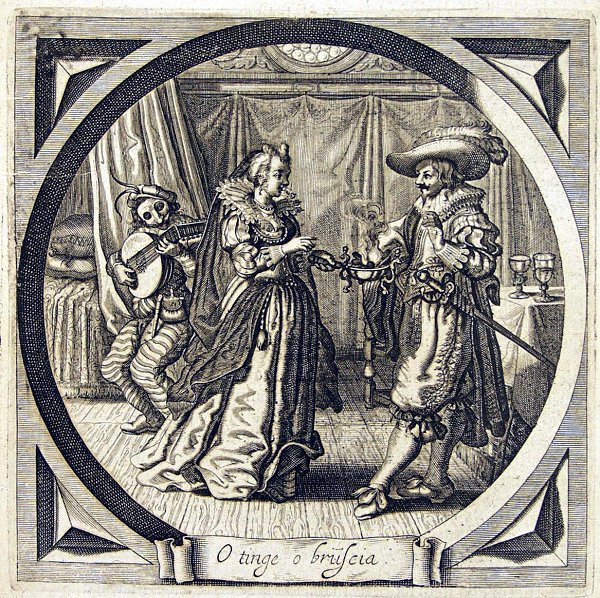
O tinge o brusciaItalian
Either it stains or it burns.AI-generated
Description of the imageAI-generated
A round medallion-shaped frame (a thick dark ring set into a square plate with hatched corner spandrels) encloses an interior scene. In a richly curtained room a woman in elaborate court dress — high lace ruff, pearl necklace, puffed sleeves, a long dark overmantle trailing behind her and a pale satin skirt, her hair dressed high — stands in the centre and holds out a footed brazier or chafing dish from which coals glow and smoke rises. Facing her at the right a young gentleman in a broad plumed hat, lace collar, slashed doublet, sash and rapier, with rosettes on his shoes, reaches toward the dish with both hands, hesitating. Behind them at the left a seated figure in a masked face (a grotesque mask) and feathered cap, wearing striped breeches, plays a lute. At the far right stands a small round table with a white cloth bearing two wine glasses; at the left is an upholstered chair or bench. Below the picture a scrollwork banderole carries the motto.
Subscriptio


TranscriptionAI-generated
De Iongelingh spreeckt. Ick sie wel, weelde-kint, ghy biedt my dese kolen, Maer onder u geschenck daer is bedrogh verholen, Ick weet wie dat ghy zijt, en watter van u koomt, Dies hebb' ick dubbel recht van u te zijn beschroomt; Tast' ick daer 'tniet en gloeyt, het vuyl kleeft aen mijn handen, En grijp ick daer het vonckt, gewis ick sal my branden; Dus ben ick in gevaer waer ick de vingers set, U kool doet als haer vrou, sy brant, of sy besmet.
TranslationAI-generated
The young man speaks. I see well, child of luxury, that you offer me these coals, But under your gift deceit lies hidden, I know who you are, and what comes from you, Therefore I have double reason to be wary of you; If I touch where it does not glow, the filth sticks to my hands, And if I grasp where it sparks, surely I shall burn myself; So I am in danger wherever I put my fingers, Your coal does as its mistress does: it burns, or it defiles.
CommentaryAI-generated
13 passages · original left, translation right (click to fold)
Ital. Nella guerra d'amore chi fuge, vince.
Italian. In the war of love, he who flees, conquers.
Lat. Ars Margaretæ est admirabile rete, Attrahit ut viscus, interimit ut basiliscus.
Latin. Margaret's art is a marvellous net; it attracts like birdlime, it kills like a basilisk.
Ital. Cortigiana che ti stringe, E le braccia al collo cinge, Poco t'ama è molto finge, E nel fin t'abrussia ó tinge.
Italian. The courtesan who embraces you and puts her arms about your neck loves you little and feigns much, and in the end she burns you or stains you.
Spaens. Ca la muger y el denero Non te burles companero.
Spanish. With woman and with money do not trifle, comrade.
Franç. Assez gagne, qui putain perd.
French. He gains enough who loses a whore.
Nederl. Een Hoere quijt te gaen/ is veel ghewonnen.
Dutch. To be rid of a whore is much gained.
'Tis quaet den duyvel een hant-schrift te geven/ want men moet de quitantie inde Helle halen.
It is a bad thing to give the devil a written bond, for one must fetch the receipt in Hell.
Syr. 9. 11. Plusieurs s'emerueillants de la beauté de la femme estrangere ont esté reprouvez, car le parler d'icelle est bruslant comme le feu.
Sirach 9:11. Many, marvelling at the beauty of a strange woman, have been cast away, for her speech burns like fire.
Syr. 42. 14. Mieux vaut la malice de l'homme que la femme bien faisant, voire la femme qui apporte honte & reproche.
Sirach 42:14. Better is the wickedness of a man than a well-doing woman, that is, a woman who brings shame and reproach.
Ios. Scaliger.
Morum malorum pestilentus spiritus Sive afflat, aufert; sive stringit, inficit: Quare ne te ullis allinet contagijs Pruritus aliquis, tale contubernium Odisse propera; namque si mores malos Non oderimus, non amabimus bonos.
Joseph Scaliger.
The pestilent breath of evil manners, whether it blows upon you, carries you off; or whether it touches you, infects you. Therefore, lest some itching lust smear you with any contagion, make haste to hate such company; for if we do not hate bad morals, we shall not love good ones.
Andoenus.
Si renum cupis incolumem servare salutem, Sirenum cantus effuge, tutus eris.
Owen.
If you wish to keep the health of your loins unharmed, flee the songs of the Sirens, and you will be safe.
Prov. 6. 27.
Hoe soude yemant op kolen gaen dat sijn voeten niet en verbranden? Of kan yemant vyer in sijnen boesem dragen dat sijn kleet niet en verberne? also gaet het dien / die tot sijns naestens wijf gaet / wie haer aenraeckt en sal niet onschuldigh blijven.
Proverbs 6:27. How should anyone walk upon coals without his feet being burnt? Or can anyone carry fire in his bosom without his garment being burnt? So it goes with him who goes in to his neighbour's wife: whoever touches her shall not remain innocent.
Drusius in Prov. Bensire 2. alpheb. dalet.
Abstrahe carnem à muliere lepidâ, tanquam à cumulo prunarum.
Drusius on the Proverbs of Ben Sira, 2nd alphabet, letter daleth.
Withdraw your flesh from a charming woman, as from a heap of burning coals.
Iconclass
86(O TINGE O BRUSCIA)proverbs, sayings, etc. (O TINGE O BRUSCIA)
Suggested Iconclass codesAI-generated
Additional codes proposed for this emblem, not (yet) part of the indexing.
33C521courtesan, hetaerahighThe correlate 'courtesan, hetaera' matches the richly dressed woman who, per the commentary, is explicitly the 'courtesan who embraces you' and offers the burning coals.
33C52whore, prostitutehighThe correlate 'whore, prostitute' matches the commentary's repeated references ('He gains enough who loses a whore', 'To be rid of a whore is much gained') to the woman depicted.
33C5prostitutionmediumThe general correlate 'prostitution' covers the scene's theme of a young gentleman being solicited and warned off a courtesan's company.
Relationships to the Adagia of ErasmusAI-generated
Suggested relationships between this emblem and adages in Erasmus’ Adagia.
- I v 20 Flamma fumo est proxima – thematic inventiomedium
Erasmus' essay glosses this adage exactly as the emblem's moral — flee danger early, 'whoever wishes not to be corrupted should avoid bad company; if one does not wish to lie with a girl one should not kiss her' — matching the youth who refuses to touch the courtesan's glowing coals at all ('In the war of love, he who flees, conquers').
- II iv 22 Periculosum est canem intestina gustasse – thematic inventiomedium
Erasmus explicitly applies this adage to the man 'who has once had dealings with a prostitute' and cannot thereafter keep clear of vice; the emblem's warning against taking anything from the courtesan's hand rests on the same logic of the first fatal taste.
- I x 74 Corrumpunt mores bonos colloquia prava – thematic inventiomedium
The Scaliger epigram quoted in the commentary ('Morum malorum pestilentus spiritus ... sive stringit, inficit ... tale contubernium odisse propera') is a versified restatement of this adage's doctrine of moral contagion by bad company, which underpins the 'it stains' half of the motto.
- I i 15 Inter sacrum et saxum – thematic inventiolow
The subscriptio states a classic double-bind ('So I am in danger wherever I put my fingers' — stained if cold, burnt if glowing), the situation of perplexity between two inescapable evils that this adage (and its companion Inter malleum et incudem) names.
- III iii 8 Pyraustae gaudes gaudium – thematic inventiolow
The emblem's fire-imagery of pleasure that burns the one who approaches it echoes Erasmus' fire-moth, whose momentary joy ends in scorched wings; the Sirach gloss ('her speech burns like fire') makes the same point.
Sources
Record ID: embstma_1288_emblem045
This emblem on the Iconclass site: https://iconclass.org/view/embstma_1288_emblem045
Copy: University Library, Glasgow, Stirling Maxwell 1288