Jacob Cats, Spiegel (The Hague, 1632)
Emblem 54

Sensim, & sine sensuLatin
Gradually, and without being felt.AI-generated
Description of the imageAI-generated
A round medallion image set in a rectangular frame with hatched corner triangles. In a dense wood at night, lit by a crescent moon in a cloudy sky at upper right, a young traveller in a broad hat, cloak and boots lies sprawled asleep, his head and shoulders propped against a tree trunk, a staff or sword beside him. He is resting on the back of a very large tortoise, whose head and front leg project from under his body at the left and whose shell forms the mound he lies on. Tall trees, some bare and broken, fill the middle and right of the scene; through a gap at the left a flat open landscape with a distant town and church spire is visible. The engraver's mark 'M' appears at the lower left of the plate border.
Subscriptio


TranscriptionAI-generated
Terwijl een rap gesel, met onvermoeyde gangen, Sich op een verren wech tot reysen hadt gestelt, Soo wort hy van den slaep in seker wout bevangen, Vermits de swarte nacht omvingh het gantsche velt; Dies soeckt hy daer ontrent waer hem tot rust te geven, Om, door een soeten slaep, te krijgen nieuwe kracht; Hy vint, benevens hem, een plaetse wat verheven, Hier kies ick (seyt de vrient) mijn bed voor desen nacht. Hy meynde dat hy sach een heuvel op den velde: En siet! een * Schilt-padt sat gedoken in het sant, Hier op was dat de man sich om te rusten stelde, Vermits hy daer ontrent geen beter plaets en vant. De vrient, soo haest hy sat, began terstont te slapen, Gelijck men in 't gemeen met moede leden placht, Het beest rijst onder dies om sijnen kost te rapen, En gaet een staegen tret by nae den gantschen nacht. Als nu de gulde son quam weder aen-gereden, En dat met een de slaep den jongelingh verliet, Soo stelt hy sijnen gangh om vorder aen te treden, Maer hy en kent het lant, hy kent de wegen niet. Hoe! (seyt hy) droom ick dan? of ben ick buyten sinnen? Of is op eenen nacht dit gantsche wout verdraeyt? Wat vreemdigheyt is dit? wat sal ick gaen beginnen? Waer dat ick henen keer, my dunckt ick stae bekaeyt! Waer is de groote rots die aen den wege paelde? Waer is het schoon gebou dat lagh ter rechter hant? Waer isset al te mael? Dus stont hy vast en maelde, Tot dat hy op het lest de rechte gronden vandt, Tot dat hy kent het beest daer op hy quam gereden, En al den handel siet door klaerheyt vanden dagh; Doen wist de Iongelingh, doen wist hy eerst de reden, Waerom hy niet en vint dat hy te vooren sagh. Let, vrient, wat dit beduyt, het sal u mogen stercken: De Man, is yder Mensch, de Schilt-pad is de Tijt; De Slaep ons dom Verstant, dat niet en kan bemercken Hoe veerdigh even staegh ons leven henen glijt; Dit heb ick eens geproeft, al over langh geleden, Ick quam doen metter haest te Leyden in de stadt, Daer gingh ick langen tijt door al de straten treden, En waer ick andermael eens goede vrienden hadt; Maer wat ick soecken mocht, het eynde was verlooren, Een yder was verhuyst, of in des doots gebiet, My docht de gantsche stadt en was niet als te vooren, Want binnen Leyden selfs, en vont ick Leyden niet. Eylaes! terwijl de mensch gaet hier en ginder woelen, Ontslipt hem even-staeg, ontglipt hem menigh jaer; Wy werden out (och arm!) oock sonder ons gevoelen, En veel-tijts als men 't is, dan wort men 't eerst gewaer. D'uyr-wijser gaet gestaegh, men siet hem niet bewegen, De boom, wel eer een rijs, wort ongevoelick groot: 'tIs even met de mensch, 'tis even soo gelegen, Een slaep, een diepe slaep, die leyt hem nae de doot. Mijn Ziel, wilt ghy verstaen hoe nae wy zijn ten ende, Hoe nae wy zijn vervoert tot in des doots gevaer, Keert u eens om en om, en telt al u bekende, Al die ghy niet en vint die roepen u tot haer.
TranslationAI-generated
While a nimble fellow, with untiring strides, had set out to travel on a far road, he was overcome by sleep in a certain wood, since the black night had wrapped the whole field around; so he looks about there for a place to give himself rest, in order to gain new strength through a sweet sleep; he finds, close beside him, a spot somewhat raised: 'Here I choose (says the friend) my bed for this night.' He thought he saw a little hill upon the field: and look! a tortoise sat hidden in the sand. On this the man settled himself to rest, since he found no better place anywhere near. The friend, as soon as he sat down, began at once to sleep, as people commonly do with weary limbs; meanwhile the beast rises up to gather its food, and goes at a steady pace nearly the whole night. Now when the golden sun came riding back again, and with it sleep left the young man, he sets himself to go on further, but he does not know the land, he does not know the roads. 'What!' (says he) 'am I dreaming then? or am I out of my senses? Or has this whole wood been turned around in a single night? What strangeness is this? what shall I begin to do? Wherever I turn, it seems to me I am stuck fast! Where is the great rock that bordered the road? Where is the fine building that lay on the right hand? Where is it all together?' Thus he stood brooding, until at last he found the true ground of it, until he recognises the beast on which he had come riding, and sees the whole business by the clear light of day; then the young man knew, then first he knew the reason why he does not find what he saw before. Note, friend, what this means, it may strengthen you: the Man is every Human being, the Tortoise is Time; Sleep is our dull Understanding, which cannot perceive how swiftly and steadily our life glides away. I once experienced this, long ago now: I came then in haste to the city of Leiden; there I walked a long while through all the streets, to see where I once again had good friends; but whatever I might seek, the outcome was lost: everyone had moved away, or was in death's dominion. It seemed to me the whole city was not as before, for within Leiden itself I did not find Leiden. Alas! while man goes bustling here and there, there slips from him steadily, there glides from him, many a year; we grow old (poor us!) also without our feeling it, and most often when one is so, then one first becomes aware of it. The clock-hand moves constantly, one does not see it move; the tree, once a twig, grows imperceptibly great: it is just so with man, it is just so disposed; a sleep, a deep sleep, lies nearest to his death. My Soul, if you will understand how near we are to the end, how near we are carried into the peril of death, turn yourself about and about, and count all your acquaintances: all those whom you do not find are calling you to them.
CommentaryAI-generated
2 passages · original left, translation right (click to fold)
* Staet te letten dat inde heete landen Schilt-padden zijn, die meer als een mensche konnen dragen, en daer mede voort kruypen, gelijck geloofweerdige lieden, die sulcx seggen gesien te hebben, konnen getuygen.
* It should be noted that in the hot countries there are tortoises which can carry more than a man, and creep along with it, as trustworthy people, who say they have seen such a thing, can testify.
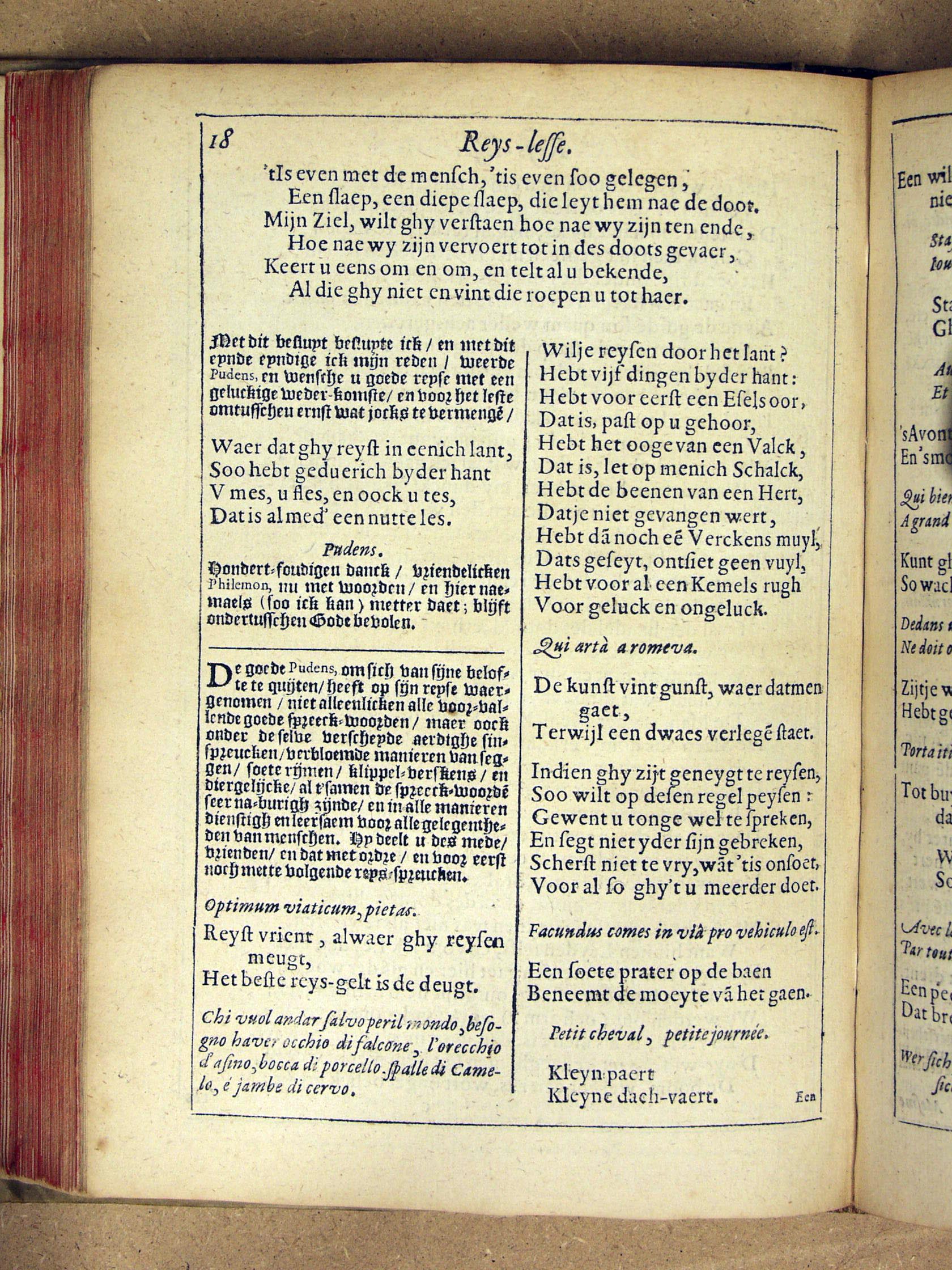
Met dit besluyt besluyte ick / en met dit eynde eyndige ick mijn reden / weerde Pudens, en wensche u goede reyse met een geluckige weder-komste / en voor het leste ondertusschen ernst wat jocks te vermengē /
Waer dat ghy reyst in eenich lant, Soo hebt geduerich byder hant V mes, u fles, en oock u tes, Dat is al med' een nutte les.
Pudens. Hondert-foudigen danck / vriendelicken Philemon, nu met woorden / en hier naemaels (soo ick kan) metter daet; blijft ondertusschen Gode bevolen.
De goede Pudens, om sich van sijne belofte te quijten / heeft op sijn reyse waer-genomen / niet alleenlicken alle voor-vallende goede spreeck-woorden / maer oock onder deselve verscheyde aerdighe sin-spreucken / verbloemde manieren van seggen / soete rijmen / klippel-verskens / en diergelijcke / al t'samen de spreeck-woordē seer na-burigh zijnde / en in alle manieren dienstigh en leersaem voor alle gelegentheden van menschen. Hy deelt u des mede / vrienden / en dat met ordre / en voor eerst noch mette volgende reys-spreucken.
Optimum viaticum, pietas.
Reyst vrient, alwaer ghy reysen meugt, Het beste reys-gelt is de deugt.
Chi vuol andar salvo per il mondo, besogno haver occhio di falcone, l'orecchio d'asino, bocca di porcello, spalle di Camelo, e jambe di cervo.
Wilje reysen door het lant? Hebt vijf dingen byder hant: Hebt voor eerst een Esels oor, Dat is, past op u gehoor, Hebt het ooge van een Valck, Dat is, let op menich Schalck, Hebt de beenen van een Hert, Datje niet gevangen wert, Hebt dā noch eē Verckens muyl, Dats geseyt, ontsiet geen vuyl, Hebt voor al een Kemels rugh Voor geluck en ongeluck.
Qui artà a romeva.
De kunst vint gunst, waer datmen gaet, Terwijl een dwaes verlegē staet.
Indien ghy zijt geneygt te reysen, Soo wilt op desen regel peysen: Gewent u tonge wel te spreken, En segt niet yder sijn gebreken, Scherst niet te vry, wāt 'tis onsoet, Voor al so ghy't u meerder doet.
Facundus comes in viâ pro vehiculo est.
Een soete prater op de baen Beneemt de moeyte vā het gaen.
Petit cheval, petite journée.
Kleyn paert Kleyne dach-vaert.
With this conclusion I conclude, and with this ending I end my discourse, worthy Pudens, and I wish you a good journey with a happy return; and for the last, meanwhile, to mix a little jest with earnest:
Wherever you travel in any land, keep always at hand your knife, your flask, and also your purse — that too is a useful lesson.
Pudens. A hundredfold thanks, friendly Philemon, now in words and hereafter (as far as I can) in deed; meanwhile remain commended to God.
The good Pudens, in order to acquit himself of his promise, has on his journey taken note not only of all the good proverbs that occurred, but also among them various pleasant maxims, figurative ways of speaking, sweet rhymes, doggerel verses and the like, all of them very close neighbours to proverbs, and in every way serviceable and instructive for all the circumstances of men. He shares them with you, friends, and that in order, and first of all with the following travel-sayings.
The best provision for the road is piety.
Travel, friend, wherever you may travel: the best travel-money is virtue.
Whoever wishes to go safely through the world needs to have the eye of a falcon, the ear of an ass, the mouth of a pig, the shoulders of a camel, and the legs of a stag.
Do you want to travel through the land? Have five things at hand: have first of all an ass's ear — that is, mind your hearing; have the eye of a falcon — that is, watch out for many a rogue; have the legs of a stag, so that you are not caught; have besides a pig's snout — that is to say, do not shrink from filth; have above all a camel's back for good luck and bad luck.
He who has a skill goes to Rome [i.e. gets on anywhere].
Skill finds favour wherever one goes, while a fool stands at a loss.
If you are inclined to travel, then think on this rule: accustom your tongue to speak well, and do not tell everyone his faults; do not jest too freely, for that is unpleasant, above all if you do it to your superior.
An eloquent companion on the road is as good as a carriage.
A pleasant talker on the road takes away the trouble of walking.
Little horse, little day's journey.
Small horse, small day's travel.
Iconclass
86(SENSIM, & SINE SENSU)proverbs, sayings, etc. (SENSIM, & SINE SENSU)
Suggested Iconclass codesAI-generated
Additional codes proposed for this emblem, not (yet) part of the indexing.
25F44tortoises, turtleshighThe correlate 'tortoises, turtles' matches the very large tortoise on whose shell the sleeping traveller rests, discussed as a real animal in the commentary.
46C5travelling; tourismhigh'Travelling; tourism' matches both the depicted traveller in hat, cloak and boots with staff on the road and the commentary's wholly travel-oriented maxims and good wishes for a journey.
86proverbs, sayings, etc.high'Proverbs, sayings, etc.' directly matches the commentary, which is an explicit collection of travel-proverbs, maxims and rhymes.
86(...)proverbs, sayings, etc. (with TEXT)mediumThe emblem pairs the image with specific quoted sayings ('The best provision for the road is piety', etc.), fitting 'proverbs, sayings, etc. (with TEXT)'.
25FF44fabulous animals ~ tortoiseslow'Fabulous animals ~ tortoises' could cover the improbably man-sized tortoise, though the commentary insists such tortoises really exist in hot countries.
Relationships to the Adagia of ErasmusAI-generated
Suggested relationships between this emblem and adages in Erasmus’ Adagia.
- I ix 50 Fuimus Troes – thematic inventiolow
Cats's Leiden anecdote — 'binnen Leyden selfs, en vont ick Leyden niet', all the old friends moved away or dead — reproduces the topos of Erasmus's adage on things that have ceased to be ('fuit Ilium... campos ubi Troia fuit').
- II i 9 Dimidio vitae nihil differunt felices ab infelicibus – thematic inventiolow
The emblem's sleeper, carried along unawares while asleep, matches the adage's point (and Erasmus's quotation that 'sleep like a tax-collector takes half of life') that sleep robs man of consciousness and of his lifetime; Cats glosses Sleep as 'ons dom Verstant'.
- II iii 48 Homo bulla – thematic inventiolow
The closing moral — life gliding away unnoticed, old age arriving before we feel it, 'een slaep, een diepe slaep, die leyt hem nae de doot' — belongs to the same commonplace of the brevity and fleetingness of human life that Erasmus develops at length under Homo bulla.
Sources
Record ID: embstma_1288_emblem054
This emblem on the Iconclass site: https://iconclass.org/view/embstma_1288_emblem054
Copy: University Library, Glasgow, Stirling Maxwell 1288