Jacob Cats, Spiegel (The Hague, 1632)
Emblem 53
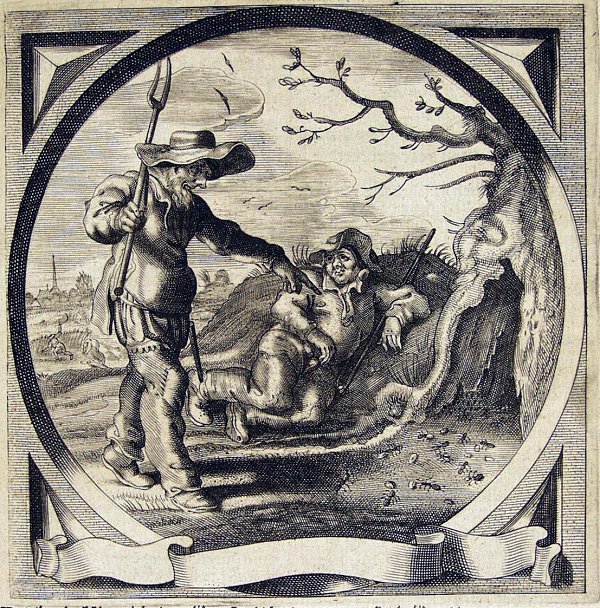
Vade ad formicam, pigerLatin
Go to the ant, you sluggard.AI-generated
Description of the imageAI-generated
Within an oval frame set in a rectangular plate (with corner spandrels and an empty banderole below) a bearded peasant in a broad-brimmed hat, carrying a long-handled pitchfork over his shoulder, stands at the left and bends forward, stretching out his hand to shake awake a young man who lies sprawled asleep on a grassy bank at the foot of a bare, gnarled tree. The sleeper, in a cap and loose jacket with his shirt open, leans back with one arm thrown out, a stick lying beside him. On the bare ground in the foreground a trail of ants is visible. In the left background is a flat landscape with a village church spire, fields and a few small figures under a cloudy sky.
Subscriptio




TranscriptionAI-generated
By een krepel leertmen hincken, By den vuylen leertmen stincken, Ionge lieden, wie ghy zijt, Quaet geselschap dient gemijt.
TranslationAI-generated
With a cripple one learns to limp, with a filthy man one learns to stink; young people, whoever you are, bad company ought to be shunned.
CommentaryAI-generated
16 passages · original left, translation right (click to fold)
De twede klippe die te mijden staet/ is quae geselschap/ met af-maninge van 't selve/ waer mede de twee wijste ende Godtsalichste koningen/ te weté/ David/ en Salomon/ beyde haer schriften begonnen hebben/ om te toonen hoe grooten af-keer sy daer van waren hebbende/ Psal. 1.1. Prov. 1.10. 'tIs niet vreemt
Want
By een krepel leertmen hincken, By den vuylen leertmen stincken, Ionge lieden, wie ghy zijt, Quaet geselschap dient gemijt.
En wijders/
By wolven en uylen Daer leertmen huylen.
Van gelijcke/
Van het peck Blijft een vleck.
d'Ervarentheyt spreeckt selve:
Die met honden gaet te bedt Deelt van hare vloyen met.
Qui se couche avec les chiens, se leve avec les puces.
't Is daerom nae de kunst gesprocken:
Sumuntur à conversantibus mores. Sen.
Segt my met wié dat ghy verkeert Soo heb ick uwen aert geleert.
Het quaet is gantsch vruchtbaer: een siecke kan dickwils veel gesonde in sieckten brengen; maer veel gesonden en sullé noyt door haer geselschap een eenigen siecken lustigh en fris maecken;
Een kleyn getal van rotte peeren Dat kan aen duysent gave deeren.
Maer boven alle saecken is het exempel van de ouders van groote kracht/ ten aensiene van de jonckheyt/ soo ten goede/ als ten quade/ en daerom
Nemo errat uni sibi. Sen.
Al ghy die jonge kinders voedt, Let watje segt, en watje doet; VVant wat het zy, en hoe het gae De sone doet den vader nae, De dochter gaet haers moeders gangh, En dat haer gantsche leven langh.
In een pijpers huys (seyt de spaignaert) leert een yder fluyten.
En la casa del alboguero, todos son albogueros.
A la maison du fluteur, tous sont jouuers des flustes.
Maer niet het doé alleen/ maer oock yder woort buyté tucht gaende/ is hier gantsch schadelick.
Laet geen kint vuyle reden hooré VVant kleyne potten hebbé ooré.
Wat aengaet de leeringe selfs/ daer toe segh ick alleenlick
Ea pueris discenda sunt, quibus viri sint usuri. Plutarch.
Dat een yder dat best leert als hy een kint is, Dat hem best sal te passe komen als hy een man is.
En of al schoon de eerste beginselen in het leeren niet ten besten voort en willen/ de moedt is daerom niet verloren te geven/
Nullus idem est diuturnus, & præcox fructus.
Een kint verstandigh voor de jaré Dat sietmé dickwils qualick varé.
Ons spreeck-woort seyt/ Vroegh hengst/ vroegh guyl. En vorder
Vroegh rijp, vroegh rot, Vroegh wijs, vroegh sot.
Ick besluyte dan hier/ en segge
Niet dat soo wel gedijt Als rijp te rechter tijt.
Maturè, non citò.
IONGELINCK.
t'Samen-spraecke tusschen PHILEMON en PVDENS.
Philemon. Wel Pudens! wat veranderingh is dit? ick vinde u nu een jongelingh/ daer ick u onlancx niet als een kint en liet; te rechte seyt men
Groene kersen worden root, Kleyne kinders worden groot.
Pudens. Ist wonder?
Ad virile robur per pueritiam itur. Sen.
De boom daer ghy nu vrucht af leest, Dat is wel eer een rijs geweest.
Philemon. Maer hoe dus gekleet / als of ghy tot reysen veerdigh stont?
Pudens. Ick meyne dat het voor my lang genoech onder dé roock van mijns moeders schouwe geseten is. Hier goet en elders goet.
Nul en pris En son pais.
Niemant is in weerde In sijn eygen eerde.
Sie ick't niet alle dage?
Men acht geen verstant In sijn eygen lant.
En daerom (nae my dunckt) ist best wat te reysen/ om alsoo/ door vreemde talen/ en aen-neminge van heusche manieren / aensienlicker t'huys te komen; want anders placht men ons licht te seggen
Die thuys sijn jonckheyt heeft versleten, En by den bry-pot heeft geseten, En daer geen letters heeft gegeté, Wat kan de goede slocker weten?
In tegendeel/
Die lange leven en verre reysen Die leeren op haer saecken peysé.
Philemon. Ick sie dat ghy u seggé met spreeck-woorden en spreucken soeckt vast te maecken; maer als ick u mette selve munte soude betalen/ heb ick niet wel eenige spreucken gehoort die vry al wat anders klincken? Hoe seyt men niet in't gemeen?
Al reyst een los-hooft buytés lants Noch blijft hy wel een domme gans.
En wederom
Gaet sent een esel nae Parijs Ghy krijgt hem weder even wijs.
En voor reden
Wie over zee veel plach te swieré Verandert lucht, en geen manieré.
Tot besluyt
Hoe dattet gaet, of hoe het is, De botten blijven plat-vis,
En of al schoon de manieren vande soodanige somtijts al wat verandert worden/ 'tis selden in beter.
Iamais bon cheval, ou homme N'amenda pour aller a Rome.
Te Romé ging noyt man of peert, Of 'twas des vry te minder weert.
En wat de vrouwen aengaet (die al mede somtijts reysen willen sonderlinge onder decksel van bedevaerden/ om in't voor by gaen daer van mede wat te seggen) daer heeft het spaens spreeck-woort het stuck (mijns oordeels) wel geraeckt;
Ir Romera y boluer Ramera.
Aller pelerine & revenir putain.
Hier is te letten (om de aerdigheyt van de spreucke recht te vatten) dat Romera (beteyckende eé pelgrimessche/ ofte een vrou-mensch die in beevaert gaet) maer een letter en verschilt van Ramera, beteyckenende een oneerlick wijf/ dat wy een hoere noemen.
Reyst vrou of maegt in bedevaert Sy krijgt wel licht een lichté aert.
Pudens. Daer is misschié al wat aé / Philemon, maer des niet te min so houde ick vast dat vreemde landen/ vreemde oogé/ en vreemde streken/ diemen in't reysen dickwils ontmoet/ ons al vry wat leeren konnen.
Die hier en daer eés wort genepé, En dickwils by den neus gegrepé, Al is hy plomp, hy wort geslepen.
De reden daer van is klaer/
Apres domage Chacun est sage.
Harde steenen slijpen yser, Harde stooten maken wijser.
Philemon. Men segge wat men wil/ en men soecke waer men wil/ ons nederlants spreeck-woort luyt ende sluyt meesterlick:
Wilje wel zijn, wilje rusten? Soeckt het niet in vreemde kusté, Eygen huys en eygen dack Dat is vry een groot gemack.
A chacun oiseau Son nid est beau.
Elck vogel prijst sijn nest; Ghy dan vaert nae Oost of West, Eygen huys is alderbest.
Pudens. Hier stelle ick een ander tegen/ dat mede sijn bescheyt heeft;
Patria est, ubicunque bene est.
Al waer men is in goeden stant, Dat is al med' ons Vaderlant.
En wat het rusten aengaet/ daer op segge ick/
Geé jongmá mach om rusté peysé Die buyten is gesint te reysen, Maer ismen oudt, of sieck, of moe, Dien stae ick eerst het rusten toe.
Philemon. Gelooftet/ waer datmen komt daer vint men sijn weert t'huys.
Want
En tout pais mordent les chiens.
Honden hebben tanden, In alle landen.
Men houde soo veel van reysen alsiné wil/ ick hebbe nochtans eens gelesen seecker boecxken van D. Joseph Hal/ in't Engels geschreven / daer van het op-schrift is Quo vadis? daer in hy veel goede redenen by brengt/ die soo geheel seer voor het veel reysen niet en zijn. Alle beweginge (seyt hy) maeckt onruste/ en die beyde ongenoegen; daer in het tegendeel de geluckige stant des Hemels wort afgebeelt by ruste. Ghy dan/ die so genegen schijnt te zijn tot reysen/ siet toe dat ghy niet eenmael met berou en koomt uyt te roepen/ soo als onlangs seker jongelinck (ons niet onbekent) met leet-wesen dede/ ten tijde hy veel en lange door de werelt gedwaelt en gemaelt hadde; In't reysen (seyde hy) heb ick menigen Engelot uyt-gesonden/ die noyt haren meester eenige tijdinge weder en brachte/ en dit dede ick soo lange tot dat ick een burger van al de werelt was geworden/ ende een vreemdelinck so in mijn vaderlant/ als aé mijn eygé selvé/ en quam alsoo thuys meer beladen met gebreken/ als met gelt/ meer met waen / als met wijsheyt. Dan niet te min so bekenne ick/ dat de gene die met een goet voornemen uytgaen/ niet te lange uyt en blijven / ende een goede reys-lesse met nemen/ somwijlen wel yet goets thuys konnen brengen.
Pudens. Ick wenste wel soo een reys-lesse te hebbé/ ick soude die voor my/ als een draet in een dool-hof/ ende als een leyts-man opte wegen gestadigh aen de hant houden; ghy daerom (isser yet sulcx by u) ick bid u en spaert geen broot voor de vrienden.
Philemon. My is onlancx soo een reys-lesse ter hant gekomen/ ende my dunckt soo ghy die met ernst woudt in't werck stellen ghy soudter u wel by bevinden; doch op dat ghy des te meerder kennisse mochte krijgen/ soo wil ick u deselve jegenwoordelick eens voor-lesen/
Ghy, hoort toe En staet wat stil,
Pudens. Soo ick doe En soo ick wil.
Reys-lesse.
Philemon. Een vader had een rauwé quant Die wou gaen reysen uyt het lant, Om eens te leeren metter daet, Hoe dattet inde weerelt gaet, Hy (die wist hoe de jonkheyt malt, En waerse dickmael henen valt, Bysonder alse buyten dwangh, Mach hebben haren vryen gangh) Riep sijnen soon ter zijden af Daer hy hem dese lesse gaf:
Nadié (seyt hy) mijn weerde kint Dat ghy tot reysen zijt gesint, So hoort doch hier op mijné raet, Die ick geleert heb uytte daet;
Eerst, waer ghy u tot reysen set, Begint den dach met u gebet; Want haver geven aen u beest, En Godt te bidden inden geest, Schoon dattet beyde tijt vereyst, En doet geen hinder alsmen reyst.
Dan is noch vorder mijn bevel, Gaet kiest voor u een reys-gesel; Want reysen sonder mede-maet, En was noyt wijse lieden raet; Maer kiest een vrient van uwé aert, Die hant en herte reyn bewaert, En niet en helt nae vuyl bejach Dat jonge lieden schaden mach; Noyt speelder ymāt met het peck Die niet en hield een vuyle vleck.
Maer ghy, die u tot reysen stelt Begintet nimmer sonder gelt; Want die wil reysen achter lant, Die hebbe munte byder hant, Dat is een kruyt vā groote kracht VVaer op de gansche werelt acht, En als u dat geselschap faelt So wort ghy selden wel onthaelt.
Doch gelt te dragen over al, Dat baert by wijlen ongeval, Ghy, vrijt u van dat ongerief, En dient u van een wissel-brief; VVant dat en is geen lastigh pack, Maer voor die reysé groot gemak.
Voorts, wilt ghy reysen met verstant, Soo hebt een kaerte byder hant, Van yder rijck dat ghy betreet, Op dat gy daer de gronden weet, En kent by nae de gantsche kust, Ook eer ghy daer oyt hebt gerust.
En isser onder wege dan, Een wijs, geleert, of deftigh man, En laet niet, of besoeckt den vriét, Vermits het u ten nutte dient; De wijsheyt is een rijcke schat, Wie die genaeckt ontfangter wat.
Wanneer ghy vanden peerde sit, En van het reysen zijt verhit, En eyst terstont geen bier of wijn, Want dat en kan maer hinder zijn, Toomt hier en elders uwe lust, Dat is de grondt van uwe rust, Niet al, niet al, dat ons behaecht, En dient den mensché nagejaecht.
Stelt u dit voor een vaste wet, Dat ghy op alle dingen let, Dat ghy gestaech u voordeel doet, Met al wat yewers u ontmoet.
De werelt is een wonder boeck, Het maekt sijn leser wōder kloeck, Maer wie het sonder oordeel leest, Die blijft gelijck hy is geweest; Ghy doet niet als de meesté hoop, Maer doet met aēdacht uwé loop, Hoort ghy een sneeg, een geestich man, Daer hoorje dat u leeren kan; Siet ghy een ongesouten geck, Leert noch al yet uyt sijn gebreck, Leert mijden dat hy qualijck doet, En hoemen sotten vieren moet. Int korte, waer ghy d'oogé keert, Siet datje 'teen of 'tander leert. Al watmen hoort of watmen siet Die leere wil die leerter yet; Wat isset of ghy verde rijt? En in een goet geselschap zijt, En dan in eenigh lustigh velt, Veel cristallijne beecken telt, Of elders in een open wout Vint schoone slooten op-gebout, Vint Prinçen huysen neer geruckt, Vint torens in het stof gedruckt, Vint puyn, en ick en weet niet wat Daer eertijts stōt eē schone stadt; Vint weder dreven nieu geplant, Tot çiersel van het gantsche lant, Vint hoven na de kunst gemaeckt, Daer vā dat gy de vruchté smaekt, Vint rotsen uytermaten hoogh, Oock verre boven 'smenschē oog, Vint ander vreemt en nieu gewas, Daer van men noyt te vooren las,
Voorwaer al dat en acht ick niet, Ten zy dat ghy wat verder siet, Ten zy u dom en grilligh hert Besetter, en oock beter wert; 'tIs niet gereyst, 'tis maer gedwaelt Indienmé daer geé wijsheyt haelt. Waer gy oyt gaet of hené treckt Houdt staegh u beurs en hert bedeckt; En melt niet door een lossen praet Van waer ghy komt of hené gaet, En min noch wat u herte jaegt, Want dat heeft menigh man beklaegt. Siet! waer men gaet, of waer men reyst, Noyt dient geseyt al watmé peyst; Een heusche mont is altijt goet, Doch meest voor een die reysen moet. Nu voorts, op dat ghy schouwen meugt Veel malle grepen van de jeugt, So laet geé dranck u meester zijn, Het zy dan bier, of heete wijn, Want die gebruyckt in overvloet En is te gener plaetse goet, Maer als ghy uyt den lande zijt Soo dient hy boven al gemijt: Doch so ghy eens wert over-last, Of van een heeten damp verrast, So mijt noch al een vorder quaet, En loopt niet mallen over straet, Maer houdt u stil soo langen tijt Tot datje weder nuchter zijt. Begeeft u noyt des avonts laet, Noch op den wech, noch opte straet: Vroech uyt te gaé, vroech onder 't dack, Dat is gesont, en groot gemack. Des nachts te loopé hier en daer, Dat is niet anders als gevaer. Ghy, laet dé nacht en haer bejach, En doet u saecken by den dach; Want dat men in het duyster doet VVort opten lichten dach geboet. Kijft niet in't bed of aendé heert, En twist ook niet met uwé weert, Maer is hy vils, of niet te pluys, Betaelt, en soeckt een ander huys. En twist niet met u reys-gesel, Spreekt ymant qualick? antwoort wel, Schoon spreecken is van groote kracht, Het maeckt oock harde koppen sacht. Bewaert u ooch, u mont, u beurs, En hoet u voor eé vrouwe-keurs, En mijdt u voor een mede-maet, Die op die gladde wegen gaet; Oock wacht u voor den dobbel-steen, VVant dit zijn kanckers in het been.
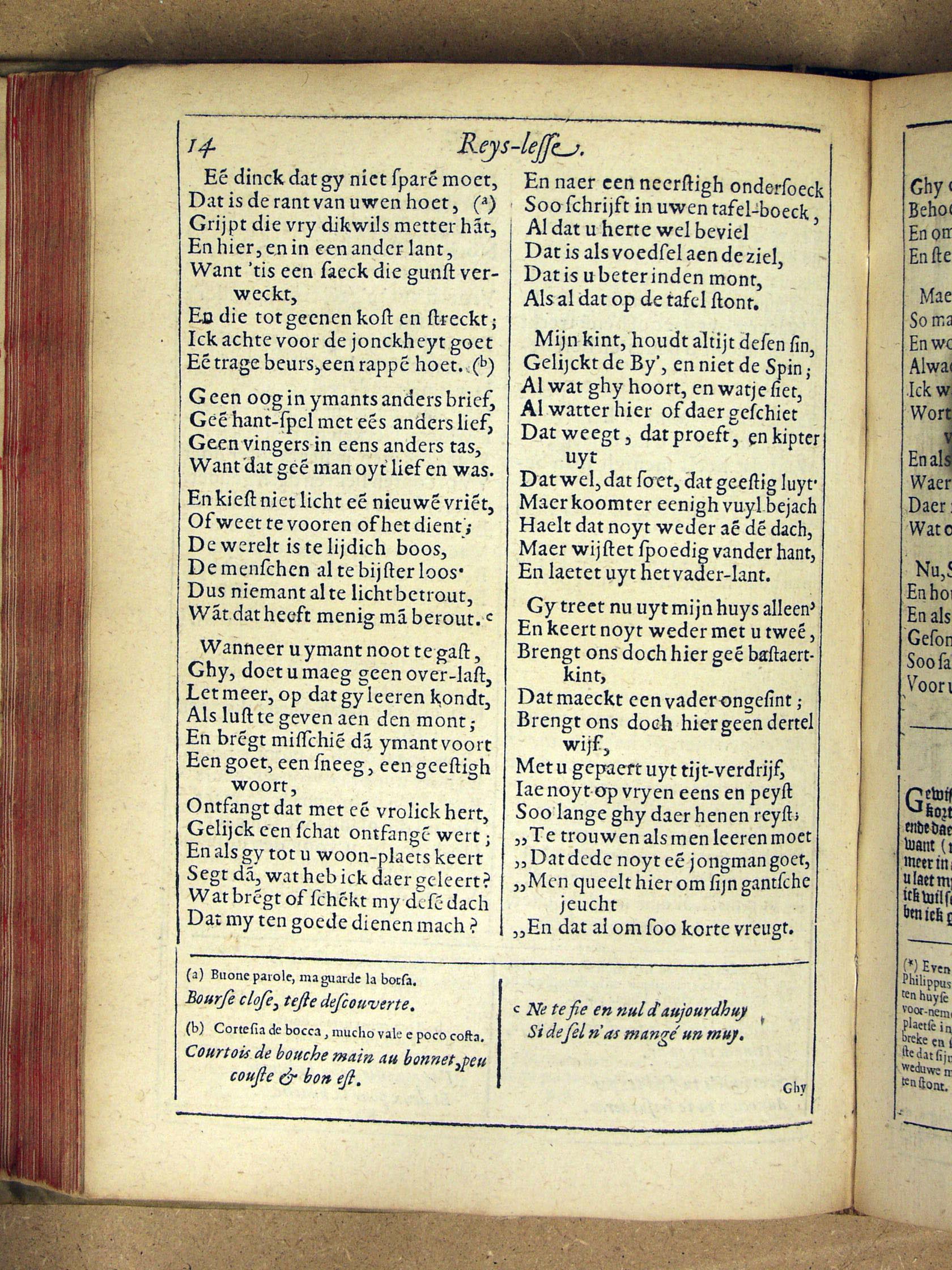
Eē dinck dat gy niet sparé moet, Dat is de rant van uwen hoet, Grijpt die vry dikwils metter hāt, En hier, en in een ander lant, Want 'tis een saeck die gunst verweckt, En die tot geenen kost en streckt; Ick achte voor de jonckheyt goet Eē trage beurs, een rappé hoet.
Geen oog in ymants anders brief, Geé hant-spel met eés anders lief, Geen vingers in eens anders tas, Want dat geé man oyt lief en was.
En kiest niet licht eé nieuwé vriét, Of weet te vooren of het dient; De werelt is te lijdich boos, De menschen al te bijster loos· Dus niemant al te licht betrout, Wāt dat heeft menig mā berout.
Wanneer u ymant noot te gast, Ghy, doet u maeg geen over-last, Let meer, op dat gy leeren kondt, Als lust te geven aen den mont; En brēgt misschié dā ymant voort Een goet, een sneeg, een geestigh woort, Ontfangt dat met eé vrolick hert, Gelijck een schat ontfangé wert; En als gy tot u woon-plaets keert Segt dā, wat heb ick daer geleert? Wat brēgt of schēkt my desé dach Dat my ten goede dienen mach? En naer een neerstigh ondersoeck Soo schrijft in uwen tafel-boeck, Al dat u herte wel beviel Dat is als voedsel aen de ziel, Dat is u beter inden mont, Als al dat op de tafel stont.
Mijn kint, houdt altijt desen sin, Gelijckt de By', en niet de Spin; Al wat ghy hoort, en watje siet, Al watter hier of daer geschiet Dat weegt, dat proeft, en kipter uyt Dat wel, dat soet, dat geestig luyt· Maer koomter eenigh vuyl bejach Haelt dat noyt weder aé dé dach, Maer wijstet spoedig vander hant, En laetet uyt het vader-lant.
Gy treet nu uyt mijn huys alleen, En keert noyt weder met u tweé, Brengt ons doch hier geé bastaert-kint, Dat maeckt een vader ongesint; Brengt ons doch hier geen dertel wijf, Met u gepaert uyt tijt-verdrijf, Iae noyt op vryen eens en peyst Soo lange ghy daer henen reyst; ,,Te trouwen als men leeren moet ,,Dat dede noyt eé jongman goet, ,,Men queelt hier om sijn gantsche jeucht ,,En dat al om soo korte vreugt.
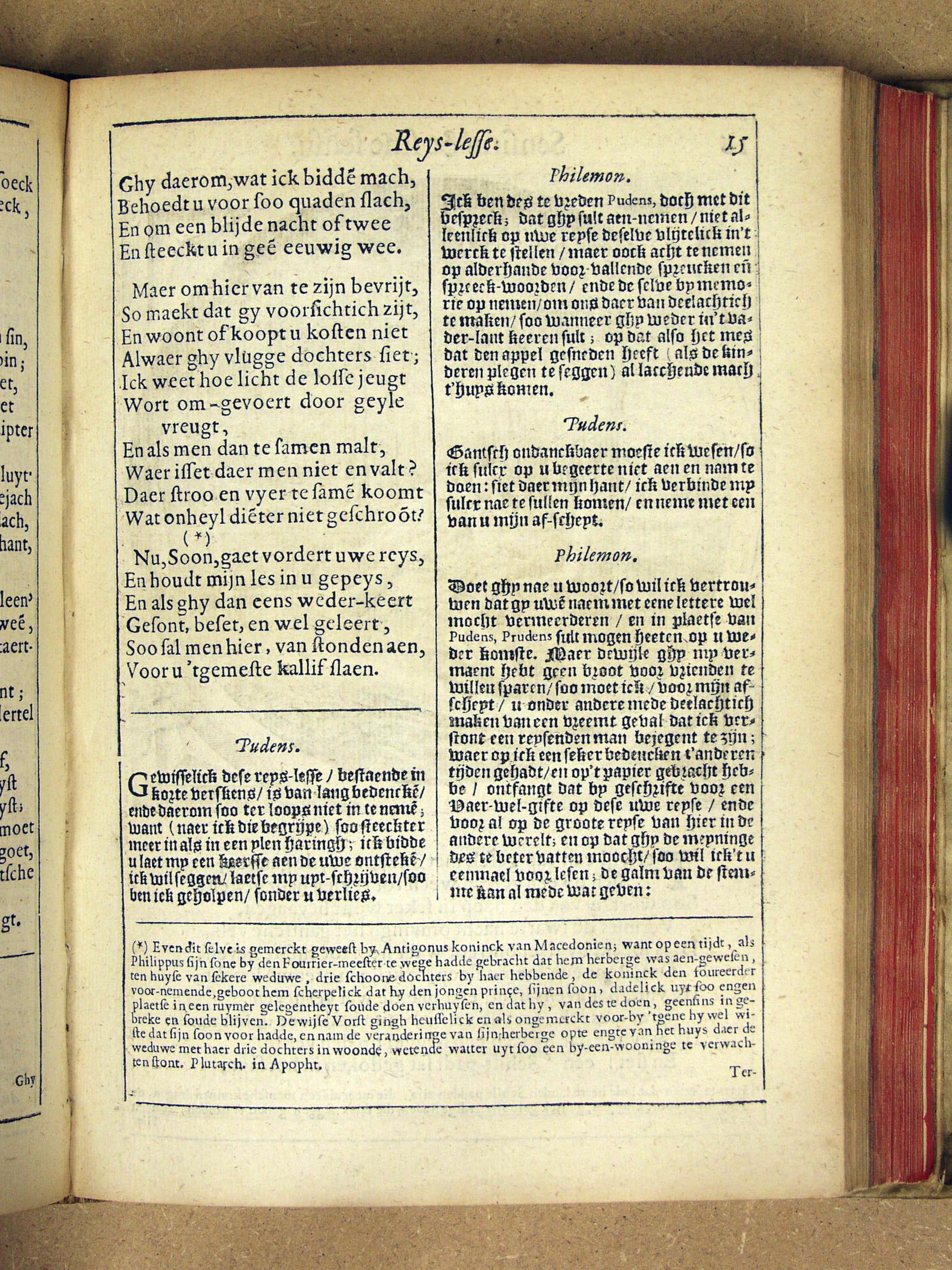
Ghy daerom, wat ick biddé mach, Behoedt u voor soo quaden slach, En om een blijde nacht of twee En steeckt u in geé eeuwig wee.
Maer om hier van te zijn bevrijt, So maekt dat gy voorsichtich zijt, En woont of koopt u kosten niet Alwaer ghy vlugge dochters siet; Ick weet hoe licht de losse jeugt Wort om-gevoert door geyle vreugt, En als men dan te samen malt, Waer isset daer men niet en valt? Daer stroo en vyer te samé koomt Wat onheyl diéter niet geschroōt?
Nu, Soon, gaet vordert uwe reys, En houdt mijn les in u gepeys, En als ghy dan eens weder-keert Gesont, beset, en wel geleert, Soo sal men hier, van stonden aen, Voor u 'tgemeste kallif slaen.
Pudens. Gewisselick dese reys-lesse / bestaende in korte verskens/ is van lang bedencké/ ende daerom soo ter loops niet in te nemé; want (naer ick die begrijpe) soo steeckter meer in als in een plen haringh; ick bidde u laet my een keersse aen de uwe ontstekē/ ick wil seggen/ laetse my uyt-schrijven/ soo ben ick geholpen/ sonder u verlies.
Philemon. Ick ben des te vreden Pudens, doch met dit bespreck; dat ghy sult aen-nemen / niet alleenlick op uwe reyse deselve vlijtelick in't werck te stellen / maer oock acht te nemen op alderhande voor-vallende spreucken en spreeck-woorden/ ende de selve by memorie op nemen/ om ons daer van deelachtich te maken/ soo wanneer ghy weder in't vader-lant keeren sult; op dat also het mes dat den appel gesneden heeft (als de kinderen plegen te seggen) al lacchende mach t'huys komen.
Pudens. Gantsch ondanckbaer moeste ick wesen/ so ick sulcx op u begeerte niet aen en nam te doen: siet daer mijn hant/ ick verbinde my sulcx nae te sullen komen/ en neme met een van u mijn af-scheyt.
Philemon. Doet ghy nae u woort/ so wil ick vertrouwen dat gy uwé naem met eene lettere wel mocht vermeerderen/ en in plaetse van Pudens, Prudens sult mogen heeten op u weder komste. Maer dewijle ghy my vermaent hebt geen broot voor vrienden te willen sparen/ soo moet ick/ voor mijn af-scheyt/ u onder andere mede deelachtich maken van een vreemt geval dat ick verstont een reysenden man bejegent te zijn; waer op ick een seker bedencken t'anderen tijden gehadt/ en op't papier gebracht hebbe / ontfangt dat by geschrifte voor een Vaer-wel-gifte op dese uwe reyse/ ende voor al op de groote reyse van hier in de andere werelt; en op dat ghy de meyninge des te beter vatten moocht/ soo wil ick't u eenmael voor lesen; de galm van de stemme kan al mede wat geven:
The second rock that must be avoided is bad company, with a warning against it, with which the two wisest and most godly kings, namely David and Solomon, both began their writings, to show how great an aversion they had to it, Psalm 1:1, Proverbs 1:10. It is no wonder. For: With a cripple one learns to limp, with a filthy man one learns to stink; young people, whoever you are, bad company ought to be shunned. And further: With wolves and owls one learns to howl. Likewise: From pitch a stain remains. Experience itself speaks: He who goes to bed with dogs shares in their fleas. — 'Who lies down with dogs gets up with fleas.' Therefore it is artfully said: Manners are taken from those one associates with (Seneca). Tell me with whom you associate and I have learned your nature. Evil is very fruitful: one sick man can often make many healthy people sick; but many healthy people will never by their company make a single sick man merry and fresh. A small number of rotten pears can spoil a thousand sound ones. But above all things the example of parents has great power over youth, both for good and for evil, and therefore: No one errs for himself alone (Seneca). All you who raise young children, watch what you say and what you do; for whatever it be and however it goes, the son follows the father, the daughter goes her mother's way, and that all her life long. In a piper's house (says the Spaniard) everyone learns to pipe. — In the piper's house all are pipers. — At the flute-player's house all are flute-players. But not the deed alone; every word spoken without discipline is very harmful here. Let no child hear foul talk, for little pots have ears. As to the teaching itself, I say only this: Children should learn those things which they will use as men (Plutarch). That each best learns as a child what will best serve him when he is a man. And although the first beginnings in learning do not always go well, courage must not therefore be given up: No fruit is both long-lasting and early. A child clever beyond its years is often seen to fare badly. Our proverb says: early a stallion, early a nag. And further: Early ripe, early rotten; early wise, early foolish. I conclude then here, and say: Nothing thrives so well as ripeness at the right time. Maturely, not quickly. — YOUNG MAN. A dialogue between Philemon and Pudens. Philemon: Well, Pudens! what a change is this? I find you now a young man, whom not long ago I left no more than a child; rightly it is said: Green cherries turn red, little children grow big. Pudens: Is that a wonder? One comes to manly strength through childhood (Seneca). The tree from which you now gather fruit was once a twig. Philemon: But why dressed like this, as if you stood ready to travel? Pudens: I think I have sat long enough under the smoke of my mother's chimney. Good here and good elsewhere. No one is prized in his own country. Nobody is valued in his own soil. Do I not see it every day? No understanding is esteemed in one's own land. And therefore (as it seems to me) it is best to travel a little, so as by foreign languages and the acquiring of polite manners to come home more respected; for otherwise people are apt to say of us: He who has worn out his youth at home and sat by the porridge-pot and eaten no letters there, what can the good glutton know? On the contrary: Those who live long and travel far learn to think about their affairs. Philemon: I see you seek to confirm your sayings with proverbs and maxims; but if I were to pay you in the same coin, have I not heard some sayings that sound quite otherwise? How do people commonly say? Though a feather-brain travel abroad, he still remains a stupid goose. And again: Go, send an ass to Paris, you will get him back just as wise. And with reason: Whoever used to roam much over sea changes his air but not his manners. In conclusion: However it goes or however it is, flounders stay flat-fish. And although the manners of such people are sometimes somewhat changed, it is seldom for the better. Never did a good horse or man improve by going to Rome. To Rome no man or horse ever went but he was worth the less for it. And as for women (who also sometimes want to travel, especially under cover of pilgrimages, so as to be able to say something of it in passing), there the Spanish proverb has, in my judgement, hit the mark: To go a pilgrim-woman and return a whore. — To go a pilgrim and return a whore. Here it is to be noted (to grasp the wit of the saying rightly) that Romera (meaning a pilgrim-woman, or a woman who goes on pilgrimage) differs by only one letter from Ramera, meaning a dishonourable woman, whom we call a whore. If a wife or maid travels on pilgrimage she easily acquires a light nature. Pudens: There may be something in that, Philemon, but nonetheless I hold firmly that foreign lands, foreign eyes and foreign regions, which one often meets in travelling, can teach us a good deal. He who is pinched here and there and often taken by the nose, clumsy though he be, becomes polished. The reason for it is clear: After damage everyone is wise. Hard stones sharpen iron, hard knocks make wiser. Philemon: Say what one will and seek where one will, our Dutch proverb runs and closes masterfully: Would you be well, would you rest? Do not seek it on foreign shores; one's own house and one's own roof, that is indeed a great comfort. To every bird its own nest is beautiful. Every bird praises its nest; so, whether you sail to East or West, one's own house is best of all. Pudens: Here I set another against it, which also has its sense: One's fatherland is wherever one is well off. Wherever one is in good estate, that too is our fatherland. And as to resting, I say of that: No young man may think of rest who is minded to travel abroad; but if one is old, or sick, or tired, to him I first grant rest. Philemon: Believe it, wherever one comes one finds one's landlord at home. For: In every country the dogs bite. Dogs have teeth in all lands. Let a man think as much of travelling as he will, I have nevertheless once read a certain little book by Dr Joseph Hall, written in English, whose title is Quo vadis?, in which he brings forward many good reasons that are not at all in favour of much travelling. All motion (he says) makes unrest, and both make discontent; whereas on the contrary the happy state of Heaven is figured by rest. You then, who seem so inclined to travel, take care that you do not one day cry out with regret, as a certain young man (not unknown to us) lately did with sorrow, after he had long wandered and roamed through the world: In travelling (said he) I have sent out many an angel-coin which never brought its master back any tidings; and this I did so long until I had become a citizen of the whole world and a stranger both in my fatherland and to my own self, and so came home more laden with faults than with money, more with conceit than with wisdom. Yet nonetheless I confess that those who go out with a good purpose, do not stay out too long, and take a good travel-lesson with them, may sometimes bring home something good. Pudens: I should indeed like to have such a travel-lesson; I would keep it constantly at hand as a thread in a labyrinth and as a guide on the roads; so (if you have anything of the sort) I beg you, do not spare bread for friends. Philemon: Such a travel-lesson lately came into my hands, and it seems to me that if you would earnestly put it into practice you would find it profitable; but so that you may get the better knowledge of it, I will now read it to you once. 'You, listen, and stand still a while.' Pudens: 'So I do, and so I will.' — Travel-lesson. Philemon: A father had a raw young fellow who wanted to go travelling out of the land, to learn once by experience how things go in the world. He (who knew how youth plays the fool, and where it often falls, especially when, free of restraint, it may have its own way) called his son aside and there gave him this lesson: Since (says he) my dear child, you are minded to travel, hear then my advice, which I have learned from experience. First, wherever you set out to travel, begin the day with your prayer; for giving oats to your beast and praying to God in spirit, though both require time, do no hindrance when one travels. Then my further charge is: go and choose yourself a travelling companion; for to travel without a comrade was never wise men's counsel; but choose a friend of your own sort, who keeps hand and heart clean and does not incline to foul pursuits that may harm young people; never did anyone play with pitch who did not keep a foul stain. But you who set out to travel, never begin without money; for he who will travel through the country must have coin at hand; that is a herb of great power on which the whole world sets store, and if that company fails you, you will seldom be well received. Yet to carry money everywhere sometimes causes mishap; free yourself of that inconvenience and use a bill of exchange; for that is no heavy burden, but for the traveller a great convenience. Further, if you will travel with understanding, have a map at hand of every realm you set foot in, so that you know the lie of the land and know almost the whole coast even before you have ever rested there. And if there is on the way a wise, learned or worthy man, do not fail to visit the friend, since it serves your profit; wisdom is a rich treasure, whoever approaches it receives something. When you dismount from your horse and are heated from travelling, do not at once call for beer or wine, for that can only be a hindrance; bridle your desire here and elsewhere, that is the ground of your rest; not everything, not everything that pleases us should be pursued by man. Set this before you as a fixed law, that you pay attention to all things, that you constantly make your profit of everything you meet anywhere. The world is a book of wonders; it makes its reader wonderfully clever, but whoever reads it without judgement stays as he was. Do not do as the greater crowd does, but make your journey with attention. Do you hear a shrewd, witty man? there you hear what can teach you. Do you see an unsalted fool? learn still something from his failing: learn to avoid what he does badly and how one must humour fools. In short, wherever you turn your eyes, see that you learn one thing or another. Of all that one hears or sees, he who will learn learns something. What good is it that you ride far and are in good company, and then in some pleasant field count many crystal brooks, or elsewhere in an open wood find fine castles built, find princes' houses pulled down, find towers laid in the dust, find rubble and I know not what where once a fine city stood; find new-planted avenues again, for the adornment of the whole land; find gardens made by art, whose fruits you taste; find rocks exceedingly high, far above man's sight; find other strange and new growths of which one never read before — truly all that I count as nothing, unless you see somewhat further, unless your dull and whimsical heart becomes steadier and also better. It is no travelling, it is only wandering, if one fetches no wisdom there. Wherever you go or move, keep your purse and your heart always covered; and do not disclose by loose talk where you come from or are going, still less what your heart pursues, for that has made many a man lament. See! wherever one goes or travels, one should never say all one thinks; a civil mouth is always good, but most of all for one who must travel. Now further, that you may shun many foolish tricks of youth: let no drink be your master, be it beer or hot wine, for drink used in excess is good in no place; but when you are out of the country it must above all be avoided. Yet if you are once overcome, or surprised by a hot vapour, then avoid still a further evil and do not run raving through the street, but keep quiet so long until you are sober again. Never set out late in the evening, neither on the road nor in the street: to go out early and be under roof early, that is healthy and a great comfort. To run about here and there at night is nothing but danger. Leave the night and its pursuits, and do your business by day; for what is done in the dark is paid for in the broad daylight. Do not quarrel in bed or at the hearth, and do not dispute with your host either; but if he is nasty or not pleasant, pay and seek another house. And do not quarrel with your travelling companion. Does someone speak ill? answer well; fair speech is of great power, it makes hard heads soft too. Guard your eye, your mouth, your purse, and beware of a woman's choice; and avoid a comrade who walks on those slippery ways; also beware of the dice, for these are cankers in the bone. One thing you must not spare is the brim of your hat: grip it freely and often with your hand, both here and in another land, for it is a thing that wins favour and costs nothing. I hold it good for youth: a slow purse and a quick hat. No eye in another man's letter, no hand-play with another's sweetheart, no fingers in another's bag, for that was never dear to any man. And do not lightly choose a new friend, or know beforehand whether it serves; the world is grievously wicked, people all too dreadfully sly; so trust no one too lightly, for that has made many a man repent. When someone invites you as a guest, do not overload your stomach; attend more to what you may learn than to giving pleasure to the mouth; and if perhaps someone brings forth a good, shrewd, witty word, receive it with a glad heart, as a treasure is received; and when you return to your lodging, say then: what have I learned there? what does this day bring or give me that may serve me for good? And after a diligent examination, write then in your note-book all that pleased your heart well; that is as food for the soul, that is better to you in the mouth than all that stood on the table. My child, keep always this disposition: be like the bee and not like the spider. All that you hear and that you see, all that happens here or there, weigh it, taste it, and pick out what sounds good, sweet and witty; but if any foul pursuit comes, never bring it to light again, but put it quickly away from you and leave it out of the fatherland. You now step out of my house alone; never come back as two. Bring us no bastard child here, that makes a father displeased; bring us here no wanton wife, coupled with you out of pastime; yes, never think of wooing so long as you are travelling there. 'To marry when one must be learning never did a young man good; one pines here all one's youth, and all for so short a joy.' Therefore, whatever I may beg, guard yourself against so bad a stroke, and for one or two merry nights do not plunge yourself into eternal woe. But to be free of this, see that you are prudent and do not lodge or buy your board where you see nimble daughters; I know how easily loose youth is carried away by lewd pleasure, and when people fool about together, where is it that one does not fall? Where straw and fire come together, what mischief is not to be dreaded? Now, son, go and pursue your journey, and keep my lesson in your thoughts; and when you return once healthy, settled and well taught, then here forthwith the fatted calf will be killed for you. Pudens: Certainly this travel-lesson, consisting of short verses, is of long consideration, and therefore not to be taken in so hastily; for (as I understand it) there is more in it than in a flat herring; I beg you, let me light a candle at yours — I mean, let me copy it out — then I am helped without loss to you. Philemon: I am content with that, Pudens, but on this condition: that you will undertake not only diligently to put it into practice on your journey, but also to take note of all sorts of sayings and proverbs that occur, and to take them up in memory, so as to make us partakers of them when you return to the fatherland; so that thus the knife that cut the apple (as children are wont to say) may come home laughing. Pudens: I should be wholly ungrateful if I did not undertake to do so at your desire: there is my hand, I bind myself to perform it, and herewith take my leave of you. Philemon: If you act according to your word, I trust that you might well increase your name by one letter, and instead of Pudens may be called Prudens on your return. But since you have exhorted me not to spare bread for friends, I must, before my leave-taking, make you a partaker among other things of a strange case which I understood had befallen a travelling man; upon which I had at another time a certain reflection and set it on paper. Receive it in writing as a farewell gift for this journey of yours, and above all for the great journey from here into the other world; and so that you may the better grasp the meaning, I will read it to you once aloud: the sound of the voice may also add something.
La priere ny l'avoine n'empesche pas la journeé.
Neither prayer nor oats hinders the day's journey.
Nous apprenons en diverses façons Des sages, des fols, des mauvais, & de bons.
We learn in various ways from the wise, from fools, from the bad and from the good.
Men kan verstant en wijsheyt trecken Van quade/ van goede/ van wijse/ van gecken.
One can draw understanding and wisdom from the bad, from the good, from the wise, from fools.
Benè Lipsius Epist. ad Lanoium in Italiam iter molientem, Hæc tria, inquit, mihi serva, frons sit tibi aperta, mens clausa, lingua parca.
Well said Lipsius in his letter to Lanoy, who was preparing a journey into Italy: Keep, he says, these three things for me: let your brow be open, your mind closed, your tongue sparing.
Ne monstre jamais le fond de ta bourse, ny celuy de ton cœur.
Never show the bottom of your purse, nor that of your heart.
Si es nuicts tu fais tes pas Aux coups tu te hasarderas.
If you take your steps by night, you will expose yourself to blows.
D'un mauvais hoste Tost t'en oste.
From a bad host, remove yourself quickly.
Una aguia para la borsa, Y dos para la bocca.
One needle for the purse, and two for the mouth.
Vne aiguille pour la bourse, Et deux pour la bouche.
One needle for the purse, and two for the mouth.
Buone parole, ma guarde la borsa.
Good words, but watch your purse.
Bourse close, teste descouverte.
Purse closed, head uncovered.
Cortesia de bocca, mucho vale e poco costa.
Courtesy of the mouth is worth much and costs little.
Courtois de bouche main au bonnet, peu couste & bon est.
Courteous of mouth, hand to the cap: it costs little and is good.
Ne te fie en nul d'aujourdhuy Si de sel n'as mangé un muy.
Trust no one of today unless you have eaten a bushel of salt with him.
(*) Even dit selve is gemerckt geweest by Antigonus koninck van Macedonien; want op een tijdt, als Philippus sijn sone by den Fourrier-meester te wege hadde gebracht dat hem herberge was aen-gewesen, ten huyse van sekere weduwe, drie schoone dochters by haer hebbende, de koninck den fourerder voor-nemende, geboot hem scherpelick dat hy den jongen prince, sijnen soon, dadelick uyt soo engen plaetse in een ruymer gelegentheyt soude doen verhuysen, en dat hy, van des te doen, geensins in gebreke en soude blijven. De wijse Vorst gingh heusselick en als ongemerckt voor-by 'tgene hy wel wiste dat sijn soon voor hadde, en nam de veranderinge van sijn herberge opte engte van het huys daer de weduwe met haer drie dochters in woonde, wetende watter uyt soo een by-een-wooninge te verwachten stont. Plutarch. in Apopht.
(*) This very thing was noted by Antigonus, king of Macedonia; for once, when his son Philip had arranged through the quartermaster that lodging had been assigned him in the house of a certain widow who had three fair daughters with her, the king, taking the quartermaster to task, sternly ordered him immediately to move the young prince, his son, out of so narrow a place into roomier accommodation, and that he should in no way fail to do so. The wise prince passed politely and as if unnoticing over what he well knew his son had in mind, and based the change of lodging on the narrowness of the house in which the widow lived with her three daughters, knowing what was to be expected from such a living-together. Plutarch, in the Apophthegms.
Iconclass
86(VADE AD FORMICAM, PIGER)proverbs, sayings, etc. (VADE AD FORMICAM, PIGER)
Suggested Iconclass codesAI-generated
Additional codes proposed for this emblem, not (yet) part of the indexing.
71Y1(Prov. 6:6)'go to the ants, O sluggard' ~ an ant-heap and a lazy personhighThe correlate 'go to the ants, O sluggard' ~ an ant-heap and a lazy person exactly matches the scene of the old man pointing down at the sprawling, idle youth beside a long trail of ants.
25F711(ANT)insects: anthighThe correlate 'insects: ant' corresponds literally to the long trail of ants crawling in the right foreground.
86proverbs, sayings, etc.mediumThe correlate 'proverbs, sayings, etc.' fits the commentary, which is built almost entirely out of quoted proverbs and adages about bad company and travel.
Relationships to the Adagia of ErasmusAI-generated
Suggested relationships between this emblem and adages in Erasmus’ Adagia.
- I x 73 Si juxta claudum habites, subclaudicare disces – direct mottohigh
The emblem's Dutch subscriptio opens with a verbatim vernacular rendering of this adage: 'By een krepel leertmen hincken' = 'If you live next to a cripple, you will learn to limp', and the whole piece applies it, as Erasmus does, to the contagion of bad company.
- I x 74 Corrumpunt mores bonos colloquia prava – essay quotehigh
Cats's commentary quotes 'Sumuntur à conversantibus mores. Sen.', precisely the sentence from Seneca's De ira 3 that Erasmus transcribes at length in the essay of this adage; the emblem's whole argument ('quae geselschap dient gemijt') is that evil communications corrupt good manners.
- III iv 95 Oscitante uno deinde oscitat et alter – thematic inventiolow
Erasmus's adage on the involuntary spread of behaviour from one person to another (loci: contagio morum) matches Cats's argument that 'one sick man can make many healthy sick' and that vice is caught from those one lives with.
- V ii 31 Mala malis eveniunt – thematic inventiolow
Erasmus's 'E turpibus enim facta turpia discimus', on children learning wickedness from a parent's example, matches Cats's insistence that 'the example of parents has great power over youth', with 'Nemo errat uni sibi' and 'the son follows the father'.
- IV viii 37 A bonis bona disce – thematic inventiolow
The positive counterpart of the emblem's warning: virtue is best learnt from the company of the good, which is the explicit advice of the travel-lesson ('kiest een vrient van uwé aert', visit the wise and learned).
- IV iii 86 Non semper erit aestas – thematic inventiolow
Erasmus here retells the ant-and-cicada fable and says the saying 'should have been inscribed on young men's caps', urging youth to lay up learning and virtue — the same lesson as the pictured trail of ants and the motto 'Vade ad formicam, piger' addressed to the sprawling idle youth.
- I ii 24 Cicada cicadae cara, formicae formica – thematic inventiolow
The 'like consorts with like' proverb (ant dear to ant) underlies Cats's 'Segt my met wié dat ghy verkeert / Soo heb ick uwen aert geleert', and ants are the conspicuous motif of the plate.
- I ii 15 Suum cuique pulchrum – thematic inventiolow
The dialogue's clinching proverb 'A chacun oiseau son nid est beau / Elck vogel prijst sijn nest, eygen huys is alderbest' is the vernacular form of Erasmus's adage that everyone finds his own things fairest (with its 'asinus asino pulcherrimus' examples).
Sources
Record ID: embstma_1288_emblem053
This emblem on the Iconclass site: https://iconclass.org/view/embstma_1288_emblem053
Copy: University Library, Glasgow, Stirling Maxwell 1288