Geffrey Whitney, A choice of emblemes (Leiden, 1586)
Emblem 18
A donkey, carrying all kinds of food, is eating thistles

In auarosLatin
On misers
- Interpretation
- Ass eating thistles (On the avaricious)
- Interpretation (German)
- Geiz
Description of the imageAI-generated
Within an ornamental foliate border, a woodcut shows an ass standing in a landscape under a cloudy sky. Its back is loaded with a pack-saddle bearing panniers, baskets, a covered vessel or flask and bundles of provisions. The animal lowers its head to the ground to crop a thistle and other rough weeds growing at its feet. At the upper right, from outside the picture, a hand (or driver's arm) holds a long rod or goad from which a looped strap or halter hangs over the beast's head.
Subscriptio
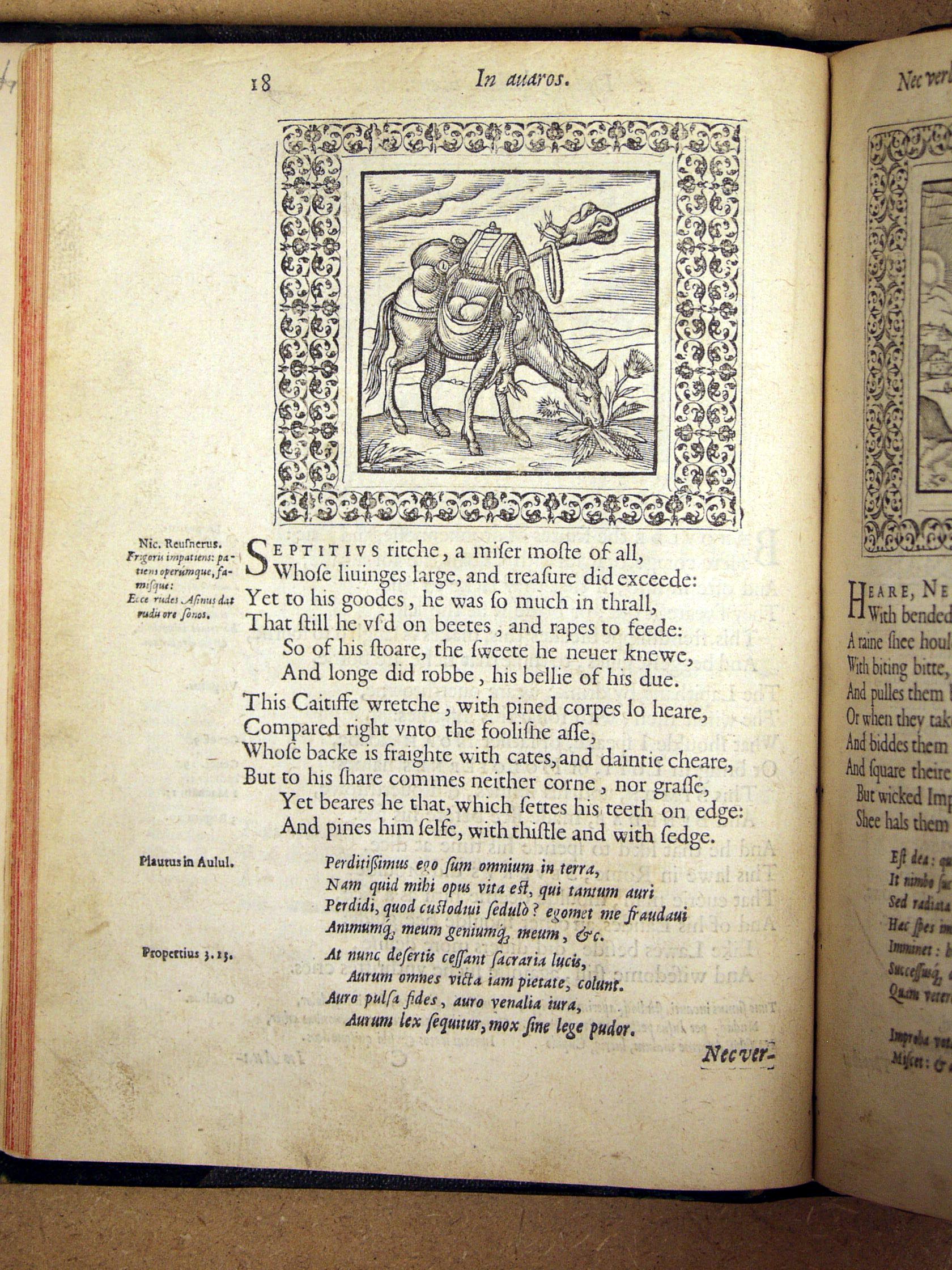
TranscriptionAI-generated
SEPTITIVS ritche, a miser moste of all, Whose liuinges large, and treasure did exceede: Yet to his goodes, he was so much in thrall, That still he vs'd on beetes, and rapes to feede: So of his stoare, the sweete he neuer knewe, And longe did robbe, his bellie of his due. This Caitiffe wretche, with pined corpes lo heare, Compared right vnto the foolishe asse, Whose backe is fraighte with cates, and daintie cheare, But to his share commes neither corne, nor grasse, Yet beares he that, which settes his teeth on edge: And pines him selfe, with thistle and with sedge.
TranslationAI-generated
Septitius, a rich man and the greatest of misers, whose large livings and treasure exceeded all: yet he was so much enslaved to his goods that he still fed on beets and turnips; so of his store he never knew the sweetness, and long robbed his belly of its due. This wretched caitiff, with his starved body, behold here, rightly compared to the foolish ass, whose back is freighted with delicacies and dainty fare, but to his own share comes neither corn nor grass; yet he carries that which sets his teeth on edge, and starves himself with thistle and with sedge.
CommentaryAI-generated
3 passages · original left, translation right (click to fold)
Nic. Reusnerus. Frigoris impatiens: patiens operúmque, famísque: Ecce rudes Asinus dat rudis ore sonos.
Nicolaus Reusnerus. Unable to bear the cold, yet enduring of labours and of hunger: behold, the rude ass gives forth rude sounds from his mouth.
Plautus in Aulul. Perditissimus ego sum omnium in terra, Nam quid mihi opus vita est, qui tantum auri Perdidi, quod custodiui sedulò? egomet me fraudaui Animúmq́, meum geniúmq́, meum, &c.
Plautus in the Aulularia. I am the most ruined of all men on earth, for what need have I of life, who have lost so much gold, which I guarded so carefully? I myself have cheated myself and my own soul and my own spirit, etc.
Propertius 3. 13. At nunc desertis cessant sacraria lucis, Aurum omnes victa iam pietate, colunt. Auro pulsa fides, auro venalia iura, Aurum lex sequitur, mox sine lege pudor.
Propertius 3.13. But now the shrines lie idle in deserted groves; all men, piety being now vanquished, worship gold. By gold faith is driven out, by gold laws are made venal; the law follows gold, and soon modesty follows without law.
Notes and related emblems
- Related emblem in another book: embmne_mig1591_emblem085
Iconclass
25G4(THISTLE)(+32)plants and herbs: thistle (+ flowers, blossom, blossoming)25F26(HARE)(+63)rodents: hare (+ dying animal; death of animal; dead animal)25H114low hill country41A775wooden container: barrel, cask41A777container of textile material: bag, sack, net41C26131plucked fowl41C621(+5)bread, loaf (+ foodstuffs in other container, e.g.: barrel, can, cask, tin, etc.)41C69:41C2511meat; still life of meat❧spit ~ cooking41C693sausage41C711(+5)wine ~ alcoholic drinks (+ foodstuffs in other container, e.g.: barrel, can, cask, tin, etc.)46A1632(+0)money-chest, treasure-chest, money-box (+ variant)46C13142(+739):31A244?❧head bent forward; bowing46C13142(+745)ass, donkey (+ animals eating and drinking)46C133pack-animal55CC11(+4)Greed, Covetousness, Cupidity; 'Cupidità' (Ripa) (+ emblematical representation of concept)86(IN AVAROS)proverbs, sayings, etc. (IN AVAROS)98B(SEPTIMUS)3male persons from classical history (SEPTIMUS) - representations to which the NAME of a person from classical history may be attached
Suggested Iconclass codesAI-generated
Additional codes proposed for this emblem, not (yet) part of the indexing.
46C13142ass, donkeyhighThe correlate 'ass, donkey' matches the central figure, a laden pack-ass standing in a landscape.
25G4(THISTLE)plants and herbs: thistlehighThe correlate 'plants and herbs: thistle' matches the thistle and rough weeds the ass crops at its feet.
46C1461prick, goadmediumThe correlate 'prick, goad' matches the long rod/goad held by the driver's hand at the upper right.
11N34Covetousness; 'Avaritia' (Ripa) ~ personification of one of the Seven Deadly SinsmediumThe correlate 'Covetousness; Avaritia ~ personification of one of the Seven Deadly Sins' matches the emblem's theme, the beast bearing riches yet feeding on thistles, glossed by the commentary's attack on the worship of gold.
32A44misermediumThe correlate 'miser' fits the moral subject evoked by Plautus' Aulularia lament over lost hoarded gold and the ass that carries wealth without enjoying it.
Relationships to the Adagia of ErasmusAI-generated
Suggested relationships between this emblem and adages in Erasmus’ Adagia.
- II vi 14 Tantali poena – thematic inventiomedium
Erasmus explains this adage as applying to those who have good things within reach but may not enjoy them, and says expressly that it was commonly used of rich men who are mean and avaricious, quoting Horace's lines about the miser snoring on his money-bags ('mutato nomine de te fabula narratur'). This is exactly Whitney's Septitius, who 'of his stoare, the sweete he neuer knewe.'
- IV viii 38 Asinus stramenta mavult quam aurum – thematic inventiomedium
The emblem's central image — an ass whose back is loaded with precious fare while it crops thistles and coarse weeds — is the same proverbial contrast between the ass and the riches it ignores or cannot use; Erasmus' essay likewise contrasts the ass's coarse fodder with gold it has no use for.
- I x 71 Similes habent labra lactucas – thematic inventiolow
Erasmus states that this adage 'took its rise from a donkey eating thistles' (ab asino carduos pascente), discussing at length the ass's hard lips and the thistle; the woodcut shows precisely the ass cropping a thistle, and the subscriptio ends 'pines him selfe, with thistle and with sedge.'
- I vi 22 Tantali talenta – thematic inventiolow
Erasmus here too applies the Tantalus figure to 'grasping rich men' who suffer amid heaped-up wealth, quoting Horace's 'mutato nomine de te fabula narratur' — the same moral of the miser starving in the midst of his own abundance that the emblem dramatizes.
Sources
Record ID: embstma_1667_emblem018
This emblem on the Iconclass site: https://iconclass.org/view/embstma_1667_emblem018
Copy: University Library, Glasgow, Stirling Maxwell 1667