Geffrey Whitney, A choice of emblemes (Leiden, 1586)
Emblem 26
Windmill with unmoving vanes; a sleeping man
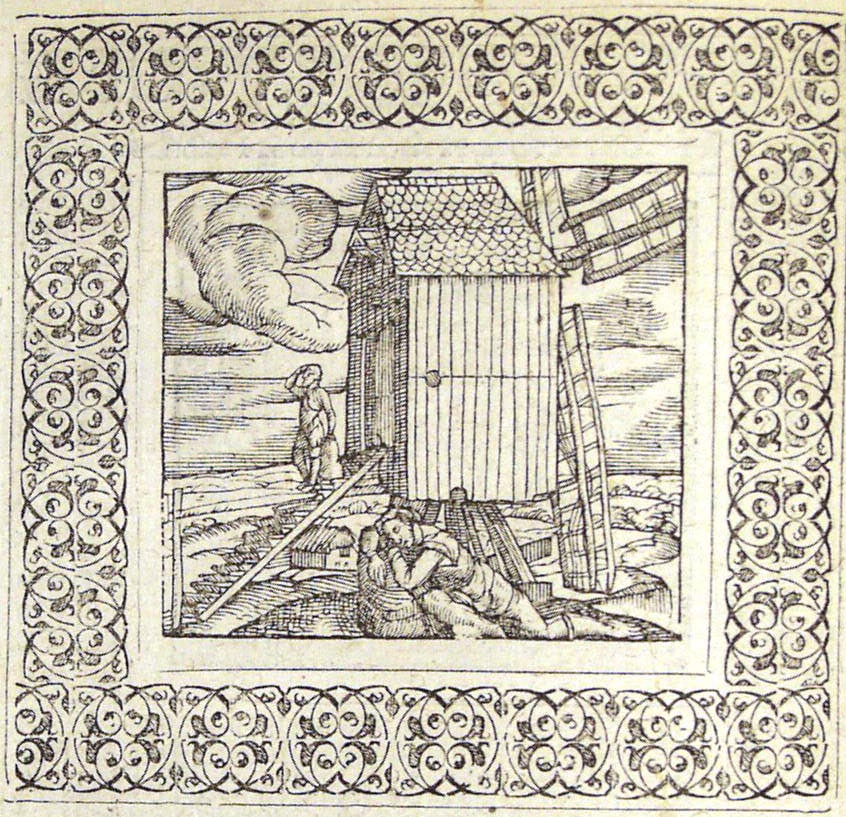
Otium sortem exspectatLatin
Idleness awaits its destiny
- Interpretation
- Miller sleeping (Idleness awaits its destiny)
Description of the imageAI-generated
Within an ornamental border, a woodcut shows a windmill with a shingled roof and plank walls, its sails at the right side, standing on a wooden trestle base on a rise of ground. In the foreground at the lower right a man lies sprawled on the ground, leaning on one arm, apparently asleep or resting beside sacks and a wooden chest. At the left, in the middle distance, a figure in a cloak stands on a path by a fence. Clouds fill the upper left of the sky.
Subscriptio

TranscriptionAI-generated
A Windmill faire, that all thinges had to grinde, Which man coulde make, the father lefte his sonne: The corne was broughte, there nothing lack'd, but winde, And Customers, did freshlie to it ronne: The sonne repoas'de his truste vppon the mill, And dailie dream'de on plentie at his will. Thus he secure, a while his daies did passe, And did not seeke, for other staie at all: And thoughe hee founde, howe coulde the profit was, And that soe small, vnto his share did fall: Yet still he hoap'de, for better lucke at laste, And put his truste, in eache vncertaine blaste. Vnto this foole, they maie compared bee, Which idlie liue, and vainlie hoape for happe: For while they hope, with wante they pine, wee see: And verie fewe, are lul'de on fortunes lappe: While grasse doth growe, the courser faire doth sterue, And fortune sield, the wishers turne doth serue.
TranslationAI-generated
A fine windmill, able to grind everything that a man could make, the father left to his son: the corn was brought, nothing was lacking but wind, and customers came running eagerly to it. The son rested his trust upon the mill, and daily dreamed of plenty at his will. Thus he passed his days for a while in security, and sought no other support at all: and though he found how slight the profit was, and that so little fell to his share, yet still he hoped for better luck at last, and put his trust in every uncertain gust. To this fool they may be compared who live idly and vainly hope for good fortune: for while they hope they pine with want, we see; and very few are lulled on fortune's lap. While the grass grows, the fine steed starves, and fortune seldom serves the wishers' turn.
CommentaryAI-generated
2 passages · original left, translation right (click to fold)
Ouid. 1. Pont. 6. Cernis vt ignauum corrumpant otia corpus? Ut capiant vitium ni moueantur aquæ.
Ovid, Letters from Pontus 1.6: Do you see how idleness corrupts a sluggish body? How waters take on taint unless they are stirred?
Plaut. Rud. —— vigilare decet hominem, Qui vult sua tempori conficere officia. Nam qui dormiunt libenter, sine lucro, & cum malo quiescunt.
Plautus, Rudens: A man ought to stay awake who wants to get his duties done in good time. For those who sleep willingly take their rest without profit and with harm.
Notes and related emblems
- Related emblem in another book: embmne_sam1569_emblem060
Iconclass
25G11groups of trees25H114low hill country25I3farm or solitary house in landscape26Aclouds31A2362lying face downwards31A2515(+933)arm held downwards (+ holding something)31A25341looking with the hand above the eyes31A262(+51)legs in different position (+ standing)31BB13sleeping on the ground - BB - out of doors31D14(+72)adult man (+ two persons)41A777container of textile material: bag, sack, net41D211(+81)dress, gown (+ men's clothes)41D233(+81)gear for legs and feet (+ men's clothes)47B192miller47D31windmill54DD2(+4)Idleness; 'Otio' (Ripa) (+ emblematical representation of concept)54F12(+4)Luck, Fortune, Lot; 'Fato', 'Fortuna', 'Fortuna aurea', 'Fortuna buona', 'Fortuna pacifica overo clemente', 'Sorte' (Ripa) (+ emblematical representation of concept)56D1(+4)Hope; 'Speranza', 'Speranza delle fatiche' (Ripa) (+ emblematical representation of concept)86(OTIUM SORTEM EXPECTAT)proverbs, sayings, etc. (OTIUM SORTEM EXPECTAT)
Suggested Iconclass codesAI-generated
Additional codes proposed for this emblem, not (yet) part of the indexing.
25I41windmill in landscapehighThe woodcut depicts a windmill standing on a rise of ground within an outdoor landscape setting, exactly matching 'windmill in landscape'.
47D31windmillhighThe central object is a windmill with sails and trestle base, matching the correlate 'windmill' as a milling structure.
41A777container of textile material: bag, sack, netmediumSacks (presumably grain sacks by the mill) lie in the foreground beside the resting man, matching 'container of textile material: bag, sack'.
41A733chest, coffermediumA wooden chest lies in the foreground next to the sprawled man, matching 'chest, coffer'.
41A54fence, wall, palingmediumA fence runs beside the path where the cloaked figure stands in the middle distance, matching 'fence, wall, paling'.
Relationships to the Adagia of ErasmusAI-generated
Suggested relationships between this emblem and adages in Erasmus’ Adagia.
- II ix 14 Semper agricola in novum annum dives – thematic inventiomedium
The emblem's miller is the exact type Erasmus describes: one who is 'rich in hopes of future profits' and lives on the expectation of a better yield ('Yet still he hoap'de, for better lucke at laste'), while present want pines him. The agricultural/milling setting (corn, grinding, harvest expectations) reinforces the parallel.
- IV iii 5 Inani spe flagrat – thematic inventiomedium
The subscriptio condemns those who 'idlie liue, and vainlie hoape for happe' and put trust 'in eache vncertaine blaste' — precisely Erasmus's 'futilely promises himself great things,' where hope gives courage only to fools.
- II vi 12 Ignavis semper feriae sunt – thematic inventiolow
The motto 'Otium sortem exspectat' and the sprawled, sleeping figure in the picture illustrate the idler's perpetual holiday; Erasmus's adage on sluggards' endless leisure shares the moral reinforced by the Ovid and Plautus tags on idleness and sleep.
Sources
Record ID: embstma_1667_emblem026
This emblem on the Iconclass site: https://iconclass.org/view/embstma_1667_emblem026
Copy: University Library, Glasgow, Stirling Maxwell 1667