Geffrey Whitney, A choice of emblemes (Leiden, 1586)
Emblem 25
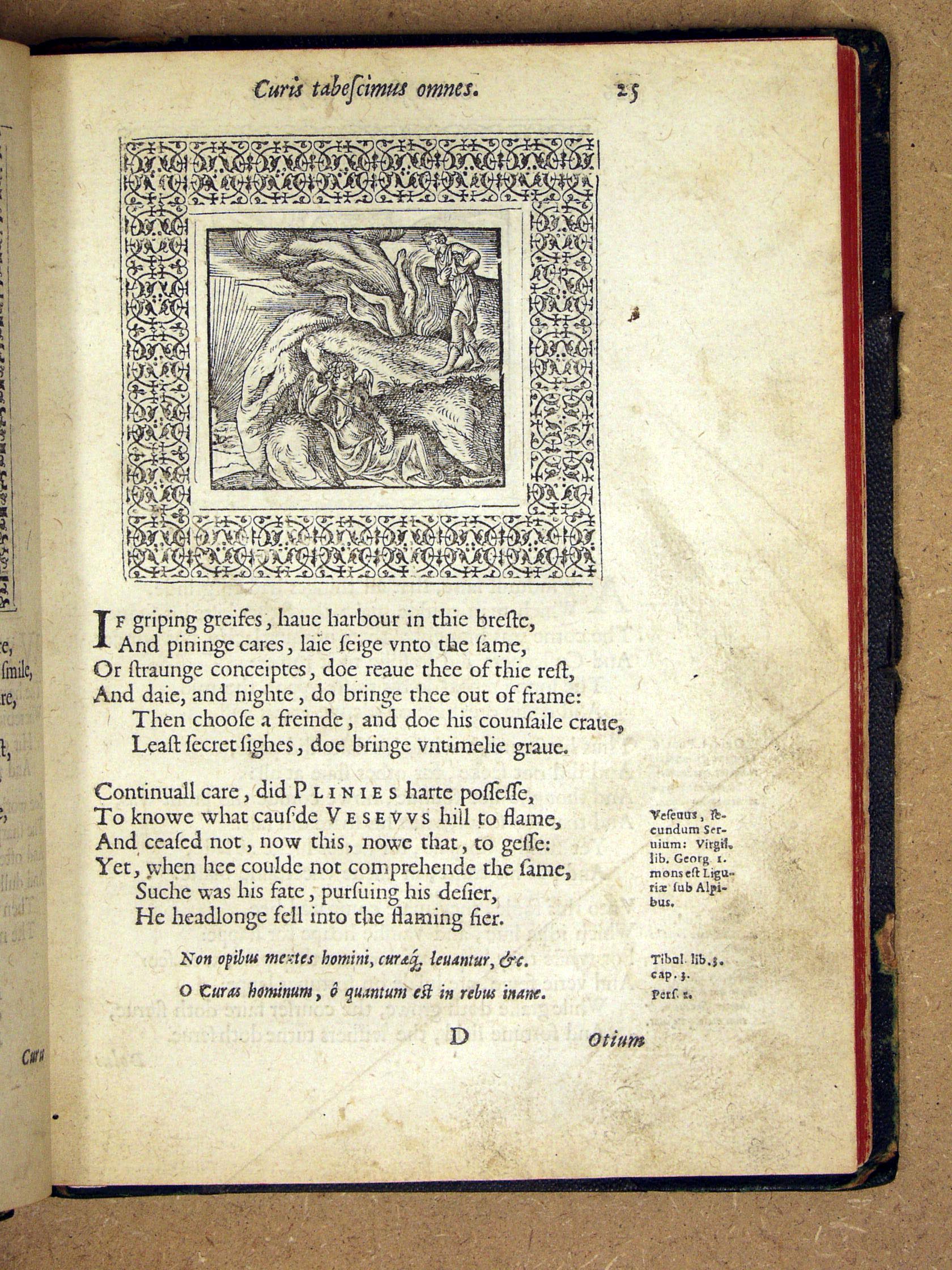
Pliny the Elder at the edge of Vesuvius, Empedocles falling into Etna

Curis tabescimus omnesLatin
We are all consumed by cares
- Interpretation
- Pliny over-curious (From cares we all waste away)
Description of the imageAI-generated
A square woodcut within an ornamental woven border: a mountain or rocky hillside erupting with great billowing flames and smoke rising to the upper left, with rays or lines at the left edge. On the slope at the right stands a man in doublet and hose, turned toward the fire with a hand raised to his head. In the foreground below, a winged or draped figure reclines among the rocks, leaning on one arm and looking upward at the blaze.
Subscriptio
TranscriptionAI-generated
IF griping greifes, haue harbour in thie breste, And pininge cares, laie seige vnto the same, Or straunge conceiptes, doe reaue thee of thie rest, And daie, and nighte, do bringe thee out of frame: Then choose a freinde, and doe his counsaile craue, Least secret sighes, doe bringe vntimelie graue. Continuall care, did PLINIES harte possesse, To knowe what causde VESEVVS hill to flame, And ceased not, now this, nowe that, to gesse: Yet, when hee coulde not comprehende the same, Suche was his fate, pursuing his desier, He headlonge fell into the flaming fier.
TranslationAI-generated
If gripping griefs have harbour in thy breast, and pining cares lay siege unto the same, or strange conceits do reave thee of thy rest, and day and night do bring thee out of frame: then choose a friend, and do his counsel crave, lest secret sighs do bring an untimely grave. Continual care did Pliny's heart possess, to know what caused Vesuvius hill to flame; and he ceased not, now this, now that, to guess. Yet when he could not comprehend the same, such was his fate, pursuing his desire, he headlong fell into the flaming fire.
CommentaryAI-generated
4 passages · original left, translation right (click to fold)
Non opibus mentes homini, curaq́; leuantur, &c.
O curas hominum, ô quantum est in rebus inane.
Men's minds and cares are not relieved by riches, etc.
O the cares of men, O how much emptiness there is in things!
Veseuus, secundum Seruium: Virgil. lib. Georg. 1. mons est Liguriæ sub Alpibus.
Vesevus, according to Servius on Virgil, Georgics book 1, is a mountain of Liguria below the Alps.
Tibul. lib. 3. cap. 3.
Tibullus, book 3, chapter 3.
Pers. 1.
Persius, satire 1.
Notes and related emblems
- Related emblem in another book: embmne_sam1569_emblem117
Iconclass
21Cfire (one of the four elements)24A1sunrise25C11eruption (of volcano)25C12volcano25G13groups of plants (herbs)25F(+342):31AA2224animals (+ wings of an animal)❧shoulder - AA - female human figure31A2321leaning forward31AA2351sitting on the ground - AA - female human figure31A244head bent forward; bowing31A2512(+931)arm stretched forward (+ indicating, pointing at)31A2516(+933)arm or hand held in front of the body (+ holding something)31A25161arm or hand held in front of the chest31A25312head held in the hand(s), with elbows leaning on an elevation or on the knees31A2621one leg in front of the other31AA2626(+53)sitting or lying with one leg stretched forward and the other leg drawn up - AA - female human figure (+ sitting)31A2731falling41B121flame41B162smoke41D211(+81)dress, gown (+ men's clothes)41D211(+82)dress, gown (+ women's clothes)41D233(+81)gear for legs and feet (+ men's clothes)41D2339barefoot49L511quill41D233(+81)gear for legs and feet (+ men's clothes)48C91writer, poet, author49L511quill5(+11)Abstract Ideas and Concepts (+ abstract concept represented by female figure)52A12(+4)Curiosity, Inquisitiveness, Desire of Knowledge; 'Curiosità' (Ripa) (+ emblematical representation of concept)58AA1(+4)Destruction (+ emblematical representation of concept)61D(AETNA)geographical names of countries, regions, mountains, rivers, etc. (AETNA) (AETNA)61D(VESUVIUS)geographical names of countries, regions, mountains, rivers, etc. (VESUVIUS) (VESUVIUS)86(CURIS TABESCIMUS OMNES)proverbs, sayings, etc. (CURIS TABESCIMUS OMNES)92B29111the Cyclopes forging Jupiter's thunderbolt98B(EMPEDOCLES)68death of Empedocles: the philosopher leaps into the crater of Etna98B(PLINY THE ELDER)68death of Pliny the Elder during the eruption of Vesuvius
Suggested Iconclass codesAI-generated
Additional codes proposed for this emblem, not (yet) part of the indexing.
41B121flamehighThe correlate 'flame' directly matches the great billowing flames erupting from the mountainside that dominate the woodcut.
46A16the richlowThe correlate 'the rich' loosely corresponds to the commentary's theme that men's minds and cares are not lightened by riches, though no wealthy figure is actually depicted.
Relationships to the Adagia of ErasmusAI-generated
Suggested relationships between this emblem and adages in Erasmus’ Adagia.
- I vi 69 Quae supra nos, nihil ad nos – thematic inventiomedium
The emblem's exemplum of a man destroyed while investigating a natural marvel beyond human comprehension matches Erasmus's adage that what is above us is no concern of ours, used against those who torment themselves researching hidden natural and celestial causes.
- II ix 39 Qui apud Inferos sunt terniones – thematic inventiolow
Erasmus uses this adage to mock those who with anxious, painstaking industry 'rummage through' hidden and abstruse matters — the very fault of the emblem's Pliny, who 'ceased not, now this, nowe that, to gesse' about the volcano's cause.
- II ii 18 Mens est in tergoribus – thematic inventiolow
Erasmus explains the phrase as said of worried men wholly absorbed by an anxiety, which parallels the emblem's picture of the mind besieged by 'pininge cares' and fixed obsessively on one object.
- II i 47 Res sacra consultor – thematic inventiolow
The remedy offered in the subscriptio — 'Then choose a freinde, and doe his counsaile craue' — echoes the adage's doctrine that a counsellor is a sacred thing, especially invoked (per Suidas) when dangerous matters are deliberated.
Sources
Record ID: embstma_1667_emblem025
This emblem on the Iconclass site: https://iconclass.org/view/embstma_1667_emblem025
Copy: University Library, Glasgow, Stirling Maxwell 1667