Guillaume de La Perrièrre, Le Theatre Des Bons Engins (Lyon, 1545)
Emblem 89
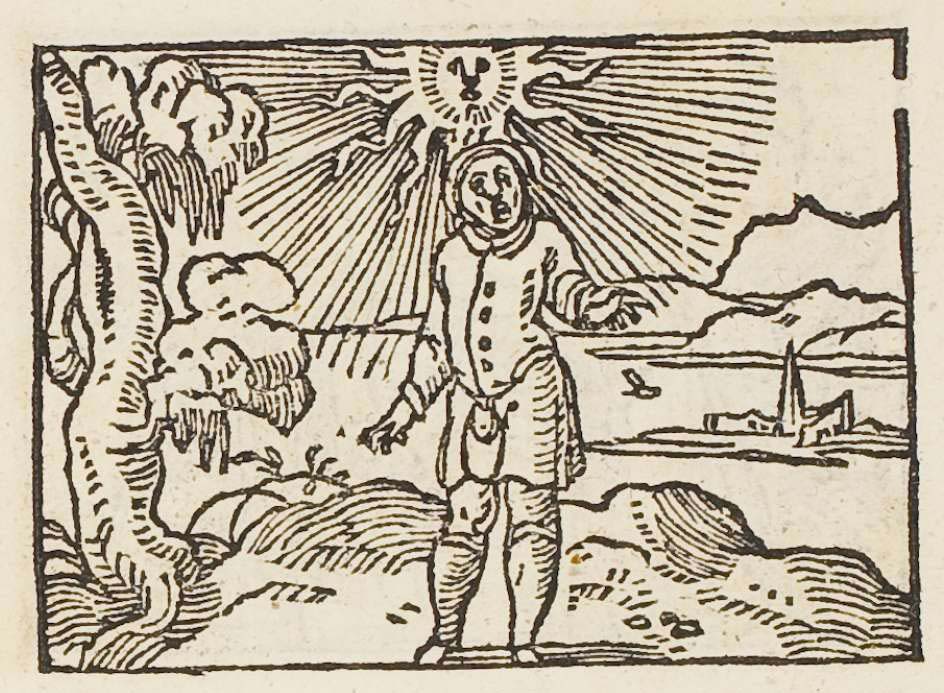
A man standing beneath the noonday sun, casting almost no shadowAI-generated
Au Vertueux Enuie ne peult nuyre,
To the virtuous man, Envy can do no harm.AI-generated
Description of the woodcutAI-generated
A woodcut in a rectangular frame. In the centre a man in a belted doublet and hose stands on rough, hilly ground, arms held slightly out from his sides, facing the viewer. Directly above his head a large radiant sun with a human face sends out long straight rays filling the upper part of the scene, with small clouds at either side. At the left grows a gnarled, partly bare tree beside a rock or bank with foliage; at the right the ground falls away to a stretch of water with a small boat, and beyond it a shoreline with buildings, a tower and hills in the distance. The man casts almost no shadow on the ground.
Subscriptio

TranscriptionAI-generated
SI le Soleil luyct au droict de ta teste,Ton corps rédra nulle ou bié petite vmbre:Si par enuie aduient, qu'on te tempeste,Ta grand' vertu te gardera d'encombre.Vertu reluict à raidz qui sont sans nombre,Anichilant l'obscurité d'enuie.Maulgré Fortune, aura tousiours en vieCueur vertueux, honneur, loz, & support:Et quand viendra, que du monde desuie,Sera viuant en gloire apres sa mort.
TranslationAI-generated
If the Sun shines straight above your head, your body will cast no shadow, or a very small one: if through envy it happens that you are assailed, your great virtue will keep you from trouble. Virtue shines with rays beyond number, annihilating the darkness of envy. In spite of Fortune, a virtuous heart will always have, while alive, honour, praise and support: and when the time comes that he departs from the world, he will be living in glory after his death.
Iconclass
86(AU VERTUEUX ENUIE NE PEULT NUYRE,)proverbs, sayings, etc. (AU VERTUEUX ENUIE NE PEULT NUYRE,)25H13coast25G3trees31D14adult man24A6sun represented as face, wheel, etc.24A81sunbeams24A7positions of the sun57A6Virtuousness; 'Amor di Virtù', 'Attione virtuosa', 'Guida sicura de' veri honori', 'Virtù', 'Virtù insuperabile' (Ripa)54F2Victory11N32Envy; 'Invidia' (Ripa) ~ personification of one of the Seven Deadly Sins
Suggested Iconclass codesAI-generated
Additional codes proposed for this emblem, not (yet) part of the indexing.
31A2811man without shadowhighThe correlate 'man without shadow' matches the man standing beneath the vertical sun who casts almost no shadow on the ground.
31A28man and his shadowmediumThe broader 'man and his shadow' category covers the emblem's theme of a human figure depicted in relation to his (absent) shadow.
22C8shadowlowThe general concept 'shadow' is thematically central, since the picture's point is the lack of a cast shadow at midday.
Relationships to the Adagia of ErasmusAI-generated
Suggested relationships between this emblem and adages in Erasmus’ Adagia.
- V i 83 Virtus aeterna – thematic inventiomedium
The subscriptio's close — that the virtuous heart has honour and praise in life and 'sera viuant en gloire apres sa mort' — restates the adage's point that life is short but the memory of virtuous deeds never dies, so that the good man lives on in glory among posterity.
- III x 96 Gloria futuri – thematic inventiomedium
Erasmus' essay pairs posthumous glory with the Ovidian tag 'Pascitur in vivis livor, post fata quiescit' (envy feeds on the living, after death it is silent) — exactly the emblem's pairing of envy that cannot harm virtue and glory enjoyed after death.
- IV viii 59 Cognatio movet invidiam – thematic inventiolow
The essay ends with the idea that those who rise to such heights that their glory overcomes ill-will are 'extra invidiae tela', beyond envy's darts — the same conceit as the man standing beneath the zenith sun whom envy's shadow cannot reach.
- V i 76 Fama prodit omnia – thematic inventiolow
The adage's Euripidean line, that fame reveals the good man even in the hollows of the earth and celebrates the dead as well as the living, matches the emblem's claim that virtue's innumerable rays shine out and secure glory after death.
Sources
Record ID: embhab_162-3-eth-b_emblem089
This emblem on the Iconclass site: https://iconclass.org/view/embhab_162-3-eth-b_emblem089
Page in the digital copy of the Herzog August Bibliothek: http://diglib.hab.de/drucke/162-3-eth-b/start.htm?image=00102