Guillaume de La Perrièrre, Le Theatre Des Bons Engins (Lyon, 1545)
Emblem 90
A man reaching after a bird that has flown from his handAI-generated
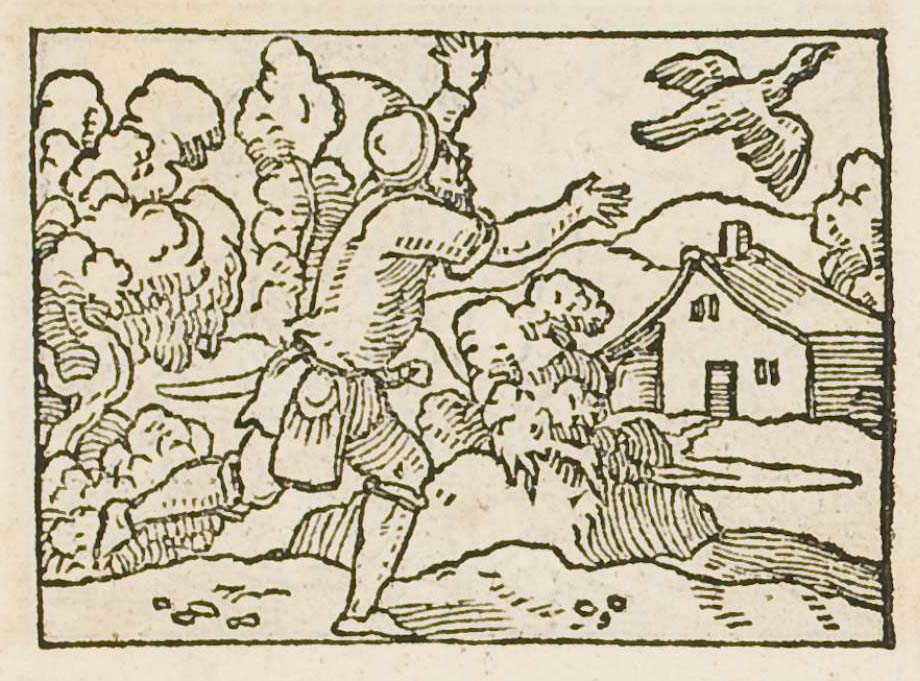
Ce qu'on a dict, ne peult estre à redire.
Emblem 90. What has been said cannot be unsaid.AI-generated
Description of the woodcutAI-generated
A woodcut in a rectangular frame showing a rural landscape. In the left foreground a man in a short tunic, cap and purse at his belt strides forward with his right arm stretched up and out, reaching after a bird that flies away in the upper right of the scene. Behind and around him are large billowing clouds and bushes; at the right stands a small house with a chimney, a door and windows, with trees and hills in the background. Stones or pebbles lie scattered on the ground at his feet.
Subscriptio

TranscriptionAI-generated
Lors que l'Oyseau s'enuole de ta main,Bien difficile en est la recouurance:Lors qu'on profere vne parolle en vain,Il n'est pas temps d'en auoir repentance.Lon cognoistra d'vn homme l'inconstancePar vn seul mot, ou bien simple parolle:Ce que l'vn dict, bien tost à l'aultre vole,Souuent en vient grand reproche & danger.L'homme discret pour bien iouer son rolle,Se gardera de parler de leger.
TranslationAI-generated
When the bird flies away from your hand, it is very difficult to get it back: when one utters a word in vain, there is no time to repent of it. A man's inconstancy will be known by a single word, or just a simple utterance: what the one says soon flies to the other, and from it often comes great reproach and danger. The discreet man, to play his part well, will keep himself from speaking lightly.
Iconclass
86(CE QU'ON A DICT, NE PEULT ESTRE À REDIRE)proverbs, sayings, etc. (CE QU'ON A DICT, NE PEULT ESTRE À REDIRE)25I3farm or solitary house in landscape31D14(+61)adult man (+ forward)31A27112running25F3(+5262)birds (+ flying animal(s))25F3(+524)birds (+ movement of animal(s) in relation to an other animal, human figure, or object)52AA21Rashness, Imprudence, Recklessness52D4Prolixity, Verbosity, Loquacity; 'Loquacità' (Ripa)
Suggested Iconclass codesAI-generated
Additional codes proposed for this emblem, not (yet) part of the indexing.
56D1Hope; 'Speranza', 'Speranza delle fatiche' (Ripa)lowThe correlate 'Hope' (Speranza) matches the emblem's theme of a man vainly stretching out his hand after an escaping bird, i.e. grasping at hope that flies away.
Relationships to the Adagia of ErasmusAI-generated
Suggested relationships between this emblem and adages in Erasmus’ Adagia.
- III i 18 Levissima res oratio – thematic inventiohigh
Erasmus' essay gathers precisely the emblem's materials: Homer's 'winged words' that fly away and cannot fly back, Horace's 'semel emissum volat irrevocabile verbum', and Menander's comparison of a word let loose with a heavy stone thrown from the hand. The woodcut's escaping bird and the stones scattered at the man's feet, together with the motto 'Ce qu'on a dict, ne peult estre à redire', reproduce this cluster exactly.
- II ii 39 Lingua quo vadis? – thematic inventiomedium
The adage teaches that the tiny tongue brings mortals the greatest benefit or the greatest ruin; the subscriptio similarly warns that from a single careless word 'often comes great reproach and danger', urging the prudent man to guard his speech.
- I ii 99 Non est eiusdem et multa et opportuna dicere – thematic inventiolow
Erasmus' warning against multiloquium ('in the multitude of words there wanteth not sin') matches the emblem's closing counsel that the discreet man 'se gardera de parler de leger'.
- I v 73 Quicquid in linguam venerit – thematic inventiolow
The adage describes blurting out 'whatever comes in a rash moment to the tongue', the very fault the emblem condemns when it says that a man's inconstancy is revealed by a single rashly uttered word.
Sources
Record ID: embhab_162-3-eth-b_emblem090
This emblem on the Iconclass site: https://iconclass.org/view/embhab_162-3-eth-b_emblem090
Page in the digital copy of the Herzog August Bibliothek: http://diglib.hab.de/drucke/162-3-eth-b/start.htm?image=00103