Guillaume de La Perrièrre, Le Theatre Des Bons Engins (Lyon, 1545)
Emblem 91
A barded horse (Bucephalus) trampling a manAI-generated
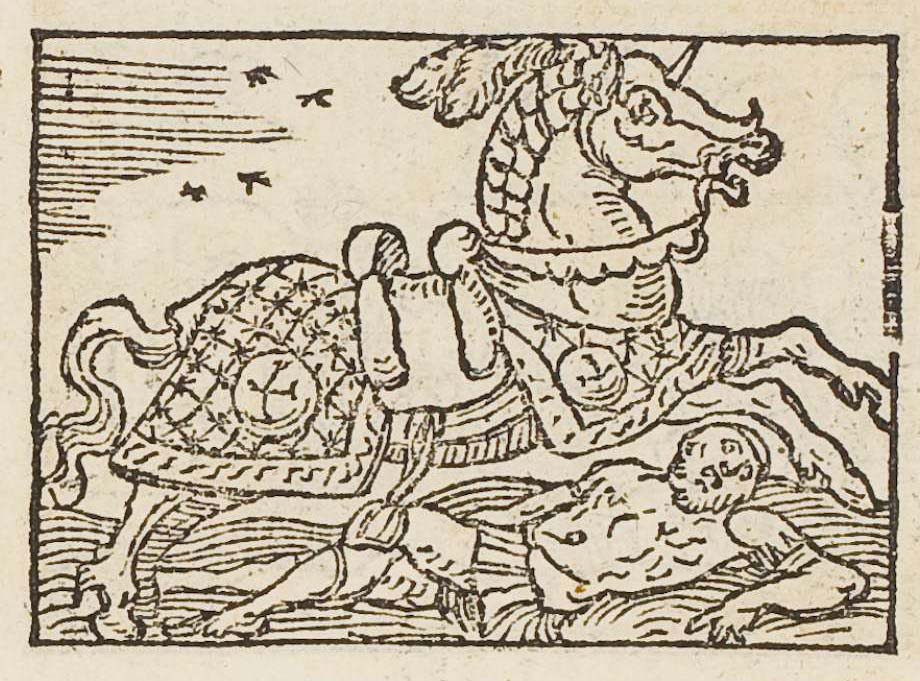
Poure enrichy deuient fort orgueilleux.
Emblem 91. A poor man made rich becomes very proud.AI-generated
Description of the woodcutAI-generated
A woodcut in a rectangular frame. At the right, a horse in full barding — plumed and armoured head-piece (chanfron), armoured neck, and a richly patterned, fringed caparison with roundels covering its body — rears or strides forward with an empty saddle. Beneath its hooves a bare-headed man lies sprawled on the ground, face turned upward, his arms and legs tangled under the horse's forelegs and the hanging cloth. At the upper left, hatched lines indicate the sky with several small birds in flight.
Subscriptio

TranscriptionAI-generated
Quand Bucephal se cognoissoit bardé,Si fier estoit, que plus ne pouuoit estre:Pour lors aucun ne se fust hazardéLe cheuaucher, reseruè son seul maistre.Par ce pourtraict est donné à cognoistre,Que Gens extraictz de quelque rasse infime,Si paruenir peuuent à grosse estime,Si fiers se font, qu'on ne les peult tenir.Quand poureté monte en honneur sublime,Lon ne la peult à peine retenir.
TranslationAI-generated
When Bucephalus knew himself to be armoured, he was so proud that he could not be more so: then no one would have risked riding him, save only his own master. By this picture it is given to be understood that people descended from some lowly stock, if they can rise to great esteem, make themselves so haughty that one cannot hold them in. When poverty climbs to sublime honour, one can scarcely restrain it.
Iconclass
86(POURE ENRICHY DEUIENT FORT ORGUEILLEUX)proverbs, sayings, etc. (POURE ENRICHY DEUIENT FORT ORGUEILLEUX)46C13141horse46C13183galloping horse31D14adult man31A2364lying on one side, with uplifted upper part of the body and leaning on the arm46C13192horse throwing rider98B(ALEXANDER THE GREAT)131Bucephalus57AA64Pride, Loftiness; 'Alterezza in persona nata povera civile' (Ripa)46A166parvenu, 'nouveau riche', upstart
Suggested Iconclass codesAI-generated
Additional codes proposed for this emblem, not (yet) part of the indexing.
94S6suffering, misfortune of BellerophonmediumThe correlate 'suffering, misfortune of Bellerophon' matches the fallen rider lying beneath his riderless, caparisoned mount, the classic image of Bellerophon thrown from his steed, and Bellerophon is named in the commentary.
11N31Pride; 'Superbia' (Ripa) ~ personification of one of the Seven Deadly SinsmediumThe commentary's 'Superbia' corresponds to this personification of Pride, the vice exemplified by the proud rider cast down under his horse's hooves.
56F11Ambition; 'Ambitione', 'Amor di Fama' (Ripa)medium'Ambition' ('Ambitione', 'Amor di Fama') fits the commentary's moral that over-reaching ambition brings the rider to the ground.
92B391PhaethonlowPhaethon, named in the commentary as the archetype of the presumptuous driver hurled down, parallels the thrown horseman, though no chariot or sun-team is shown.
54FFortune and Misfortunelow'Fortune and Misfortune' matches the commentary's theme of the reversal that topples the rider from his splendid horse.
Relationships to the Adagia of ErasmusAI-generated
Suggested relationships between this emblem and adages in Erasmus’ Adagia.
- Asperius nihil est humili cum surgit in altum (not identified) – direct mottomedium
The French motto 'Poure enrichy deuient fort orgueilleux' and the closing couplet ('Quand poureté monte en honneur sublime, / Lon ne la peult à peine retenir') render exactly the proverbial Claudian line 'Nothing is harsher than a lowly man when he rises high', a saying collected among the adages.
- I viii 68 Tollere cornua – thematic inventiomedium
Erasmus' essay glosses the adage precisely with the poor man made insolent — Horace's 'addis cornua pauperi' and Ovid's 'tunc pauper cornua sumit' — and derives the image from beasts that threaten with their horns, matching the emblem's rearing, trampling horse as figure of the enriched pauper's arrogance.
- I vi 93 Pennas nido maiores extendere – thematic inventiomedium
The subscriptio's 'Gens extraictz de quelque rasse infime, / Si paruenir peuuent à grosse estime' is the adage's situation — one born to a small estate who enlarges it beyond his origins; the birds flying in the woodcut's sky recall the fledglings outgrowing the nest.
- II vii 76 Jovis sandalium – thematic inventiomedium
Erasmus applies the adage to those puffed up merely by association with a prince, and expressly extends it to admiring 'a royal horse or coat' for no reason other than its belonging to the king — precisely Bucephalus made haughty by his royal barding.
- III iv 86 A remo ad tribunal – thematic inventiolow
The adage describes a sudden rise 'from the lowest condition' to high office, the same movement the emblem moralizes ('Quand poureté monte en honneur sublime'), though the emblem adds the moral of resulting insolence.
- I viii 69 Tollere cristas – thematic inventiolow
'To lift one's crest' is Erasmus' companion adage for swelling self-conceit, and the woodcut literally gives the horse a plumed crest on its chanfron as the sign of its newly puffed-up pride.
- II ii 4 Asinus portans mysteria – thematic inventiolow
The beast that grows insolent because of the honourable trappings it bears — not its own worth — is the same conceit as Bucephalus made unmanageable by his rich caparison.
Sources
Record ID: embhab_162-3-eth-b_emblem091
This emblem on the Iconclass site: https://iconclass.org/view/embhab_162-3-eth-b_emblem091
Page in the digital copy of the Herzog August Bibliothek: http://diglib.hab.de/drucke/162-3-eth-b/start.htm?image=00104