Jacob Cats, Spiegel (The Hague, 1632)
Emblem 24
One man points at the trunk of a tree that has just been felled; in the background a woodcutter continues removing branches
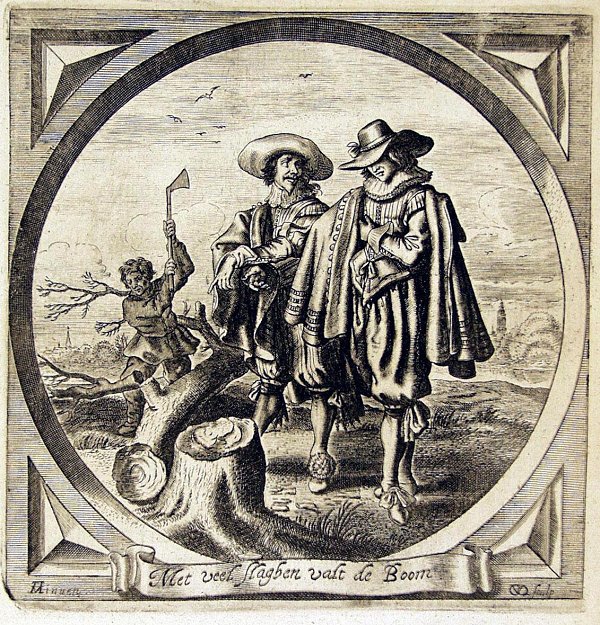
De boom en valt ten eersten slagh nietDutch
The tree does not fall at the first stroke.AI-generated
Description of the imageAI-generated
Within a thick oval frame set in a rectangular border with triangular corner ornaments, an outdoor landscape scene. In the foreground right stand two gentlemen in wide-brimmed hats, lace collars, short cloaks and knee-breeches with ribboned shoe-roses; one looks toward the other, who stands with a downcast expression and his hands crossed in front of him. Behind them at the left a boy or young woodcutter in a smock swings a broad axe above his head, standing astride a large felled tree trunk whose branches lie on the ground. In the centre foreground is the freshly cut stump of the tree. In the distance on both sides are low hills with a village church tower and houses; birds fly in the sky. A scroll/banderole at the bottom of the oval carries an engraved inscription, with an engraver's signature at the lower left and right of the plate.
Subscriptio


TranscriptionAI-generated
Wel, vrient, hoe staet ghy dus bedroeft? My dunckt dat ghy wel troost behoeft, My dunckt dat ghy soo deerlick siet, Al waer u 'thoogste leet geschiet; My dunckt dat u een stege meyt Wt trots moet hebben af-geseyt; Iae siet! dat is het dat u quelt Dat isset dat u dus ontstelt. Maer, lieve, daerom niet getreurt; Tis meerder man als u gebeurt. Ick bid, ontwaeckt uyt desen droom, En slaet het oogh op desen boom, Dit was een dick' een hooge stam, Die schier tot aen den hemel quam, En siet! nu leytse neer gestort, Soo datter op getreden wort. Ghy vraegj' hoe dat een eenigh man Soo dicken ballick vellen kan? Wel hoort, ghy sultet haest verstaen, Hoe dat een man dit heeft gedaen. Hy nam een bijl van enckel stael, En kapte veel, en menichmael, En siet! het staegh en dickmael slaen En kond' de boom niet wederstaen, Maer viel ten lesten in het gras Soo dick en stijf gelijck hy was; Soo datmen vry wel seggen magh, Geen boom en valt van eenen slagh. Ghy vryer soo ghy wilt bedien Doet soo gelijck ghy hebt gesien; Want 'tis een seggen int gemeen Een staege drop die holt den steen.
TranslationAI-generated
Well, friend, why do you stand so sad? It seems to me that you are much in need of comfort; it seems to me that you look so pitiful, as if the greatest sorrow had befallen you; it seems to me that some stubborn maid must have refused you out of pride; yes, look! that is what torments you, that is what so upsets you. But, dear fellow, do not grieve for that; it has happened to greater men than you. I beg you, wake up out of this dream, and cast your eye on this tree. This was a thick and lofty trunk, which almost reached to heaven, and see! now it lies fallen down, so that people tread upon it. You ask how a single man can fell so thick a beam? Well, listen, you shall soon understand how one man has done this. He took an axe of pure steel, and chopped much and many a time, and see! the constant and repeated striking the tree could not withstand, but it fell at last into the grass, as thick and stiff as it was; so that one may well say: no tree falls at a single blow. You, suitor, if you wish to woo, do as you have seen; for it is a common saying: a constant drop hollows out the stone.
CommentaryAI-generated
11 passages · original left, translation right (click to fold)
Lat. Multis ictibus deijcitur quercus.
Latin. By many blows the oak is brought down.
Hoogd. Mit viel streichen wird der stockfisch linde.
High German. With many strokes the stockfish becomes tender.
Nederd. Veel slagen maken den stock-bis murruw.
Low German. Many blows make the stockfish tender.
Lat. Omnia conando docilis solertia vincit.
Latin. Teachable skill conquers all things by trying.
Griecx. Πρεπόντων πονων, πωλᾶσιν ἁμῖν πάντα τ' ἀγαθὰ οἱ θεοί.
Greek. For fitting labours the gods sell us all good things.
Convenientibus laboribus vendunt nobis omnia Dij. Epich.
For suitable labours the gods sell us all things. Epicharmus.
Nul bien sans peine. Franç.
No good without pain. French.
Omnia diligentiæ subijciuntur. Lat.
All things are subject to diligence. Latin.
Diligence passe science. Ital.
Diligence surpasses knowledge. (labelled 'Italian')
Par est fortuna labori. Lat.
Fortune is equal to the labour. Latin.
Bordes
Bordes (source attribution)
Iconclass
25G3(+21)trees (+ stem, trunk)25G3(+371)trees (+ dead, withered plant)25I5landscape with tower or castle31AA2511(+933)arm raised upward - AA - both arms or hands (+ holding something)31D14adult man33A35(+0)conversation, dialogue; conversation piece (+ variant)41D221(HAT)head-gear: hat47D8(AXE)tools, aids, implements ~ crafts and industries: axe47I84woodcutting, woodcutter ~ forestry53A2(+4)Perseverance, Resolution, Determination; 'Perseveranza' (Ripa) (+ emblematical representation of concept)53A21(+4)Constancy, Tenacity; 'Costanza', 'Tenacità' (Ripa) (+ emblematical representation of concept)86(DE BOOM EN VALT TEN EERSTEN SLAGH NIET)proverbs, sayings, etc. (DE BOOM EN VALT TEN EERSTEN SLAGH NIET)86(MET VEEL SLAGHEN VALT DE BOOM)proverbs, sayings, etc. (MET VEEL SLAGHEN VALT DE BOOM)
Suggested Iconclass codesAI-generated
Additional codes proposed for this emblem, not (yet) part of the indexing.
47D8(AXE)tools, aids, implements ~ crafts and industries: axehighThe correlate 'tools, aids, implements ~ crafts and industries: axe' matches the woodcutter swinging a broad axe to fell the oak.
53A2Perseverance, Resolution, Determination; 'Perseveranza' (Ripa)high'Perseverance, Resolution, Determination' is precisely the moral of 'by many blows the oak is brought down' and 'teachable skill conquers all things by trying'.
54A2Carefulness, Diligence; 'Diligenza' (Ripa)high'Carefulness, Diligence' matches the mottoes 'All things are subject to diligence' and 'Diligence surpasses knowledge'.
86proverbs, sayings, etc.mediumThe emblem's multilingual sayings ('many blows make the stockfish tender', 'no good without pain') are proverbs, matching 'proverbs, sayings, etc.'
46A170LabourlowThe correlate 'Labour' corresponds to the emblem's theme that the gods sell all good things for fitting labours, illustrated by the toiling woodcutter.
Relationships to the Adagia of ErasmusAI-generated
Suggested relationships between this emblem and adages in Erasmus’ Adagia.
- I viii 94 Multis ictibus dejicitur quercus – direct mottohigh
The emblem's Latin commentary gives the motto verbatim as 'Multis ictibus deijcitur quercus', and the Dutch motto 'De boom en valt ten eersten slagh niet' / 'Met veel slaghen valt de Boom' with its woodcutter felling an oak is precisely Erasmus's adage on persistence (a single blow does nothing, but frequent blows lay the great oak low).
- II ii 53 Exercitatio potest omnia – essay quotehigh
The emblem's commentary quotes the Epicharmus line 'θεοὶ τἀγαθὰ τοῖς πόνοις πωλοῦνται / Dii bona laboribus vendunt' and 'Omnia diligentiae subijciuntur' (= Antiphanes' 'Τῆς ἐπιμελείας πάντα δοῦλα γίγνεται'), both of which Erasmus strings together in the essay of this adage on the power of persistent effort.
- III iii 3 Assidua stilla saxum excavat – essay quotehigh
The closing line of the subscriptio, 'Een staege drop die holt den steen' ('a constant drop hollows the stone'), is a vernacular rendering of this adage, cited there as the companion proverb of assiduity to the felling of the tree.
- II v 99 Bis septem plagis polypus contusus – thematic inventiomedium
The German and Low German parallels in the commentary ('with many strokes the stockfish becomes tender') reproduce exactly Erasmus's image of the polyp that must be beaten long and hard with blows to become soft and edible, used as a figure for what repeated blows accomplish.
- I iii 2 Minutula pluvia imbrem parit – thematic inventiolow
The emblem's doctrine that small repeated efforts accumulate into a great effect (the tree finally falling, the drop hollowing the stone) matches this adage's point that tiny drops produce a downpour; Erasmus likewise links it to Plautus' falling leaves and trees.
Sources
Record ID: embstma_1288_emblem024
This emblem on the Iconclass site: https://iconclass.org/view/embstma_1288_emblem024
Copy: University Library, Glasgow, Stirling Maxwell 1288