Jacob Cats, Spiegel (The Hague, 1632)
Emblem 70

Canta la rana Y no tiene pelo ni lanaSpanish
The frog sings, and yet it has neither hair nor wool.AI-generated
Description of the imageAI-generated
Within an oval frame set in a rectangular plate with hatched triangular corner-pieces: an outdoor scene on the bank of a pond. At the left rises a large gnarled tree whose leafy branch stretches across the top of the oval; birds fly in the sky. A young man in a wide plumed hat, ruff, doublet, cloak and slashed breeches sits on the grassy bank, leaning forward and pointing downward with his left hand toward the water, while his right hand touches the hand of a lady seated beside him at the right. She is richly dressed in a broad lace ruff, veiled and jewelled headdress, and voluminous skirts, and turns her face toward him. In the water in the foreground several frogs swim and leap among reeds and water plants; more frogs sit on the bank. In the right background a town skyline with a large domed church and a few small figures in an open field.IC 86(CANTA LA RANA Y NO TIENE PELO NI LANA)
Subscriptio


TranscriptionAI-generated
Al is de puyt een arrem dier, Al isse naeckt gelijck een pier, Al heeftse schoon geen wol of haer, Sy maeckt noch efter bly gebaer; Want op het landt ist datse springt, En in het water datse singt; En daerom houdtmen voor gewis Dat sy staegh bly en lustigh is. Meynt yemant dat een vrolick hert Wt rijckdom maer gesogen wert? En dat een bly, een fris gelaet, Alleen maer hangt aen grooten staet? Neen, neen, gesellen, dencktet niet, Het gelt heeft mede sijn verdriet; En die met weynigh is vernoegt, En sijnen lust nae reden voegt, Is dickwils blijder van gemoet Als graef, of prins, of koninck doet; Dies stel ick dit hier voor besluyt, Want siet! de reden wijstet uyt: » Het groot beslagh is maer een pack, » En kleyne staet is groot gemack.
TranslationAI-generated
Though the frog is a poor creature, though it is naked as an earthworm, though it has no wool or hair at all, it still makes a merry show; for on land it leaps about, and in the water it sings; and therefore one holds it for certain that it is always cheerful and lively. Does anyone think that a joyful heart is sucked only out of riches? And that a merry, fresh countenance depends only on high estate? No, no, fellows, do not think it; money too has its sorrow; and he who is contented with little, and fits his desire to reason, is often of a gladder mind than a count, or prince, or king is. Therefore I set this down here as my conclusion, for see! reason shows it plainly: "Great display is only a burden, and a small estate is great ease."
CommentaryAI-generated
54 passages · original left, translation right (click to fold)
Franç. La grenoille chante par la plaine Et n'a pourtant n'y poil n'y laine.
French. The frog sings about the plain, and yet it has neither hair nor wool.
Nederl. Een bly gemoet / En matigh goet / Is wonder soet.
Dutch. A cheerful mind and a moderate estate are wonderfully sweet.
Lat. Cui cum paupertate bene convenit, dives est.
Latin. He who gets on well with poverty is rich.
Franç. Le pauvre content n'est pas pauvre. Le riche mal-content n'est pas riche.
French. The contented poor man is not poor. The discontented rich man is not rich.
Peu & paix, est beaucoup.
Little and peace is much.
A faute de chapon Pain & oignon.
For want of a capon, bread and onion.
Peu de bien, peu de soucy. Franç.
Little property, little care. French.
Geen rijcker man in alle steden Als die met 'tsijne leeft te vreden. Nederl.
No richer man in all the towns than he who lives content with his own. Dutch.
Deis proximus, qui eget paucissimis. Lat.
Nearest to the gods is he who needs fewest things. Latin.
Vivitur exiguo melius. Lat.
One lives better on little.
Pauper enim non est cui rerum suppetit usus.
For he is not poor who has the use of things sufficient for him.
Is satis est dives, cui satis est quod habet.
He is rich enough for whom what he has is enough.
Franç. Qui est content est riche.
French. He who is content is rich.
Le moyen pour s'enrichir promptement, est se contenter de ce qu'on à.
The way to grow rich quickly is to be content with what one has.
Celuy ne peut avoir faute de beaucoup, qui est resolu se conteter de peu. Franç.
He cannot lack much who is resolved to content himself with little. French.
Le vertueux avec pain & l'eau, peut combatre la felicité des plus riches.
The virtuous man, with bread and water, can rival the happiness of the richest.
Senec. Securius divites erimus, si sciverimus quam non sit grave pauperem esse.
Seneca. We shall be rich with more security if we have learned how little a burden it is to be poor.
Iuvenal. Cantabit vacuus coram latrone viator.
Juvenal. The empty-handed traveller will sing in the robber's presence.
Senec. Parabile est quod natura desiderat, & ad manum quod satis est.
Seneca. What nature desires is easily got, and what suffices is close at hand.
Cicer. Eum intelligimus divitem, cui tanta possessio est, ut ad liberaliter vivendum facile contentus sit; qui nihil quærat, nihil appetat, nihil optet amplius.
Cicero. We call him rich whose possessions are such that he is easily content to live liberally; who seeks nothing, craves nothing, wishes for nothing more.
Quint. Satis divitiarum est, nil amplius velle.
Quintilian. It is riches enough to wish for nothing more.
Griecx. Καιρῷ δουλεύειν, μηδ' ἀντιπνέειν ἀνέμοισι.
Greek. Serve the occasion, and do not blow against the winds.
Lat. Occasioni obtempera & noli spirare contra ventos.
Latin. Yield to the occasion, and do not blow against the winds.
Ne contra fluminis ictum Adversus solem ne meito.
Not against the stream's current; do not make water facing the sun.
Franç. Aprend la haute & la basse, & ce que le temps sonnera, danse-le.
French. Learn the high and the low dance, and whatever the time plays, dance it.
Tu nihil invitâ dices, faciesve Minervâ. Lat.
You will say or do nothing against Minerva's will (i.e. contrary to your natural gift). Latin.
Op een siedende pot en sit noyt vliegh. Nederl.
No fly ever sits on a boiling pot. Dutch.
Van heete pottagie en snoept geen kat.
No cat nibbles at hot pottage.
A une marmite qui boullst, mousche ne s'attacque. Franç.
A fly does not attack a pot that is boiling. French.
Noli te opponere irato, Nec regi, nec exundanti fluvio. Bensirc.
Do not set yourself against an angry man, nor against a king, nor against an overflowing river. Ben Sira.
De Leser beelde sich in een man, die een flessche met een engen hals willende vol gietē, meest al het water ter aerden stort, vermits hy te veel teffens giet.
Let the reader picture to himself a man who, wishing to fill a bottle with a narrow neck, spills nearly all the water on the ground, because he pours too much at once.
Franç. Qui verse l'eau en un bocal tout à coup, il en repend plus qu'il n'entre dedans.
French. He who pours water into a jar all at once spills more than goes in.
Indiender yemant het onderscheyt tusschē eenē grootē ende kleynen staet recht wil verstaē, die beelde sich in dat hy voor hem siet een swaen, een struys ofte eenen anderen grooten vogel, gantsch kael en sonder veren; ende wederom aende andere zijde een musch, een vinck, ofte ander kleyn vogelken, mede geheel naeckt ende ontpluymt wesēde, ende stelle sich dā noch voor dat deselve beyde gātsch besich zijn yder om haer bloote lijvē te mogē bedeckē; so doende sal hy dadelicken gewaer werden datter in soodanigen gevalle een vinck, ofte musch vry beter aē is als eē swaen ofte vogel-struys, vermits so eē kleyn dier, als een musch ofte vinck is, met het minste veerken ofte andere ruychte dat het hier ofte daer ontmoet en op-raept, lichtelicken sijne kleyne ledekens sal konnen bedecken; maer een swaen waer sal die konnen bekomen soodanigen menichte van pluymen, om dat groot lijf, ende dien hoogh-uyt-gestreckten hals mede te bekleeden? Past dese gelijckenisse, Leser, aen de eene zijde op een Prins, ofte yemant anders die groot is inde werelt; ende aen d'ander zijde op eenē gemeenē burger, beyde uyt hare gelegētheyt door eenigh ongeluck vervallen, ende tot kleynicheyt ofte armoede geraeckt, ghy sult inder daedt, als met handen tasten, 'tgeene wy hier vooren met woorden hebben geseyt.
If anyone wishes rightly to understand the difference between a great and a small estate, let him imagine that he sees before him a swan, an ostrich, or some other large bird, quite bare and without feathers; and on the other side a sparrow, a finch, or some other little bird, likewise entirely naked and unplumed; and let him then further suppose that both of them are wholly busy, each to cover its bare body. Doing so, he will at once perceive that in such a case a finch or a sparrow is far better off than a swan or an ostrich, since so small a creature as a sparrow or a finch can easily cover its little limbs with the least feather or other stuff it meets with and picks up here or there; but a swan — where shall she get such a quantity of plumes to clothe that great body and that long outstretched neck? Apply this comparison, Reader, on the one side to a Prince, or anyone else who is great in the world, and on the other side to an ordinary citizen, both fallen from their condition by some misfortune and reduced to smallness or poverty; and you will indeed, as if with your hands, grasp what we have here set forth in words.
Lat. Nubibus ipsis Inserta caput Turris pluvio Vapulat austro.
Latin. The tower whose head is thrust into the very clouds is beaten by the rainy south wind.
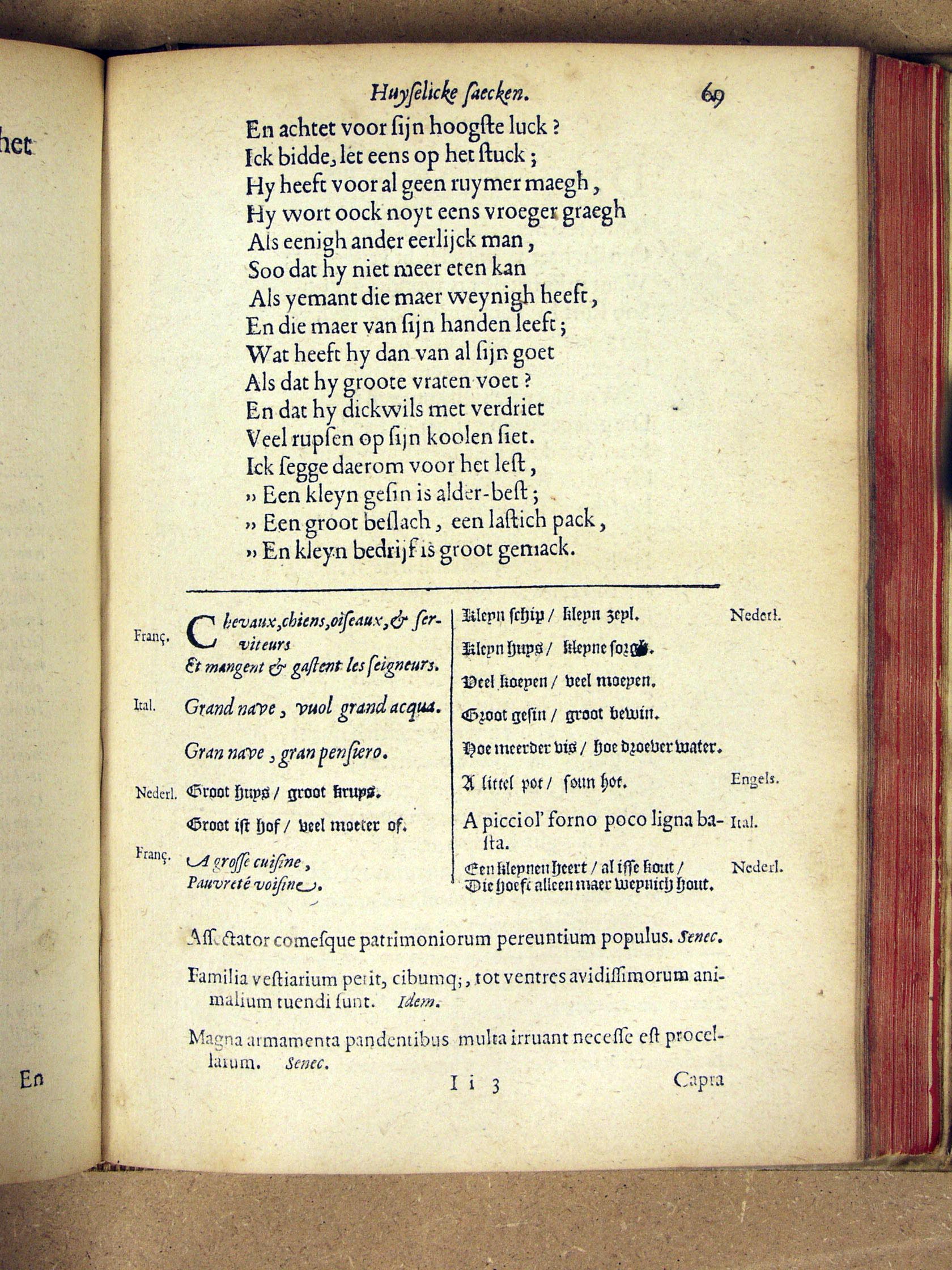
Groote heeren / Groote kleeren.
Groot ist hof Veel moeter of. Nederl.
Great lords, great clothes. Great is the court, much must go out of it. Dutch.
Franç. Il n'y à grand montée Qu'il n'y ait grande vallée.
French. There is no great climb without a great valley.
Groote neersen / groote broecken / Groote koppen / groote doecken.
Big backsides, big breeches; big heads, big kerchiefs.
Senec. Magna armamēta pandētibus multū irruat necesse est procellarū.
Seneca. Those who spread great sails must needs have many storms rush upon them.
De Leser beelde sich in, een man, die in een groot hoff ofte princen palleys, op den ommeslagh vā het gheheel gesin staet en let.
Let the reader picture a man who, in a great court or prince's palace, stands and observes the whole bustle of the household.
Franç. Chevaux, chiens, oiseaux, & serviteurs Et mangent & gastent les seigneurs.
French. Horses, dogs, birds and servants both eat up and ruin their lords.
Ital. Grand nave, vuol grand acqua.
Gran nave, gran pensiero.
Italian. A big ship needs deep water. A big ship, a big worry.
Nederl. Groot huys / groot kruys.
Groot ist hof / veel moeter of.
Dutch. Great house, great cross. Great is the court, much must go out of it.
Franç. A grosse cuisine, Pauvreté voisine.
French. To a big kitchen, poverty is a neighbour.
Kleyn schip / kleyn zeyl. Kleyn huys / kleyne sorgh. Veel koeyen / veel moeyen. Groot gesin / groot bewin. Hoe meerder vis / hoe droever water. Nederl.
Small ship, small sail. Small house, small care. Many cows, many troubles. Big household, big management. The more fish, the muddier the water. Dutch.
A littel pot / soun hot. Engels.
A little pot is soon hot. English.
A picciol' forno poco ligna basta. Ital.
For a small oven, little wood suffices. Italian.
Een kleynen heert / al isse kout / Die hoeft alleen maer weynich hout. Nederl.
A small hearth, even if it is cold, needs only a little wood. Dutch.
Affectator comesque patrimoniorum pereuntium populus. Senec.
The crowd is the courter and companion of estates that are perishing. Seneca.
Familia vestiarium petit, cibumq;, tot ventres avidissimorum animalium tuendi sunt. Idem.
The household demands clothing and food; so many bellies of most greedy creatures must be maintained. The same author.
Magna armamenta pandentibus multa irruant necesse est procellarum. Senec.
Those who spread great sails must needs have many storms rush upon them. Seneca.
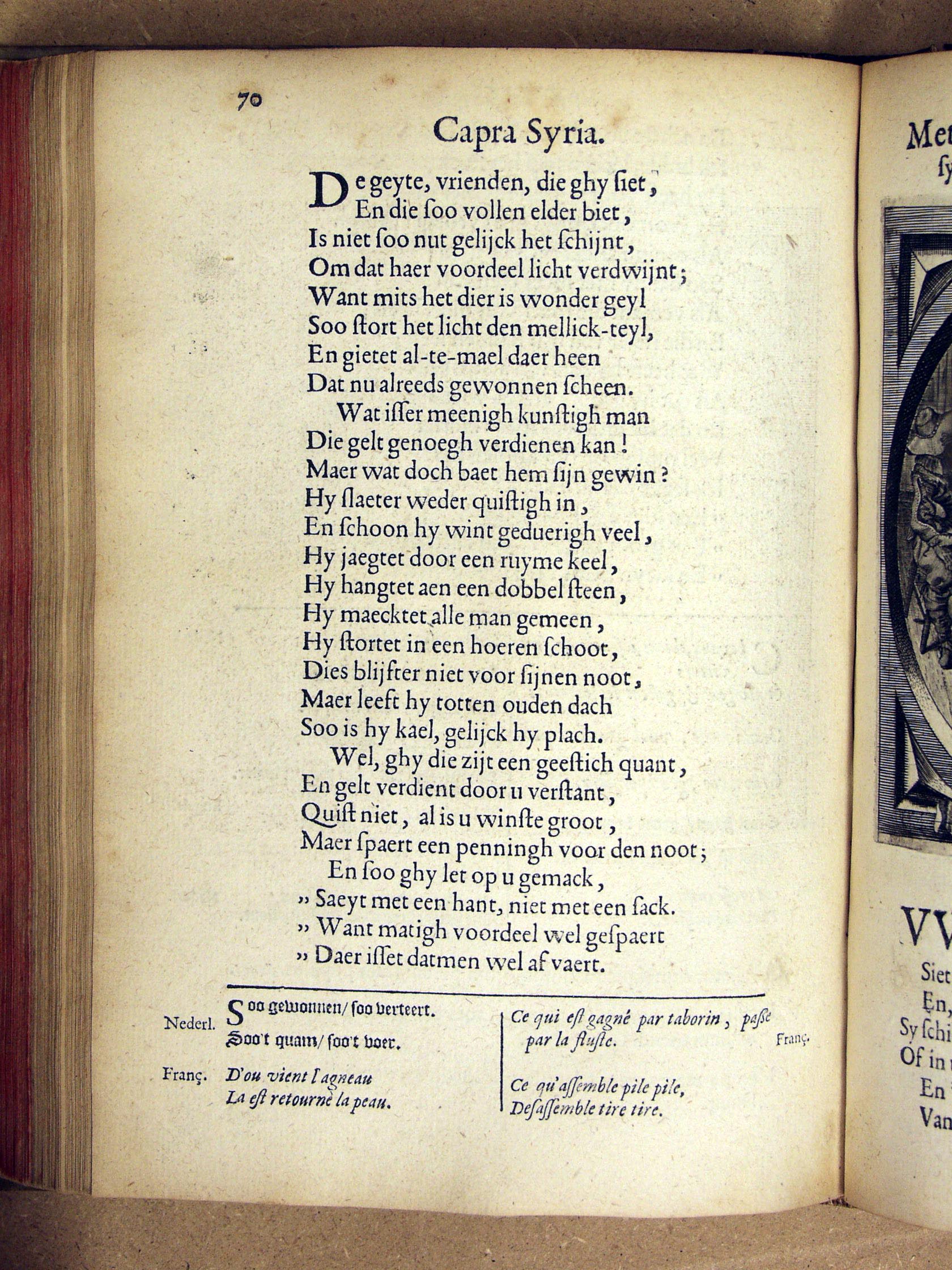
Nederl. Soo gewonnen / soo verteert. Soo't quam / soo't voer.
Dutch. So won, so spent. As it came, so it went.
Franç. D'ou vient l'agneau La est retourné la peau.
French. Where the lamb came from, there the skin has gone back.
Ce qui est gagné par taborin, passe par la fluste. Franç.
What is earned by the tabor goes away by the flute. French.
Ce qu'assemble pile pile, Desassemble tire tire.
What 'heap, heap' gathers, 'pull, pull' scatters.
Suggested Iconclass codesAI-generated
Additional codes proposed for this emblem, not (yet) part of the indexing.
25F51(FROG)tailless amphibians: froghighThe correlate 'tailless amphibians: frog' matches the frogs swimming, leaping in the water and sitting on the bank, which are the emblem's central motif.
25H2143pond, poolhighThe correlate 'pond, pool' matches the landscape setting on the bank of a pond with reeds and water plants.
56B3Satisfaction, Contentment; 'Contento' (Ripa)highThe correlate 'Satisfaction, Contentment' matches the commentary's repeated moral that 'he who is content is rich' and a cheerful mind with a moderate estate is sweet.
55BB1Poverty; 'Povertà', 'Povertà del doni', 'Povertà in uno ch'habbia bell'ingegno' (Ripa)mediumThe correlate 'Poverty' matches the commentary's sustained reflection on being poor yet rich ('he who gets on well with poverty is rich'; 'the contented poor man is not poor').
46A21contrast between rich and poormediumThe correlate 'contrast between rich and poor' matches the commentary's extended comparison of the great lord's burdens versus the small householder's ease (swan vs. sparrow, great house great cross).
Relationships to the Adagia of ErasmusAI-generated
Suggested relationships between this emblem and adages in Erasmus’ Adagia.
- I x 20 Capra Scyria – direct mottohigh
The emblem's Latin motto "Capra Syria" is simply a variant (Syria for Scyria) of Erasmus's adage, and the subscriptio reproduces exactly Erasmus's explanation: the goat, being wanton/wild, kicks over the milk-pail she has just filled, destroying the benefit she had given — applied to those who squander what they earn.
- III i 52 Manu serendum, non thylaco – direct mottohigh
The concluding proverbial pointe of the Capra Syria subscriptio, "Saeyt met een hant, niet met een sack" (Sow with the hand, not with the sack), is a literal rendering of Erasmus's adage τῇ χειρὶ δεῖ σπείρειν, ἀλλὰ μὴ ὅλῳ τῷ θυλάκῳ, and carries the same lesson of measured dispensing of one's resources.
- I i 42 Invita Minerva – essay quotemedium
The Latin commentary to "Wie tegen wint spout" quotes "Tu nihil invitâ dices, faciesve Minervâ" (Horace, Ars poetica), the very line Erasmus cites in his adage Invita Minerva; the emblem's moral 'do nothing against nature/the wind' is the adage's sense of acting against one's natural bent.
- II i 1 Festina lente – thematic inventiolow
The flask-filling emblem ("he who pours water in all at once spills more than goes in") and its conclusion that honour climbing by steps and goods growing slowly bring most joy restate the Erasmian commonplace of hastening slowly, though no verbal quotation of the adage occurs.
Sources
Record ID: embstma_1288_emblem070
This emblem on the Iconclass site: https://iconclass.org/view/embstma_1288_emblem070
Copy: University Library, Glasgow, Stirling Maxwell 1288