Jacob Cats, Spiegel (The Hague, 1632)
Emblem 71

Met groote Heeren ist quaet kersen eten, sy kiesen de grootste, en schieten met de steenenLatin
It is bad to eat cherries with great lords: they choose the biggest, and shoot with the stones.AI-generated
Description of the imageAI-generated
An oval framed engraving (with hatched corner spandrels) showing an interior banquet scene. Around a round, cloth-covered table sit and recline several richly dressed gentlemen in wide-brimmed plumed hats, ruffs and slashed doublets, with curtains and drapery behind them. On the table stands a large dish heaped with cherries, with two smaller plates beside it. One man at the centre leans forward and raises his hand to his mouth as if blowing or flicking a cherry stone; another at the right gestures across the table toward him; the man at the left reaches toward a plate. Servants and other figures stand behind the seated company in the shadows. The foreground figures stretch their legs out toward the viewer, their shoes and stockings visible on the tiled floor.
Subscriptio




TranscriptionAI-generated
VVil yemant boom-gewas met groote meesters eten, Die moet voor alle dingh een nutte lesse weten; Siet! al het beste freuyt dat is voor hun alleen, En, soo men kersen eet, sy schieten metten steen; Sy schieten daer het valt, en waerse konnen raecken, Of in u schoonen baert, of op u bolle kaecken, En 'tstaet u al-te-mael te lijden met verdragh, Van morren niet een woort, van pruylen geen gewagh: Ghy moet, beminde vrient, in dese vreemde rancken, Noch toonen bly gelaet, en even leeren dancken; Dus schoon ghy schade lijdt, des noch al niet-te-min Ontfanght al wat ghy kunt, en achtet voor gewin: Of soo u dat mis-haegt, soo voegt u by de gasten Met wien het u betaemt vrymoedich toe te tasten: Laet heeren voor den raedt, en vorsten aen het rijck, En handelt, soo ghy kunt, alleen met uws gelijck.
TranslationAI-generated
If anyone wants to eat tree-fruit with great masters, he must above all know one useful lesson: See! all the best fruit is for them alone, and when one eats cherries they shoot with the stone; they shoot wherever it falls, and wherever they can reach, either into your fine beard or onto your round cheeks, and you must suffer it all with patience, not a word of grumbling, no mention of sulking. You must, beloved friend, in these strange dealings still show a cheerful face and even learn to say thank you; thus although you suffer loss, nevertheless receive all you can and count it as gain; or if that displeases you, then join the guests with whom it befits you to help yourself freely. Leave lords to the council and princes to the realm, and deal, as far as you can, only with your equals.
CommentaryAI-generated
94 passages · original left, translation right (click to fold)
Heeren peeren rotten niet.
Lords' pears do not rot.
Heeren bidden is gebieden.
Lords' asking is commanding.
Met groote Heeren kleyne kennis.
With great lords, little acquaintance.
Groote heeren salmen groeten / Selden moeten.
Great lords one should greet, but seldom meet.
Met groote heeren korte morghen-spraeck.
With great lords, a short morning conversation.
Hooge boomen geven meer schaduwe als vruchten.
Tall trees give more shade than fruit.
Tis quaet met stercke worstelen/want der stercken spel is der krancken doot.
It is bad to wrestle with the strong, for the sport of the strong is the death of the weak.
Men moet den Edelen haer wilt-braet/ De boeren haer kermis / En de honden hare bruyloft laten.
One must leave the nobles their venison, the peasants their fair, and the dogs their wedding.
Heeren huldt en is geen erf.
Lords' favour is no inheritance.
Die heeren dient krijgt heeren loon.
He who serves lords gets lords' wages.
Hüt dich vor herren vnd konige / sie haben lange arme.
Beware of lords and kings: they have long arms.
Weit beherret / nahent geschwägert/ vnd gefreundt.
Lorded over from afar, related and befriended near at hand.
Mit grossen herrn ist nit gut kirschen essen / sie schiessen gern mit stainen zu / vnd werffen die steil einen an kopff.
With great lords it is not good to eat cherries: they like to shoot at you with the stones and throw them at your head.
Herrn gunst / frauwen lieb / and rosen-bletter / Verkehrn sich wie aprillen wetter.
Lords' favour, women's love and rose petals change like April weather.
Der katzen scherz ist der meuß todt.
The cat's sport is the mouse's death.
Au foible le fort Faict souvent tort.
The strong often does wrong to the weak.
Ludi stultorum, dominorum, sive luporum Non bene luduntur, quia seria sæpe loquuntur.
The games of fools, of lords, or of wolves are not played well, because they often speak in earnest.
Die den heere wil honen geve hem tsijne.
He who would shame the lord, let him give him what is his.
Wintersche nachten / Vrouwen gedachten / En gunste van heeren / Sietmen haest verkeeren.
Winter nights, women's thoughts, and the favour of lords: one soon sees them change.
Jongh hovelingh / Out schovelingh.
A young courtier, an old beggar/outcast.
Korte repen hoven wel.
Short strips court well (short dealings at court are best).
Wijt beheert / nae bevrient.
Lorded over from afar, befriended close by.
Schouten en bailjuwen / Grijpen als wuwen.
Sheriffs and bailiffs grab like kites (birds of prey).
Heeren en hoeren verscheelen maer een letter.
Lords and whores differ by only one letter.
La balette à envie de manger la chauve-souris, soit pource qu'il est oiseau, ou qu'il est rat.
The weasel has a mind to eat the bat, whether because it is a bird or because it is a rat.
Vn receveur du roy est cötable jusques au jour du jugement.
A king's receiver is accountable until the day of judgement.
Nul ne mange de l'oye du roy que cent ans apres il en chie la plume.
No one eats of the king's goose but that a hundred years later he shits the feather.
C'est follie de manger cerises avec son signeur.
It is folly to eat cherries with one's lord.
A petite occasion Prend le loup le mouton.
On a small occasion the wolf takes the sheep.
Si tu veux estre sans esmoy Ne te sers de ceux qui ont servi plus grand que toy.
If you wish to be without trouble, do not employ those who have served a greater man than you.
Au pauvre n'est utile s'accompagner du puissant.
It is not useful for the poor man to keep company with the powerful.
En jeu ni tout à bon N'ay ton signeur pour compagnon.
Neither in play nor in earnest take your lord for a companion.
Ne depars poires avec ton signeur.
Do not share pears with your lord.
L'espée du noble luy sert de faucille.
The nobleman's sword serves him as a sickle.
Partir comme des freres, Le mien est mien & le tien est à nous deux.
To share like brothers: what is mine is mine, and what is yours belongs to us both.
Arbori grandi fanno piu ombra che frutto.
Big trees make more shade than fruit.
Si vuoi del tuo mestier cavar guadagno D'un tuo maggiore non ti far compagno.
If you want to draw profit from your trade, do not make yourself the partner of a greater man.
En burlas y en veras, Con tu señor no partas peras.
In jest and in earnest, do not share pears with your lord.
Al pobre no es provechoso Accompagnjar se con el poderoso.
It is not profitable for the poor man to keep company with the powerful.
Syrach. 8. 1. Ne deba point avec homme puissant, de peur que tu ne tombes en ses mains.
Sirach 8:1. Do not strive with a powerful man, lest you fall into his hands.
Syrach. 9. 18. Retire toy loing de l'homme qui à puissance de tuer, & tu ne seras point en crainte de mort.
Sirach 9:18. Keep far from the man who has power to kill, and you will not be in fear of death.
Syr. 13. 2. Maeckt u geselschap niet met den geweldigen / wat doet de aerde pot by den metalen?
Sirach 13:2. Do not keep company with the mighty: what has the earthen pot to do with the metal one?
De Leser beelde sich in een jager, staende ontrent een Hart dat de groote honden ter aerden vellen, bijtende de bracken (die het selve hebben op-gedaen) daer van.
Let the reader imagine a hunter, standing near a stag which the big dogs are bringing to the ground, while they bite the hounds (which had started it) away from it.
Tel bat les buissons Qui n'a pas les oisillons.
He who beats the bushes does not get the little birds.
Che divide le pera con l'orso n'ha sempre men che parte.
He who divides pears with the bear always gets less than his share.
Sic vos non vobis vellera fertis oves. Sic vos non vobis fertis aratra boves.
Thus you sheep bear fleeces, but not for yourselves. Thus you oxen draw ploughs, but not for yourselves.
Vid. Richt. axiom. hist. 27.
See Richter, Historical Axioms, 27.
De Leser beelde sich in een visscher, uyt een grooten visch een kleynen visch treckende, ende sijn kint toonende, die spreeckt aldus:
Let the reader imagine a fisherman drawing a small fish out of a big fish and showing it to his child; he speaks thus:
Wann ein schlang die ander nit freß / so wirde kein drach drauß.
If one snake did not eat the other, no dragon would come of it.
Il n'y à ruisseau qui enrichisse son courant avec de l'eau claire.
There is no brook that enriches its stream with clear water.
Ni ay artoyo que enriqueza su corrieuse de agua clara.
Nor is there a brook that enriches its current with clear water.
Serpens nisi serpentem deglutiat, non fit draco.
Unless a serpent swallows a serpent, it does not become a dragon.
Von kleinen fischlin worden die hecht groß.
From little fishes the pike grow big.
Homo homini lupus.
Man is a wolf to man.
Qui faict grands les grands Si non qu'ils peignent sur les gens?
What makes the great great, except that they comb (fleece) the people?
Les grands poissons mangent les petits.
The big fish eat the little ones.
Qui pote plus urget: sic pisces sæpe minutos Magnus comest, ut aves enecat accipiter.
He who can, presses harder: thus the big fish often eats up the tiny ones, as the hawk kills the birds.
August. ex mille loq. serm. 53. de resurrect. An non est mare hoc sæculum? an flumen non est ubi se homines quasi pisces devorant?
Augustine, from the thousand sermons, sermon 53 on the resurrection. Is not this world a sea? Is it not a river where men devour one another like fishes?
Syr. 23. Gelijck de Leeu het wilt verslint / soo verslinden de rijcke den armen.
Sirach 23. As the lion devours the game, so the rich devour the poor.
Syr. 13. 21. & seqq. Comme les asnes sauvages sont la proye des Lions: ainsi les pauvres sont la pasture des riches.
Sirach 13:21 and following. As wild asses are the prey of lions, so the poor are the pasture of the rich.
Het beeldt kan zijn een arm huys-man die staet en klaeght in een stal, daer niet en is als tē doode koeye, int verschiet eē rijck mā in een treffelijck paleys klagēde ontrent sijn eenig kint dat gestorven is.
The picture may be a poor peasant standing and lamenting in a stable, where there is nothing but the dead cow; in the distance a rich man in a splendid palace lamenting over his only child that has died.
Das ongluck trifft nur den armen.
Misfortune strikes only the poor.
Omnia naturæ contraria legibus ibunt.
All things will go contrary to the laws of nature.
A chi è disgratiato, gli tempesta il pan nel forno.
For the unlucky man, even the bread in the oven is hailed upon.
Wer auff ein heller gemüntzt ist kömt nimmer ehr auff den Creutzer.
He who is coined as a heller never rises to a kreutzer.
Da Dios havas à quien non tiene quixadas.
God gives beans to him who has no jaws.
Dieu donne febues à qui n'a de machoires.
God gives beans to him who has no jaws.
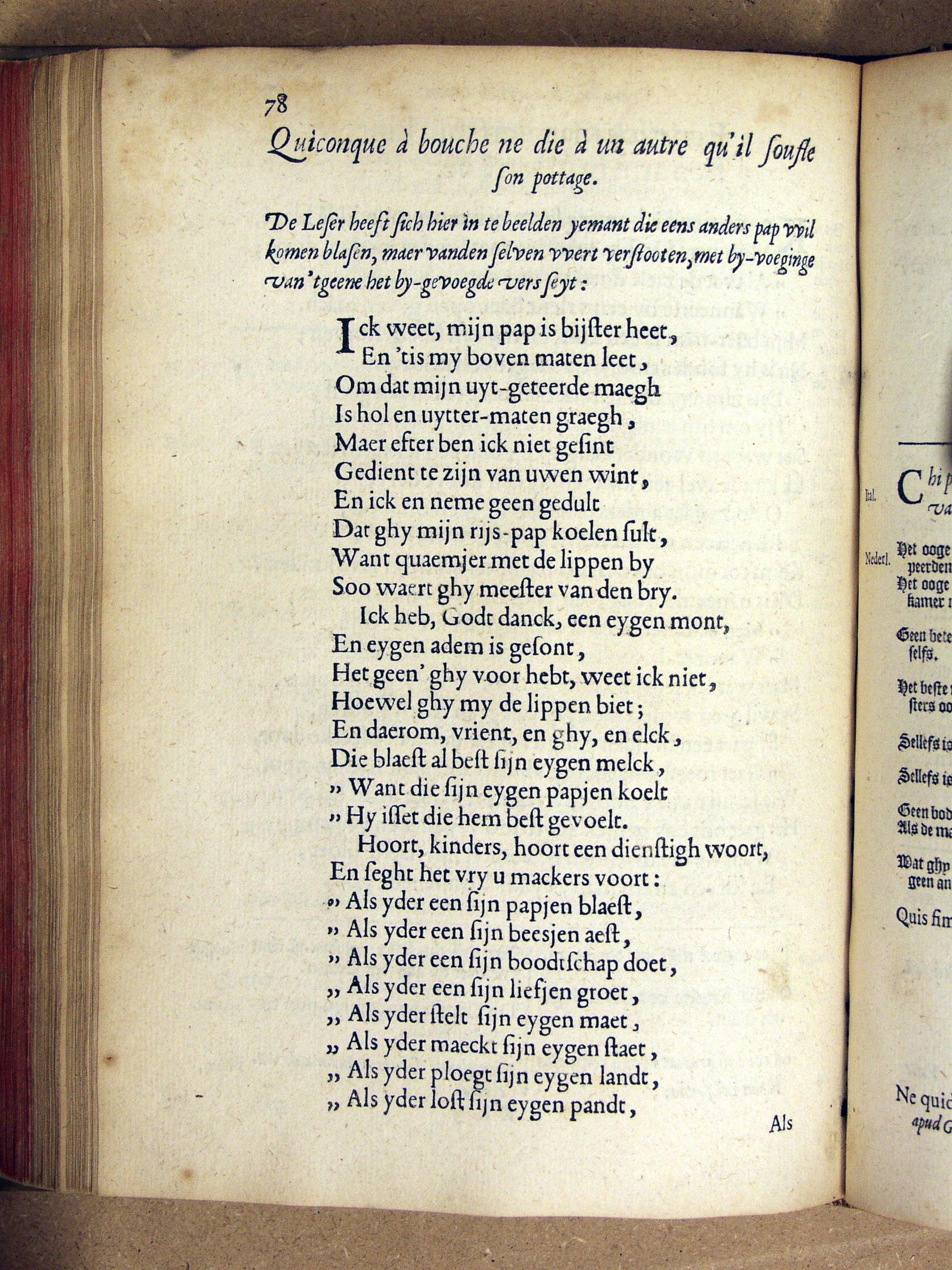
De Leser heeft sich hier in te beelden yemant die eens anders pap vvil komen blasen, maer vanden selven vvert verstooten, met by-voeginge van 'tgeene het by-gevoegde vers seyt:
The reader must here imagine someone who comes to blow upon another's porridge, but is pushed away by him, with the addition of what the accompanying verse says:
Chi può guazzar l'acqua, non vadi al ponte.
He who can ford the water, let him not go to the bridge.
Het ooge van den heer dat maeckt de peerden vet / Het ooge van de vrou dat maeckt de kamer net.
The master's eye makes the horses fat; the mistress's eye makes the room neat.
Geen beter hof-meester/ als de weert selfs.
No better steward than the host himself.
Het beste mis opten acker / is 'smeesters oogh en voet.
The best manure on the field is the master's eye and foot.
Sellefs is goet krupt.
Oneself is a good herb (self-help is the best remedy).
Sellefs is de man.
Oneself is the man.
Geen bode soo goet / Als de man sellefs doet.
No messenger so good as the man does himself.
Wat ghy alleen kunt doen / roept daer geen andere toe.
What you can do alone, call no one else to it.
Niet so quaet/ als quaden toe-verlaet.
Nothing so bad as a bad reliance (on others).
Maeckt u bedde sooje slapen wilt.
Make your bed as you want to sleep.
Eigen fewr kocht wol.
One's own fire cooks well.
Oculus domini pascit equum.
The master's eye feeds the horse.
Ni mayor domo que mire por la hazienda como el Dueño.
No steward looks after the estate like the owner.
Il n'y à point de maistre d'hostel qui prenne garde de si pres au bien de la maison comme le maistre mesme.
There is no steward who looks after the household's good as closely as the master himself.
Qui ne voit que par les yeux d'autruy il est taupe.
He who sees only through another's eyes is a mole.
Qui tient la poile par la queue Il la tourne comme il veut.
He who holds the pan by the handle turns it as he wishes.
Quis fimus in agro optimus? oculus œconomicus. Arist. in œcon.
What is the best manure in a field? The householder's eye. Aristotle, in the Economics.
Arab. prov. Erp. Nil scabat caput tuum præter ungues tuos.
Arabic proverbs (Erpenius). Nothing scratches your head except your own nails.
Puta vitem tuam manu tuâ, non alienâ.
Prune your vine with your own hand, not another's.
Suam quisque rem meminit. Eras. 870.
Each one remembers his own affair. Erasmus, 870.
Ne quid exspectes amicos facere, quod per te queas. Ennius apud Gellium.
Do not expect friends to do anything that you can do yourself. Ennius, in Gellius.
De Leser beelde sich hier in een koeye inde sloot gevallen, ende den eygenaer (te vergeefs om hulpe geroepen hebbende) de selve by den steert grijpende om die uyt te helpen.
Let the reader here imagine a cow fallen into the ditch, and the owner (having called in vain for help) seizing her by the tail to help her out.
Wann sich der baur nit buckt / so ackert er nich guts.
If the peasant does not bend down, he ploughs nothing good.
Wa der mann selbs nit kompt / da wird ihm sein haupt nit wol gezwagt.
Where the man does not come himself, there his head is not well washed.
Der herren aug düngt den acker wohl.
The master's eye manures the field well.
Der herren füß machet das pferd faißt.
The master's foot makes the horse fat.
Iconclass
86(MET GROOTE HEEREN IST QUAET KERSEN ETEN, SY KIESEN DE GROOTSTE, EN SCHIETEN MET DE STEENEN)proverbs, sayings, etc. (MET GROOTE HEEREN IST QUAET KERSEN ETEN, SY KIESEN DE GROOTSTE, EN SCHIETEN MET DE STEENEN)
Suggested Iconclass codesAI-generated
Additional codes proposed for this emblem, not (yet) part of the indexing.
31A56servantmediumThe correlate 'servant' matches the servants standing behind the seated company in the shadows of the banquet room.
42F5house personnel, servantsmedium'House personnel, servants' fits the attendants waiting on the richly dressed gentlemen at the table in a domestic interior.
46A21contrast between rich and poormedium'Contrast between rich and poor' matches the commentary's insistent theme that the powerful devour the weak and that the poor man should not keep company with the mighty.
71Y4the book of Ecclesiasticus, the wisdom of Jesus SirachlowThe commentary repeatedly quotes 'the wisdom of Jesus Sirach' (Sirach 8:1, 9:18, 13:2, 13:21) as its scriptural authority, though the book itself is not depicted.
Relationships to the Adagia of ErasmusAI-generated
Suggested relationships between this emblem and adages in Erasmus’ Adagia.
- I i 70 Homo homini lupus – direct mottohigh
The emblem's apparatus prints the Latin proverb "Homo homini lupus" verbatim among the parallel sayings to the motto on big fish devouring little ones, exactly as Erasmus gives the adage headword (from Plautus, Asinaria).
- I vii 89 Leonina societas – thematic inventiohigh
Erasmus explains the lion's-share partnership as one where all profit goes to one partner, the rest being forcibly defrauded, 'as often happens with kings or very powerful men'; the subscriptio's "all the best fruit is for them alone" and the Italian "he who divides pears with the bear always gets less than his share" are the same point.
- III viii 38 Cavendum a potentiore – thematic inventiohigh
Erasmus's adage advises the man who 'has no wish to deal with a much more powerful person who could do him great harm' — the exact lesson of the motto and of the closing counsel "handelt, soo ghy kunt, alleen met uws gelijck" and Sirach 8:1.
- III ix 69 Cum principe non pugnandum – thematic inventiohigh
The adage ('it is hard for a mortal to overcome a god / a private man a ruler') matches the emblem's "Tis quaet met stercke worstelen" and "Laet heeren voor den raedt, en vorsten aen het rijck."
- II iv 79 Ne caprea contra leonem – thematic inventiomedium
Erasmus glosses it as 'do not contend when you are much the weaker,' which is the burden of the emblem's "Au foible le fort faict souvent tort," "der stercken spel is der krancken doot," and Sirach 13:2 on the earthen pot and the metal one.
- V i 46 Preces armatae – thematic inventiomedium
Erasmus's adage on 'requests backed by force' — the prayers of princes mixed with compulsion, 'Cogit rogando qui rogat potentior' — is the Latin equivalent of the emblem's commentary proverb "Heeren bidden is gebieden" (lords' asking is commanding).
- I ii 3 Longae regum manus – thematic inventiomedium
The German saying in the commentary, "Hüt dich vor herren vnd konige / sie haben lange arme," is a vernacular form of Erasmus's adage on the long arms of kings (Ovid, Heroides), reinforcing the warning to avoid dealings with the powerful.
- II v 11 Leonem radere – thematic inventiomedium
Erasmus applies it to those who deal cleverly with the fierce and powerful 'at great risk to themselves' — the risk run by the guest who eats cherries at a great lord's table and must smile while the stones are shot at him.
- IV v 73 Leo cordula vinctus – thematic inventiolow
Erasmus's gloss on the courtier bound to a prince for a tiny advantage and paraded at court matches the emblem's court proverbs ("Jongh hovelingh / Out schovelingh," "Heeren huldt en is geen erf," "Die heeren dient krijgt heeren loon").
- I i 61 Leonem stimulas – thematic inventiolow
Erasmus uses it of those who provoke the fierce and powerful to their own destruction, which underlies the emblem's injunction to bear the lords' cherry-stones "van morren niet een woort, van pruylen geen gewagh."
- I ii 19 Frons occipitio prior – essay quotemedium
The commentary's Latin tags "Oculus domini pascit equum" and "Quis fimus in agro optimus? oculus œconomicus" reproduce the Cato/Pliny/Aristotle material that Erasmus assembles in the essay on this adage about the master's own eye and footstep being the best manure.
Sources
Record ID: embstma_1288_emblem071
This emblem on the Iconclass site: https://iconclass.org/view/embstma_1288_emblem071
Copy: University Library, Glasgow, Stirling Maxwell 1288