Jacob Cats, Spiegel (The Hague, 1632)
Emblem 72

Faites feste au chien, il te gastera ton habitFrench
Make a fuss of the dog, and he will spoil your clothes.AI-generated
Description of the imageAI-generated
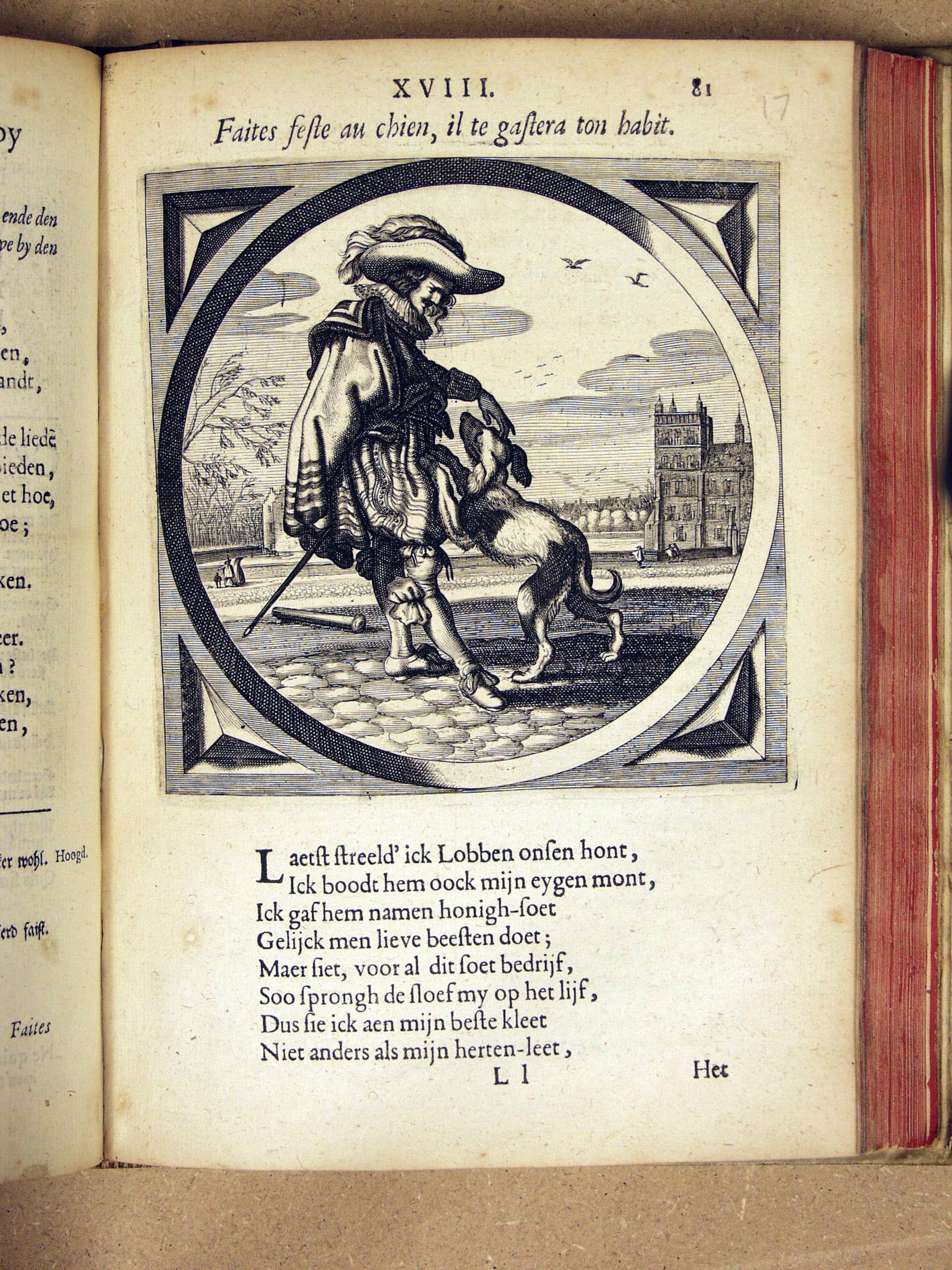
Within a circular frame set in a square with dark triangular corner ornaments, an elegantly dressed man walks along a cobbled street or quay. He wears a wide-brimmed hat with a long plume, a lace collar, a short cloak, a doublet with slashed sleeves, full breeches with ribbon garters, stockings and shoes with rosettes; a thin rapier or cane hangs at his side and trails behind him. He bends slightly and reaches out his right hand toward a large shaggy dog that has reared up on its hind legs and placed its forepaws against his cloak and sleeve, its muzzle near his hand. In the background at the right stands a tall gabled house or castle with towers; at the left are bare trees and a low building, with a few small figures strolling in the middle distance along a road, and birds flying in the cloudy sky.
Subscriptio


TranscriptionAI-generated
Laetst streeld' ick Lobben onsen hont, Ick boodt hem oock mijn eygen mont, Ick gaf hem namen honigh-soet Gelijck men lieve beesten doet; Maer siet, voor al dit soet bedrijf, Soo sprongh de sloef my op het lijf, Dus sie ick aen mijn beste kleet Niet anders als mijn herten-leet, Het quijl uyt sijnen open muyl Dat maeckt mijn schoonen mantel vuyl, Mijn schoe-lint, en dees moye strick, En is niet als een enckel slick, Mijn vleyen maeckt den rekel stout, Soo dat hy maet noch regel houdt. Hebt ghy een knecht, of eygen kint, Of yemant anders wel besint, En liffe-laftse niet te seer, Haer vrientschap is te wonder teer, Sy dient gedragen, niet getoont, Of wel ghy wort met dreck geloont; Dus wilt ghy lust, en geen verdriet, Draeght liefde, maer en toontse niet.
TranslationAI-generated
Lately I stroked Lobben, our dog; I even offered him my own mouth; I gave him honey-sweet names, as one does to beloved animals. But look, for all this sweet behaviour the slovenly beast jumped up against my body, so that on my best clothes I now see nothing but my heart's sorrow. The slobber from his open muzzle makes my fine cloak filthy; my shoe-ribbon and this pretty bow are nothing but a single smear; my flattering makes the cur bold, so that he keeps neither measure nor rule. If you have a servant, or a child of your own, or anyone else you are fond of, do not fondle and coddle them too much; their friendship is wondrously tender, it should be borne, not displayed, or else you will be rewarded with filth. So, if you want pleasure and no vexation, bear love, but do not show it.
CommentaryAI-generated
20 passages · original left, translation right (click to fold)
Ioüe vous de l'asne il vous donnera de la queve au travers du nez.
Play with the ass and he will give you his tail across your nose.
Chantez à l'asne il vous donnera de pets.
Sing to the ass and he will give you farts.
Faictes feste au chat, il vous sautera au visage.
Make a fuss of the cat and he will jump at your face.
Burlaos con el asno, daros ha en la barva con el rado.
Jest with the ass, and he will hit you in the beard with his tail.
Cria corvo y sacar te hal el ojo.
Raise a crow and it will peck out your eye.
Nourri un corbeau il te crevera l'œil.
Feed a crow and it will put out your eye.
Hyos y criados no los has de regalar si los quieres gozar.
Children and servants you must not pamper if you wish to enjoy them.
Les enfants & serviteurs il ne les faut mignarder, si tu en veus joüir.
Children and servants must not be coddled, if you want to have joy of them.
Nimia familiaritas parit contemptum.
Too much familiarity breeds contempt.
Il troppo conversar partorrisce dispregio.
Too much keeping company gives birth to contempt.
Chose accoustumée N'est pas fort prisée.
A thing grown customary is not much prized.
Nulli te facias nimis sodalem.
Make yourself too intimate a companion to no one.
A casa de tu Tia, Mas no cada dia; A casa de tu hermano, Non iras cada serano.
To your aunt's house, but not every day; to your brother's house you shall not go every evening.
A la maison de ta tante Mais non tous les jours; A la maison de ton frere Mais non tous les soirs.
To your aunt's house, but not every day; to your brother's house, but not every evening.
Qui se faict brebis le loup le mange, Qui se faict porceau se met dans la fange.
He who makes himself a sheep, the wolf eats him; he who makes himself a pig puts himself in the mire.
Syr. 30. 9. Amignotte ton enfand & il te donnera maint effroy, ioüe toy avec luy & il te contristera.
Sirach 30:9. Pamper your child and he will give you many a fright; play with him and he will make you sorrowful.
Syr. 8. 5. Ne te joüe point avec un homme mal apris.
Sirach 8:5. Do not jest with an ill-bred man.
In tegen-deel van dat hier voren is geseyt, so vermaendt het Hebreeus spreeck-vvoordt datmen eenen vriendt van suycker niet en moet op-eten, dat is geseydt: datmen den vvilligen niet te veel en moet vergen, datmen niemants beleeftheyt en moet mis-bruycken, ende datmen een gevvilligh peert niet en moet over-rijden.
On the contrary to what has been said above, the Hebrew proverb warns that one must not eat up a friend made of sugar; that is to say: that one must not demand too much of the willing, that one must not abuse anyone's courtesy, and that one must not ride a willing horse to death.
Een sedigh mā sonder rijs, stock, of spoor te peerde sittende, spreeckt
A modest man, sitting on horseback without switch, stick or spur, speaks
Il ne faut prendre de son amy tout ce qu'on peut.
One must not take from one's friend all that one can.
Iconclass
86(FAITES FESTE AU CHIEN, IL TE GASTERA TON HABIT)proverbs, sayings, etc. (FAITES FESTE AU CHIEN, IL TE GASTERA TON HABIT)
Suggested Iconclass codesAI-generated
Additional codes proposed for this emblem, not (yet) part of the indexing.
34A1friendship between man and animal; caressing, pettinghighThe correlate 'friendship between man and animal; caressing, petting' exactly matches the gentleman reaching out his hand to the dog that rears up against him.
45C13(RAPIER)hacking and thrusting weapons: rapiermediumThe correlate 'hacking and thrusting weapons: rapier' matches the thin rapier hanging at the elegantly dressed man's side.
33A51unilateral friendshiplow'Unilateral friendship' loosely fits the moral about one-sided over-familiarity (the dog's exuberant affection and the warning not to let anyone grow too intimate), though it is not literally depicted.
Relationships to the Adagia of ErasmusAI-generated
Suggested relationships between this emblem and adages in Erasmus’ Adagia.
- II i 86 Ale luporum catulos – thematic inventiomedium
Erasmus's adage (with Socrates' 'Be kind to wicked men, and keep a pack of wolves' and the ewe suckling the wolf-cub) teaches that those we nurture and caress repay us with harm — exactly the emblem's point about the petted dog fouling one's clothes and its Spanish/French parallels 'Raise a crow and it will peck out your eye' and 'Children and servants must not be coddled.'
- I v 67 Funem abrumpere nimium tendendo – thematic inventiomedium
Erasmus explains the taut rope that snaps as said of those who press matters to extremes and so alienate those they deal with; this matches the second half of the emblem, 'One must not take from one's friend all one can' and the Hebrew proverb about not eating up a friend made of sugar / not riding a willing horse to death.
- IV v 77 Arcus tensus rumpitur – thematic inventiomedium
The bow that breaks when strung too tight is Erasmus's image for immoderate strain, under the locus 'Modestia modusque'; the rider who uses neither whip nor spur on his willing horse argues the same lesson that a willing nature must not be over-stretched.
- I vi 96 Ne quid nimis – thematic inventiomedium
Both halves of the emblem ('do not fondle and coddle them too much'; 'even your best friend should not be pressed too hard') are applications of the classic maxim of measure, 'Nothing to excess', which also underlies the Latin commentary 'Nimia familiaritas parit contemptum'.
- I vii 64 Jucunda vicisstudo rerum – thematic inventiolow
Erasmus's essay on this adage cites 'Bonarum rerum consuetudo pessima est' (good things grown too familiar turn to bad), which is virtually the emblem's French commentary 'Chose accoustumée n'est pas fort prisée' and the Italian 'Il troppo conversar partorrisce dispregio'.
- II viii 52 Equo senescenti minora cicela admove – thematic inventiolow
This equine adage on lightening the burden as strength fails shares the second emblem's imagery and moral of sparing a serviceable horse (and, by transfer, a willing friend) rather than driving it to exhaustion.
Sources
Record ID: embstma_1288_emblem072
This emblem on the Iconclass site: https://iconclass.org/view/embstma_1288_emblem072
Copy: University Library, Glasgow, Stirling Maxwell 1288