Jacob Cats, Spiegel (The Hague, 1632)
Emblem 73
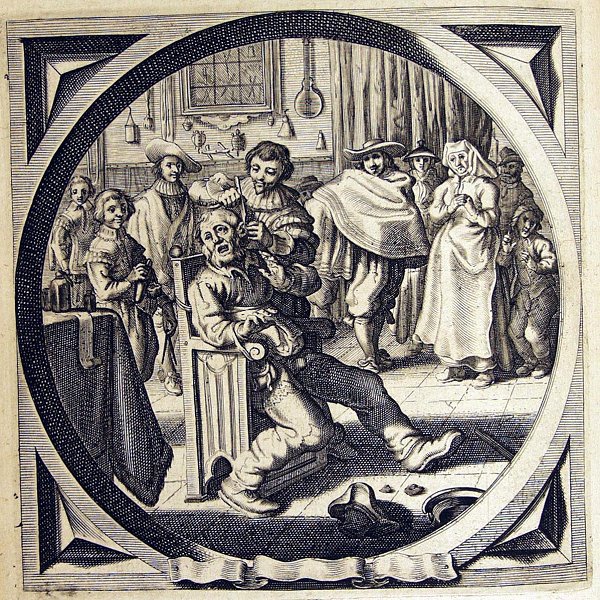
In eens anders oor is te snijden als in een vilt-hoetDutch
In another man's ear one may cut as in a felt hat.AI-generated
Description of the imageAI-generated
An oval medallion set in a rectangular frame shows the interior of a barber-surgeon's shop. In the centre a seated man in light jacket and dark breeches sprawls back in a high wooden chair, gripping its arm, his face contorted in pain, his legs stretched out; a surgeon standing behind him holds his head with one hand and works at his ear with a small instrument. Around them a crowd of onlookers presses in: a young woman and a boy at the left behind a draped table, a man in a broad-brimmed hat, a man wrapped in a pale cloak with a feathered hat, a woman in a white head-cloth and apron clasping her hands, another man, and a small child peering out at the right. On the back wall are a lattice window, shelves with flasks, pots and surgical instruments, a hanging basin and a bag. On the tiled floor in the foreground lie the patient's hat and a barber's brass basin. An empty blank ribbon or scroll runs along the bottom of the frame.
Subscriptio


TranscriptionAI-generated
VVel, maets, wat isser dat u let? Wat isser dat u dus ontset? Ist om den handel die ghy siet? Ey lieve kinders, moeytje niet. Ick snijd' hier in een anders oor, En dan en geef ick geen gehoor Noch aen geklagh, noch aen gekrijt, Wat pijne dat oock yemant lijt; En of hy dichte tranen schreyt, En duysent jammer-woorden seyt, Al dat en gaet my geensins in, Ick passe slechts op mijn gewin; ,, Want van eens anders leet of seer ,, En hinckt de meester nimmermeer.
TranslationAI-generated
Well, mates, what is it that ails you? What is it that so dismays you? Is it because of the business you see? Ah, dear children, do not trouble yourselves. I am cutting here in another man's ear, and then I give no heed either to complaining or to screaming, whatever pain anyone may suffer; and though he weeps thick tears and says a thousand words of woe, none of that gets to me at all, I only attend to my profit; "for from another's hurt or sore the master never limps."
CommentaryAI-generated
48 passages · original left, translation right (click to fold)
De Chirurgijn spreeckt tot de omstanders.
The surgeon speaks to the bystanders.
Hoogd. Auß eins andern seckel ist gut gelt zehlen.
High German: Out of another man's purse it is easy to count money.
Ital. Del cuojo d'altri si fanno le correggie large.
Italian: Of other people's leather one makes broad straps.
Hoogd. Es ist gut riemen auß eines andern haut schneiden.
High German: It is easy to cut straps out of another man's hide.
Nederl. Een anders ham / een eygen mes.
Dutch: Another man's ham, one's own knife.
Een gehuyrt peert / eygen spooren.
A hired horse, one's own spurs.
Gehuyrde peerden maken korte mijlen.
Hired horses make short miles.
De koe en lickt geen vreemt kalf.
The cow does not lick a strange calf.
Daer't vry gelach is / ist goet gasten nooden.
Where the reckoning is free, it is easy to invite guests.
Hoogd. Es ist gut in ander leut kuchen kochen.
High German: It is easy to cook in other people's kitchen.
Nederl. 'Tis licht groot vyer maken van eens anders turf.
Dutch: It is easy to make a big fire with another man's peat.
'Tis goet breede riemen snijden uyt een ander mans leer.
It is easy to cut broad straps out of another man's leather.
'Tis goet danssen op een ander mans vloer.
It is easy to dance on another man's floor.
Nederl. 'Tis goet feest houden op eens anders sael.
Dutch: It is easy to hold a feast in another man's hall.
Niemant hinckt van eens anders seer.
Nobody limps from another man's sore.
Die de koe aengaet / die grijptse by den steert.
He whom the cow concerns grabs her by the tail.
Hoogd. Es ist gut mit ander leut schaden weiß werden.
High German: It is easy to grow wise by other people's harm.
Nederl. Avontuert ghy u laken / ick avontuere mijn schaer / sey de kleer-maecker / en sneder in.
Dutch: If you risk your cloth, I risk my scissors, said the tailor, and cut into it.
Spaens. De piel agena, larga la correa.
Spanish: From another man's hide, a long strap.
Franç. Du cuir d'autruy large courroye.
French: From another man's leather, a broad strap.
Spaens. Poco os duelen, don Ximeno Estocadas en cuerpo ageno.
Spanish: Little do they hurt you, Don Ximeno, sword-thrusts in another man's body.
Franç. Peu vous douleur, don Ximeno, les estocades au corps d'autruy.
French: Little do they pain you, Don Ximeno, the sword-thrusts in another man's body.
Hoogd. Es ist in eins andern haut zu schneiden wie in ein filtzhut.
High German: One may cut in another man's skin as in a felt hat.
Es ist gut den schnitt an fremden tuch lernen.
It is easy to learn cutting on someone else's cloth.
Griecx. Λίθος κυλινδόμενος τὸ φῦκος οὐ ποιεῖ.
Greek: A rolling stone does not gather moss.
Lat. Lapis saepe revolutus non obducitur musco.
Latin: A stone often rolled over is not covered with moss.
Engels. The rolling stone neuer gathereth mosse.
English: The rolling stone never gathers moss.
Hoogd. Waltzender stein wart nie mosig.
High German: A rolling stone never grows mossy.
Ital. Sasso che non sta fermo non fa muschio Pietra mossa non fa muscio.
Italian: A stone that does not stay still makes no moss. A moved stone makes no moss.
Turcks. Iuuuar lanan tascha Iossun Iapischmas.
Turkish: Moss does not cling to a rolling stone.
Franç. Pierre souvent muée, ne quest point mousse.
French: A stone often moved gathers no moss.
Lat. Arbor quae crebrò transfertur non coalescit, Non lapis hirsutus fit per loca plura volutus.
Latin: The tree that is often transplanted does not take root; a stone rolled through many places does not become shaggy (mossy).
Nederl. Veel verhuysens kost veel bedt-stroo.
Dutch: Much moving house costs much bed-straw.
Daer wast geen raegh aen een draeyende meulen-kam.
No cobweb grows on a turning mill-cog.
Boomen diemen veel verplant / gedyen selden.
Trees that are often transplanted seldom thrive.
Een looper en gedijt niet.
A runner does not prosper.
Blyven doet beklyven.
Staying makes things take root.
Franç. Qui est couvert quand il pleut Il n'est pas sage s'il se meut.
French: He who is under cover when it rains is not wise if he moves.
Ital. Arbore spesso trapiantato Mai de frutti è caricato.
Italian: A tree often transplanted is never laden with fruit.
Syr. 29. 31. C'est une vie malheureuse, que de remuer d'une maison à autre.
Sirach 29:31. It is a wretched life to move from one house to another.
Griecx. Πλαγκτοσύνης οὐκ ἔστι κακώτερον ἄλλο βροτοῖσιν.
Greek: There is nothing else worse for mortals than wandering.
Lat. Nil magis est miserum quam incerta sede vagari.
Latin: Nothing is more wretched than to wander with no fixed abode.
Nederl. Vaertmen over een sloot / Men laeter een broot; Vaertmen over een veer / Men laeter noch meer.
Dutch: If one crosses a ditch, one leaves a loaf behind; if one crosses a ferry, one leaves still more.
Nederl. Geen oude schoenen wech werpen / eermen nieuwe heeft.
Dutch: Do not throw away old shoes before you have new ones.
Franç. Qui change de pais change de fortune.
French: He who changes country changes fortune.
Lat. Omnis mutatio habet periculum.
Latin: Every change carries danger.
Ital. Chi ben sta, non se move.
Italian: He who is well off does not move.
Qui mutant, nutant.
Those who change, totter.
Iconclass
86(IN EENS ANDERS OOR IS TE SNIJDEN ALS IN EEN VILT-HOET)proverbs, sayings, etc. (IN EENS ANDERS OOR IS TE SNIJDEN ALS IN EEN VILT-HOET)
Suggested Iconclass codesAI-generated
Additional codes proposed for this emblem, not (yet) part of the indexing.
86proverbs, sayings, etc.highThe correlate 'proverbs, sayings, etc.' exactly matches the emblem, whose commentary is a multilingual compilation of proverbs illustrated by the barber-surgeon scene.
86(...)proverbs, sayings, etc. (with TEXT)mediumThe emblem illustrates specific proverbial sayings (e.g. 'It is easy to cut broad straps from another man's leather'), which the 'proverbs, sayings, etc. (with TEXT)' template is designed to record.
41A82moving (house)lowThe correlate 'moving (house)' corresponds only to the commentary's cluster of proverbs on frequent removals ('Much moving house costs much bed-straw'; Sirach 29:31), not to anything shown in the picture.
Relationships to the Adagia of ErasmusAI-generated
Suggested relationships between this emblem and adages in Erasmus’ Adagia.
- III iv 74 Saxum volutum non obducitur musco – direct mottohigh
The emblem's Latin motto 'Lapis saepe revolutus non obducitur musco' with the Greek Λίθος κυλινδόμενος τὸ φῦκος οὐ ποιεῖ is simply Erasmus's adage of the rolling stone that gathers no moss; the subscriptio's closing couplet on the often-transplanted tree ('Arbor quae crebrò transfertur non coalescit') also corresponds to the companion saying cited in that adage's discussion.
- II ii 88 De alieno ludis corio – thematic inventiohigh
The whole proverb-cluster of the barber-surgeon emblem ('cutting straps from another man's hide/leather', 'cutting in another's ear as in a felt hat', 'sword-thrusts in another man's body') is the Dutch equivalent of Erasmus's 'to gamble with another man's hide', i.e. acting carelessly at someone else's risk (loci: alieno periculo).
- III x 50 De alieno liberalis – thematic inventiomedium
Several of the collected sayings in the commentary — 'Out of another man's purse it is easy to count money', 'Where the reckoning is free it is easy to invite guests', 'easy to make a big fire with another man's peat' — express exactly Erasmus's point that we are lavish with other people's goods but not our own.
- II ix 71 Innocuus alium aspiciam meum habentem malum – thematic inventiomedium
The surgeon's refrain 'from another's hurt or sore the master never limps' and the German 'it is easy to grow wise by other people's harm' match this adage's sense and the Plautine line quoted in its essay, 'Feliciter sapit, qui alieno periculo sapit' — watching unharmed while another bears the pain.
- II x 4 Non est meum negotium, multum valeat – thematic inventiomedium
The surgeon's indifference ('none of that gets to me at all, I only attend to my profit') and the proverb 'Nobody limps from another man's sore' reproduce this adage's point, including the Pindar tag quoted in its essay that the heart is soon consoled for another man's grief.
- I iv 41 Alienam metis messem – thematic inventiolow
Erasmus's adage covers both profiting from others' labour and handling another's business carelessly, which is the burden of the emblem's sayings such as 'Another man's ham, one's own knife' and 'A hired horse, one's own spurs'.
- IV i 42 Suam quisque homo rem meminit – thematic inventiolow
The Dutch tag 'He whom the cow concerns grabs her by the tail' (and 'the cow does not lick a strange calf') states the same commonplace Erasmus draws from Plautus and the lark fable: men doze through another's affairs but are wide awake in their own.
Sources
Record ID: embstma_1288_emblem073
This emblem on the Iconclass site: https://iconclass.org/view/embstma_1288_emblem073
Copy: University Library, Glasgow, Stirling Maxwell 1288