Jacob Cats, Spiegel (The Hague, 1632)
Emblem 96

A little pot Is soen hotEnglish
A little pot is soon hot.AI-generated
Description of the imageAI-generated
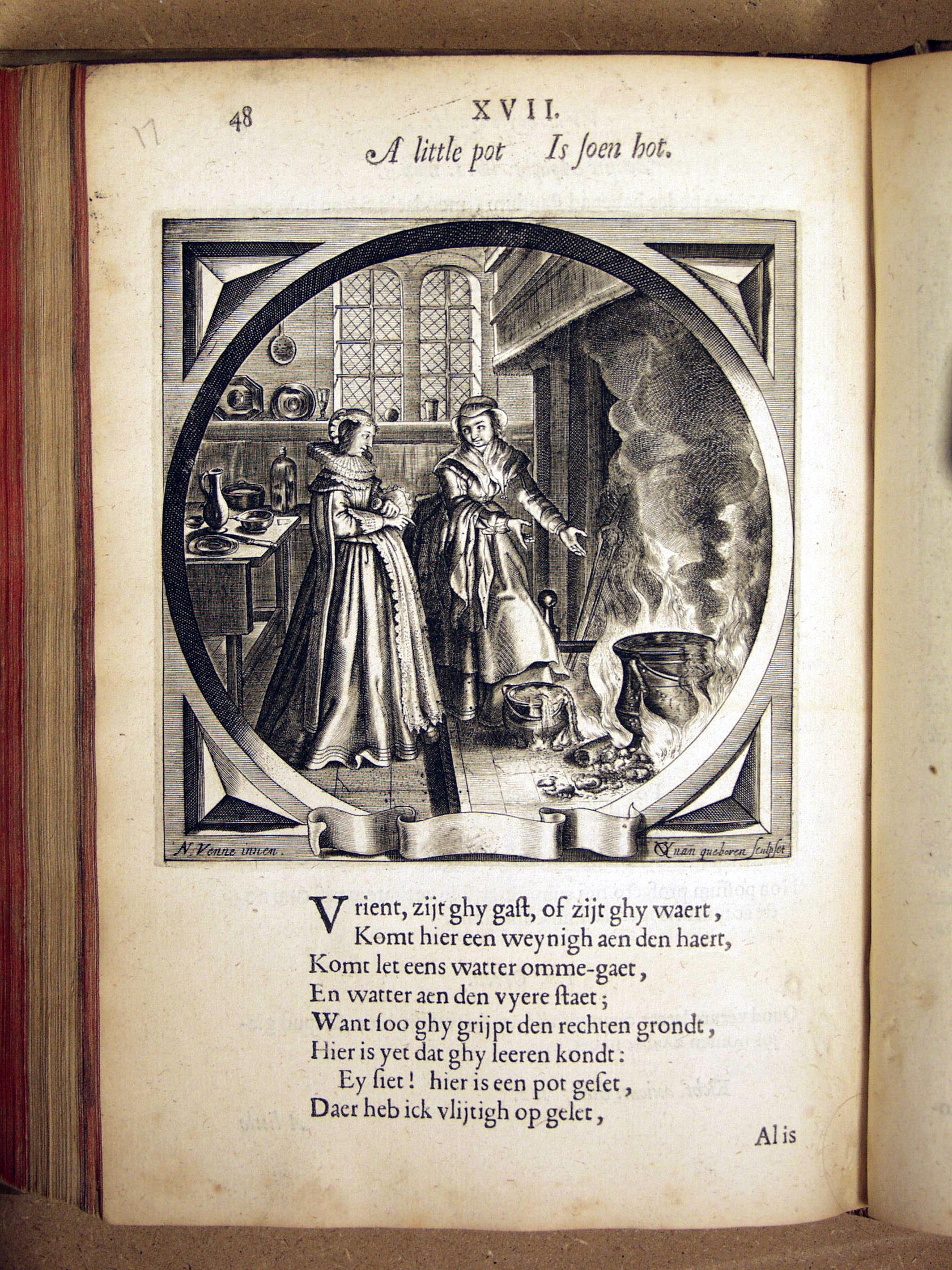
A kitchen interior seen through a large oval frame set in a rectangular border with hatched corner spandrels. At the left stand two women in early seventeenth-century dress with lace-edged ruffs, caps and long aprons; the woman on the right gestures with her outstretched hand toward the hearth. Behind them a mullioned leaded window, a shelf with pewter plates, dishes, a jug and bottles, and a table with a bowl and plate. At the right a wide chimney-piece with a blazing fire and billowing smoke: a large cauldron stands quietly at the side of the fire, while a small pot set directly over the coals boils over, its contents spilling and hissing into the flames; a fire-shovel and tongs lean nearby. Below the oval hangs an empty scrolled banderole. Signed at lower left 'N. Venne inven.' and at lower right with the engraver's name and 'sculpsit'.
Subscriptio


TranscriptionAI-generated
Vrient, zijt ghy gast, of zijt ghy waert, Komt hier een weynigh aen den haert, Komt let eens watter omme-gaet, En watter aen den vyere staet; Want soo ghy grijpt den rechten grondt, Hier is yet dat ghy leeren kondt: Ey siet! hier is een pot geset, Daer heb ick vlijtigh op gelet, Al is die nae de vlam gewent, Al isser vyers genoegh ontrent, Al leggen daer veel kolen aen Noch blijft hy echter stille staen; En schoon men hem veel hitte biet Hy schuymt, hy raest, hy bobbelt niet; Maer siet den pot aen geenen kant, Die siedt genoeghsaem sonder brant, En schoon hy raeckt naeu aen het vier, Hy maeckt terstont een groot getier, Hy maeckt, 'ken weet niet wat geluyt, Het schijnt sijn gront-sop wilder uyt. Vraegt yemant hier de reden van? My dunckt dat ickse geven kan: Die pot die in de vlamme staet, En doch niet op of neder gaet, Dat is een groot en machtigh vat, En daer in schuylt een killigh nat, Die wort niet haestigh omgeroert, Of door het vyer om hoogh gevoert; Maer dese pot van kleyn beslach, En daer maer weynich in en mach, Die is van stonden aen geraeckt Met dat hem maer het vyer genaeckt. Nu vrient, staet noch een weynich stil, En let eens wat dit seggen wil: Al wort een edel hert geterght, En dickwils dit en dat geverght, Noch wortet niet te licht beroert, Of van de gramschap omgevoert, Maer neemtet op met koelen moet Al wat hem dees of geene doet. Maer yder mensch van kleyn verstant Die bobbelt als in heeten brant Soo haest men hem maer eens genaeckt; » Geringe breynen haest geraeckt.
TranslationAI-generated
Friend, whether you are a guest or the host, come here a little while to the hearth; come and see what is going on, and what stands at the fire; for if you grasp the true ground of it, there is something here that you may learn. Oh look! here a pot is set, which I have diligently watched: although it is turned toward the flame, although there is fire enough around it, although many coals lie against it, yet it stands still and quiet; and though much heat is offered it, it does not foam, it does not rage, it does not bubble. But look at the pot on the other side: it boils up abundantly without much burning, and although it barely touches the fire, it at once makes a great uproar; it makes, I know not what noise; it seems its very dregs want to come out. Does anyone here ask the reason? I think I can give it: that pot which stands in the flame and yet does not go up or down, that is a great and mighty vessel, and in it there lies a cold liquid, which is not quickly stirred, nor driven upward by the fire; but this pot of small size, that can hold but little, is affected at once as soon as the fire merely touches it. Now, friend, stand still a little longer, and consider what this means: although a noble heart is provoked, and often pressed with this and that, still it is not too easily disturbed, nor carried away by anger, but takes with cool courage whatever this or that person does to it. But every man of small understanding bubbles as if in a hot blaze as soon as one but touches him: small brains are quickly stirred.
CommentaryAI-generated
1 passages · original left, translation right (click to fold)
De gront-reghels van veel menschen die groot-moedigh willen schijnen te zijn, gaen regel-recht aen, niet alleen tegens de rechte groot-moedicheyt, maer oock regel-recht tegens alle de eyghenschappen van een recht Christen; veel meynen groote eere te zijn niet te verdragen, maer alles aen een yder feytelick uyt te wetten, en in teghendeel soo wijst de ghesonde Leere klaerlick uyt, datter gheen meerder groot-moedigheyt en is, als ongelijck met gedult te konnen lijden, en sich in sijn tochten te over-winnen. Een Christen en kan geen vaster teycken hebben, van dat hy een kint Gods is, als dat hy met sachtmoedicheyt, en sonder weder-wraecke, kan oversetten het ongelijck datmen hem aen-doet; Leert van my dat ick ootmoedich en sachtmoedich ben van herten, (seydt de Heere Christus) en ghy sult ruste vinden aen uwe zielen. Alle kleyn en vuyl ghespuys is wraeck-gierich; muysen bijten, byen steecken, slangen, oock onverhoets geraeckt, schieten haer fenijn, kinderen zijn korsel, oude en siecke lieden gemelijck, maer een wel-gestelt lichaem, gestijft met een recht-matige ziele, kan lijden en mijden.
Dit soude oock op een anderen sin geduyt konnen werden, als te weten: dat yemant, van een kleynen ofte middel-matighen staet, met weynigh sich kan erneren, met kleyne kosten sijn huys-gesin onderhouden; want anders:
Groot is het Hof/ Veel moeter of.
Tot een kleynen oven is weynich vyers van noode.
The basic rules of many people who wish to seem magnanimous run straight counter, not only to true magnanimity, but also straight counter to all the properties of a true Christian; many think it a great honour not to put up with anything, but to take actual revenge on everyone for everything; whereas on the contrary sound Doctrine clearly shows that there is no greater magnanimity than to be able to bear injustice with patience, and to overcome oneself in one's passions. A Christian can have no surer token that he is a child of God than that with meekness, and without taking revenge, he can pass over the wrong that is done to him. 'Learn of me, that I am humble and meek of heart (says the Lord Christ), and ye shall find rest unto your souls.' All small and filthy vermin are vengeful: mice bite, bees sting, snakes, if touched unawares, shoot out their venom; children are peevish, old and sick people are querulous; but a well-ordered body, strengthened by a well-regulated soul, can suffer and forbear.
This might also be interpreted in another sense, namely: that someone of small or middling estate can support himself with little, and maintain his household at small cost; for otherwise:
Great is the house (establishment) / Much must go out of it.
For a small oven little fire is needed.
Iconclass
86(A LITTLE POT IS SOEN HOT)proverbs, sayings, etc. (A LITTLE POT IS SOEN HOT)
Suggested Iconclass codesAI-generated
Additional codes proposed for this emblem, not (yet) part of the indexing.
41C211kitchen-interiorhighThe scene is literally a kitchen-interior with hearth, shelf of pewter, jug, bottles and table.
41B21open hearth, fire-placehighA wide chimney-piece with a blazing open fire dominates the right side, matching 'open hearth, fire-place'.
41C27(CAULDRON)kitchen-utensils: cauldronhighA large cauldron standing quietly beside the fire is the key kitchen-utensil of the emblem's image.
54A44Patience; 'Patienza' (Ripa)mediumThe commentary's central lesson is 'to be able to bear injustice with patience', the personified virtue Patience.
57A71Magnanimity; 'Grandezza e robustezza d'animo', 'Magnanimità' (Ripa)mediumThe text explicitly debates what true 'magnanimity' is, matching the allegorical concept Magnanimity.
56EE2Meekness; 'Mansuetudine' (Ripa)mediumMeekness is the virtue praised ('with meekness, and without taking revenge'), opposed to the boiling-over anger imaged by the small pot.
57A64Humility; 'Humiltà' (Ripa)mediumThe quoted 'Learn of me, that I am humble and meek of heart' makes Humility a core argued concept.
11V85bearing injustice patiently ~ one of the (seven) spiritual Acts of MercylowThe commentary's 'bear injustice with patience' corresponds verbally to this spiritual Act of Mercy, though the emblem is not a Works-of-Mercy scene.
57AA741Revenge, Requital, Retaliation; 'Vendetta' (Ripa)lowRevenge is the vice repeatedly rejected in the commentary ('take actual revenge on everyone for everything'), though it is not personified in the image.
Relationships to the Adagia of ErasmusAI-generated
Suggested relationships between this emblem and adages in Erasmus’ Adagia.
- I x 66 Indus elephantus haud curat culicem – thematic inventiomedium
Erasmus' adage teaches that 'slight and casual injuries should be overlooked by lofty minds' - exactly the emblem's moral that a 'edel hert' remains unmoved by provocations while small natures flare up at the least touch.
- II vii 13 Sustine et abstine – thematic inventiomedium
The commentary's closing formula 'een wel-gestelt lichaem ... kan lijden en mijden' is a Dutch rendering of Epictetus' ἀνέχου καὶ ἀπέχου / 'sustine et abstine', the adage's prescription of fortitude in adversity and self-restraint in the passions.
- II x 76 In fermento jacere – thematic inventiolow
Erasmus explains the phrase as being 'swollen with rage', from leaven that sours and swells; the emblem literalises the same metaphor in the small pot that foams, bubbles and boils over the moment heat touches it.
- IV vi 40 Fluctus mutus – thematic inventiolow
The adage contrasts the silent swelling sea with the roaring storm and is applied to anger that must be kept from boiling over ('reprime iram effervescentem'), paralleling the emblem's quiet great cauldron versus the noisy little pot.
- IV vi 89 Iracundior Adria – thematic inventiolow
Proverbial description of the irritable temperament that is instantly provoked, the character type the emblem assigns to 'geringe breynen haest geraeckt'.
Sources
Record ID: embstma_1288_emblem096
This emblem on the Iconclass site: https://iconclass.org/view/embstma_1288_emblem096
Copy: University Library, Glasgow, Stirling Maxwell 1288