Jacob Cats, Spiegel (The Hague, 1632)
Emblem 98

Non tace invidia quando gloria cridaLatin
Envy does not keep silent when glory cries out.AI-generated
Description of the imageAI-generated
Within a circular frame set in a square with dark corner ornaments: at left a radiant sun low in the sky sends long rays across a landscape with a distant town and tower. In the foreground stands an old bearded man in a long heavy robe and cap, hands folded over a staff, his body casting a shadow. Above, a winged putto or angel in flowing drapery flies through the air blowing a curved trumpet. At the right, among dark rocks and a cave mouth overhung with foliage, crouches a wild half-naked figure with snake-like hair, mouth open and hands raised toward its head; snakes writhe on the rocky ground below. A few conifers stand in the middle distance between the man and the rocks.
Subscriptio

TranscriptionAI-generated
Siet wat een selsaem ding! hoe gaen des werelts saecken! Het licht, het schoonste licht, dat kan eē doncker makē; Want als de gulde Son haer toont op eene zy Daer valt van stonden aen een swarte schaduw' by. Al waer oyt eere koomt met haer vergulde stralen, Al waer het bly geluck koomt uytten hemel dalen, Daer is van stonden aen, daer is de swarte nijt, Die met een open keel wel luyd' en leelick krijt, Die laet schier nimmer af van tegens eer te rasen, En komt haer vuyle gif op haer geduerich blasen; Maer 'tis een nutter dingh wanneer het Godt behaeght, Van dees en die benijt als over al beklaeght.
TranslationAI-generated
See what a strange thing! how the world's affairs go! The light, the fairest light, can make something dark; for when the golden Sun shows herself on one side, straightway a black shadow falls beside it. Wherever honour ever comes with her gilded beams, wherever glad fortune comes down out of heaven, there straightway, there is black envy, who with open throat screams loudly and foully, who scarcely ever ceases from raging against honour, and comes continually blowing her foul poison upon it; but it is a more useful thing, when it pleases God, to be envied by this one and that than to be pitied everywhere.
CommentaryAI-generated
10 passages · original left, translation right (click to fold)
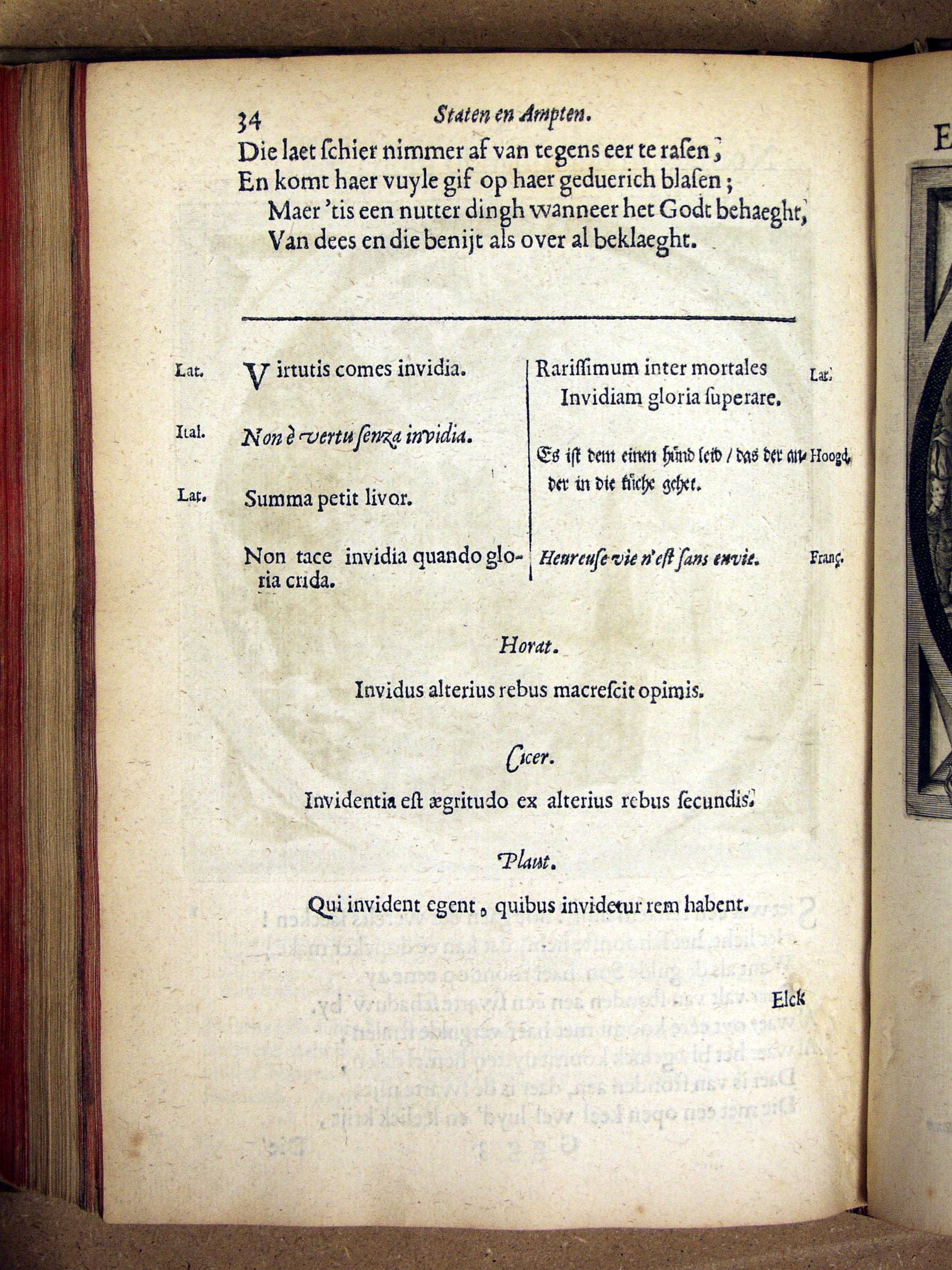
Lat. Virtutis comes invidia.
Latin. Envy is the companion of virtue.
Ital. Non è vertu senza invidia.
Italian. There is no virtue without envy.
Lat. Summa petit livor.
Latin. Spite attacks the highest things.
Non tace invidia quando gloria crida.
Envy does not keep silent when glory cries out.
Lat. Rarissimum inter mortales Invidiam gloria superare.
Latin. It is most rare among mortals for glory to overcome envy.
Hoogd. Es ist dem einen hund leid / das der ander in die küche gehet.
High German. It grieves the one dog that the other goes into the kitchen.
Franç. Heureuse vie n'est sans envie.
French. A happy life is not without envy.
Horat. Invidus alterius rebus macrescit opimis.
Horace. The envious man grows lean at another's rich possessions.
Cicer. Invidentia est ægritudo ex alterius rebus secundis.
Cicero. Envy is distress arising from another's prosperity.
Plaut. Qui invident egent, quibus invidetur rem habent.
Plautus. Those who envy are in want; those who are envied have property.
Iconclass
86(NON TACE INVIDIA QUANDO GLORIA CRIDA)proverbs, sayings, etc. (NON TACE INVIDIA QUANDO GLORIA CRIDA)
Suggested Iconclass codesAI-generated
Additional codes proposed for this emblem, not (yet) part of the indexing.
11N32Envy; 'Invidia' (Ripa) ~ personification of one of the Seven Deadly SinshighThe crouching wild figure with snake-like hair in a rocky cave, gnawing/clutching at itself, is the standard personification of Envy ('Invidia'), the theme named repeatedly in the commentary.
96A5(INVIDIA)Invidia (Envy) as Roman personificationmediumThe snaky-haired figure corresponds to Invidia as a classical (Roman) personification of Envy, consistent with the Latin mottoes on 'invidia'.
57A6Virtuousness; 'Amor di Virtù', 'Attione virtuosa', 'Guida sicura de' veri honori', 'Virtù', 'Virtù insuperabile' (Ripa)mediumThe dignified old man in the sunlight embodies Virtue/virtuousness, the counterpart to Envy in the mottoes 'Envy is the companion of virtue' and 'no virtue without envy'.
92C254Minerva visits the cave of Envy (Invidia) in order to punish AglauroslowThe dark cave mouth housing the snaky Envy figure echoes Ovid's cave of Invidia, though neither Minerva nor Aglauros is present in the scene.
Relationships to the Adagia of ErasmusAI-generated
Suggested relationships between this emblem and adages in Erasmus’ Adagia.
- IV iv 87 Praestat invidiosum esse, etc – thematic inventiohigh
The closing couplet of the Dutch subscriptio ('it is a more useful thing... to be envied by this one and that than to be pitied everywhere') is a vernacular rendering of the proverb Erasmus discusses here, 'praestat invidiosum esse quam miserabilem,' including his point that envy is the companion of good fortune and pity of disaster.
- IV viii 59 Cognatio movet invidiam – essay quotemedium
The Latin commentary 'Rarissimum inter mortales Invidiam gloria superare' echoes the closing sentence of this adage's essay, 'qui eo altitudinis processerunt, ut invidiam gloria superarint, extra omnem aleam, extraque invidiae tela esse dicuntur' — the same phrase 'invidiam gloria superare.'
- III x 52 Iactantiae comes invidia – thematic inventiomedium
The emblem's Latin commentary 'Virtutis comes invidia' reproduces exactly the formula of this adage's headword, and its doctrine — that conspicuous glory or divine gifts attract Nemesis/envy — is the emblem's whole point (shadow inseparable from sunlight, envy from honour).
- I ii 25 Figulus figulo invidet, faber fabro – thematic inventiolow
Erasmus' locus classicus on envy (Hesiod's potter and smith) stands behind the emblem's general theme that success inevitably provokes grudging rivals; the German proverb added in the commentary ('it grieves the one dog that the other goes into the kitchen') is a vernacular analogue of the same idea.
Sources
Record ID: embstma_1288_emblem098
This emblem on the Iconclass site: https://iconclass.org/view/embstma_1288_emblem098
Copy: University Library, Glasgow, Stirling Maxwell 1288