Jacob Cats, Spiegel (The Hague, 1632)
Emblem 105
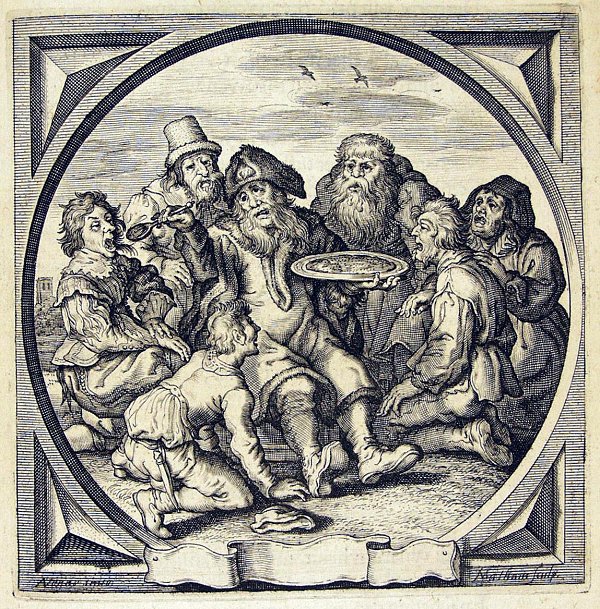
Hy moet veel brijs hebben, die elck den mont sal stoppenDutch
He must have a lot of porridge who intends to stop everyone's mouth.AI-generated
Description of the imageAI-generated
Within a circular frame set in a rectangular border with hatched corner spandrels, a crowd of ragged figures is pressed together in the open air. In the centre a long-bearded man in a fur cap sits with his mouth open; beside him another bearded old man holds out a shallow dish filled with porridge. At the left a young woman with tousled hair throws back her head with wide-open mouth while a man in a tall hat leans over her and holds a spoon to her lips. At the right two more men and a hooded figure crane forward, mouths gaping. In the foreground a kneeling boy, seen from behind, also tilts his head back with open mouth; a spoon lies at his side and a scrap of cloth or paper lies on the ground. Birds fly in the sky above and a distant town or tower appears at the left edge. At the bottom of the plate are two blank ribbon-like banderoles; the engraver's and designer's names appear in the lower corners ('Adriaen inven.' at left, 'Nathan sculp.' at right).
Subscriptio


TranscriptionAI-generated
VVat heb ick menigh vyer gestoockt! Wat heb ick dickmael pap gekoockt! Wat heb ick menigh mont gestopt, Iae tot de tanden vol gepropt! En noch soo isset even-veel, Schier yder heeft een open keel, Schier yder houdt een hollen mont, Dat is een diepte sonder gront; Want t'wijl ick hier den lepel bie, Soo ist dat ick daer yemant sie, Die gaept van nieus 'ken weet niet hoe, En splijt tot aen sijn oiren toe; En stracx al weder metter daet Soo vind' ick noch een nieuwen vraet, Die vint sich eeuwigh neven my, En schoon hy krijgt geduerigh bry, Noch grolt hy efter tusschen bey Gelijck een kater inde mey; Gewis ick bender qualick aen, Want siet! 'ken hebbe noyt gedaen; En schoon mijn pot hieldt soo veel brijs, Van blommen meel, of enckel rijs, Gelijck een vat daer in men brout, Dat somtijts dertich tonnen hout, Noch efter bleef ick in't verdriet, Want al mijn pap en bater niet. Wat raedt dan voor soo diepen kolck? Wat raedt voor soo veel gapent volck? Ghy swijght, ô vrient, en siet op my! Wel hoort dan wat mijn oordeel zy: Ick wil mijn heert, mijn hert, mijn huys, Gaen maecken net, en houden kuys, En schaffen dan gelijck het dient, En voor een gast, en voor een vrient, En voor een yder billick man, Nae dat mijn keucken lijden kan; Ick wil niet morssen soo ick plach, Maer koken inden hellen dach, Soo doende stel ick my gerust, En laetse schreeuwen die het lust.
TranslationAI-generated
How many a fire have I stoked! How often have I cooked porridge! How many a mouth have I stopped, indeed stuffed full up to the teeth! And still it is all the same: almost everyone has an open throat, almost everyone keeps a hollow mouth, which is a depth without a bottom; for while I offer the spoon here, I see somebody over there who gapes anew, I know not how, and splits his mouth right up to his ears; and straight away, in fact, I find yet another glutton, who is forever at my side, and although he constantly gets porridge, he still growls in between like a tomcat in May. Surely I am badly off, for see! I have never done with it; and though my pot held as much porridge, of fine flour or of plain rice, as a vat in which one brews, that sometimes holds thirty barrels, still I would remain in trouble, for all my porridge is of no help. What remedy, then, for so deep a whirlpool? What remedy for so many gaping folk? You are silent, O friend, and look at me! Well then, hear what my judgement is: I will make my hearth, my heart, my house neat, and keep them chaste, and then provide as is fitting, both for a guest and for a friend, and for every fair-minded man, as far as my kitchen can bear; I will not waste as I used to do, but cook in the bright daylight; doing so I set myself at ease, and let them shout who feel like it.
CommentaryAI-generated
3 passages · original left, translation right (click to fold)
De man die den pap biedt spreeckt
The man who offers the porridge speaks
Nederl. Wie kan't gevoegen / Nae elcx genoegen. Lat. Ne Iupiter quidem omnibus placet. Nederl. Hy en kan't yder niet passen / Selfs die het koren doet wassen. Het is voorwaer een kunstigh man / Die t' elck te passe maken kan. Lat. Ne cures nimium lector quid quisque loquatur. Hic bene nam de te, dicet & ille male. Franç. Impossible est de complaire à tous. Lat. Neque Iuppiter omnibus idem. Nederl. Die een quaet gheruchte heeft is half gehangen. Hoogd. Der muß viel mel haben der al meuler wil verkleiben. Nederl. 'Tis quaet alle krom-houten rechten. Men kan't qualijck al besorgen. Voor alle gaten ist quaet garen hangen. Men behoeft wel pap met volle potten / Om mont te stoppen aen alle sotten. Men kan alle dingh doot swijgen / niet doot kijven. Hy moet wijt gapen die tegen den oven gapen sal. Quand aurons nous trouvé le moyen de contenter tout le monde & plaire aux bons & mauvais tout ensemble? justifions nous à Dieu & à nous mesmes, & nostre conscience estant nette & incontaminée rien ne nous pourra offenser. Du Vair. Sainte Philos. Buchanan. Jephte. O foeminarum sorte vulgus asperâ Productum inauras, quas, licet culpâ vacent, Rumor malignus dente rodit invido Pro facto habetur quidquid ira finxerit Servi loquacis, quod maritus suspicax Commentus ipse est, malevola aut vicinia. Quid suspicetur genitor in mea manu Non est, remedium id arbitror tutissimum Intaminata conscientia frui. Plutarch. in solone. Ἔργμασιν ἐν μεγάλοις πᾶσιν ἁδεῖν χαλεπόν. .i. Omnibus, in magnis difficile ut placeas.
Dutch: Who can arrange it to everyone's satisfaction? Latin: Not even Jupiter pleases everybody. Dutch: He cannot suit everyone, not even he who makes the corn grow. He is truly a skilful man who can make it fit for everybody. Latin: Do not care too much, reader, what each one says. For this man will speak well of you, and that one ill. French: It is impossible to please everyone. Latin: Nor is Jupiter the same to all. Dutch: He who has a bad reputation is half hanged. High German: He must have much flour who wants to plaster up all mouths. Dutch: It is hard to straighten all crooked timber. One can hardly provide for everything. It is bad hanging yarn before every hole. One would indeed need porridge in full pots to stop the mouths of all fools. One can silence everything to death, but not scold it to death. He must gape wide who would gape against an oven. French: When shall we have found the means to content the whole world and to please both the good and the bad together? Let us justify ourselves before God and before ourselves, and, our conscience being clean and uncontaminated, nothing will be able to offend us. Du Vair, Holy Philosophy. Buchanan, Jephthah: O crowd of women, brought forth into the air under a harsh lot, whom, though they are free of guilt, malicious rumour gnaws with envious tooth. Whatever the anger of a talkative servant has invented, whatever a suspicious husband or a spiteful neighbourhood has itself made up, is taken as fact. What my father may suspect is not in my power; I judge this the safest remedy: to enjoy an unstained conscience. Plutarch, in his Life of Solon: In great affairs it is hard to please everyone. That is: It is difficult for you to please everybody in great matters.
Nederl. Hy behoeft wel een goede voor-spraeck / die voor alle-mans vier-schaer betrocken wort. Franç. Qui sert au commun nul ne le paye / Et s'il defaut chacun abbaye. Franç. Le chemin Est un mauvais voisin. Hoogd. Wer bey dem weg bawet / der hat viel meister. Mesig. cap. 9. Qui edifie en publique place / Faict maison trop haute ou trop basse.
Dutch: He indeed needs a good advocate who is summoned before everybody's tribunal. French: He who serves the public, nobody pays him, and if he fails, everyone barks at him. French: The road is a bad neighbour. High German: He who builds beside the road has many masters. Mesig[not] chap. 9: He who builds in a public place makes his house either too high or too low.
Iconclass
86(HY MOET VEEL BRIJS HEBBEN, DIE ELCK DEN MONT SAL STOPPEN)proverbs, sayings, etc. (HY MOET VEEL BRIJS HEBBEN, DIE ELCK DEN MONT SAL STOPPEN)
Suggested Iconclass codesAI-generated
Additional codes proposed for this emblem, not (yet) part of the indexing.
31B6233mouth wide openhighThe correlate 'mouth wide open' exactly matches the woman, boy and men who throw back their heads with gaping mouths waiting for the porridge.
41C313spoonhighThe correlate 'spoon' matches the spoon dipped toward the woman's mouth and the spoon lying beside the kneeling boy.
41C342serving-dish, plattermediumThe correlate 'serving-dish, platter' fits the large shallow dish of porridge held up by the central old man to serve the crowd.
46A151beggarmediumThe correlate 'beggar' suits the group of ragged, poor men, woman and boy crowding with outstretched hands for food.
41C6121cereallowThe correlate 'cereal' loosely covers the grain-based porridge that is central to the image and to the proverb about him 'who makes the corn grow'.
Relationships to the Adagia of ErasmusAI-generated
Suggested relationships between this emblem and adages in Erasmus’ Adagia.
- II vii 55 Ne Jupiter quidem omnibus placet – direct mottohigh
Cats gives this adage verbatim as the Latin motto accompanying the Dutch 'Hy moet veel brijs hebben, die elck den mont sal stoppen' ('Ne Iupiter quidem omnibus placet'), and repeats a variant ('Neque Iuppiter omnibus idem') plus the Dutch gloss 'He cannot suit everyone, not even he who makes the corn grow.'
- I vi 26 Domum cum facis, ne relinquas impolitam – thematic inventiomedium
The paired motto 'Die aende wegh timmert heeft veel berichts' and its subscriptio on every passer-by criticising the mason's kitchen, gable and cellar match Erasmus' explanation of Hesiod's line, that an unfinished house becomes a public laughing-stock with passers-by carping at it and the chattering crow croaking on the roof.
- I iii 7 Quot homines, tot setentiae – thematic inventiomedium
The emblem's whole point — 'Wie kan't gevoegen / Nae elcx genoegen', the impossibility of satisfying every gaping mouth and every judgement — rests on the commonplace that each man has his own taste and opinion, which Erasmus expounds under 'Quot homines, tot sententiae' (loci: Alia aliis placent).
- II ii 84 Carpet citius aliquis quam imitabitur – thematic inventiolow
The second subscriptio's complaint that every stone laid and every book written is faulted by readers who mock without reason echoes Erasmus' point that excellent work is far more easily carped at than equalled.
- III x 10 Vulgus suspicax – thematic inventiolow
The commentary's Buchanan quotation on malicious rumour, the suspicious husband and the spiteful neighbourhood that turn invention into fact corresponds to Erasmus' adage that the common crowd is suspicious and interprets everything in the worst sense.
Sources
Record ID: embstma_1288_emblem105
This emblem on the Iconclass site: https://iconclass.org/view/embstma_1288_emblem105
Copy: University Library, Glasgow, Stirling Maxwell 1288