Geffrey Whitney, A choice of emblemes (Leiden, 1586)
Emblem 37
Ajax and Hector exchange gifts: a sword and a belt
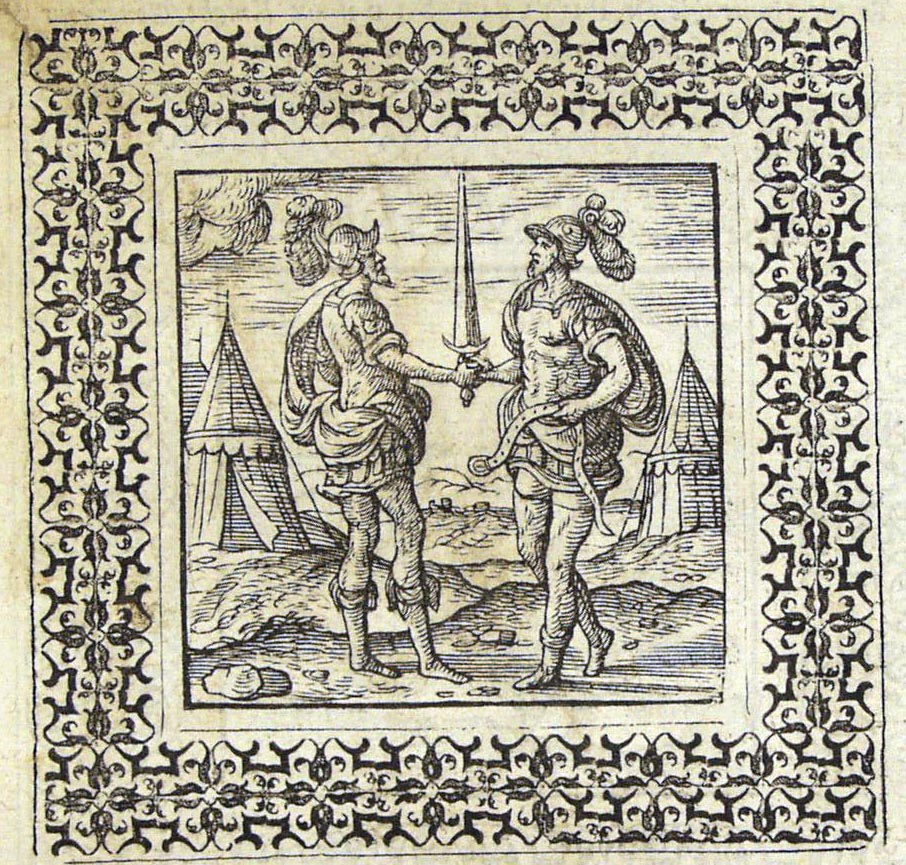
Inimicorum dona, infaustaLatin
Gifts of enemies are unlucky
Subscriptio

TranscriptionAI-generated
IF of thy foe, thow doest a gifte receaue, Esteeme it not, for feare the fates doe lower, And with the gifte, ofte tyme thie life doe reaue, Yea giftes wee reade, haue suche a secret power, That oftentimes, they LYNCEVS eies doe blinde, And he that giues, the taker faste doth binde. To AIAX heare, a sworde did HECTOR sende, A girdle stronge, to him did AIAX yeelde, With HECTORS gifte, did AIAX woorke his ende, And AIAX gifte, hal'de HECTOR throughe the fielde: Of mortall foes, then see noe gifte thow take, Althoughe a while, a truce with them thow make.
TranslationAI-generated
If you receive a gift from your enemy, do not value it, for fear the fates may frown, and with the gift often take away your life; for we read that gifts have such a secret power that they often blind even Lynceus' eyes, and he who gives binds the receiver fast. To Ajax here Hector sent a sword; a strong girdle Ajax yielded to him. With Hector's gift Ajax worked his own end, and Ajax's gift dragged Hector through the field. From mortal foes, then, see that you take no gift, although for a while you make a truce with them.
CommentaryAI-generated
2 passages · original left, translation right (click to fold)
———— ———— aut vlla putatis Dona carere dolis Danaum, &c.
Sic titulo obsequij, quæ mittunt hostibus hostes Munera, venturi præscia fata ferunt.
"... or do you think any gifts of the Greeks are free from guile, etc."
Thus, under the title of courtesy, the presents which enemies send to enemies bring with them fates foreknowing of what is to come.
Lacoon apud Virgilium lib. Æneid. 2. sic de equo, loquitur Troianis.
Alciat.
Laocoon in Virgil, Aeneid book 2, thus speaks to the Trojans about the horse.
Alciato.
Notes and related emblems
- In Alciatus' Emblemata the motto is: "Echthroon adoora doora (Gr.)"
- Related emblem in another book: embmne_mig1591_emblem167
Iconclass
25H114low hill country25I5landscape with tower or castle26Aclouds31A2512(+933)arm stretched forward (+ holding something)31A2512(+934)arm stretched forward (+ reaching for somebody or something, seizing something, touching)31A2621(+51)one leg in front of the other (+ standing)31A26211(+51)one leg in front of the other, walking position (+ standing)31A534beard31D14(+72)adult man (+ two persons)33A4bringing gifts; exchanging gifts33A410:33B5?❧enemy41D233(+81)gear for legs and feet (+ men's clothes)41D2656belt, girdle, waistband41D27drapery, draped garment, 'Gewandgebung'45C13(SWORD)hacking and thrusting weapons: sword45C22armour45C221helmet45C41(military) camp with tents54FF11(+4)Adversity, Misfortune, Bad Luck; 'Fortuna infelice', 'Infortunio' (Ripa) (+ emblematical representation of concept)86(INIMICORUM DONA, INFAUSTA)proverbs, sayings, etc. (INIMICORUM DONA, INFAUSTA)94G235Hector's body, tied to Achilles' chariot, is dragged around the city94G63suicide of Ajax95A(AJAX THE GREAT)5Ajax the Great - non-aggressive, friendly or neutral activities and relationships95A(HECTOR)5Hector - non-aggressive, friendly or neutral activities and relationships
Suggested Iconclass codesAI-generated
Additional codes proposed for this emblem, not (yet) part of the indexing.
45C13(SWORD)hacking and thrusting weapons: swordhighA large upright sword is the central object being handed over between the two warriors, matching the general weapon category 'sword'.
41D2656belt, girdle, waistbandhighThe right-hand figure holds a long belt or girdle looping from his hand, the counter-gift in the exchange.
45C41(military) camp with tentshighThe background shows a military encampment of pointed tents on both sides of the armed figures.
41A1911tent-campmediumThe setting is an encampment of multiple tents, which fits the general architectural notion of a tent-camp.
94H211Laocoon, the priest, tries to dissuade the Trojans from bringing the horse inside the walls, and hurls a spear at itmediumThe commentary explicitly quotes Laocoon warning the Trojans about the Greeks' gift (the horse) in Aeneid II, though the scene itself is not depicted.
Relationships to the Adagia of ErasmusAI-generated
Suggested relationships between this emblem and adages in Erasmus’ Adagia.
- I iii 35 Hostium munera, non munera – direct mottohigh
The motto 'Inimicorum dona, infausta' is a direct variant of Erasmus's adage (Greek ἐχθρῶν ἄδωρα δῶρα), and the subscriptio retells precisely Erasmus's chief illustration from Iliad 7: Hector's sword given to Ajax (with which Ajax killed himself) and Ajax's belt (by which Hector was dragged round Troy).
- III i 41 Gladium dedisti, qui se occideret – thematic inventiomedium
Erasmus himself cross-references this adage to 'gifts of enemies are no gifts'; the emblem's picture of a sword handed over that becomes the receiver's death ('With HECTORS gifte, did AIAX woorke his ende') embodies exactly the idea of giving someone the sword with which he kills himself.
- IV ii 1 Δούρεος ἵππος – thematic inventiomedium
The Latin commentary quotes Laocoon's warning in Aeneid 2 about the Greeks' treacherous gift, i.e. the Trojan Horse, the very subject of this adage on hidden treachery concealed in an apparent gift.
- II i 54 Lynceo perspicacior – thematic inventiomedium
The subscriptio invokes the proverbial sharp-sightedness of Lynceus ('they LYNCEVS eies doe blinde'), using this adage's proverbial figure to say that gifts blind even the keenest eyes.
- I iii 18 Muneribus vel dii capiuntur – thematic inventiolow
The subscriptio's claim that gifts have a 'secret power' that blinds and binds the receiver echoes the commonplace of this adage that gifts overcome even gods and kings.
- IV iii 4 Malum munus – thematic inventiolow
Shares the Loci communes topic 'Munus non munus': a harmful gift is no benefit but a loss, which is the emblem's moral about gifts received from enemies.
Sources
Record ID: embstma_1667_emblem037
This emblem on the Iconclass site: https://iconclass.org/view/embstma_1667_emblem037
Copy: University Library, Glasgow, Stirling Maxwell 1667