Guillaume de La Perrièrre, Le Theatre Des Bons Engins (Lyon, 1545)
Emblem 54
A fowler luring birds into his net with a bird-callAI-generated
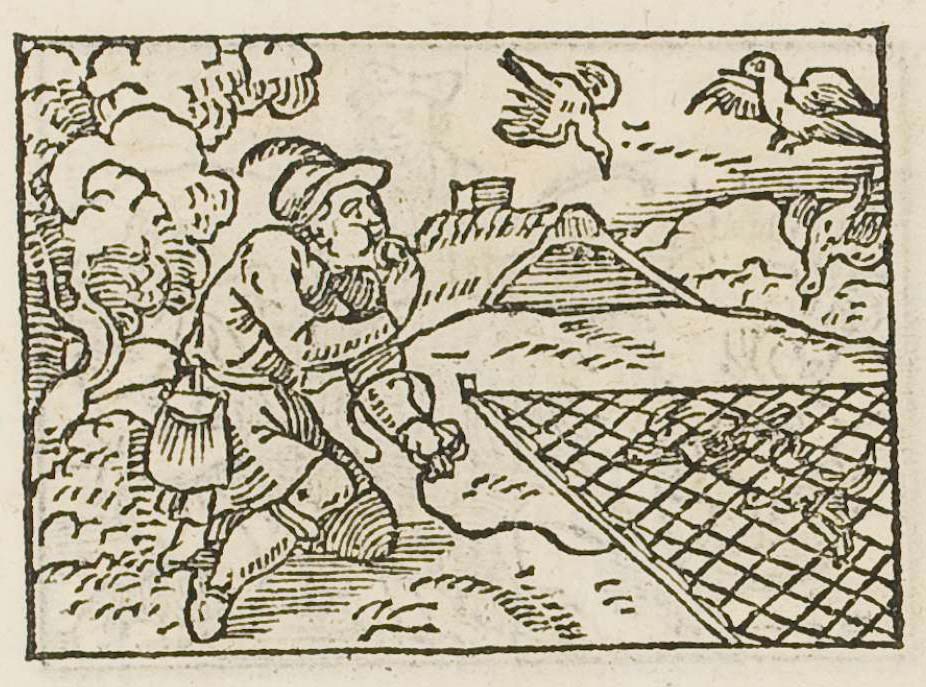
Le Prince doibt euiter les flatteurs.
The Prince ought to avoid flatterers.AI-generated
Description of the woodcutAI-generated
A woodcut in a rectangular frame. At the left, among trees and bushes, a bearded fowler wearing a cap and a short tunic crouches/kneels on a grassy bank, blowing into a small pipe or bird-call held to his mouth, with a pouch or bag hanging at his side. Before him, spread out across the open ground to the right, is a large net stretched on the grass with a stake and a curved pole; beyond it a stretch of water or open field. In the upper right of the scene two birds fly through the sky toward the lure.
Subscriptio

TranscriptionAI-generated
Quand l'Oyseleur veult beaucoup d'oyseaux prendre,Il sainct sa voix auec quelque instrument,Au son duquel vers luy se viennent rendre:Par ce moyen les prend facilement.Flatteurs de Court, font tout semblablement,Pour attirer les Princes en leurs laqs:Car pour complaire, & leur donner soulas,Cent foys le iour changent de contenance:Mais quand le Prince, est contrainct dire helas,Il est trop tard, d'en auoir cognoissance.
TranslationAI-generated
When the fowler wants to catch many birds, he feigns his voice with some instrument, at the sound of which they come to give themselves up to him: by this means he catches them easily. Flatterers of the Court do just the same, to draw Princes into their snares: for in order to please them and give them comfort, a hundred times a day they change their expression. But when the Prince is forced to say 'alas', it is too late to have knowledge of it.
Iconclass
86(LE PRINCE DOIBT EUITER LES FLATTEURS)proverbs, sayings, etc. (LE PRINCE DOIBT EUITER LES FLATTEURS)25I3farm or solitary house in landscape43C13fowling, fowler43C13(+415)fowling, fowler (+ net)43C13(+433)fowling, fowler (+ imitation calls ~ lures (hunting))57AA6121Flattery; 'Adulatione' (Ripa)44B152royal household; courtiers, retinue, train
Suggested Iconclass codesAI-generated
Additional codes proposed for this emblem, not (yet) part of the indexing.
43C13fowling, fowlerhighThe scene literally shows 'fowling, fowler': a bearded bird-catcher with a bird-call pipe, net, stake and pole luring two birds.
57AA621Cheat, Deceit; 'Fraude', 'Inganno' (Ripa)mediumThe emblem's point, signalled by the commentary's 'deceit', is the personified Deceit/Fraud — luring victims with a pleasant sound into a hidden net.
57AA6121Flattery; 'Adulatione' (Ripa)lowThe sweet bird-call that entices the birds to destruction corresponds to the allegory of Flattery ('Adulatione') raised in the commentary.
57AA6131Guile, Artfulness, Craftiness, DeceitfulnesslowThe fowler's hidden craft of concealed net plus seductive lure matches 'Guile, Artfulness, Craftiness, Deceitfulness'.
Relationships to the Adagia of ErasmusAI-generated
Suggested relationships between this emblem and adages in Erasmus’ Adagia.
- IV v 70 In transennam in ducere – thematic inventiomedium
Erasmus explains the phrase as taken from fowlers who scatter bait within their nets to trap little birds; the emblem's picture (net spread on the ground, fowler luring birds) and its moral that flatterers 'attirer les Princes en leurs laqs' match exactly this proverbial image of luring into the snare.
- II v 73 Inescare homines – thematic inventiomedium
The adage is about baiting men as fish are baited, and Erasmus explicitly applies it to Cleon winning the people over with blandishments ('you captured them with far smaller bait'), precisely the emblem's point that courtly flatterers bait princes with pleasing sounds.
- I viii 58 Letale mulsum – thematic inventiomedium
Erasmus applies the 'deadly honey-brew' to flattery, which 'delights with its flattery and suffocates with its falsehood' – the same paradox as the sweet bird-call that leads the birds into the fowler's net and the prince into ruin.
- I i 28 Sero sapiunt Phryges – thematic inventiomedium
The subscriptio's close – 'quand le Prince est contrainct dire helas, Il est trop tard d'en auoir cognoissance' – restates the commonplace of wisdom coming too late, of which this is Erasmus' standard adage (cf. also 'Malo accepto stultus sapit').
- IV v 22 Pulcre fallit vulpem – thematic inventiolow
Erasmus' explanation digresses on fowlers' decoys – blinded doves placed in the net to lure other birds, and those who set nets (paleutai) – which is the exact technique depicted in the woodcut of the piping fowler and his spread net.
- I x 54 Χρηστολόγος – thematic inventiolow
The adage describes those whose words are fair but deeds foul, who 'by fair speech beguile the hearts of the innocent' – the moral of the emblem's courtiers who change countenance a hundred times a day to please the prince.
- IV ii 25 Benignior pellace vulpe – thematic inventiolow
Used of one who feigns benevolence for his own advantage, matching the emblem's flatterers who feign (fainct) pleasing behaviour to entrap princes.
Sources
Record ID: embhab_162-3-eth-b_emblem054
This emblem on the Iconclass site: https://iconclass.org/view/embhab_162-3-eth-b_emblem054
Page in the digital copy of the Herzog August Bibliothek: http://diglib.hab.de/drucke/162-3-eth-b/start.htm?image=00067