Guillaume de La Perrièrre, Le Theatre Des Bons Engins (Lyon, 1545)
Emblem 73
A double-fronted courtier offering a dish while turning awayAI-generated
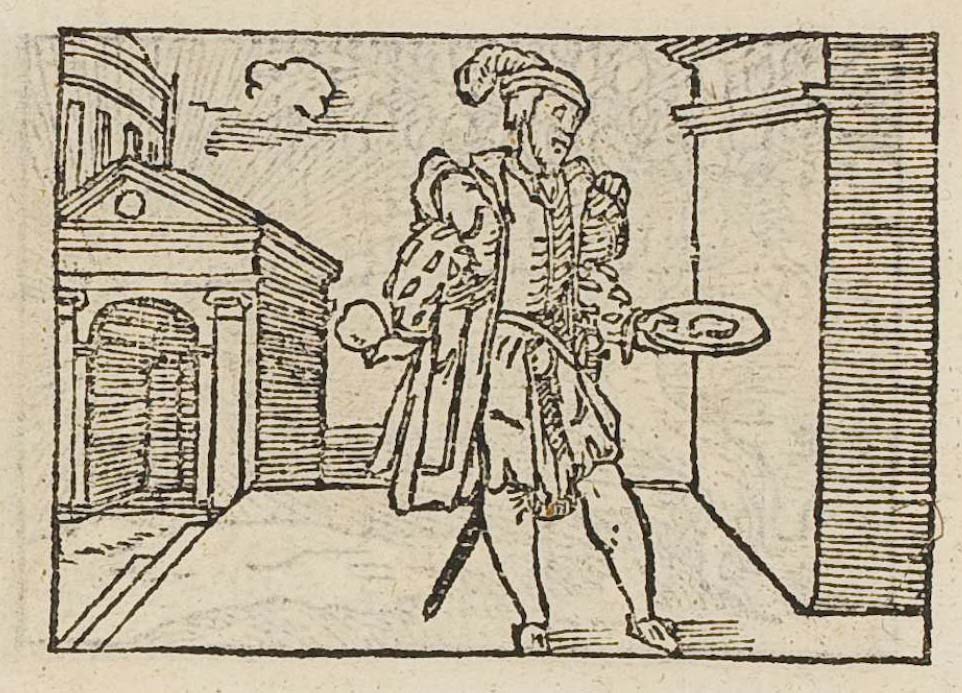
Traistre & Flatteur disent l'vn & font l'autre.
Traitor and Flatterer say one thing and do another.AI-generated
Description of the woodcutAI-generated
A woodcut set in a street or courtyard before a classical building with columns, an arched doorway and a pedimented porch. In the foreground a richly dressed man strides to the right: he wears a plumed cap, a slashed doublet, puffed breeches and a sword at his side, and he holds out a round flat dish or platter in his left hand while his right hand is raised near his chest. Immediately behind him, and seemingly joined to him, is a second cloaked figure facing the opposite direction, so that the pair appears as one body with two fronts. Clouds and hatched sky appear above the rooftops.
Subscriptio

TranscriptionAI-generated
FLateurs de court tiénét la paste aux mains,A tous venantz feront des seruiables:Iusques à tant, que par tours inhumains,Auront saoulez leurs cueurs insatiables,Pour se monstrer enuers tous amyables,Ont grand babil, auecques peu d'effect:Merueille n'est, si leur cueur contrefaict,Ha maintes gens reculez en arriere:Car tousiours ont, par leur vouloir infect,Langue deuant, & le cueur en arriere.
TranslationAI-generated
Court flatterers hold the dough in their hands; to all comers they will act obligingly, until, by inhuman tricks, they have glutted their insatiable hearts. To show themselves friendly toward everyone, they have much chatter with little effect; it is no wonder if their counterfeit heart has driven many people back, for always, through their infected will, they have the tongue in front and the heart behind.
Iconclass
86(TRAISTRE & FLATTEUR DISENT L'VN & FONT L'AUTRE)proverbs, sayings, etc. (TRAISTRE & FLATTEUR DISENT L'VN & FONT L'AUTRE)31D14(+933)adult man (+ holding something)31A22141tongue41C341dish, plate, saucer31A2221heart25I144square, place, circus, etc.41A1civic architecture; edifices; dwellings57AA6121Flattery; 'Adulatione' (Ripa)57AA6223Ambuscade, Trap; 'Insidia' (Ripa)44B152royal household; courtiers, retinue, train
Suggested Iconclass codesAI-generated
Additional codes proposed for this emblem, not (yet) part of the indexing.
96A128(JANUS' HEAD)Janus' head, two-faced headhighThe correlate 'Janus' head, two-faced head' matches the single body with two fronts facing opposite directions in the woodcut, and the commentary's reference to Janus.
57AA611Dissimulation, Hypocrisy; 'Hippocresia', 'Simulatione' (Ripa)high'Dissimulation, Hypocrisy' matches the emblem's two-faced figure and the commentary's explicit theme of dissimulation and hypocrisy.
57AA6121Flattery; 'Adulatione' (Ripa)high'Flattery; Adulatione (Ripa)' corresponds to the commentary's flatterer, personified by the finely dressed, double-faced courtier.
32A45parasite, spongermedium'Parasite, sponger' fits the commentary's parasite and the dish/platter the richly dressed man holds out.
57AA6122Sponging, Parasitizingmedium'Sponging, Parasitizing' personifies the parasitical flatterer named in the commentary and signalled by the proffered food platter.
57AA621Cheat, Deceit; 'Fraude', 'Inganno' (Ripa)medium'Cheat, Deceit; Fraude, Inganno (Ripa)' matches the commentary's theme of deceit embodied in the duplicitous figure.
57AA6131Guile, Artfulness, Craftiness, Deceitfulnesslow'Guile, Artfulness, Craftiness, Deceitfulness' echoes the commentary's deceitfulness, though it overlaps with the more specific dissimulation/flattery concepts.
41C342serving-dish, plattermedium'Serving-dish, platter' matches the round flat dish the man holds out in his left hand.
45C13(SWORD)hacking and thrusting weapons: swordmedium'Hacking and thrusting weapons: sword' matches the sword worn at the richly dressed man's side.
53AA21Inconstancy; 'Incostanza', 'Instabilità', 'Instabilità overo Incostanza' (Ripa)low'Inconstancy (Ripa)' is suggested by the commentary's inconstancy and the figure facing two ways at once.
Relationships to the Adagia of ErasmusAI-generated
Suggested relationships between this emblem and adages in Erasmus’ Adagia.
- I x 54 Χρηστολόγος – essay quotehigh
Erasmus defines χρηστολόγοι as those 'qui probe loquuntur, & improbe faciunt' — who speak well and act badly; the French motto 'Traistre & Flatteur disent l'vn & font l'autre' is virtually a translation of this gloss, and the subscriptio's 'grand babil, auecques peu d'effect' matches the adage's fair-speech-that-beguiles theme.
- II ii 86 Lacon, alia asinus illius portat – thematic inventiomedium
Erasmus says this adage was used 'in eos quorum oratio dissentiret à factis' — exactly the emblem's point that the traitor-flatterer says one thing and does another.
- I viii 29 Altera manu fert lapidem, altera panem ostentat – thematic inventiomedium
Erasmus applies it to those 'qui coràm blandiuntur, clàm obtrectantes, palàm amicos agunt, clanculum nocent,' which is the emblem's flatterer who seems obliging to all while secretly harming; the woodcut's figure likewise offers a dish with one hand while his other self faces away.
- I viii 30 Ex eodem ore calidum et frigidum efflare – thematic inventiomedium
The adage targets the 'bilingues' who blow hot and cold from one mouth; the emblem's double-fronted figure with 'langue deuant, & le cueur en arriere' embodies the same duplicity of speech versus intent.
- IV iv 74 Altera manu fert aquam, etc – thematic inventiomedium
Erasmus explicitly applies it to one 'qui cum coram sit blandus, occulte noceat' and to the bilinguis who praises and reviles — the emblem's two-faced court flatterer whose outward service conceals an 'insatiable' and 'counterfeit' heart.
- IV vi 58 Magadari – thematic inventiolow
The adage describes the 'bilingues' who from the same mouth utter praise and blame, flattery and abuse, which matches the emblem's figure that speaks one way and acts another; Erasmus himself cross-references it to 'Ex eodem ore calidum et frigidum efflare.'
- IV ii 25 Benignior pellace vulpe – thematic inventiolow
Said of one 'qui commodi sui causa simulat benevolentiam' — exactly the court flatterer who 'feront des seruiables' to all comers only until his insatiable heart is satisfied.
- I viii 57 Melle litus gladius – thematic inventiolow
Erasmus applies the honeyed sword to 'perniciosa adulatio' — sweet words hiding a wounding intent — which is the emblem's flatterer, pictured as a sword-wearing courtier proffering a dish while turned away behind.
Sources
Record ID: embhab_162-3-eth-b_emblem073
This emblem on the Iconclass site: https://iconclass.org/view/embhab_162-3-eth-b_emblem073
Page in the digital copy of the Herzog August Bibliothek: http://diglib.hab.de/drucke/162-3-eth-b/start.htm?image=00086