Guillaume de La Perrièrre, Le Theatre Des Bons Engins (Lyon, 1545)
Emblem 78
A man filling a large sailing shipAI-generated
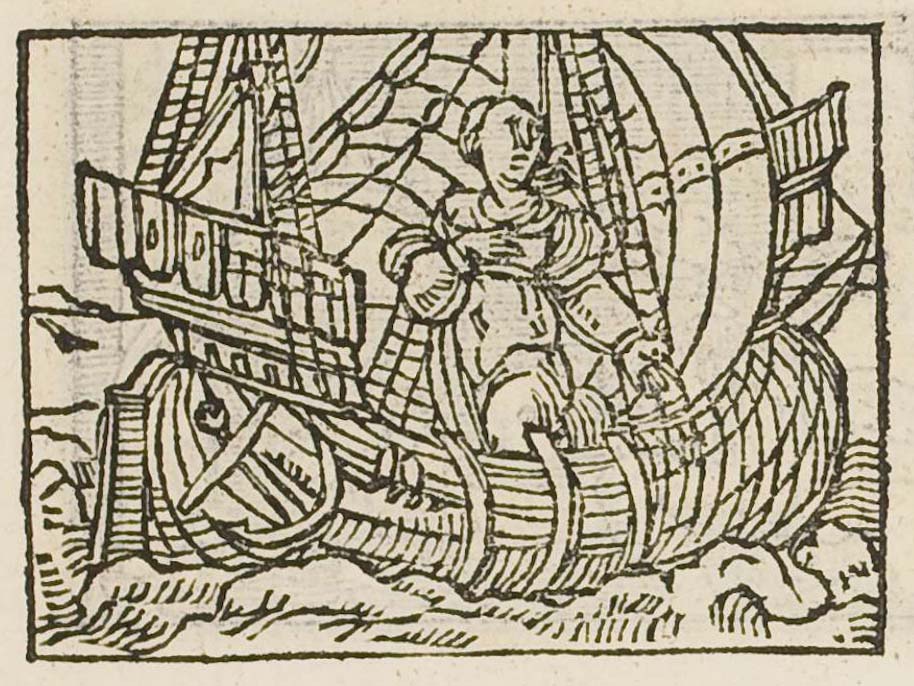
Impossible est, rendre femmes contentes.
It is impossible to make women content.AI-generated
Description of the woodcutAI-generated
A woodcut in a plain rectangular frame showing a large sailing ship on choppy water, seen from the side with its bow to the right. The ship has two masts with furled and billowing sails, rigging lines, a high stern castle with square windows, and a projecting bowsprit. Amidships stands a single figure in a cap and long robe, leaning forward over the open hull, apparently working at or filling the vessel; the planking of the hull is drawn open to show its interior ribs, with a barrel-like shape near the stern. Waves and a sandbank or rock are indicated in the foreground.
Subscriptio

TranscriptionAI-generated
FEmmes & Nefz, ne sont iamais complies,C'est vne chose, ou lon doibt bien penser,Quand on les cuyde auoir du tout remplies,C'est lors le temps, qu'il fault recommencer.Vous les pourriez, cent foys mieulx agencer,Qu'a la parfin, vous serez à refaire:C'est grosse charge, & trop peneux affaire,Voyre plus grand encores qu'on n'estime,Heureux seroit, qui s'en pourroit deffaire,Ou se garder d'entrer en tel abysme.
TranslationAI-generated
Women and ships are never finished; it is a thing one ought to think hard about. When you think you have filled them completely, that is just the moment when you must start again. You could arrange them a hundred times better, yet in the end you will have to do it over: it is a heavy burden and too troublesome a business, indeed greater still than people reckon. Happy would he be who could rid himself of it, or keep himself from entering into such an abyss.
Iconclass
86(IMPOSSIBLE EST, RENDRE FEMMES CONTENTES)proverbs, sayings, etc. (IMPOSSIBLE EST, RENDRE FEMMES CONTENTES)
Suggested Iconclass codesAI-generated
Additional codes proposed for this emblem, not (yet) part of the indexing.
46C24sailing-ship, sailing-boathighThe correlate 'sailing-ship, sailing-boat' directly matches the large two-masted sailing vessel on water that dominates the woodcut.
46C241sailing-ship's riggingmediumThe correlate 'sailing-ship's rigging' fits the explicitly depicted masts, furled and billowing sails, rigging lines and bowsprit.
Relationships to the Adagia of ErasmusAI-generated
Suggested relationships between this emblem and adages in Erasmus’ Adagia.
- I iv 42 Penelopes telam retexere – thematic inventiomedium
The subscriptio's core conceit — that the work on women (and ships) is never finished, so that just when you think you have completed it 'il fault recommencer' — reproduces exactly the proverbial image of unravelling Penelope's web, an endlessly self-undoing labour, and Erasmus's adage likewise involves a woman's never-finished work.
- I x 7 Impossibilia captas – thematic inventiomedium
The motto 'Impossible est, rendre femmes contentes' states an adynaton of the very type Erasmus classifies under 'Impossibilia'; the emblem presents contenting a woman as a goal one can never attain, i.e. pursuing the impossible.
- II ii 48 Ignis mare mulier, tria mala – thematic inventiomedium
The emblem yokes woman and ship/sea together as parallel burdens ('Femmes & Nefz'), and the picture is of a vessel on rough water; Erasmus's adage similarly couples sea and woman as proverbial evils, with woman said to resemble the unconquerable waves.
- IV ii 35 Qui non litigat, coelebs est – thematic inventiomedium
The subscriptio's conclusion — that marriage to a woman is 'grosse charge & trop peneux affaire' and that happy is the man who escapes it or never enters that abyss — matches the adage's point that every marriage is full of strife and only celibacy brings peace.
- V i 47 Libero lecto nihil jucundius – thematic inventiolow
The closing wish to be rid of the burden or never to enter it echoes the adage's praise of the bachelor's 'bed to oneself' as preferable to the troubles of a wife.
- III x 21 Foemina nihil pestilentius – thematic inventiolow
The emblem belongs to the same misogynist commonplace tradition, presenting woman as an insatiable burden and 'abysme' from which a man would be happy to escape.
Sources
Record ID: embhab_162-3-eth-b_emblem078
This emblem on the Iconclass site: https://iconclass.org/view/embhab_162-3-eth-b_emblem078
Page in the digital copy of the Herzog August Bibliothek: http://diglib.hab.de/drucke/162-3-eth-b/start.htm?image=00091