Jacob Cats, Spiegel (The Hague, 1632)
Emblem 15
A man and woman holding hands in front of an open hearth; in the background a boy gets sparks from a flint and steel
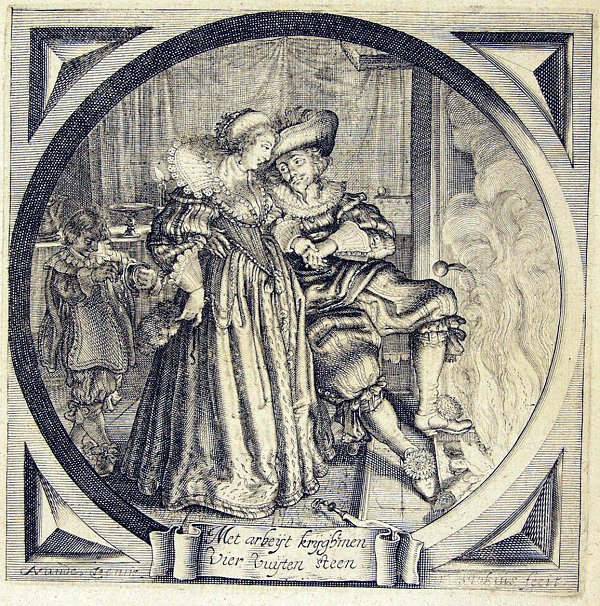
Met arbeydt krijgtmen vyer uyt den steenDutch
By labour one gets fire out of the stone.AI-generated
Description of the imageAI-generated
An interior scene set within a large oval frame with hatched corner spandrels. At the right a fashionably dressed gentleman in a broad plumed hat, ruff, slashed doublet and high boots with rosettes sits sprawled on a chair beside an open hearth in which a fire blazes; a long-handled pan or warming pan hangs at the fireplace. A lady in a tall lace ruff, pearl-trimmed cap and richly embroidered gown stands leaning over him, her head close to his, one hand holding a fan, the other resting toward his hand. Behind them are a curtained bed and a table with a covered cup; in the left background a young servant or boy in a doublet and breeches stands with a second small figure. A pair of tongs or a striking iron lies on the floor in the foreground. Below hangs a scroll banderole inscribed in script 'Met arbeijt krijgbmen Vier vuijten steen', with the engraver's and designer's signatures at the lower left and right of the plate.
Subscriptio


TranscriptionAI-generated
Siet hier, ghy koele vryers, siet Wat doet de vlijt en moeyte niet? Als ick eerst desen steen bequam, En van den stueren ouver nam, Doen wasse raeu, en ongebout, En dan noch hart en wonder kout, Noyt mensch en dacht, die hem besagh, Dat eenigh vyer daer binnen lagh; En efter als ick eens begon, En sloeger op al wat ick kon, Doen zijnder, door gestadigh slaen, Veel helle voncken uyt-gegaen, En die nam ick wel neerstigh waer, En dus zijn al mijn saken klaer: Want siet! mijn heert, die niet en was Als vuyl gemul, en enckel as, Die blinckt nu van een helle vlam, Die uyt mijn vlijt haer voetsel nam. De Vrijster, die ghy heden siet, Die my nu handt en herte biet, Was noch in 't eerste van de mey Soo hart gelijck een blaeuwe key, Soo koel gelijck als killich ijs, En tegen my geweldigh vijs; Maer na dat ick met staege vlijt, Geen moeyt', of pijn en heb gemijt, Soo is het stuck soo ver gebracht, Dat sy nu soetjens op my lacht, Dat sy my valt tot inden arm, En hierom sijn wy beyde warm. Siet, Vryers, siet dit koomter van, Wanneer men doen en lijden kan. Wel ghy, die treurigh sit en klaegt, Dat ghy bemint een koele maegt, Dat ghy een grilligh meysjen vrijt, Daerom ghy groote smerte lijt, Mach ick u bidden, lieve vriendt, Indien u slechts de vrijster diendt, Soo schept een moedt, en lijt de pijn, Gewis het sal eens beter zijn; Want siet! door vlijt en soet gevley Soo kreegh ick vyer uyt dese key.
TranslationAI-generated
See here, you cool wooers, see: what does diligence and effort not achieve? When I first got this stone, and took it from the rugged shore, it was then raw and unworked, and moreover hard and wondrously cold. No man who looked at it ever thought that any fire lay within it; and yet, when once I began and struck at it all I could, then, by steady striking, many bright sparks flew out, and these I carefully caught; and so all my affairs are in order: for see! my hearth, which was nothing but foul dust and mere ashes, now shines with a bright flame that took its nourishment from my diligence. The sweetheart whom you see today, who now offers me hand and heart, was still, at the beginning of May, as hard as a blue pebble, as cool as chilly ice, and mightily contrary toward me; but after I, with constant diligence, avoided no trouble or pain, the matter has been brought so far that she now smiles sweetly on me, that she falls into my arms — and therefore we are both warm. See, wooers, see what comes of it when one can act and endure. Well then, you who sit mourning and complaining that you love a cool maiden, that you court a capricious girl, and therefore suffer great pain: may I beg you, dear friend, if only the girl suits you, take courage and bear the pain; surely it will one day be better; for see! by diligence and sweet coaxing I thus got fire out of this pebble.
CommentaryAI-generated
1 passages · original left, translation right (click to fold)
Nederd. De stadige jager vangt het wilt. Aenhouden doet verkrijgen. Franç. Continuelle goutiere Rompt la pierre. Lat. ---- labor omnia vincit Improbus. Engels. A muse in time may bite a two a cable. Griecx. Πόνος εὐκλείας πατήρ. Hoogd. Fleiß bricht Eyß. Lat. Par est fortuna labori. Labor bonæ gloriæ pater. Ferreus assiduo consumitur annulus usu. Invia virtuti nulla est via. Salust. Vigilando, agendo bene, consulendo prosperè omnia cedunt. Franç. Nul bien sans peine. Nederd. Die in Venus hof wil wandelen Moet stout versoecken en sachtjens handelen. Lat. Nihil unquam vehementer imperavit sibi humanus animus, quod non effecerit. Spaens. A la larga el galgo a la lievre mata. .i. Franç. A la longue le levrier tue le lievre. Horat. --- nil sine magno Vita labore dedit mortalibus-- Epich. Πρεπόντων πόνων πωλοῦσιν ἡμῖν πάντα Τ' ἀγαθὰ οἱ Θεοί. i. Convenientibus laboribus vendunt nobis omnia bona Dij.
Dutch: The steady hunter catches the game. Persevering brings success. — French: A continual gutter-drip breaks the stone. — Latin: Unremitting toil conquers all things. — English: A mouse in time may bite in two a cable. — Greek: Toil is the father of good repute. — German: Diligence breaks ice. — Latin: Fortune is equal to labour. Labour is the father of good glory. An iron ring is worn away by constant use. For virtue no road is impassable. — Sallust: By keeping watch, by acting well, by taking counsel, everything turns out prosperously. — French: No good without pain. — Dutch: Whoever wishes to walk in Venus's garden must woo boldly and act gently. — Latin: The human mind has never commanded anything of itself vehemently which it has not carried out. — Spanish: In the long run the greyhound kills the hare, that is — French: In the long run the greyhound kills the hare. — Horace: Life has given nothing to mortals without great labour. — Epicharmus: For fitting labours the gods sell us all good things, that is — (Latin) For suitable labours the gods sell us all good things.
Iconclass
31A235sitting figure31AA231standing figure - AA - female human figure31D11221boy (child between toddler and youth)31D14adult man31D15adult woman33C234(lovers) caressing each other33C32pursuit of a woman, prowling41B111flint and steel41B122spark ~ fire41B1311bellows41B211warming oneself at a fire (or hearth, stove, fire-pan, brazier)41C3laid table: table-ware, table-decoration, etc.41C341dish, plate, saucer41D221(HAT)head-gear: hat41D262fan53A21(+4):56F2Constancy, Tenacity; 'Costanza', 'Tenacità' (Ripa) (+ emblematical representation of concept)❧(personifications and symbolic representations of) Love; 'Amore (secondo Seneca)' (Ripa)86(MET ARBEYDT KRIJGTMEN VYER UYT DEN STEEN)proverbs, sayings, etc. (MET ARBEYDT KRIJGTMEN VYER UYT DEN STEEN)
Suggested Iconclass codesAI-generated
Additional codes proposed for this emblem, not (yet) part of the indexing.
53A2Perseverance, Resolution, Determination; 'Perseveranza' (Ripa)highThe motto and the mass of proverbs ('Persevering brings success', 'a continual dripping breaks the stone') make Perseverance/Resolution the emblem's central abstract concept.
54A2Carefulness, Diligence; 'Diligenza' (Ripa)mediumThe commentary explicitly praises 'Diligence breaks ice' and unremitting toil, matching the personified virtue Carefulness/Diligence.
41B2121fire-tongsmediumThe description notes a pair of tongs (or striking iron) lying on the floor before the blazing open hearth, i.e. fire-tongs as fireplace equipment.
46A170LabourlowThe repeated praise of 'arbeijt'/labour as the means to success could be read as the general concept of Labour, though no labourers are actually depicted.
Relationships to the Adagia of ErasmusAI-generated
Suggested relationships between this emblem and adages in Erasmus’ Adagia.
- II ii 53 Exercitatio potest omnia – essay quotehigh
Erasmus's essay on this adage cites exactly the two sayings that anchor Cats's commentary: Virgil's 'Labor omnia vincit / Improbus' and the Greek proverb 'θεοὶ τἀγαθὰ τοῖς πόνοις πωλοῦνται' ('Dii bona laboribus vendunt'), which the emblem reproduces in its Epicharmus quotation and Latin gloss. The adage's sense ('nothing is so difficult that diligence cannot achieve it') is the emblem's whole point.
- III iii 3 Assidua stilla saxum excavat – thematic inventiohigh
The emblem's French parallel 'Continuelle goutiere rompt la pierre' is the vernacular form of this adage, and its moral — that nothing is so hard that persistence cannot soften it, the stone yielding to repeated small blows — matches Erasmus's gloss ('nihil esse tam durum, quod non emolliat... assiduitas') and the emblem's hard flint struck until it yields fire.
- III ii 100 Vitiat lapidem longum tempus – essay quotemedium
Cats's commentary line 'Ferreus assiduo consumitur annulus usu' is the Ovidian tag ('gutta cavat lapidem, consumitur anulus usu') that Erasmus quotes in full in the essay on this adage; both texts pair the wearing of iron with the wearing of stone by persistence.
- I viii 94 Multis ictibus dejicitur quercus – thematic inventiomedium
Erasmus explains this adage as applying to something hard to achieve yet conquered by unremitting effort: a single stroke seems to do nothing, but frequent strokes fell the oak. This is precisely the subscriptio's argument that one blow yields no fire but 'gestadigh slaen' draws sparks from the cold stone.
- III iii 42 Lutum nisi tundatur, non fit urceus – thematic inventiolow
Same figure of an intractable raw material (clay / rough flint) that must be beaten before it becomes useful; Erasmus's gloss 'citra laborem nullus evadit' matches the emblem's 'Nul bien sans peine' cluster.
- I vi 62 Neque mel neque apes – thematic inventiolow
Erasmus's essay on the inseparability of trouble and gain ('Fortiter malum qui patitur, post potitur bonum') matches the emblem's French motto 'Nul bien sans peine' and its counsel to the lover to endure the pain to win the prize.
- I vi 17 Dii facientes adiuvant – thematic inventiolow
The emblem's Epicharmus tag that 'the gods sell us all good things for fitting labours' and 'Par est fortuna labori' express the same doctrine Erasmus draws from this adage: divine help attends the industrious, not the idle.
Sources
Record ID: embstma_1288_emblem015
This emblem on the Iconclass site: https://iconclass.org/view/embstma_1288_emblem015
Copy: University Library, Glasgow, Stirling Maxwell 1288