Jacob Cats, Spiegel (The Hague, 1632)
Emblem 16
Woman dreamily staring in the fire of an open hearth, lifting her skirt to warm herself; couple of lovers in the background

El fuego y el Amor No dizen ve te a tu laborSpanish
Fire and Love never say: 'Go off to your work.'AI-generated
Description of the imageAI-generated
An oval-framed interior scene set within a rectangular border with shaded corner triangles. A young woman in a broad ruff, cap and wide skirts sits slumped in a high-backed chair beside an open hearth at the left, her chin propped on her hand and her elbow on her knee, feet toward the fire. Logs and coals burn on the hearth floor and a great billow of smoke rises up the chimney. Behind her are a curtained wall, a cupboard and a bed. At the lower right a dog lies on the floor next to a discarded long-handled implement (a broom or shovel). Through an open doorway or window at the right one sees an outdoor scene where a young man in a hat leans across a small table toward a seated woman, courting her. Below, a scroll-banderole carries the motto: 'El fuego y el amor no dizen ve te a tu labor'.
Subscriptio

TranscriptionAI-generated
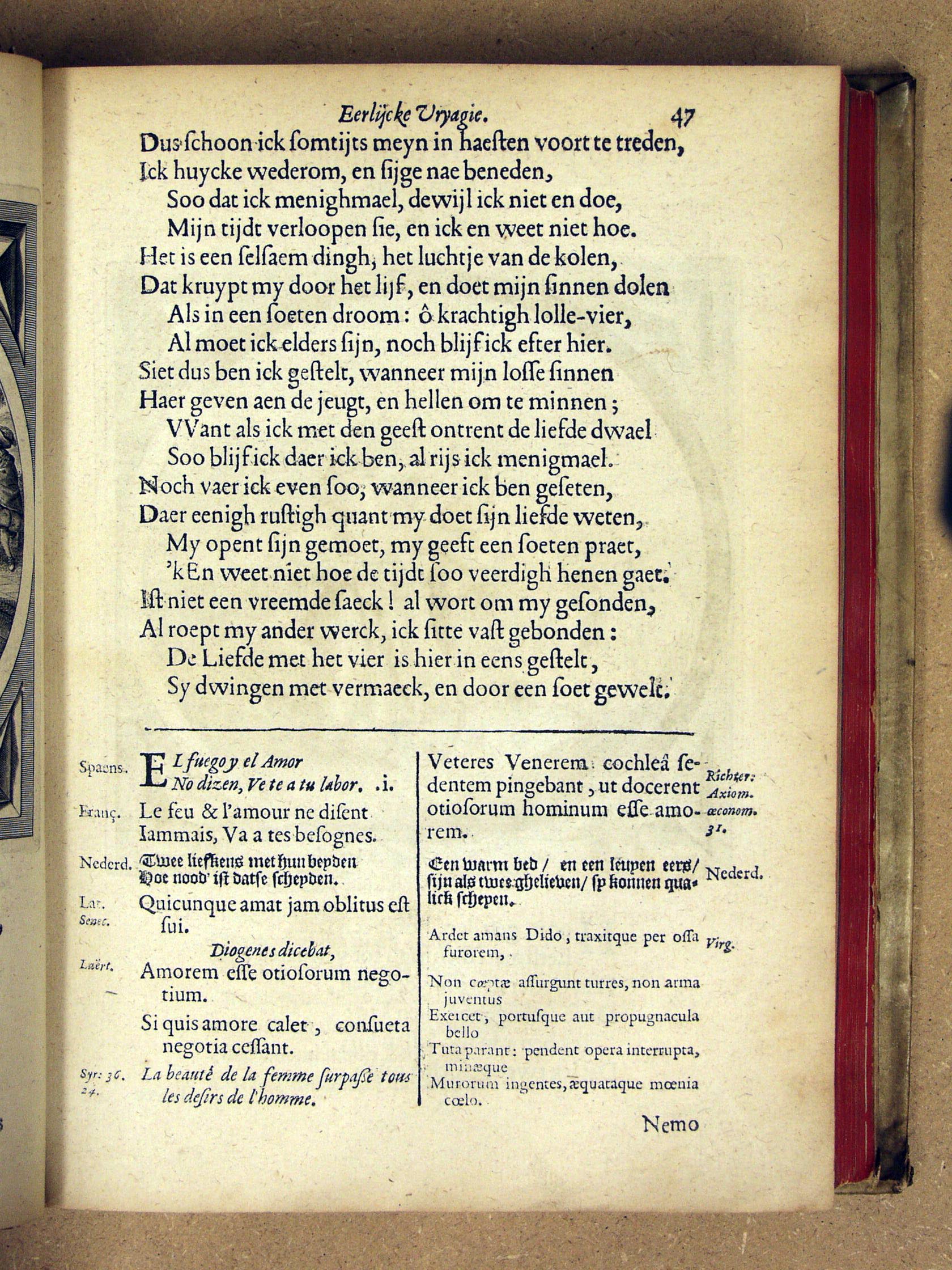
De Lolster spreeckt. Ick hebbe veel te doen in huyselicke saecken, Mijn heert is ongedweylt, mijn bedde noch te maecken, Mijn keucken ongeschickt; en des al niet te min Te gaen tot mijn beroep en heb ick genen sin. Dan ymant sal misschien hier van de reden vragen, Wel Vrijsters, tusschen ons, ick sal het u gewagen; Het vyertje datje siet dat bindt my aenden heert, Dat houdt gelijck een pick, en treckt gelijck een peert. Dus schoon ick somtijts meyn in haesten voort te treden, Ick huycke wederom, en sijge nae beneden, Soo dat ick menighmael, dewijl ick niet en doe, Mijn tijdt verloopen sie, en ick en weet niet hoe. Het is een selsaem dingh, het luchtje van de kolen, Dat kruypt my door het lijf, en doet mijn sinnen dolen Als in een soeten droom: ô krachtigh lolle-vier, Al moet ick elders sijn, noch blijf ick efter hier. Siet dus ben ick gestelt, wanneer mijn losse sinnen Haer geven aen de jeugt, en hellen om te minnen; VVant als ick met den geest ontrent de liefde dwael Soo blijf ick daer ick ben, al rijs ick menigmael. Noch vaer ick even soo, wanneer ick ben geseten, Daer eenigh rustigh quant my doet sijn liefde weten, My opent sijn gemoet, my geeft een soeten praet, 'k En weet niet hoe de tijdt soo veerdigh henen gaet. Ist niet een vreemde saeck! al wort om my gesonden, Al roept my ander werck, ick sitte vast gebonden: De Liefde met het vier is hier in eens gestelt, Sy dwingen met vermaeck, en door een soet gewelt.
TranslationAI-generated
The Fire-hugger speaks. I have much to do in household matters, My hearth is unswept, my bed still to be made, My kitchen in disorder; and nonetheless I have no desire at all to go about my business. Now someone may perhaps ask the reason for this, Well, young women, between ourselves, I shall tell you; The little fire you see there binds me to the hearth, It holds like pitch, and pulls like a horse. So, though I sometimes mean to step away in haste, I crouch down again and sink back down, So that many a time, while I do nothing, I see my time run out, and I know not how. It is a strange thing, the breath of the coals, It creeps through my body and makes my senses wander As in a sweet dream: O mighty hearth-fire, Though I must be elsewhere, yet I stay on here. See, that is how I am when my loose senses Give themselves to youth and incline to love; For when my mind goes roaming about love, I stay right where I am, though I rise many a time. And I fare just the same when I am sitting Where some quiet fellow lets me know of his love, Opens his heart to me, gives me sweet talk, I do not know how the time goes by so fast. Is it not a strange thing! though people send for me, Though other work calls me, I sit fast bound: Love and fire are here placed on a par, They compel with pleasure, and by a sweet violence.
CommentaryAI-generated
2 passages · original left, translation right (click to fold)
Spaens. El fuego y el Amor No dizen, Ve te a tu labor. .i. Franç. Le feu & l'amour ne disent Iammais, Va a tes besognes. Nederd. Twee liefkens met hun beyden / Hoe nood' ist datse scheyden. Lat. Senec. Quicunque amat jam oblitus est sui. Diogenes dicebat, Laërt. Amorem esse otiosorum negotium. Si quis amore calet, consueta negotia cessant. Syr: 36. 24. La beauté de la femme surpasse tous les desirs de l'homme. Richter: Axiom. œconom. 31. Veteres Venerem cochleâ sedentem pingebant, ut docerent otiosorum hominum esse amorem. Nederd. Een warm bed / en een leuyen eers / sijn als twee ghelieven / sy konnen qualick scheyden. Virg. Ardet amans Dido, traxitque per ossa furorem. Non coeptæ assurgunt turres, non arma juventus Exercet, portusque aut propugnacula bello Tuta parant: pendent opera interrupta, minæque Murorum ingentes, æquataque mœnia cœlo.
Spanish: Fire and Love never say, 'Go off to your work.' i.e. — French: Fire and love never say, 'Go to your tasks.' — Dutch: Two lovers together — how hard it is for them to part. — Latin, Seneca: Whoever loves has already forgotten himself. — Diogenes used to say (Laertius): that love is the business of idle people. — If anyone is warm with love, his usual occupations come to a halt. — Sirach 36:24: The beauty of a woman surpasses all the desires of a man. — Richter, Axiomata œconomica 31: The ancients painted Venus sitting on a snail, to teach that love belongs to idle men. — Dutch: A warm bed and a lazy backside are like two lovers: they can hardly be parted. — Virgil: Dido burns with love, and has drawn the frenzy through her bones. The towers she began do not rise, the young men do not practise arms, nor do they prepare harbours or ramparts safe for war; the works hang broken off, the huge threatening walls and the battlements raised to heaven.
Diogenes dicebat, Amorem esse otiosorum negotium.
Diogenes used to say that love is the business of the idle.
Iconclass
31AA235sitting figure - AA - female human figure31AA2747:41D232drawing, pulling something - AA - female human figure❧skirt31B3dream31D15adult woman33C234(lovers) caressing each other34B112(+9536)dog with bone (+ lying animal)41A621pergola41A721chair41B211warming oneself at a fire (or hearth, stove, fire-pan, brazier)41B2121fire-tongs41D221(HAT)head-gear: hat41D232skirt54AA11:56F2Sluggishness, Inertia; 'Dapocaggine', 'Pigritia' (Ripa)❧(personifications and symbolic representations of) Love; 'Amore (secondo Seneca)' (Ripa)54DD2(+4)Idleness; 'Otio' (Ripa) (+ emblematical representation of concept)86(EL FUEGO Y EL AMOR NO DIZEN VE TE A TU LABOR)proverbs, sayings, etc. (EL FUEGO Y EL AMOR NO DIZEN VE TE A TU LABOR)
Suggested Iconclass codesAI-generated
Additional codes proposed for this emblem, not (yet) part of the indexing.
41B21open hearth, fire-placehighThe correlate 'open hearth, fire-place' matches the open hearth at the left with burning logs and coals and smoke rising up the chimney beside which the woman sits.
54DD2Idleness; 'Otio' (Ripa)high'Idleness; Otio (Ripa)' matches the central theme of the slumped, work-abandoning woman with her discarded broom and the commentary's 'love is the business of idle people'.
96B3the tragedy of Dido (Virgil, Aeneid IV)low'The tragedy of Dido (Virgil, Aeneid IV)' is explicitly quoted in the commentary (Dido burning with love, the works of Carthage left interrupted), though it is not depicted in the image.
Relationships to the Adagia of ErasmusAI-generated
Suggested relationships between this emblem and adages in Erasmus’ Adagia.
- II iv 25 Aureae compedes – thematic inventiolow
The subscriptio's central conceit is a pleasurable captivity — 'ick sitte vast gebonden' and 'Sy dwingen met vermaeck, en door een soet gewelt' — which matches Erasmus's image of servitude that is 'splendid and enticing' (Seneca on loving one's fetters even when golden; Horace's lover 'grata compede vinctum').
- II i 23 Compressis manibus – thematic inventiolow
The picture shows the 'Lolster' slumped with chin on hand and the broom cast aside, doing nothing while household duties wait, which is precisely Erasmus's image of sitting 'with folded hands' as the gesture of the idle who fret but do not act.
- IV iv 57 Cochleae vita – thematic inventiolow
The Latin commentary adduces Richter's 'Veteres Venerem cochleâ sedentem pingebant, ut docerent otiosorum hominum esse amorem'; Erasmus's snail adage likewise makes the snail emblematic of a life withdrawn from business (contracti a negotiis), the idleness in which love breeds.
- II viii 97 Titio ad ignem – thematic inventiolow
Erasmus explains the 'log onto the fire' as a man given over to what he is naturally drawn to — expressly 'a lecher consigned to the society of young women' — which parallels the emblem's pairing of the hearth-fire that holds the girl fast and the amorous inclination it figures.
Sources
Record ID: embstma_1288_emblem016
This emblem on the Iconclass site: https://iconclass.org/view/embstma_1288_emblem016
Copy: University Library, Glasgow, Stirling Maxwell 1288