Jacob Cats, Spiegel (The Hague, 1632)
Emblem 27
A servant girl is offering a dish with some sausages, a gift from her master, to a young lady
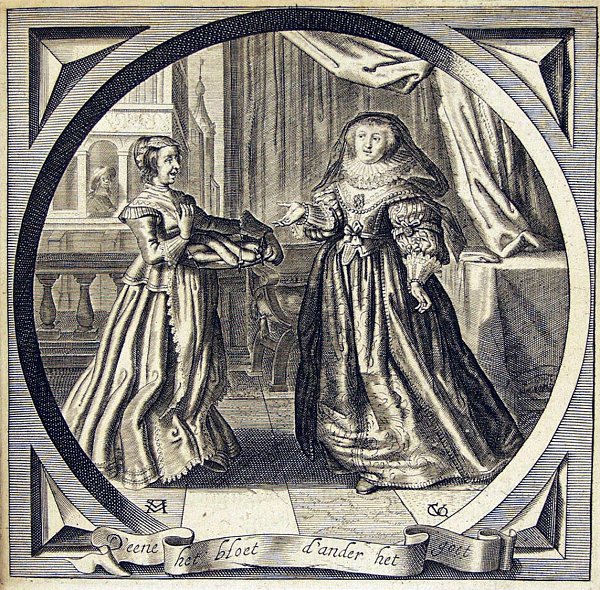
D'eene het bloet d'ander het goetDutch
The one the blood (noble birth), the other the goods (wealth).AI-generated
Description of the imageAI-generated
An interior scene set within a large oval frame, with decorative hatched spandrels in the corners. At the left a young serving-woman in a plain bodice with slashed sleeves and a cap stands holding out a folded cloth or napkin on which lie several thick sausages, offering them forward. At the right stands a richly dressed young woman in a wide, heavy gown with an embroidered stomacher, a large lace ruff, pearl jewellery and a long veil hanging from her head down her back; she holds a fan in her left hand and extends her right hand towards the offered gift. Behind them is a draped curtain, a table covered with a cloth at the right, a chair, and at the left a balustrade and a window or doorway through which a man's head and shoulders can be seen. The floor is of large square tiles. On the pavement are two small engraver's monograms. Below the oval a ribbon banderole carries the motto in script.
Subscriptio


TranscriptionAI-generated
Begaefde Iufvrou, weerde pandt, Een çierssel van dit gantsche landt, Die om u schoonheyt, om u deugt, Die om u geest en frissche jeugt Zijt aengenaem en wel gesien Van al de beste jonge lien; Besiet my niet met grammen sin, Dat ick tot u quam treden in: Ick brengh u hier (met u verlof) Ick brengh u van mijn jonckers hof Het kleyn geschenck, dat ghy hier siet, Daer med' hy u sijn gunste biet, Het is een beulingh drie of vier, Gemaeckt naer onse kocks manier, Gemaeckt voor eerst van suyver bloet, En dan van gort, en kruyt, en roet; Al stoffen van seer goede deught, Soo dat ghy die wel nutten meught. Dan eer ghy van den beulingh eet, Soo isset dienstigh dat ghy weet Als dat het vry sijn reden heeft Dat hy u desen beulingh geeft: Indien ghy tot hem waert gesint Gelijck als hy u vyerigh mint, Soo meyn ick dat u beyder trou Dees gifte wel gelijcken sou: Want siet! hy is van edel bloet, En ghy hebt groot en machtigh goet, Indien men dit te samen brengt En nae de rechte kunste mengt, Wis dit beslagh sal beter zijn Als yet dat koomt van eenigh swijn; Wel neemt dan desen beulingh aen, Het is om uwe gunst gedaen. De jonck-vrou stont een wijl en sagh, Verbaest van soo een vreemden slagh; Maer als' een weynigh had verbeyt Heeft tot haer antwoort dit geseyt: V Ioncker is een kluchtigh man, Die vry het sijne prijsen kan; Oock wortet van my niet gelaeckt, Want ick en hebbet noyt gesmaeckt; Wel segt hem dat ick dit geval Eens naerder overwegen sal. Mits gasse drinck-gelt aende meyt, En heeftse goeden dach geseyt. Dan wat den Ionckheer is geschiet Gesellen dat en segh ick niet, Maer ick beware dit geval Tot daer het beter passen sal.
TranslationAI-generated
Gifted young lady, worthy jewel, an ornament of this whole land, who for your beauty, for your virtue, who for your wit and fresh youth are pleasing and well regarded by all the best young people: do not look on me with an angry mind because I have come stepping in to you. I bring you here (by your leave), I bring you from my young master's court the small gift that you see here, with which he offers you his favour. It is three or four sausages, made after our cook's manner, made first of all of pure blood, and then of groats, and spice, and suet; all stuffs of very good quality, so that you may well enjoy them. But before you eat of the sausage, it is useful that you should know that there is indeed good reason why he gives you this sausage: if you were disposed towards him as he loves you ardently, then I think the troth of you both would be much like this gift. For see! he is of noble blood, and you have great and mighty goods; if one brings these together and mixes them according to the right art, surely this batter will be better than anything that comes from any pig. Well then, accept this sausage; it is done to win your favour. The young lady stood a while and looked, amazed at such a strange stroke; but when she had waited a little she gave this for her answer: Your young master is a droll man, who can freely praise his own; nor is it blamed by me, for I have never tasted it. Well, tell him that I shall consider this matter more closely. Thereupon she gave drink-money to the maid, and bade her good day. But what happened to the young gentleman, companions, that I do not tell; rather I keep this case until it shall fit better.
CommentaryAI-generated
2 passages · original left, translation right (click to fold)
Des Edelmans kamer-maegt spreeckt tot de rijcke vrijster.
The nobleman's chambermaid speaks to the rich marriageable girl. (marginal note)
Non abludit Apulei illud; virgo formosa etsi sit oppidò pauper, tamen abundè dotata est. Adfert quippe ad maritum novum animi indolem, pulchritudinis gratiam, floris rudimentum, &c.
Facit ad hanc rem id quod de Hipparchia, splendidâ & opulentâ virgine, memoriæ proditum est, illa enim cum philosophiæ deditissima esset Cratem Philosophum maritum sibi optare se professa est, is interscapilium retexit, quod erat gibberosum, peramque cum baculo & pallium humi posuit, professus puellæ eam sibi esse supellectilem, eamque formam quam videret; monens proinde, ut sedulò consuleret ne posteà facti pœniteret; Enimverò Hipparchia conditionem accepit, nec impar hoc sibi matrimonium existimavit, jam dudum sibi provisum satis esse & satis consultum neque ditiorem maritum neque formosiorem uspiam gentium posse inveniri, proinde duceret quo liberet; & ita Crati nupsit Hipparchia.
That saying of Apuleius is not out of tune: a beautiful maiden, even if she be exceedingly poor, is nevertheless abundantly dowered. For she brings to her husband a fresh disposition of mind, the grace of beauty, the first bloom of youth, etc.
To this matter belongs what is recorded of Hipparchia, a splendid and wealthy maiden: for since she was most devoted to philosophy, she declared that she chose Crates the philosopher for her husband. He uncovered his back, which was hunched, and laid his wallet with his staff and his cloak on the ground, declaring to the girl that this was his household furniture and this the figure she saw; warning her therefore to consider carefully, lest afterwards she should repent of the deed. But indeed Hipparchia accepted the condition, and did not think this marriage unequal for her, saying that she had long ago provided and taken counsel enough for herself, and that no richer nor handsomer husband could be found anywhere among the nations, and so he might lead her where he pleased; and thus Hipparchia married Crates.
Iconclass
86(D'EENE HET BLOET D'ANDER HET GOET)proverbs, sayings, etc. (D'EENE HET BLOET D'ANDER HET GOET)
Suggested Iconclass codesAI-generated
Additional codes proposed for this emblem, not (yet) part of the indexing.
41C693sausagehighThe correlate 'sausage' matches the several sausages wrapped in a cloth that the serving-woman holds out.
41D262fanhighThe correlate 'fan' (as a costume accessory) matches the fan held in the richly dressed lady's left hand.
42D172dowryhighThe correlate 'dowry' matches the commentary's central argument that a beautiful but poor maiden is nevertheless richly dowered.
42Dbetrothal and marriagemediumThe correlate 'betrothal and marriage' fits the theme of the marriageable girl choosing a husband, exemplified by Hipparchia's marriage to Crates.
11S711beauty, 'Pulchritudo' ~ one of the seven gifts of the bodylowThe correlate 'beauty, Pulchritudo ~ one of the seven gifts of the body' loosely echoes the commentary's listing of beauty's grace and youth's bloom as the maiden's endowment.
Relationships to the Adagia of ErasmusAI-generated
Suggested relationships between this emblem and adages in Erasmus’ Adagia.
- I iii 92 Φίλαυτοι – thematic inventiomedium
Erasmus' adage (Pittacus' advice, 'drive/whip your own top', i.e. marry a wife of your own station) is precisely the issue dramatised here: the nobleman's maid proposes a 'mixture' of noble blood and money, and the Latin commentary answers with Hipparchia and Crates, who matched themselves on virtue rather than status. The emblem's whole point is the question of marrying one's equal.
- IV iii 83 Quantum habet – thematic inventiolow
The adage ('each is only as good as he's worth') is the mercenary principle the emblem probes when the suitor offers his 'bloet' to be blended with the lady's 'goet'; Erasmus' essay quotes Apuleius' Apologia ('tanti re vera estis, quantum habetis'), the same work from which Cats takes his commentary on the poor but well-dowered beautiful girl.
- II viii 35 Pecuniae vir – thematic inventiolow
'Money makes the man' states the valuation of a person by possessions that the emblem weighs against birth and against the Apuleian/Cynic view that beauty and virtue are dowry enough.
- IV ix 79 Fumosae imagines – thematic inventiolow
Erasmus' adage mocks those who trade on ancestral nobility alone (with Juvenal's 'nobilitas sola est atque unica virtus'), which matches the gently satirised 'joncker' who offers nothing but his noble blood in exchange for the heiress's wealth.
- IV viii 65 Avis ex avibus – thematic inventiolow
Erasmus notes that nobility bought or newly acquired counts for little — exactly the transaction the emblem stages, in which wealth is to be mixed with pedigree as into a sausage.
Sources
Record ID: embstma_1288_emblem027
This emblem on the Iconclass site: https://iconclass.org/view/embstma_1288_emblem027
Copy: University Library, Glasgow, Stirling Maxwell 1288