Jacob Cats, Spiegel (The Hague, 1632)
Emblem 29
A well-dressed man is warning another man that building a complete mill just to grind one sack of grain is a bad investment

Om een mudde korens dat hy te maelen heeft, wil hy een gantsche meulen rechtenDutch
For one bushel of corn that he has to grind, he wants to erect a whole mill.AI-generated
Description of the imageAI-generated
An oval medallion within a square frame with hatched corner triangles. In the foreground of a building yard a man seen from behind carries a large, slack, mostly empty sack on his shoulder; an old bearded man in a cap steadies or peers at the sack from the left. At the right a well-dressed gentleman in a wide-brimmed hat, ruff, doublet, cloak and breeches with rosettes on his shoes stands pointing with an open hand, apparently addressing them. At the lower left a workman kneels with a mallet and chisel, dressing a block of stone beside a carpenter's trestle and tools. Behind them rises the timber framework and tall post of a windmill under construction, with scaffolding and heavy beams; a labourer at the right carries a plank or beam along a timber platform. In the distance are a town skyline with a church tower and water, and birds in the sky. A ribbon banderole with lettering runs across the bottom of the oval, with the monogram 'M' at the lower left corner and 'VQ' at the lower right.
Subscriptio

TranscriptionAI-generated
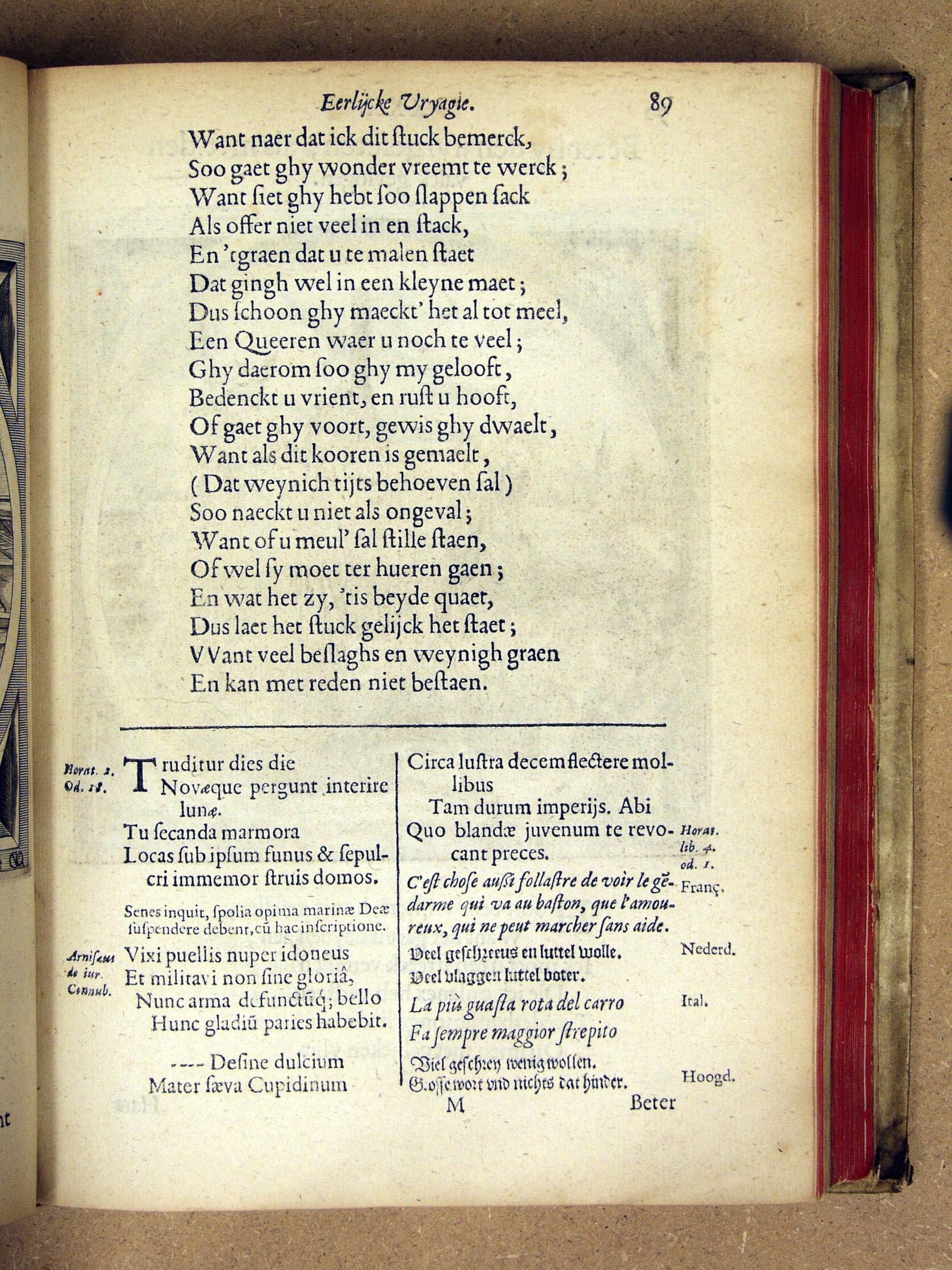
VVel vrient, waerom dit groot beslagh? Waerom doch brengje voor den dagh Dit nieu, dit hardt, dit eycken hout? Het schijnt, dat ghy een meulen bout: Een meulen, ké wat gaet u aen! Voorwaer het is te veel bestaen: Want naer dat ick dit stuck bemerck, Soo gaet ghy wonder vreemt te werck; Want siet ghy hebt soo slappen sack Als offer niet veel in en stack, En 'tgraen dat u te malen staet Dat gingh wel in een kleyne maet; Dus schoon ghy maeckt' het al tot meel, Een Queeren waer u noch te veel; Ghy daerom soo ghy my gelooft, Bedenckt u vrient, en rust u hooft, Of gaet ghy voort, gewis ghy dwaelt, Want als dit kooren is gemaelt, ( Dat weynich tijts behoeven sal ) Soo naeckt u niet als ongeval; Want of u meul' sal stille staen, Of wel sy moet ter hueren gaen; En wat het zy, 'tis beyde quaet, Dus laet het stuck gelijck het staet; VVant veel beslaghs en weynigh graen En kan met reden niet bestaen.
TranslationAI-generated
Well, friend, why all this great to-do? Why then do you bring out this new, this hard, this oaken timber? It seems that you are building a mill: a mill — come now, what are you about! Truly it is undertaking too much: for as far as I can see this business, you are going about it most strangely; for look, you have so slack a sack as though there were not much in it, and the grain you have to grind would well go into a small measure; so even if you turned it all into flour, a hand-mill would still be too much for you; therefore, if you believe me, think again, friend, and rest your head; or if you go on, surely you are straying, for when this corn is ground (which will need but little time) nothing but misfortune awaits you; for either your mill will stand idle, or else it must be let out for hire; and whichever it is, both are bad, so leave the matter as it stands; for much ado and little grain cannot reasonably go together.
CommentaryAI-generated
1 passages · original left, translation right (click to fold)
Horat. 2. Od. 18. Truditur dies die Novæque pergunt interire lunæ. Tu secanda marmora Locas sub ipsum funus & sepulcri immemor struis domos.
Senes inquit, spolia opima marinæ Deæ suspendere debent, cu hac inscriptione.
Arnisæus de iur. Connub. Vixi puellis nuper idoneus Et militavi non sine gloriâ, Nunc arma defunctûq; bello Hunc gladiû paries habebit.
---- Desine dulcium Mater sæva Cupidinum Circa lustra decem flectere mollibus Tam durum imperijs. Abi Quo blandæ juvenum te revocant preces. Horat. lib. 4. od. 1.
Franç. C'est chose aussi follastre de voir le gēdarme qui va au baston, que l'amoureux, qui ne peut marcher sans aide.
Nederd. Veel geschreeus en luttel wolle. Veel vlaggen luttel boter.
Ital. La più guasta rota del carro Fa sempre maggior strepito
Hoogd. Viel geschrey wenig wollen. Grosse wort vnd nichts dar hinder.
Horace, Odes 2.18: Day is pushed onward by day, and new moons hasten on to perish. You contract for marble to be cut on the very eve of your funeral, and, forgetful of the grave, you build houses. — Old men, he says, ought to hang up the rich spoils to the sea-goddess, with this inscription. — Arnisaeus, On the Law of Marriage: Until lately I lived fit for girls and campaigned not without glory; now this wall shall hold my arms and the sword discharged from war. — Cease, cruel mother of sweet Cupids, to bend with your soft commands one hardened by some fifty years. Go away, where the coaxing prayers of young men call you back. Horace, book 4, ode 1. — French: It is as foolish a thing to see the man-at-arms who walks with a staff as the lover who cannot walk without help. — Low German (Dutch): Much crying and little wool. Much flapping, little butter. — Italian: The most damaged wheel of the cart always makes the greatest noise. — High German: Much crying, little wool. Big words and nothing behind them.
Iconclass
86(OM EEN MUDDE KORENS DAT HY TE MAELEN HEEFT, WIL HY EEN GANTSCHE MEULEN RECHTEN)proverbs, sayings, etc. (OM EEN MUDDE KORENS DAT HY TE MAELEN HEEFT, WIL HY EEN GANTSCHE MEULEN RECHTEN)
Suggested Iconclass codesAI-generated
Additional codes proposed for this emblem, not (yet) part of the indexing.
31D160Old Age, 'Senectus'; 'Vecchiezza' (Ripa)mediumThe correlate 'Old Age' fits the emblem's central theme of the aged man (the bearded old man with the sack) who, 'forgetful of the grave', still builds and behaves like a youth.
31E211death in old agelow'Death in old age' echoes the Horatian motto about contracting for marble 'on the very eve of your funeral', though no death is actually depicted.
Relationships to the Adagia of ErasmusAI-generated
Suggested relationships between this emblem and adages in Erasmus’ Adagia.
- II viii 91 Tragoedias in nugis agere – thematic inventiomedium
The emblem's whole point — erecting an entire windmill to grind one small measure of grain ('veel beslaghs en weynigh graen') — is exactly Erasmus's figure of raising a huge commotion over a trifle; Quintilian's image quoted in the essay (fitting Hercules' mask and buskins on infants) parallels the mill built for a nearly empty sack.
- I ix 14 Parturiunt montes, nascetur ridiculus mus – thematic inventiomedium
The classic Erasmian adage for a vast apparatus producing a ridiculously small result, which is precisely the emblem's moral of a whole mill for a bushel of corn, echoed in the vernacular tags 'Veel geschreeus en luttel wolle' / 'Viel geschrey wenig wollen.'
- III iii 96 Quid de pusillis magna prooemia? – thematic inventiomedium
Erasmus's adage insists the scale of the apparatus should match the size of the matter ('as great as the business is, so great let your speech be'), which is the emblem's argument that the mill must be proportionate to the grain to be ground.
- IV v 30 Mira de lente – thematic inventiolow
Like the emblem, the adage mocks lavishing grand means on a trivial object (a magnificent encomium for a lentil = a whole mill for a handful of grain).
- I ix 69 Elephantum ex musca facis – thematic inventiolow
The emblem dramatizes the same disproportion between tiny substance and enormous construction that Erasmus illustrates by making an elephant out of a fly, matching the Dutch/German tags about much noise and little wool.
- III viii 15 In senem libidinosum – thematic inventiolow
The Latin commentary (Horace Odes 2.18 and 4.1, the old soldier hanging up his arms, the French line on the aged lover who cannot walk unaided) develops Erasmus's theme of the old man undertaking what his remaining age and powers cannot sustain.
Sources
Record ID: embstma_1288_emblem029
This emblem on the Iconclass site: https://iconclass.org/view/embstma_1288_emblem029
Copy: University Library, Glasgow, Stirling Maxwell 1288