Jacob Cats, Spiegel (The Hague, 1632)
Emblem 33
A young woman walks while holding a very fragile bottle
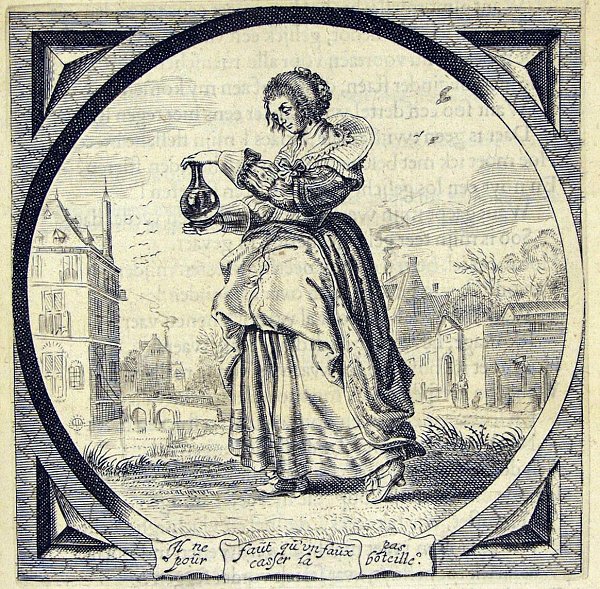
Il ne faut qu'un faux pas pour casser la boteilleFrench
It takes only one false step to break the bottle.AI-generated
Description of the imageAI-generated
Within a thick oval frame set in a rectangular border with hatched corner triangles, a young woman in a long full-skirted gown with a lace collar, puffed sleeves and an apron-like overskirt walks along a path in the open air. She is seen mostly from behind, turning her head to the left in profile; her hair is curled and dressed high. In her outstretched left hand she holds up a glass flask or carafe by its neck, supporting it from below with her other hand. Behind her at the left is a tall gabled town house beside a river with an arched stone bridge; to the right are village houses with smoking chimneys, a small church-like doorway, bare trees and distant figures. Birds fly in the sky. At the bottom of the oval a ribbon-like banderole in three sections carries the motto in script: 'Il ne faut qu'un faux pas pour casser la boteille.'
Subscriptio


TranscriptionAI-generated
De Maegt, die de flessche draegt, spreeckt My is een teer gelas, dat niet en is te wagen, My is een broose fles bevolen om te dragen, My is ter hant gedaen een kranck, en tanger vat, Daer in besloten light een snel, een vluchtigh nat; Een vocht dat dierbaer is, dat niet en is te kopen Wanneer het maer een reys aen yemant is ontlopen, Een nat, een seltsaem nat, dat als een rijp verdwijnt Soo haest een laeuwe son maer eens daer op en schijnt. Hoe moet ick nu voortaen op alle dingen letten! Hoe seker moet ick gaen! hoe vast mijn voeten setten! Want glipt my slechts het been maer eens ter zijden uyt Soo ligh ick daer bedot, gelijck een vuyle bruyt. Hoe moet ick nu voortaen voor alle menschen schromen, Die hier, of ginder staen, die by, of aen my komen! Want soo een dertel wight maer eens hier tegen steeckt Daer is geen twijffel aen, eylaes! mijn flessche breeckt. Hoe moet ick met bescheyt mijn gantsche leden stieren, En noyt een los gesicht int wilde laten swieren! Want gaept mijn weeligh oogh en hier en weder daer Soo is mijn teer gelas geduerigh in gevaer. Hoe moet ick boven dat my neerstigh leeren mijden Van onrust, van gewoel, van over al te rijden! Want siet! ick lijde noot al waer ick henen vaer, Ick drage, lieve vrient, ick drage teere waer. Hoe moet ick boven al my wachten van te mallen, Want soo ick spelen wil, soo moet de flessche vallen, En schoon die maer en hort, en niet in stucken brack, Noch ben ick evenwel niet sonder ongemack: Ach door 'ken weet niet wat soo is de geest vervlogen, En wie dit naemaels koopt die isser aen bedrogen, Gelooftet, wie het raeckt, dit snel en vluchtigh vocht Is stracx (men weet niet hoe) verdwenen inde locht. Wat sal ick tot besluyt, wat sal ick vorder seggen? De reden die ick spreeck is niet te weder-leggen, Sy dient gants vast te gaen, en noyt te zijn gewaegt Die in een teer gelas haer gantsche schatten draegt.
TranslationAI-generated
The maid who carries the bottle speaks Mine is a fragile glass, which must not be risked, Mine is a brittle flask entrusted to me to carry, Into my hand has been given a weak and slender vessel, In which is enclosed a swift, a volatile liquid; A fluid that is precious, that cannot be bought Once it has run away from someone even a single time, A liquid, a rare liquid, that vanishes like hoarfrost As soon as a mild sun once shines upon it. How must I from now on take heed of everything! How surely must I walk! how firmly set my feet! For if my leg should slip but once to the side, There I lie fooled, like a dirty bride. How must I from now on be fearful of all people, Who stand here or there, who come near or at me! For if some wanton creature once jostles against it, There is no doubt of it, alas! my bottle breaks. How must I guide all my limbs with discretion, And never let a loose glance rove about wildly! For if my wanton eye gapes here and there, Then my fragile glass is constantly in danger. How must I besides diligently learn to avoid Unrest, bustle, and riding about everywhere! For see! I suffer peril wherever I go, I carry, dear friend, I carry fragile ware. How must I above all beware of frolicking, For if I want to play, the bottle must fall, And even though it only knocks and does not break in pieces, Still I am nevertheless not without trouble: Ah, through I know not what, the spirit has flown away, And whoever afterwards buys this is cheated in it, Believe it, whoever it concerns, this swift and volatile liquid Is at once (one knows not how) vanished into the air. What shall I say in conclusion, what further shall I say? The argument I speak cannot be contradicted: She must walk entirely firmly, and never be risked, Who carries her whole treasure in a fragile glass.
CommentaryAI-generated
1 passages · original left, translation right (click to fold)
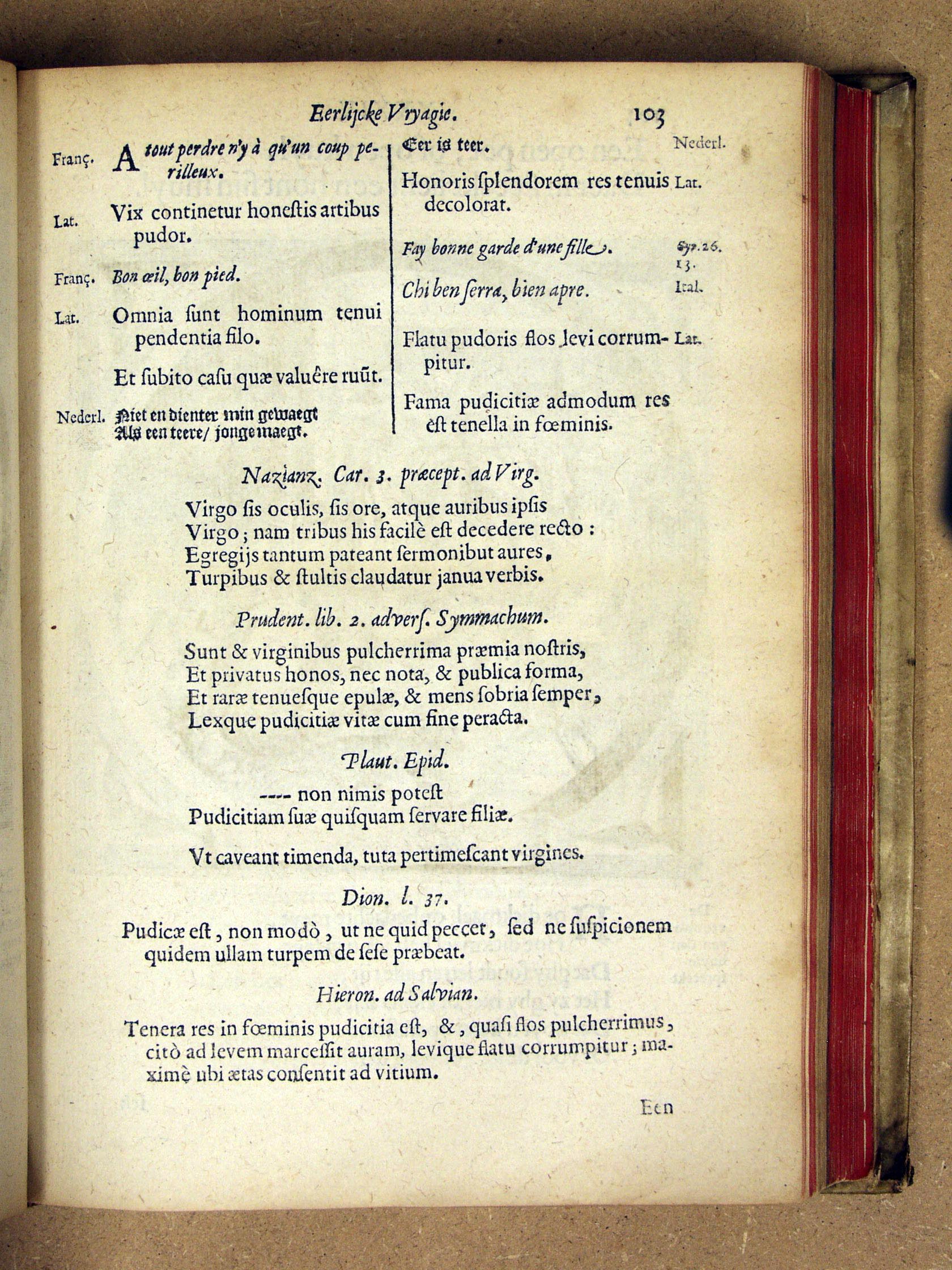
Franç. A tout perdre n'y à qu'un coup perilleux. Lat. Vix continetur honestis artibus pudor. Franç. Bon œil, bon pied. Lat. Omnia sunt hominum tenui pendentia filo. Et subito casu quæ valuêre ruũt. Nederl. Niet en dienter min gewaegt / Als een teere / jonge maegt.
Nederl. Eer is teer. Lat. Honoris splendorem res tenuis decolorat. Syr. 26. 13. Fay bonne garde d'une fille. Ital. Chi ben serra, bien apre. Lat. Flatu pudoris flos levi corrumpitur. Fama pudicitiæ admodum res est tenella in fœminis.
Nazianz. Car. 3. præcept. ad Virg. Virgo sis oculis, sis ore, atque auribus ipsis Virgo; nam tribus his facilè est decedere recto: Egregijs tantum pateant sermonibut aures, Turpibus & stultis claudatur janua verbis.
Prudent. lib. 2. advers. Symmachum. Sunt & virginibus pulcherrima præmia nostris, Et privatus honos, nec nota, & publica forma, Et raræ tenuesque epulæ, & mens sobria semper, Lexque pudicitiæ vitæ cum fine peracta.
Plaut. Epid. ---- non nimis potest Pudicitiam suæ quisquam servare filiæ.
Vt caveant timenda, tuta pertimescant virgines.
Dion. l. 37. Pudicæ est, non modò, ut ne quid peccet, sed ne suspicionem quidem ullam turpem de sese præbeat.
Hieron. ad Salvian. Tenera res in fœminis pudicitia est, &, quasi flos pulcherrimus, citò ad levem marcessit auram, levique flatu corrumpitur; maximè ubi ætas consentit ad vitium.
French: When all is to be lost, there is but one dangerous throw. Latin: Modesty is scarcely kept safe by honest arts. French: A good eye, a good foot. Latin: All human things hang by a slender thread, and what once was strong falls by a sudden chance. Dutch: Nothing ought to be less risked than a tender young maid.
Dutch: Honour is fragile. Latin: A slight thing tarnishes the splendour of honour. Sirach 26:13 — French: Keep good watch over a daughter. Italian: He who shuts well, opens well. Latin: The flower of modesty is spoiled by a light breath. The reputation of chastity is a very delicate thing in women.
Gregory Nazianzen, Poem 3, precepts to virgins: Be a virgin in your eyes, in your mouth, and in your very ears A virgin; for in these three it is easy to depart from the right: Let your ears lie open only to excellent speech, And let the door be closed to shameful and foolish words.
Prudentius, book 2 against Symmachus: Our virgins too have the fairest rewards, And a private honour, a beauty neither noted nor public, And rare and slender meals, and a mind always sober, And the law of chastity fulfilled with the end of life.
Plautus, Epidicus: ---- no one can guard his daughter's chastity too carefully.
Let virgins beware of what is to be feared, and dread even what is safe.
Dio, book 37: It belongs to a chaste woman not only to commit no fault, but not even to give any shameful suspicion of herself.
Jerome, to Salvianus: Chastity in women is a tender thing, and, like a most beautiful flower, it quickly withers at a slight breeze and is spoiled by a light breath; especially when youth inclines towards vice.
Iconclass
86(IL NE FAUT QU'UN FAUX PAS POUR CASSER LA BOTEILLE)proverbs, sayings, etc. (IL NE FAUT QU'UN FAUX PAS POUR CASSER LA BOTEILLE)
Suggested Iconclass codesAI-generated
Additional codes proposed for this emblem, not (yet) part of the indexing.
33C812chastityhighThe correlate 'chastity' is the central theme: the fragile flask the girl carries stands for the easily broken chastity/honour of a young maiden, as the commentary on female chastity makes explicit.
33C813defence of chastitymediumThe correlate 'defence of chastity' matches the admonitory content ('Keep good watch over a daughter', 'no one can guard his daughter's chastity too carefully', 'he who shuts well, opens well').
31A7211virginitymediumThe correlate 'virginity' fits the repeated exhortations to virgins (Gregory Nazianzen, Prudentius) and the young unmarried woman depicted as the bearer of the fragile vessel.
51GG3Fragility; 'Fragilità' (Ripa)mediumThe correlate 'Fragility' corresponds directly to the motto that a single false step breaks the bottle and to the stated maxim 'Honour is fragile'.
57A641Discretion, Modesty; 'Discretione', 'Modestia' (Ripa)lowThe correlate 'Discretion, Modesty' echoes the commentary's recurring 'flower of modesty' and 'modesty scarcely kept safe', though no Ripa personification is actually depicted.
Relationships to the Adagia of ErasmusAI-generated
Suggested relationships between this emblem and adages in Erasmus’ Adagia.
- I ix 72 De pilo pendet. De filo pendet – thematic inventiohigh
The emblem's Latin commentary gives the proverbial tag 'Omnia sunt hominum tenui pendentia filo. Et subito casu quæ valuêre ruunt' — exactly the proverb of things hanging by a slender thread that Erasmus collects under 'De filo pendet' (where he cites Ennius' 'filo pendebit Hetruria tota' and Synesius' 'life hangs by a fine thread'). The maid's precarious glass flask visualises the same idea of a precious thing held by the slightest security.
- I v 20 Flamma fumo est proxima – thematic inventiomedium
Erasmus explains this adage precisely as a warning to flee the occasion of danger — 'whoever wishes not to be corrupted should avoid bad company; if one does not wish to lie with a girl one should not kiss her.' The emblem's whole lesson (avoid crowds, jostling, roving eyes, frolicking, riding about) is this same doctrine of shunning the occasions that would break the fragile glass of chastity.
- II i 70 Pudor in oculis – thematic inventiomedium
The subscriptio insists 'never let a loose glance rove about wildly... if my wanton eye gapes here and there, my fragile glass is in danger', and the commentary quotes Nazianzen's 'Virgo sis oculis' — the same proverbial doctrine that modesty resides in (and is lost through) the eyes which Erasmus expounds under 'In oculis pudor'.
- I ii 64 Ubi timor, ibi et prudor – thematic inventiolow
The commentary's maxim 'Ut caveant timenda, tuta pertimescant virgines' (let maidens dread even what is safe) and the maid's constant fear of a false step restate the proverbial link between fear and modesty that Erasmus treats under 'Where there is fear, there is modesty' (licence breeds shamelessness).
Sources
Record ID: embstma_1288_emblem033
This emblem on the Iconclass site: https://iconclass.org/view/embstma_1288_emblem033
Copy: University Library, Glasgow, Stirling Maxwell 1288