Jacob Cats, Spiegel (The Hague, 1632)
Emblem 34
In the background a lady is reprimanding a servant girl, while in the foreground a dog is sticking his head in a cauldron that has tipped over

Een open pot, of open kuyl, Daer in steeckt licht een hont sijn muylLatin
An open pot, or an open pit — a dog easily sticks his snout into it.AI-generated
Description of the imageAI-generated
An oval medallion set in a rectangular frame with dark hatched corner spandrels. Inside, a domestic kitchen interior: at the right a fire blazes on the hearth, and a large copper kettle or cauldron with an arched handle has been tipped over on its side on the floor, its lid off; a lean, spotted hound thrusts its muzzle deep into the mouth of the pot. Spilled food, a dish, and scattered pieces lie on the tiled floor beside the pot, with a pot-hook or trivet at the left. In the middle ground three women stand in a panelled room: at the left a young girl in a ruff and dark gown; in the centre an older woman in a ruff, cap and wide skirt who stretches out her arm and points, apparently scolding; at the right a maidservant in apron and cap who covers her face with her hands as if weeping. Behind them a framed landscape picture hangs on the wall, with a window and a doorway to the right. A banderole at the foot of the medallion carries the motto in cursive script.
Subscriptio



TranscriptionAI-generated
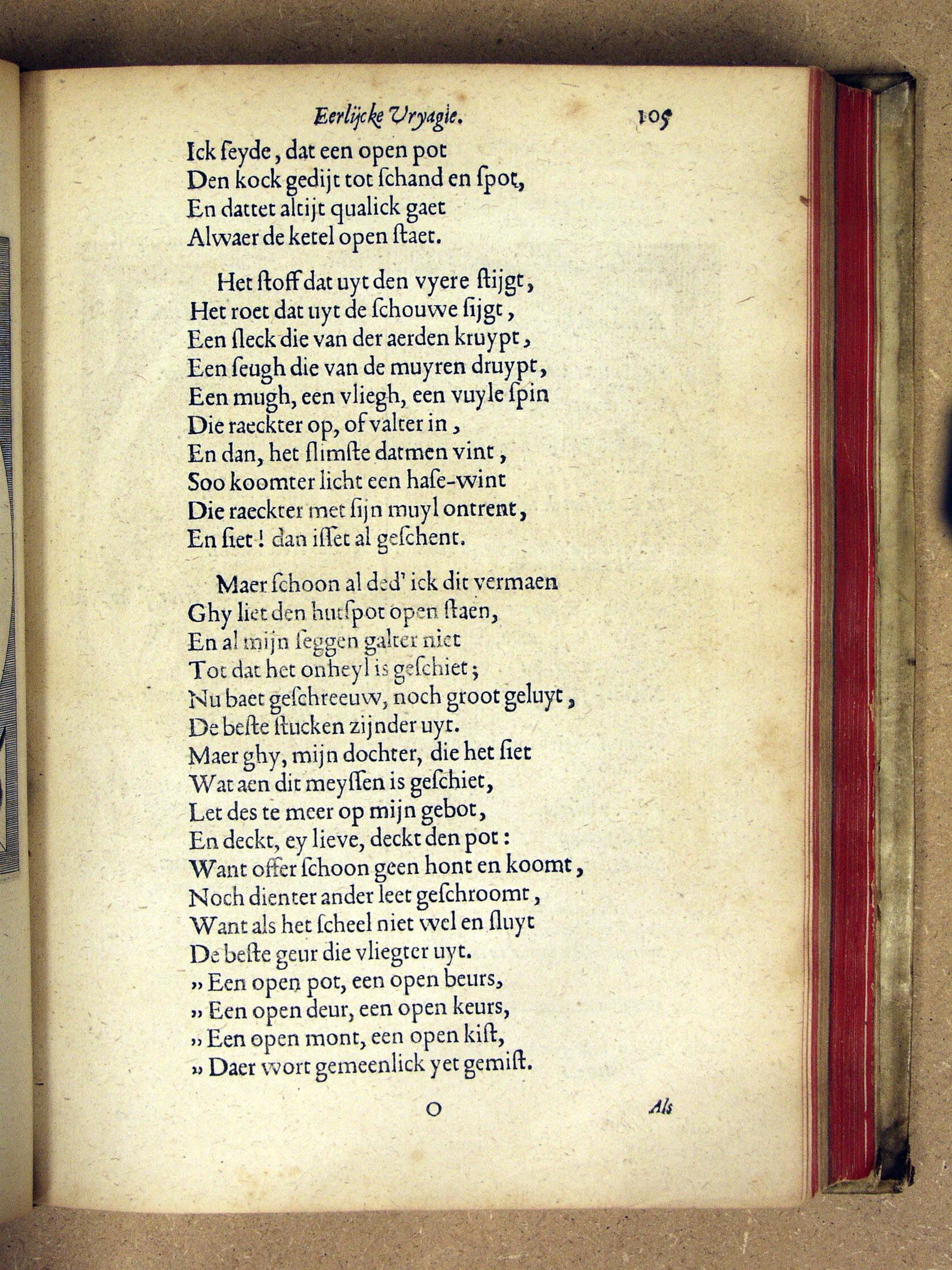
Hoe dickmael, onbedachte meyt, Hoe dickmael heb ick u geseyt Dat ghy soudt letten alle tijt, Het zy ghy hier of elders zijt, Dat noyt u ketel open stont Of voor de kat, of voor den hont; Ick seyde, dat een open pot Den kock gedijt tot schand en spot, En dattet altijt qualick gaet Alwaer de ketel open staet. Het stoff dat uyt den vyere stijgt, Het roet dat uyt de schouwe sijgt, Een sleck die van der aerden kruypt, Een seugh die van de muyren druypt, Een mugh, een vliegh, een vuyle spin Die raeckter op, of valter in, En dan, het slimste datmen vint, Soo koomter licht een hase-wint Die raeckter met sijn muyl ontrent, En siet! dan isset al geschent. Maer schoon al ded' ick dit vermaen Ghy liet den hutspot open staen, En al mijn seggen galter niet Tot dat het onheyl is geschiet; Nu baet geschreeuw, noch groot geluyt, De beste stucken zijnder uyt. Maer ghy, mijn dochter, die het siet Wat aen dit meyssen is geschiet, Let des te meer op mijn gebot, En deckt, ey lieve, deckt den pot: Want offer schoon geen hont en koomt, Noch dienter ander leet geschroomt, Want als het scheel niet wel en sluyt De beste geur die vliegter uyt. » Een open pot, een open beurs, » Een open deur, een open keurs, » Een open mont, een open kist, » Daer wort gemeenlick yet gemist.
TranslationAI-generated
How often, thoughtless maid, how often have I told you that you should always take care, whether you are here or elsewhere, that your kettle should never stand open, either to the cat or to the dog; I said that an open pot brings the cook shame and mockery, and that things always go badly wherever the kettle stands open. The dust that rises from the fire, the soot that sinks down from the chimney, a slug that crawls up from the ground, a damp drip that trickles from the walls, a gnat, a fly, a filthy spider — one gets onto it, or falls into it; and then, the worst thing one can find, there easily comes a greyhound that gets at it with his snout, and look! then it is all spoiled. But although I gave this warning, you let the stew-pot stand open, and all my talk was of no avail until the mishap had happened; now neither shouting nor loud noise helps, the best pieces are out of it. But you, my daughter, who see what has happened to this girl, pay all the more heed to my command, and cover — oh please — cover the pot: for even if no dog comes, there is still other harm to be feared, since when the lid does not close properly the best savour flies out of it. » An open pot, an open purse, » an open door, an open bodice, » an open mouth, an open chest — » there something is usually lost.
CommentaryAI-generated
2 passages · original left, translation right (click to fold)
Nederl. Schoone lieden en gescheurde schorte-kleeden hebben veel aenstoots.
Elck steeckt naer een schoone vrou/ als de vogelen na den uyl.
Ital. Chi ha cavallo bianco è bella moglie Non è mai senza doglie.
Nederl. Een sweert/ een peert/ een schoone vrou Leent niemant uyt als met berou.
Hoogd. Daß ist boß su hüten daß ieder man gefelt.
La beauté sert de taborin.
Nederl. 't Slot is qualijck te bewaren daer elck den sleutel van heeft.
Spaens. Al que tiene muger hermosa, O castillo en frontera, O viña en carrera Nunca le falta guerra.
Lat. Formosa facies muta commendatio est.
Spaens. Viña, y niña, Peral y hauar Son malos de guardar.
Franç. La vigne & la fille Le poirier & febues, aux champs Sont malaisé à garder en tout temps.
Nederl. Een schoonen roof maeckt een dief.
Franç. Qui à belle femme & chasteau en frontiere Iamais luy manque debat ny guerre.
Lat. Matura virgo inter eas res est quæ servando servari non possunt.
Spaens. Puerta abierta, al santo tienta. .i. La porte ouverte tente le saint.
Spaens. El aguiero illama al ladro. .i. Le treu appelle le larron.
Lat. Occasio facit furem.
Spaens. Ni quien se escuse de errar si no huye la occasion. .i. Personne ne peut s'exempter de pecher, s'il n'en fuit l'occasion.
Dit spreeck-woort kan oock ghepast werden op de gene die te open van monde zijn.
Nederl. Een open deur/ een open mont Dat seylter menigh in den gront.
Ital. Parola detta è sasso tratto Non può mai tornar à dietro.
Hoogd. Wenn daß word heraus ist/ so ist es eines andern.
Ital. A bocca serrata non entra mosca. Servo d'altrui si fa Chi dice il suo secreto a chi non sa.
Nederl. Swijgen is kunst/ Klappen maeckt ongunst.
Ital. Chi parla semina, chi tace ricoglia.
Ital. Chi poco considera, presto parle. Niun tacer fu mai scritto.
Dutch: Fair people and torn aprons meet with much offence. — Everyone makes for a fair woman as the birds do for the owl. Italian: He who has a white horse and a beautiful wife is never without troubles. Dutch: A sword, a horse, a beautiful wife — lend them to nobody except with regret. High German: That is hard to guard which pleases every man. French: Beauty serves as a drum (to attract attention). Dutch: The lock is hard to keep safe of which everyone has the key. Spanish: He who has a beautiful wife, or a castle on the frontier, or a vineyard beside the road, never lacks war. Latin: A beautiful face is a silent recommendation. Spanish: Vineyard and girl, pear tree and bean field, are hard to guard. French: The vine and the daughter, the pear tree and the beans in the fields, are at all times hard to guard. Dutch: A fine booty makes a thief. French: He who has a beautiful wife and a castle on the frontier never lacks quarrel or war. Latin: A ripe maiden is among those things which cannot be kept by keeping. Spanish: An open door tempts the saint; i.e. (French) the open door tempts the saint. Spanish: The hole calls the thief; i.e. (French) the hole calls the thief. Latin: Opportunity makes the thief. Spanish: Nor is there anyone who may excuse himself from erring if he does not flee the occasion; i.e. (French) no one can exempt himself from sinning if he does not flee the occasion. — This proverb can also be applied to those who are too open of mouth. Dutch: An open door, an open mouth — many a one sails to the bottom through them. Italian: A word spoken is a stone thrown; it can never come back again. High German: When the word is out, it belongs to another. Italian: Into a shut mouth no fly enters. He makes himself another's servant who tells his secret to one who does not know it. Dutch: Silence is an art; chattering makes ill will. Italian: He who speaks sows, he who is silent reaps. Italian: He who considers little speaks quickly. No silence was ever written down (held against one).
Tot besluyt van desen/ bidde ick den leser/ dit quaet exempel tot goet te willen gebruycken:
Als vveligh Lijsje gister nacht Een bastaert kint had voort-gebracht, Mits sy int kraem ontijdigh viel Al eerse feest of bruyloft hiel; Een oudt, een vvijs, een deftigh man Die gaffer dese reden van:
» Een vvijngaert dichte by de stadt, » Een boom met freuyten aen den padt, » Een slot dat op de grensen staet, » Een vvijf dat veel laveyen gaet, » Een schoone, jonge, vlugge maegt, » Gekust, gelekt, gestreelt, gevraegt, » Zijn dingen die een handigh man » Met toesien niet bevvaren kan.
In conclusion of this, I ask the reader to be willing to turn this bad example to good:
When wanton Lijsje last night had brought forth a bastard child, since she came untimely into childbed before she had held feast or wedding, an old, a wise, a worthy man gave this reason for it:
» A vineyard close by the town, » a tree with fruit beside the path, » a castle that stands on the border, » a wife who goes much gadding about, » a fair, young, lively maid, kissed, licked, caressed, courted — » these are things that no clever man can protect by watching.
Iconclass
86(EEN OPEN POT, OF OPEN KUYL, DAER IN STEECKT LICHT EEN HONT SIJN MUYL)proverbs, sayings, etc. (EEN OPEN POT, OF OPEN KUYL, DAER IN STEECKT LICHT EEN HONT SIJN MUYL)
Suggested Iconclass codesAI-generated
Additional codes proposed for this emblem, not (yet) part of the indexing.
41C211kitchen-interiorhighThe scene is literally a kitchen-interior with hearth fire, cauldron, pot-hook and dish, matching 'kitchen-interior'.
41C2111kitchen-interior with foodstuffs in foreground (Dutch: 'keukenstuk')lowSpilled food, a dish and scattered pieces lie in the foreground of the kitchen, loosely matching a 'keukenstuk' with foodstuffs in the foreground, though the focus is narrative rather than a still-life display.
86proverbs, sayings, etc.highThe medallion with banderole motto illustrates proverbs ('opportunity makes the thief', 'an open door tempts the saint'), i.e. 'proverbs, sayings, etc.'.
86(...)proverbs, sayings, etc. (with TEXT)mediumThe emblem carries a specific proverbial motto in the banderole, so the 'proverbs, sayings, etc. (with TEXT)' form applies when the motto text is supplied.
22D9silencelowThe commentary's second application praises keeping quiet ('silence is an art', 'he who is silent reaps'), touching the abstract concept of silence, though it is not visually depicted.
Relationships to the Adagia of ErasmusAI-generated
Suggested relationships between this emblem and adages in Erasmus’ Adagia.
- III x 41 Tollenda mali occasio – thematic inventiomedium
The emblem's whole moral — cover the pot, since an open pot (purse, door, bodice, mouth) invites loss — is the lesson 'remove the opportunity for evil'; the commentary makes this explicit with 'Occasio facit furem' and 'no one can exempt himself from sinning if he does not flee the occasion', while Erasmus's essay likewise cites riches tempting to luxury and familiarity with girls to lust.
- II vii 70 Phani ostium – thematic inventiomedium
Erasmus's adage is used of someone who guards something in vain, especially a husband who jealously bolts his door yet is cuckolded; this is precisely the burden of the emblem's commentary ('the lock is ill kept of which everyone has the key', 'a ripe maiden cannot be kept by keeping', the vineyard, castle and girl no watchful man can guard).
- III i 18 Levissima res oratio – thematic inventiomedium
The applied sense of the proverb in the commentary ('too open of mouth') is illustrated by 'Parola detta è sasso tratto / Non può mai tornar à dietro' and 'When the word is out, it belongs to another' — exactly the Menandrian comparison of a stone thrown from the hand and a word sent from the tongue that Erasmus develops in this adage ('once sent, the word irrevocably flies').
- I iv 3 Fenestram aperire, et similes metaphorae – thematic inventiolow
Erasmus explains opening a window or door as 'giving an occasion, a handle' for wickedness (Terence: 'what a window onto wickedness you have opened'), which is the governing image of 'an open pot, an open purse, an open door, an open mouth' and of 'the open door tempts the saint'.
- III iv 47 Os infrene – thematic inventiolow
Erasmus's adage, with its image of the mouth lacking a door or gate (ἀπύλωτον, ἀθύρωτον στόμα), matches the emblem's secondary application to those who are 'too open of mouth' and the lidless pot as emblem of an unclosed mouth.
Sources
Record ID: embstma_1288_emblem034
This emblem on the Iconclass site: https://iconclass.org/view/embstma_1288_emblem034
Copy: University Library, Glasgow, Stirling Maxwell 1288