Jacob Cats, Spiegel (The Hague, 1632)
Emblem 37
A furrier about to catch a cat; in the background a father warning his daughter about a scoundrel

Die een schoone kat heeft, en dient gheen bont-wercker in huys te brengenDutch
He who has a fine cat should not bring a furrier into the house.AI-generated
Description of the imageAI-generated
Within an oval frame set in a square border with hatched spandrels, a bearded man in a tall pointed fur-trimmed cap and a heavy fur-lined cloak strides forward with his legs wide apart, holding out in both hands a soft fur cap or round bundle of fur. At his feet, on a path in the foreground, a large tabby cat crouches, facing the viewer. At the right, two women in wide ruffs, plumed hats and long gowns stand together watching. The background shows a flat landscape with low bushes, a windmill at the far left, clouds, and a few birds in the sky. A banderole across the bottom of the plate carries a handwritten-style motto; the engravers' names appear at the lower corners.
Subscriptio

TranscriptionAI-generated
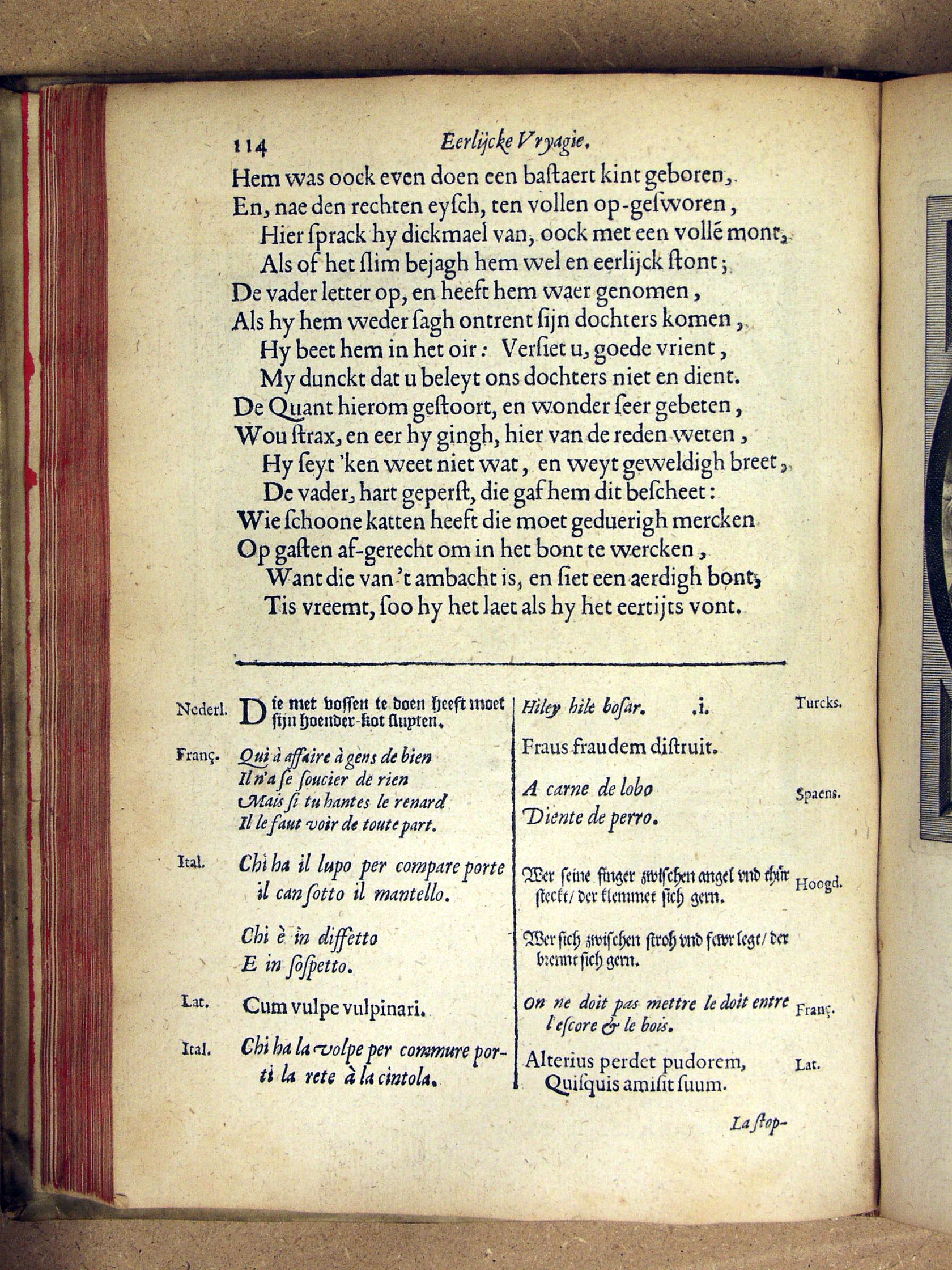
Een man had in sijn huys een hoop van jonge maegden Die menigh jongh-gesel met allen wel behaegden; Dies quã de steedsche jeugt daer meest dé gantsché dach, En nam daer soet vermaeck, gelijck de jonckheyt plach; Van allen wasser een, die inde vreemde landen Een leven had geleyt als buyten alle banden, Geen meyt en woonter by die niet een fellen strijt Die niet een harden storm, op haren maegdom lijt; Hem was oock even doen een bastaert kint geboren, En, nae den rechten eysch, ten vollen op-gesworen, Hier sprack hy dickmael van, oock met een vollé mont, Als of het slim bejagh hem wel en eerlijck stont; De vader letter op, en heeft hem waer genomen, Als hy hem weder sagh ontrent sijn dochters komen, Hy beet hem in het oir: Versiet u, goede vrient, My dunckt dat u beleyt ons dochters niet en dient. De Quant hierom gestoort, en wonder seer gebeten, Wou strax, en eer hy gingh, hier van de reden weten, Hy seyt 'ken weet niet wat, en weyt geweldigh breet, De vader, hart geperst, die gaf hem dit bescheet: Wie schoone katten heeft die moet geduerigh mercken Op gasten af-gerecht om in het bont te wercken, Want die van 't ambacht is, en siet een aerdigh bont, Tis vreemt, soo hy het laet als hy het eertijts vont.
TranslationAI-generated
A man had in his house a number of young maidens who pleased many a young fellow exceedingly well; so the town's youth came there most of the whole day, and took sweet pleasure there, as young people are wont to do; among them all there was one who, in foreign lands, had led a life as though free of all restraints. No maidservant lived near him who did not suffer a fierce battle, who did not endure a hard storm upon her virginity; a bastard child had just then been born to him too, and, according to proper legal demand, fully sworn upon him; he often spoke of this, and with a full mouth too, as if the base pursuit became him well and honourably. The father took note, and watched him closely; when he saw him come again near his daughters, he bit him in the ear (whispered to him): Look out for yourself, good friend, it seems to me your conduct does not suit our daughters. The rogue, annoyed at this, and wonderfully stung, wanted at once, before he went, to know the reason for it; he says, 'I don't know what,' and spreads himself mightily. The father, hard pressed, gave him this answer: He who has fine cats must constantly keep watch for guests trained to work in fur; for whoever is of the trade and sees a pretty pelt — it is a wonder if he leaves it as he first found it.
CommentaryAI-generated
13 passages · original left, translation right (click to fold)
Nederl. Die met vossen te doen heeft moet sijn hoender-kot sluyten.
Dutch: He who has to do with foxes must shut up his hen-house.
Franç. Qui à affaire à gens de bien Il n'a se soucier de rien Mais si tu hantes le renard Il le faut voir de toute part.
French: He who deals with honest folk need worry about nothing; but if you keep company with the fox, you must watch him on every side.
Ital. Chi ha il lupo per compare porte il can sotto il mantello.
Italian: He who has the wolf for a godfather carries the dog under his cloak.
Chi è in diffetto E in sospetto.
He who is at fault is under suspicion.
Lat. Cum vulpe vulpinari.
Latin: To play the fox with a fox.
Ital. Chi ha la volpe per commure porti la rete à la cintola.
Italian: He who has the fox for a gossip (godfather) should carry the net at his belt.
Hiley hile bosar. .i. (Turcks.)
Turkish: Guile undoes guile, that is:
Fraus fraudem distruit.
Fraud destroys fraud.
A carne de lobo Diente de perro. (Spaens.)
Spanish: For wolf's flesh, a dog's tooth.
Hoogd. Wer seine finger zwischen angel vnd thür steckt/ der klemmet sich gern.
High German: He who puts his fingers between the hinge and the door readily gets them pinched.
Wer sich zwischen stroh vnd fewr legt/ der brennt sich gern.
He who lies down between straw and fire readily burns himself.
Franç. On ne doit pas mettre le doit entre l'escore & le bois.
French: One should not put one's finger between the bark and the wood.
Lat. Alterius perdet pudorem, Quisquis amisit suum.
Latin: Whoever has lost his own sense of shame will destroy another's.
Iconclass
86(DIE EEN SCHOONE KAT HEEFT, EN DIENT GHEEN BONT-WERCKER IN HUYS TE BRENGEN)proverbs, sayings, etc. (DIE EEN SCHOONE KAT HEEFT, EN DIENT GHEEN BONT-WERCKER IN HUYS TE BRENGEN)
Suggested Iconclass codesAI-generated
Additional codes proposed for this emblem, not (yet) part of the indexing.
34B12cathighThe correlate 'cat' matches the large tabby cat crouching in the foreground of the plate.
57AA6131Guile, Artfulness, Craftiness, DeceitfulnessmediumThe correlate 'Guile, Artfulness, Craftiness, Deceitfulness' matches the emblem's Turkish motto 'Guile undoes guile' and the fox-proverbs about cunning.
57AA621Cheat, Deceit; 'Fraude', 'Inganno' (Ripa)medium'Cheat, Deceit; Fraude, Inganno' corresponds to the commentary's 'Fraud destroys fraud' and the warnings about being deceived by the sly.
57AA613Cunning, Slyness; 'Astutia ingannevole' (Ripa)low'Cunning, Slyness; Astutia ingannevole' fits the proverbial sly fox one must watch on every side, though it overlaps with the other deceit personifications.
25F23(FOX)beasts of prey, predatory animals: foxlow'Beasts of prey: fox' is central to the mottoes ('to play the fox with a fox', guarding the hen-house), though the fox itself is not actually depicted.
Relationships to the Adagia of ErasmusAI-generated
Suggested relationships between this emblem and adages in Erasmus’ Adagia.
- I ii 28 Vulpinari cum vulpe – direct mottohigh
The emblem's multilingual commentary gives as its Latin equivalent proverb 'Lat. Cum vulpe vulpinari', which is precisely Erasmus's adage I ii 28 (Ἀλωπεκίζειν πρὸς ἑτέραν ἀλώπεκα / Vulpinari cum vulpe), matching the surrounding fox-proverbs about dealing warily with a cunning guest.
- I iv 10 Ovem lupo commisisti – thematic inventiohigh
The subscriptio's story — a father warning off a notorious seducer who frequents his houseful of young daughters — is exactly the situation of Erasmus's adage, which Erasmus illustrates with Terence's Chaerea, the young man to whom a maiden was entrusted ('what an excellent guardian of sheep is a wolf').
- IV vii 91 Ut lupus ovem – thematic inventiomedium
Erasmus's essay describes exactly the emblem's moral: the young man who 'pursues a young girl to rob her of her chastity' only feigns love, as the wolf 'loves' the sheep; the furrier who cannot leave a fine pelt as he found it is the same figure.
- I i 70 Homo homini lupus – thematic inventiolow
The emblem's accompanying wolf-proverbs ('He who has the wolf for a godfather carries the dog under his cloak') and its warning not to trust a guest of known character echo Erasmus's point that one should beware an unknown man as of a wolf.
- II ii 63 Fallacia alia aliam trudit – thematic inventiolow
The Turkish/Latin pair in the commentary, 'Hiley hile bosar / Fraus fraudem destruit' (guile undoes guile), corresponds to Erasmus's adage that one deceit drives out another, the standard Latin tag for meeting trickery with trickery.
Sources
Record ID: embstma_1288_emblem037
This emblem on the Iconclass site: https://iconclass.org/view/embstma_1288_emblem037
Copy: University Library, Glasgow, Stirling Maxwell 1288