Jacob Cats, Spiegel (The Hague, 1632)
Emblem 67

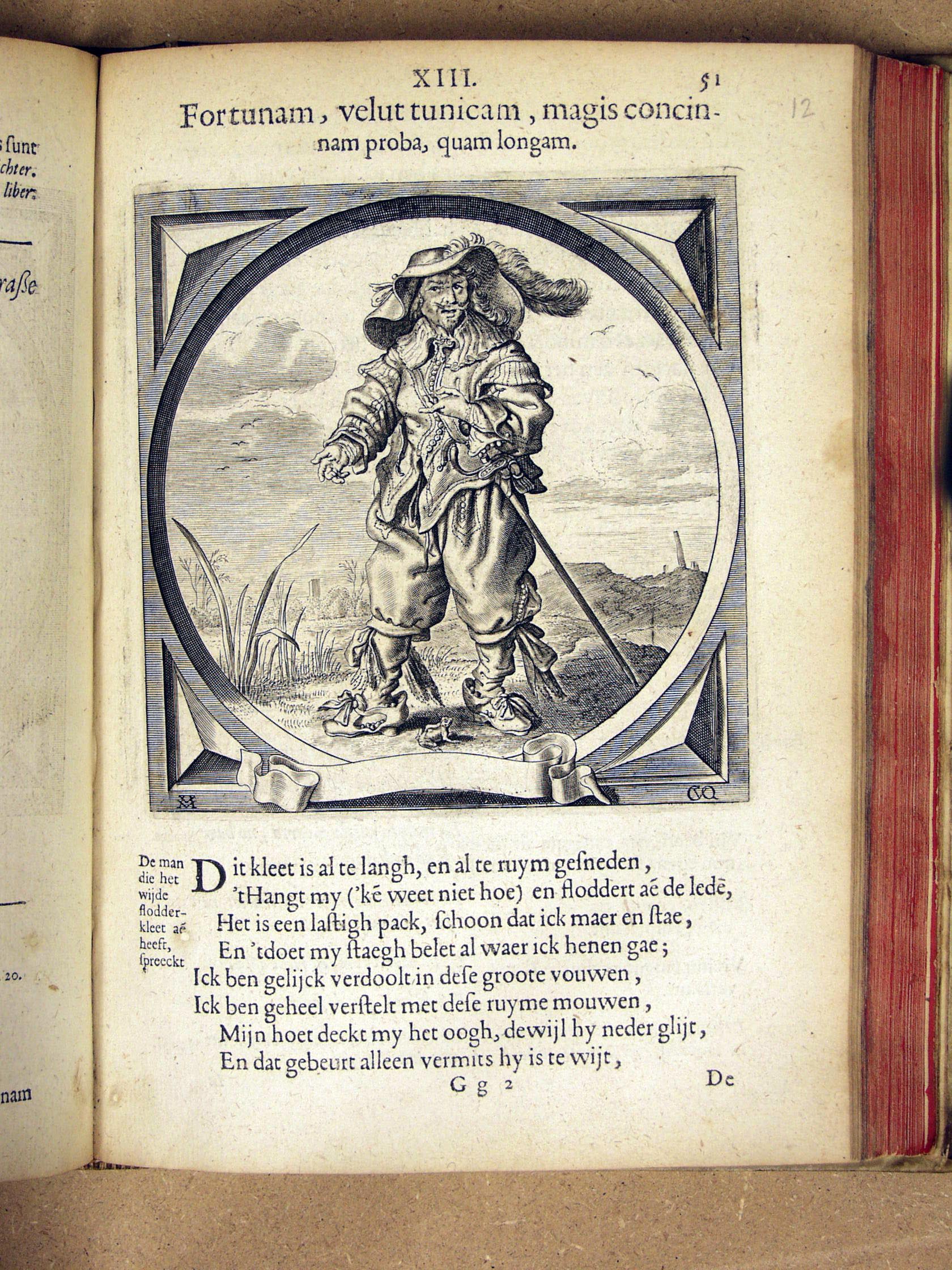
Fortunam, velut tunicam, magis concinnam proba, quam longamLatin
Approve of fortune, as of a tunic, rather well-fitting than long.AI-generated
Description of the imageAI-generated
Within a square plate containing a large oval frame (with hatched spandrels and a blank scroll-banderole across the bottom), a standing man is shown full length in an open landscape. He wears an enormous wide-brimmed hat with a huge drooping plume that slips down over his eyes, a lace-edged collar, and a loose, much too wide doublet with baggy, over-long sleeves; a cloak or scarf hangs over his left arm and a rapier hangs at his side, its point projecting behind him. His breeches are wide and slack, tied with ribbons at the knee, and his boots/shoes are far too large, with flapping tops and ribbon rosettes; a small stone or pebble lies on the ground between his feet. He gestures outward with his open right hand while his left holds part of the garment. Behind him is a low landscape with reeds and grasses at the left, a distant village or ruin, hills and a tower at the right, clouds and birds in the sky. Small engravers' monograms appear in the lower left and lower right corners of the plate.
Subscriptio



TranscriptionAI-generated
Dit kleet is al te langh, en al te ruym gesneden, 'tHangt my ('ké weet niet hoe) en floddert aé de ledé, Het is een lastigh pack, schoon dat ick maer en stae, En 'tdoet my staegh belet al waer ick henen gae; Ick ben gelijck verdoolt in dese groote vouwen, Ick ben geheel verstelt met dese ruyme mouwen, Mijn hoet deckt my het oogh, dewijl hy neder glijt, En dat gebeurt alleen vermits hy is te wijt, De koussen, die ghy siet, sijn lasten aende beenen, En in dees groote schoen daer vallen kleyne steenen, En ick en weet niet wat, dus ben ick gants verstelt, En blijve dickmael staen te midden op het velt. Ick ben een reysend' man, en hebbe veel te dwalen, Nu op een hoogen bergh, en dan in laege dalen, Nu op een driftich sant, dan op een gladde baen, My dient geen flodder-kleet om wel te mogen gaen; Voorwaer een minder rock die sou my beter passen, Die staet my aen het lijf, als uyt het lijf gewassen; Ick prijse boven al een knap, een matigh kleet, Al wat daer boven gaet, en is maer enckel leet. Wat mogen even-staegh, wat mogen alle menschen Gelt, have, renten, landt, als sonder eynde wenschen? Men segge watmen wil, die ruymen noodruft heeft Die ist die alder-best, en onbekommert leeft. Een rock niet al te ruym, niet aen het lijf gespannen, Dat is het beste kleet voor vrouwen ende mannen, Want al wat nae den eysch niet aen de leden past, En is maer ongemack, en niet als enckel last.
TranslationAI-generated
This garment is far too long and cut far too wide; it hangs on me (I do not know how) and flaps about my limbs. It is a troublesome burden, even when I am only standing still, and it always hinders me wherever I go. I am as it were lost in these great folds, I am quite bewildered by these roomy sleeves; my hat covers my eye because it slips down, and that happens only because it is too wide. The stockings you see are burdens on my legs, and into these great shoes little stones fall, and I do not know what else, so that I am utterly at a loss and often stand still in the middle of the field. I am a travelling man and have much wandering to do, now on a high mountain, then in low valleys, now on drifting sand, then on a slippery road; a flapping garment is no use to me for walking well. Truly a smaller coat would suit me better; it sits on my body as if it had grown out of it. Above all I praise a neat, moderate garment: whatever goes beyond that is nothing but affliction. Why do all people continually wish for money, goods, rents and land without end? Say what one will: he who has ample necessities is the one who lives best of all and free from care. A coat not too wide, not tight on the body, that is the best garment for women and men; for whatever does not fit the limbs as it should is nothing but discomfort and nothing but sheer burden.
CommentaryAI-generated
62 passages · original left, translation right (click to fold)
De man die het wijde flodder-kleet aé heeft, spreeckt
The man who has the wide, flapping garment on speaks (marginal note).
Franç. Les trop longues robbes empeschent le corps. Et les richesses mondaines l'ame.
French: Too long robes hinder the body, and worldly riches the soul.
Lat. Exiguum natura desiderat.
Latin: Nature desires but little.
Ital. Assai è ricco, à chi non manca.
Italian: He is rich enough who lacks nothing.
Lat. Viri beati vita castigata sit ut non egena sic egenæ proxima.
Latin: Let the life of a happy man be restrained, so that, while not needy, it is yet close to neediness.
Spaens. La quinta rueda al carro, no haze si no embaraçar.
Spanish: The fifth wheel on the cart does nothing but get in the way.
Miseros reputa qui nimiâ felicitate torpescunt.
Consider them wretched who grow sluggish through too much good fortune.
Franç. La cinquiesme roüe au chariot ne fait qu'empescher.
French: The fifth wheel on the wagon does nothing but hinder.
Vivitur exiguo melius, si noveris uti.
One lives better on little, if you know how to use it.
Qui à pour vivre, est riche assez.
He who has enough to live on is rich enough.
Peu de bien, peu de soucy.
Little property, little worry.
Franç. De peu de rente on vit honestement, Le vray tresor est le contentement.
French: On a small income one lives honourably; the true treasure is contentment.
Hoogd. Die armut ist ein ehrlich ding / wer mit vmb kan gehn.
High German: Poverty is an honourable thing, for him who knows how to deal with it.
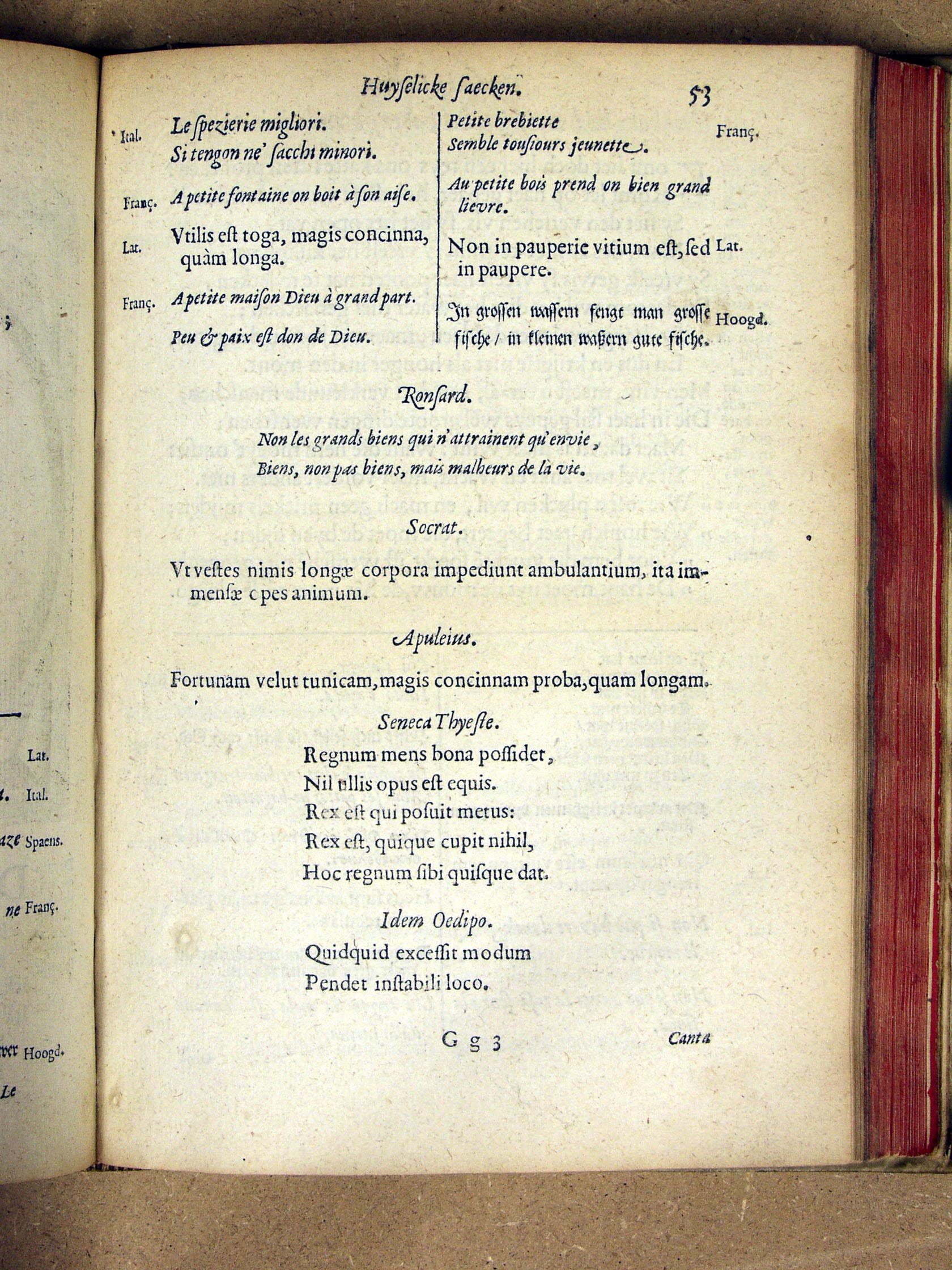
Ital. Le spezierie migliori. Si tengon ne' sacchi minori.
Italian: The best spices are kept in the smallest sacks.
Franç. Petite brebiette Semble tousiours jeunette.
French: A little ewe always seems young.
Franç. A petite fontaine on boit à son aise.
French: At a small fountain one drinks at one's ease.
Au petite bois prend on bien grand lievre.
In a small wood one may well catch a big hare.
Lat. Vtilis est toga, magis concinna, quàm longa.
Latin: A gown is useful when well-fitting rather than long.
Lat. Non in pauperie vitium est, sed in paupere.
Latin: The fault lies not in poverty, but in the poor man.
Franç. A petite maison Dieu à grand part.
French: In a small house God has a large share.
Peu & paix est don de Dieu.
Little and peace is a gift of God.
Hoogd. In grossen wassern fengt man grosse fische / in kleinen wassern gute fische.
High German: In great waters one catches big fish, in small waters good fish.
Ronsard. Non les grands biens qui n'attrainent qu'envie, Biens, non pas biens, mais malheurs de là vie.
Ronsard: Not great possessions, which draw only envy — possessions that are not possessions, but misfortunes of life.
Socrat. Vt vestes nimis longæ corpora impediunt ambulantium, ita immensæ opes animum.
Socrates: As over-long clothes hinder the bodies of those who walk, so do immense riches hinder the mind.
Apuleius. Fortunam velut tunicam, magis concinnam proba, quam longam.
Apuleius: Approve of fortune, as of a tunic, rather well-fitting than long.
Seneca Thyeste. Regnum mens bona possidet, Nil ullis opus est equis. Rex est qui posuit metus: Rex est, quique cupit nihil, Hoc regnum sibi quisque dat.
Seneca, in Thyestes: A good mind possesses a kingdom; there is no need of any horses. He is a king who has laid aside fear; he is a king who desires nothing: this kingdom each man gives to himself.
Idem Oedipo. Quidquid excessit modum Pendet instabili loco.
The same, in Oedipus: Whatever has exceeded measure hangs in an unstable place.
De Leser beelde sich in, een kat, ontrent eé tobbe met water sittéde, daer visch in leght, de kat daer op loeréde, en haré poot uyt-stekende, maer niet in't water dervéde tasten.
Let the reader imagine a cat sitting near a tub of water in which a fish lies, the cat lurking after it and stretching out her paw, but not daring to reach into the water.
Nederl. Een luype kat / Eet nimmer sat / Mits sy het nat / Te bijster mijt. Ghy / soeckje wat / Onthoudt vry dat / Men krijgt geen schat / Ten zy met vlijt.
Dutch: A lurking cat never eats its fill, since it shuns the wet too much. You, if you seek something, remember well that one gets no treasure except by diligence.
Met arbeydt krijghtmen vyer uytten steen.
By labour one gets fire out of the stone.
Lat. Qui nucleum esse vult, nucem frangat oportet.
Latin: He who wants to eat the kernel must crack the nut.
Ital. Non si può havere il mele senza le mosche.
Italian: One cannot have honey without the flies.
Non si può haver la rosa senza la spina.
One cannot have the rose without the thorn.
Ital. Chi s'ajuta, Iddio l'ajuta.
Italian: Who helps himself, God helps him.
Hoogd. Helfft euch selbst / so helfft euch God.
High German: Help yourselves, and God will help you.
Franç. Du poisson le chat tresbien mangeroit, Mais ses pattes ne bagneroit.
French: The cat would very gladly eat the fish, but would not wet her paws.
Griecx. Σῦκα φίλ' ὀρνίθεσσι φυτεύειν δ' οὐκ ἐθέλουσι.
Greek: Figs are dear to birds, but they are not willing to plant them.
Lat. Ficus sunt avibus gratæ, at plantare recusant.
Latin: Figs are pleasing to birds, but they refuse to plant them.
Nederl. De spreeuwen willen wel korsen eten / maer geen boomen planten.
Dutch: Starlings are willing enough to eat cherries, but not to plant trees.
Ital. Chi fugge la mola, si allontana dalla farina.
Italian: He who flees the millstone keeps away from the flour.
Griecx. ὁ γὰρ φεύγων μύλον ἄλφιτα φεύγει.
Greek: For he who shuns the mill shuns the barley-meal.
Franç. La mere des sciences est labeur.
French: The mother of the sciences is labour.
Hoogd. Wer eyer wil haben / der mot der hennen kakelen lijden.
High German: Whoever wants eggs must put up with the hens' cackling.
Franç. On ne prend pas des truytes à brajes seches.
French: One does not catch trout with dry breeches.
Ital. Gatto guantato non prese mai sorzi.
Italian: A gloved cat never caught mice.
Griecx. Ἁπλᾶ γὰρ ἐστι τῆς ἀληθείας ἔπη.
Greek: For the words of truth are simple.
Lat. Sunt verba veritatis simplicissima.
Latin: The words of truth are utterly simple.
Hoogd. Die warheit darff nit viel reuck.
High German: Truth needs no great perfume.
Nederl. Gemaelde bloemen riecken niet.
Dutch: Painted flowers have no scent.
Lat. Oratio amici simplex est, adulatoris habet fucatum nitorem.
Latin: A friend's speech is plain; a flatterer's has a painted gloss.
Falsa fucis, turpia phaleris indigent.
False things need paint, base things need trappings.
Veritas per se placet, Honesta per se decent.
Truth pleases of itself; honourable things are of themselves becoming.
Nederl. Op een verbrande vlade dient sucker gestroyt.
Dutch: On a burnt custard-tart sugar must be strewn.
Spaens. A casas vieias, puertas nuevas.
Spanish: To old houses, new doors.
Franç. A vieille maison porte neuve.
French: To an old house, a new door.
Franç. A vieux cheval bride rouge.
French: For an old horse, a red bridle.
Spaens. A burra vieja cincha amarilla.
Spanish: For an old she-ass, a yellow girth.
Franç. A vieille asnesse sangle jaune.
French: For an old she-ass, a yellow girth.
A vieil bœuf sonnette neuve.
For an old ox, a new bell.
Spaens. A buey vieio cencerro nuevo.
Spanish: For an old ox, a new cowbell.
Marius apud Salustium. Non sunt composita verba mea. parvi id facio. Ipsa se virtus satis ostendit: illis artificio opus est, ut turpia facta oratione tegant.
Marius in Sallust: My words are not studied; I care little for that. Virtue shows itself well enough of itself: those others need artifice, to cover their base deeds with speech.
Idem. Munditias mulieribus, viris laborem convenire.
The same: Elegance befits women, labour befits men.
Iconclass
86(FORTUNAM, VELUT TUNICAM, MAGIS CONCINNAM PROBA, QUAM LONGAM)proverbs, sayings, etc. (FORTUNAM, VELUT TUNICAM, MAGIS CONCINNAM PROBA, QUAM LONGAM)
Suggested Iconclass codesAI-generated
Additional codes proposed for this emblem, not (yet) part of the indexing.
45C13(RAPIER)hacking and thrusting weapons: rapierhighThe man wears a rapier at his side, matching 'hacking and thrusting weapons: rapier'.
25I5landscape with tower or castlemediumThe background is an open landscape with a distant village/ruin, hills and a tower, matching 'landscape with tower or castle'.
54A43Temperance, Moderation; 'Misura' (Ripa)highThe whole moral — 'let the life of a happy man be restrained', 'whatever has exceeded measure hangs in an unstable place', a tunic better fitting than long — is an allegory of Temperance/Moderation.
56B3Satisfaction, Contentment; 'Contento' (Ripa)mediumThe commentary explicitly states 'the true treasure is contentment' and 'he is rich enough who lacks nothing', matching Satisfaction/Contentment.
55BB1Poverty; 'Povertà', 'Povertà del doni', 'Povertà in uno ch'habbia bell'ingegno' (Ripa)mediumThe text repeatedly praises modest means — 'Poverty is an honourable thing, for him who knows how to deal with it' and 'the fault lies not in poverty, but in the poor man' — matching the personification of Poverty.
Relationships to the Adagia of ErasmusAI-generated
Suggested relationships between this emblem and adages in Erasmus’ Adagia.
- IV i 25 Ficus avibus gratae – direct mottohigh
The record's commentary quotes the adage verbatim in both Greek and Latin: 'Σῦκα φίλ' ὀρνίθεσσι φυτεύειν δ' οὐκ ἐθέλουσι' / 'Ficus sunt avibus gratæ, at plantare recusant', used (with the Dutch starling variant) to gloss the cat-and-fish piece about those who want the profit but shun the labour — exactly Erasmus's application 'in voluptarios, ac fugitantes honesti laboris, cum tamen appetant emolumentum'.
- I vi 62 Neque mel neque apes – thematic inventiohigh
The cat-emblem subscriptio's sententiae 'Wie honich-raet begeert, die moet de byen lijden' and the Italian 'Non si può havere il mele senza le mosche' reproduce the point of Erasmus's adage: he who will not endure the bees' stings cannot enjoy the honey, since advantage always comes joined to inconvenience.
- II v 46 Ne supra pedem calceus – thematic inventiomedium
The whole emblem — and especially the engraving's absurdly oversized shoes with flapping tops into which 'kleyne steenen' fall — enacts Erasmus's precept that the shoe should not be bigger than the foot, i.e. one should not live more grandly than one's condition allows.
- III vi 67 Herculis cothurnos aptare infanti – thematic inventiomedium
Erasmus's essay closes with Agesilaus' dictum that no cobbler is good who puts a big shoe on a small foot, 'significans orationem oportere cum re congruere, non aliter, quam vestis convenire debet corpori' — precisely the emblem's image of clothing that must fit the limbs ('al wat nae den eysch niet aen de leden past... is maer ongemack').
- I vi 96 Ne quid nimis – thematic inventiomedium
The emblem's moral — 'Ick prijse boven al een knap, een matigh kleet, / Al wat daer boven gaet, en is maer enckel leet', reinforced by Seneca's 'Quidquid excessit modum pendet instabili loco' — is the commonplace of moderation that Erasmus treats under this adage.
- I vi 92 Intra tuam pelliculam te contine – thematic inventiomedium
Erasmus uses this adage to warn against forgetting one's station and aiming at more than one's means allow; the emblem's over-wide, over-long garment that hinders the wearer is a visual version of the same warning (fortune should fit, like a tunic).
- I vi 88 Messe tenus propria vive – thematic inventiolow
The subscriptio's rejection of endless wishing for 'Gelt, have, renten, landt' in favour of sufficiency ('die ruymen noodruft heeft... leeft onbekommert') matches Erasmus's adage on living within the measure of one's own resources.
- I ix 95 Dimidium plus toto – thematic inventiolow
Erasmus explains this riddling adage as a commendation of the golden mean, where taking the whole is harmful and the half is 'moderatum' — the same logic as the emblem's preference for a 'matigh kleet' over a longer, richer one.
- I iii 88 Veritatis simplex oratio – direct mottolow
The third piece in this record ('Een vuyle bruyt heeft veel parerens aen') cites 'Ἁπλᾶ γὰρ ἐστι τῆς ἀληθείας ἔπη / Sunt verba veritatis simplicissima', which is the Euripidean tag Erasmus collects as the adage on the simplicity of truthful speech against the flatterer's painted gloss.
Sources
Record ID: embstma_1288_emblem067
This emblem on the Iconclass site: https://iconclass.org/view/embstma_1288_emblem067
Copy: University Library, Glasgow, Stirling Maxwell 1288