Jacob Cats, Spiegel (The Hague, 1632)
Emblem 122

Een oudt voer-man hoort geerne 't geklap van de sweepDutch
An old wagon-driver gladly hears the cracking of the whip.AI-generated
Description of the imageAI-generated
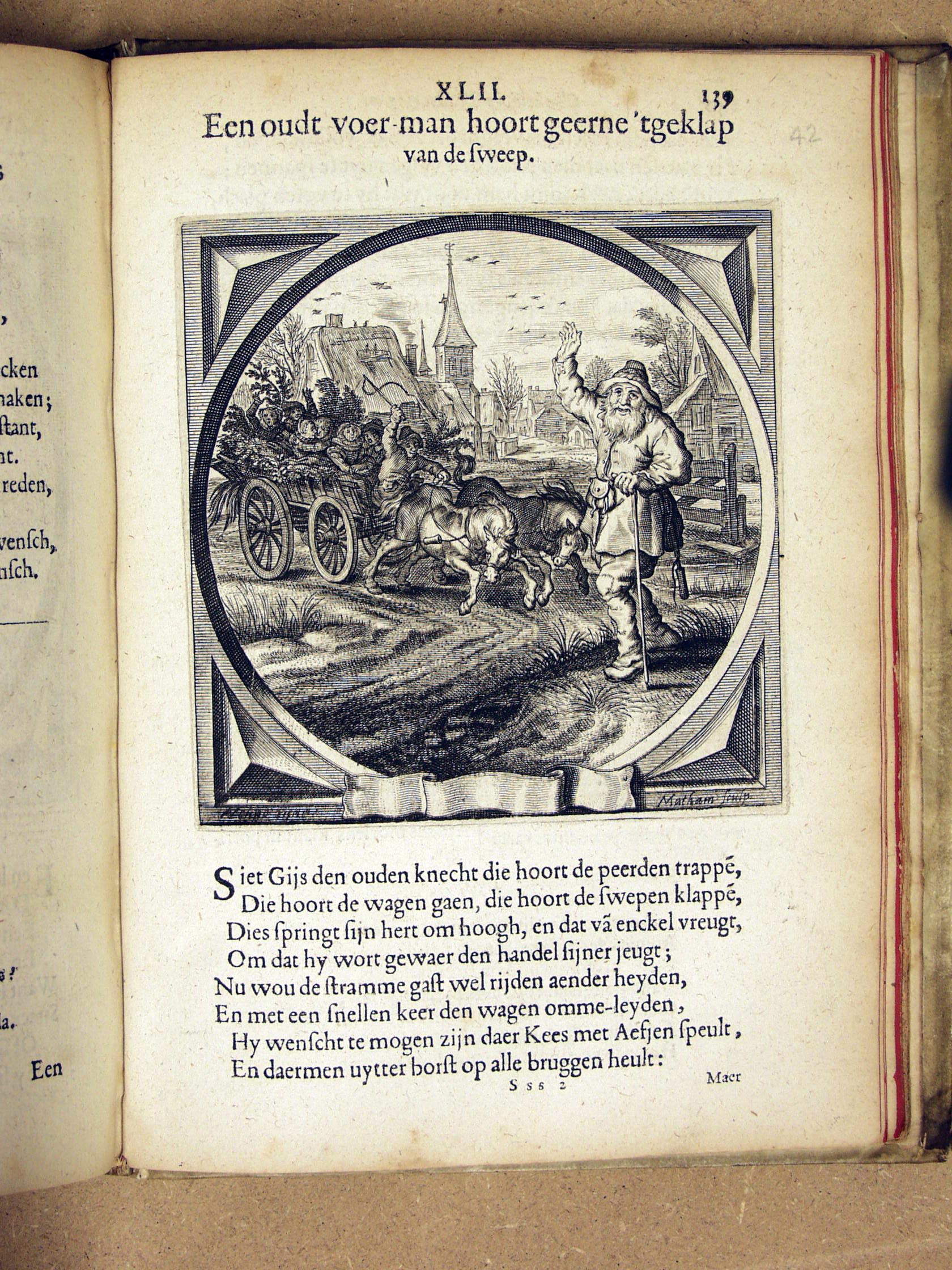
An oval engraving set in a rectangular frame with corner spandrels and a blank ribbon-banderole below. On a rutted country road a four-wheeled wagon loaded with hay and crowded with passengers (men and women in hats and caps, one waving a flag) is drawn at speed by two horses; the driver, seated at the front, cracks a long whip over them. At the right, in the foreground, stands a bearded old man in a broad hat, long coat and heavy boots, leaning on a walking stick with one hand while raising his other arm high in the air as he turns toward the passing wagon. Behind him is a wooden fence and a barrel; in the middle distance a village with a church spire, thatched farmhouses and bare trees, with birds flying in the sky. Signed lower left 'A. vande Venne invent.' and lower right 'Matham sculp.'
Subscriptio

TranscriptionAI-generated
Siet Gijs den ouden knecht die hoort de peerden trappé, Die hoort de wagen gaen, die hoort de swepen klappé, Dies springt sijn hert om hoogh, en dat vã enckel vreugt, Om dat hy wort gewaer den handel sijner jeugt; Nu wou de stramme gast wel rijden aender heyden, En met een snellen keer den wagen omme-leyden, Hy wenscht te mogen zijn daer Kees met Aefjen speult, En daermen uytter borst op alle bruggen heult: Maer dat hem meest beweeght dat zijn de volle kannen, Ter plaetsen daer men plach den wagen uyt te spannen; In 't kort', het koomt hem voor wat hy te voren plach, En siet, de wil is daer, schoon hy niet meer en mach. Men vindter over al die in haer oude jaren Noch even zijn gemoet als sy te voren waren, Men siet dat hun de jeugt noch inde leden rijt, Al is haer kranck gestel verwonnen vanden tijt. Niet soo, vernieude ziel, maer laet u oude sonden, Oock eer dat u de tijdt de lusten heeft gebonden, Of isser niet geschiet, ten minsten mijdt het quaet Als u de swackheyt selfs tot beter seden raet; Een, wien de frisse jeugt noch krachten koomt te geven, Die moet geduerigh sien hoe wel te mogen leven, Maer die nu trager wort moet letten boven al Hoe dat hy sijnen tijdt met segen eynden sal.
TranslationAI-generated
Look, Gijs the old farmhand, he hears the horses trampling, he hears the wagon going, he hears the whips cracking; therefore his heart leaps up, and that from sheer joy, because he becomes aware of the doings of his youth. Now the stiff old fellow would gladly ride out over the heath, and with a quick turn swing the wagon around; he wishes he could be where Kees is sporting with Aefje, and where people sing out lustily on every bridge. But what moves him most are the full tankards, at the places where one used to unhitch the wagon. In short, everything he used to do comes back to him, and see, the will is there, though he can do it no more. Everywhere one finds people who in their old years are still of the very same mind as they were before; one sees that youth still rides in their limbs, although their feeble frame has been conquered by time. Not so, renewed soul, but leave your old sins, and that before time has bound up your desires; or, if that has not happened, at least avoid the evil when your very weakness advises you to better conduct. One to whom fresh youth still gives strength must constantly look to how he may live well; but he who now grows slower must above all consider how he shall end his time with a blessing.
CommentaryAI-generated
10 passages · original left, translation right (click to fold)
Franç. Il souvient tousiours robyn de ses flustes.
French. Robin always remembers his flutes.
Nederl. Het rijpt haest op een oudt ijs.
Dutch. It soon freezes on old ice.
In een natten poel is haest genoegh geregent.
In a wet pool it has soon rained enough.
Spaens. Cabritilla que suele mamar, prure le el paladar.
Spanish. A little kid that is used to suckling has an itching palate.
Lat. Lupus pilum mutat, non mentem.
Latin. The wolf changes his coat, not his mind.
Franç. Chevrette accoustumé de tetter le palais luy demange.
French. A young she-goat accustomed to suckling has an itching palate.
Nederl. Een wolff hapt noch nae 't schaep, als hem de ziele uyt-gaet.
Dutch. A wolf still snaps at the sheep even as his soul is going out of him.
Nederl. Een oudt jagher hoort geerne vande weperp.
Dutch. An old hunter gladly hears about the chase.
Lat. Atticus moriens manum porrigit.
Latin. Atticus, while dying, stretches out his hand.
Phæd. fab. 40. Anus jacere vidit epotam amphoram Adhuc falerna fæce & testa nobili, Odorem quæ jucundum latè spargeret, Hanc postquam totis avida texit naribus; O suavis anima! qualem te dicam bonam Ante hac fuisse! tales cum sint reliquiæ. Hoc quo pertineat; dicet qui me noverit.
Phaedrus, fable 40. An old woman saw a drained wine-jar lying, still noble with its Falernian lees and its jar, which spread a pleasant smell far around. After she had greedily covered it with her whole nostrils: 'O sweet spirit! how good must I call you to have been before, when such are your remains!' To what this refers, he who knows me will say.
Iconclass
86(EEN OUDT VOER-MAN HOORT GEERNE 'T GEKLAP VAN DE SWEEP)proverbs, sayings, etc. (EEN OUDT VOER-MAN HOORT GEERNE 'T GEKLAP VAN DE SWEEP)
Suggested Iconclass codesAI-generated
Additional codes proposed for this emblem, not (yet) part of the indexing.
47I1451hay-wagonhighThe correlate 'hay-wagon' matches exactly the four-wheeled wagon loaded with hay and drawn by two horses that dominates the scene.
46C1463whipmediumThe correlate 'whip' fits the driver seated at the front cracking a long whip over the horses.
86proverbs, sayings, etc.highThe correlate 'proverbs, sayings, etc.' matches the emblem's multilingual series of proverbs about old habits persisting ('It soon freezes on old ice', 'The wolf changes his coat, not his mind').
86(...)proverbs, sayings, etc. (with TEXT)mediumThe correlate 'proverbs, sayings, etc. (with TEXT)' allows the specific proverb texts cited in the commentary to be recorded for this proverb-illustration.
Relationships to the Adagia of ErasmusAI-generated
Suggested relationships between this emblem and adages in Erasmus’ Adagia.
- III iii 19 Lupus pilum mutat, non mentem – direct mottohigh
The emblem's Latin commentary cites verbatim 'Lat. Lupus pilum mutat, non mentem' as the Latin equivalent of the Dutch motto about the old wagoner still thrilling to the whip-crack; Erasmus III iii 19 likewise explains that age brings white hair to the wicked but does not remove their iniquity.
- IV viii 94 Scarabaeo citius persuaseris – thematic inventiomedium
Erasmus applies this adage to those so habituated to their old ways that they cannot be persuaded to give them up — exactly the emblem's point that old men keep the mind of their youth ('de wil is daer, schoon hy niet meer en mach') and must be urged to leave their old sins.
- IV ix 25 Usus est altera natura – thematic inventiomedium
The subscriptio's moral — that ingrained youthful habits still 'ride in the limbs' of the aged even when the body is conquered by time — is the commonplace that habit becomes second nature, which Erasmus expounds under this adage (same locus communis, Malum assuetum).
- I ii 60 Senis doctor – thematic inventiolow
Erasmus' adage on the futility of teaching the old, who are 'intractable, slow and forgetful' unlike teachable youth, matches the emblem's contrast between the still-unreformed old man and the exhortation to amend oneself while young.
Sources
Record ID: embstma_1288_emblem122
This emblem on the Iconclass site: https://iconclass.org/view/embstma_1288_emblem122
Copy: University Library, Glasgow, Stirling Maxwell 1288