Geffrey Whitney, A choice of emblemes (Leiden, 1586)
Emblem 23
A sheaf of corn
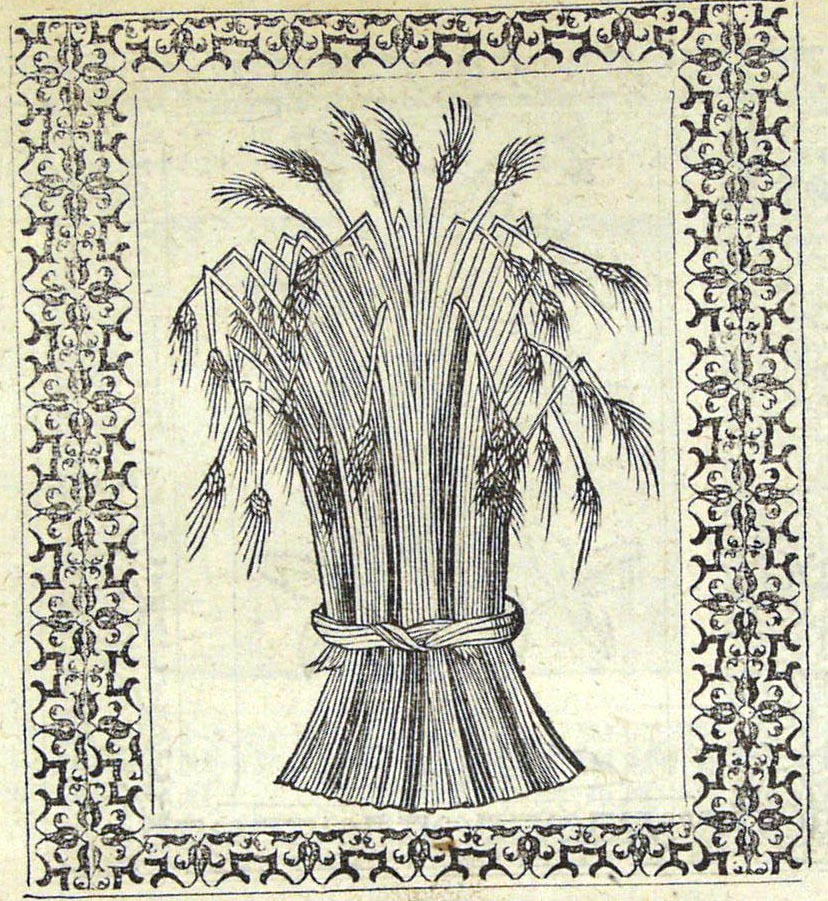
Mihi pondera, luxusLatin
Excess is a burden to me
- Interpretation
- Ears of corn and sheaf (Excess is a weight to me)
Description of the imageAI-generated
Within an ornamental woodcut border, a large sheaf of ripe wheat or corn stands upright, bound about the middle with a twisted straw band; the heavy bearded ears at the top bend and droop outwards on all sides, several stalks broken over.
Subscriptio

TranscriptionAI-generated
WHEN autumne ripes, the frutefull fieldes of graine, And CERES doth in all her pompe appeare, The heauie eare, doth breake the stalke in twaine, Wherebie wee see, this by experience cleare: Hir owne excesse, did cause her proper spoile, And made her corne, to rotte vppon the soile. Soe worldlie wealthe, and great aboundaunce, marres: The sharpenes of our sences, and our wittes, And oftentimes, our vnderstanding barres, And dulles the same, with manie carefull fittes: Then since Excesse procures our spoile and paine, The meane preferre, before immoderate gaine.
TranslationAI-generated
When autumn ripens the fruitful fields of grain, and Ceres appears in all her pomp, the heavy ear breaks the stalk in two, whereby we see this clearly by experience: her own excess caused her own ruin, and made her corn rot upon the soil. So worldly wealth and great abundance spoil the sharpness of our senses and our wits, and often bar our understanding, and dull it with many anxious fits: then, since Excess brings about our ruin and pain, prefer the mean before immoderate gain.
CommentaryAI-generated
2 passages · original left, translation right (click to fold)
—— nec te iucunda fronte fefellit Luxuries prædulce malum, quæ dedita semper Corporis arbitriis, hebetat caligine sensus Membraq; Circæis effeminat acrius herbis.
— nor has Luxury, that too-sweet evil, deceived you with its pleasant face, which, ever given over to the body's whims, dulls the senses with darkness and unmans the limbs more sharply than Circe's herbs.
Claud. 2.
Claudian, book 2.
Notes and related emblems
- Compare: Par.244
- Related emblem in another book: embmne_pad1615_emblem169
Iconclass
11R5(personifications of) 'Vanitas', the vanity of human life; Fragilità humana, Fugacità delle grandezze & della gloria mondana, Meditatione della morte, Opera vana, Piacere vano, Vana gloria, Vanità (Ripa)25G4(WHEAT)plants and herbs: wheat47I1111ears of corn47I1421sheaf51GG3(+4)Fragility; 'Fragilità' (Ripa) (+ emblematical representation of concept)51H42(+4)Abundance; 'Abondanza', 'Abondanza maritima' (Ripa) (+ emblematical representation of concept)55B1(+4)Wealth, Opulence; 'Opulenza', 'Richezza' (Ripa) (+ emblematical representation of concept)86(MIHI PONDERA LUXUS)proverbs, sayings, etc. (MIHI PONDERA LUXUS)92M171Ceres, patroness of agriculture
Suggested Iconclass codesAI-generated
Additional codes proposed for this emblem, not (yet) part of the indexing.
92M18(CORN-SHEAF)sheaf of corn as attribute of CeresmediumThe correlate text designates the corn-sheaf motif (as Ceres' attribute), which is the single object depicted: a large bound sheaf of ripe bearded wheat.
55B2Luxury, LuxuriousnesshighThe correlate 'Luxury, Luxuriousness' matches the commentary's central theme of Luxury, the 'too-sweet evil' with a pleasant face that must be resisted.
11N36Lust, Luxury, 'Luxuria'; 'Lussuria' (Ripa) ~ personification of one of the Deadly SinslowThe correlate for Lust/'Luxuria' as a Deadly Sin matches the moral vice named in the commentary, though no personification is actually depicted in the emblem.
33C811sensualitymedium'Sensuality' corresponds to the commentary's description of being 'given over to the body's whims', dulling the senses and unmanning the limbs.
11S716voluptuousness, pleasure, 'Voluptas' ~ one of the seven gifts of the bodylow'Voluptuousness, pleasure, Voluptas ~ gift of the body' echoes the commentary's bodily pleasure that deceives with its pleasant face.
95B(CIRCE)CircemediumThe correlate simply denotes Circe, who is explicitly invoked in the commentary through the enervating power of 'Circe's herbs'.
Relationships to the Adagia of ErasmusAI-generated
Suggested relationships between this emblem and adages in Erasmus’ Adagia.
- I vi 96 Ne quid nimis – thematic inventiomedium
The emblem's explicit moral — "since Excesse procures our spoile and paine, / The meane preferre, before immoderate gaine" — is precisely the doctrine of the golden mean that Erasmus expounds under Μηδὲν ἄγαν / Ne quid nimis, though Whitney quotes Claudian rather than Erasmus.
- III vii 4 Nihil minus expedit quam agrum optime colere – thematic inventiomedium
Erasmus (after Pliny) argues from agriculture that over-abundant cultivation ruins rather than enriches — 'to farm well is necessary, to farm best is ruinous' — exactly the emblem's image of corn so heavy with its own excess that it breaks the stalk and rots on the ground.
- I ix 95 Dimidium plus toto – thematic inventiolow
The adage's riddling praise of the aurea mediocritas — taking the whole is harmful, the half is moderate and therefore 'more' — matches the subscriptio's preference of 'the meane' over 'immoderate gaine'.
- I v 67 Funem abrumpere nimium tendendo – thematic inventiolow
Like the overladen ear that snaps its own stalk, the taut rope breaks because of immoderate straining after gain; Erasmus applies it to those who lose everything by being 'plus satis attenti ad lucrum'.
- IV v 77 Arcus tensus rumpitur – thematic inventiolow
Shares the emblem's structural image of a thing destroyed by the excess of its own tension/weight, used by Erasmus to urge moderation.
Sources
Record ID: embstma_1667_emblem023
This emblem on the Iconclass site: https://iconclass.org/view/embstma_1667_emblem023
Copy: University Library, Glasgow, Stirling Maxwell 1667