Jacob Cats, Spiegel (The Hague, 1632)
Emblem 63
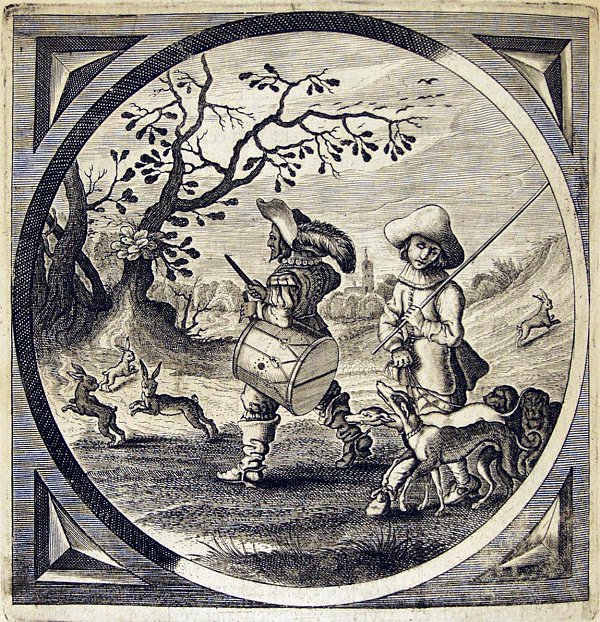
On ne prend lievre au taboryn ny oiseau à la tarte velleFrench
One does not catch a hare with a drum, nor a bird with a rattle (clapper).AI-generated
Description of the imageAI-generated
Within a large oval frame (set in a square plate with hatched corner triangles) a landscape scene: at the left a big gnarled tree with spreading bare branches; in the middle distance a village with a church tower and rolling hills, birds in the sky. In the foreground, seen from behind, a drummer in a plumed broad hat, slashed doublet and wide boots beats a large side-drum with his sticks. To the right stands a huntsman in a broad hat and ruff, holding a long pole or spear upright in one hand and leading on a leash two greyhounds, which press forward at his side. Four hares are running away in all directions: three bounding off to the left past the tree, one fleeing up the slope on the right.
Subscriptio


TranscriptionAI-generated
AL wie een snellé haes met trommels meynt te vangen Die heeftet qualick voor, en doet verkeerde gangen, Want eer de jager koomt ontrent het groene wout Soo is het vluchtigh dier verloren in het hout; Daer leyt het dan en duyckt, soo dat de grage winden Geen wilt-braet op en doen, geen haes en konnen vinden; Daer koomt dan onse vriendt gants moede vande jacht, En brengt niet anders met als slechts een droevé nacht. Sit yemant inden raedt, of wil hy leeren krijgen Die moet voor alle dingh sijn tonge leeren swijgen, Want die van sijn bedrijf met open monde spreeckt Die vintmen inder daedt dat hy den aenslagh breeckt; Met swijgen, soete jeught, met swijgen is te minnen, Met swijgen kan een Vorst de vaste Steden winnen; Een die geduerigh swetst van dat hy wil bestaen En brengt niet anders t'huys als slechts een malle waen. Met klappen soete jeught en is niet uyt te rechten, Noch in het soet gevry, noch in het wreede vechten, Maer die met heusschen mont sijn dingen heelen kan Die mach een vryer zijn, en oock een oorloghs-man.
TranslationAI-generated
Whoever thinks to catch a swift hare with drums has a bad plan and takes the wrong course, for before the hunter comes near the green wood the fleeing beast is lost in the timber; there it lies and ducks down, so that the eager greyhounds raise no game and can find no hare; then our friend comes home quite weary from the hunt, and brings nothing back with him but a dismal night. If someone sits in council, or wishes to gain learning, he must above all teach his tongue to keep silent; for he who speaks with open mouth about his business is in fact found to wreck his own enterprise. By silence, sweet youth, by silence one wins love; by silence a prince can take strong cities. He who continually boasts of what he intends to undertake brings nothing else home but a foolish conceit. By chattering, sweet youth, nothing is to be achieved, neither in sweet wooing nor in cruel fighting; but he who can conceal his affairs with a courteous mouth, he may be a wooer and also a man of war.
CommentaryAI-generated
38 passages · original left, translation right (click to fold)
Hoogd. Weise leute haben ihren mundt im hertzen.
High German: Wise people have their mouth in their heart.
Spaens. Quien paxaro ha de tomar non ha de oxear.
Spanish: He who is to catch a bird must not scare it off.
Franç. Qui veut prendre un oiseau il ne faut pas l'effaroucher.
French: He who wants to catch a bird must not frighten it.
Nederl. 'Tis quaet hasen met trommels vanghen.
Dutch: It is a bad business to catch hares with drums.
Franç. On ne prend le lievre au tabour ny l'oiseau à la tarte-velle.
French: One does not catch the hare with the drum, nor the bird with the rattle.
Nederl. Alle vogels schouwen d'openbare netten.
Dutch: All birds shun nets set out in the open.
Ital. Chi dice tutto quel ch' egli sa, fà tutto quel che egli può è mangia ciò che egli ha; nõ gli resta niente.
Italian: He who says all that he knows, does all that he can, and eats all that he has, is left with nothing.
Franç. Pense ce que tu veux parle ce que tu dois.
French: Think what you will, say what you ought.
Hoogd. Sag nicht alles das du weist / Glaub nicht alles das du hörest / Thue nicht alles das du kanst / Wisse nicht alles das du list.
High German: Do not say all that you know; do not believe all that you hear; do not do all that you can; do not (seek to) know all that you read.
Ital. Le minaccie sono arme del minacciato.
Italian: Threats are the weapons of the man who is threatened.
A mucha parola obra poco.
Much talk, little work.
Franç. Par trop dire on est perdu.
French: By saying too much one is ruined.
Lat. Multorum conscij pauca loquuntur.
Latin: Those who are privy to many things speak few words.
In ira nihil decentius quam cum adest silentium. Plut.
In anger nothing is more becoming than when silence is present. Plutarch.
Vestigatoribus & venatoribus diurni nocturnique Labores essent irriti si nõ silentio prius quã Venabulis & impetu feras interciperent. Carol. Paschal. Virt. & Vit. cap. 32.
For trackers and hunters the labours of day and night would be in vain if they did not catch the wild beasts by silence before doing so with hunting-spears and assault. Carolus Paschalius, On Virtues and Vices, chapter 32.
Ital. Colui che è saggio, quietamente gode.
Italian: He who is wise enjoys quietly.
Franç. Chat mioleur, ne fut onques bon chasseur.
French: A mewing cat was never a good hunter.
Ital. Chi non sa tacere, Non sa godere.
Italian: He who cannot keep silent cannot enjoy.
Hoogd. Wann die henn ihr gatzen ließ so wust man nit das sie gelegt het.
High German: If the hen would leave off her cackling, one would not know that she had laid.
Franç. C'est vn fort beau jeu Quand on faict & parle peu.
French: It is a very fine game when one does much and speaks little.
Engels. Cannot you be content tho fare wel but you must crie rost meet?
English: Can you not be content though you fare well, but you must cry roast meat?
Lat. Nullum est tempus, quo dicenda sunt omnia.
Latin: There is no time at which everything should be told.
Nederl. Hoort / swijght / en siet / Muyst maer en mauwt niet.
Dutch: Hear, be silent, and look; mouse, but do not mew.
Nutten sonder krassen / Kluyven sonder bassen.
Feed without cawing, gnaw without barking.
Lupus dum prædam agit, ne hiscit quidem. Lat.
Latin: While the wolf drives off its prey, it does not even open its mouth.
Franç. Taire & faire. Par mer & par terre.
French: Be silent and act, by sea and by land.
Spaens. Callar y ojos, tomaremos la madre y los pollos.
Spanish: Silence and eyes (open), and we shall take the mother and the chicks.
Franç. Se taire & ouvrir les yeux c'est pour prendre la mere & les petits.
French: To keep quiet and open one's eyes is the way to catch the mother and the little ones.
Ital. Pensa molto, parla poco è scrivi meno.
Italian: Think much, speak little, and write less.
Assai sa, chi non sa, se tacer sa.
He who knows nothing knows enough, if he knows how to keep silent.
Si tu veus vivre en pais Ne dis tout ce que scais.
If you wish to live in peace, do not tell all that you know.
Nederl. Watje hoort of siet Muyst ende en mauwt niet.
Dutch: Whatever you hear or see, mouse and do not mew.
Lat. Sæpes sapientiæ est silentium.
Latin: Silence is the hedge of wisdom.
Nederl. Die kan swijgen en horen Groote rust is hem geboren.
Dutch: He who can keep silent and listen, great rest is born for him.
Die kan horen en swijgen Groote saecken kan hy krijgen.
He who can listen and keep silent can obtain great things.
Nederl. Hoort / siet / swijght en verdraeght / Soo weet niemant watje jaeght.
Dutch: Hear, see, be silent and endure, then no one knows what you are hunting.
Die veel kalt Veel ontvalt.
He who talks much, much slips away from him.
Gaeter yet naer uwen wil / Veeght u mont / en houdt u stil.
If anything goes according to your wish, wipe your mouth and keep quiet.
Iconclass
86(ON NE PREND LIEVRE AU TABORYN NY OISEAU À LA TARTE VELLE)proverbs, sayings, etc. (ON NE PREND LIEVRE AU TABORYN NY OISEAU À LA TARTE VELLE)
Suggested Iconclass codesAI-generated
Additional codes proposed for this emblem, not (yet) part of the indexing.
43C111261hare-hunting, rabbit-huntinghighThe correlate 'hare-hunting, rabbit-hunting' exactly matches the huntsman with greyhounds pursuing the fleeing hares, and the proverb about catching hares with drums.
43C11hunting, chasehighThe general correlate 'hunting, chase' describes the depicted huntsman with spear and leashed hounds chasing game.
25F26(HARE)rodents: harehigh'Rodents: hare' matches the four hares running away in the foreground and background.
48C7341drum (musical instrument)high'Drum (musical instrument)' matches the large side-drum beaten with sticks by the foreground figure.
22D9silencemediumThe abstract concept 'silence' is the central moral of the commentary ('Silence is the hedge of wisdom', 'hear, be silent and look').
52DD3Taciturnity; 'Secretezza', 'Secretezza overo Taciturnità' (Ripa)medium'Taciturnity; Secretezza' corresponds to the emblem's lesson of not saying all one knows and keeping one's counsel while acting.
43C1112hunt ~ mammalslow'Hunt ~ mammals' covers the hunting of hares with dogs shown in the scene.
48CC7341drum (musical instrument) - CC - out of doorslowThe qualified correlate 'drum (musical instrument) - out of doors' fits the drummer playing in an open landscape.
Relationships to the Adagia of ErasmusAI-generated
Suggested relationships between this emblem and adages in Erasmus’ Adagia.
- I vii 16 Cornicari – thematic inventiomedium
Erasmus explains κρώζειν as both 'croaking vainly over prey' and foolish chatter, quoting Chremylus' 'I know why you croak — you want a share of what I stole'; the emblem's second subscriptio makes exactly this point: the raven that caws loudly over its booty attracts an uninvited guest, whereas silent eating keeps the belly full.
- II vii 79 Lupus ante clamorum festinat – thematic inventiomedium
Erasmus' essay describes the wolf which seizes its prey and makes off before the countrymen raise the alarm; the emblem's Latin commentary 'Lupus dum praedam agit, ne hiscit quidem' (the wolf does not even open its mouth while driving off its prey) applies the same wolf-and-booty image to the lesson of keeping silent about one's gains.
- IV i 93 Cautus enim metuit, etc. – thematic inventiolow
The adage's Horatian lines about the hawk fearing 'suspected nets' and different traps for different beasts match the emblem's Dutch saying 'All birds shun nets set out in the open' and the Spanish/French maxims that he who would catch a bird must not frighten it.
- I ii 99 Non est eiusdem et multa et opportuna dicere – thematic inventiolow
Erasmus' warning that verbosity inevitably leads to error ('in multiloquio non abesse peccatum') underlies the emblem's cluster of maxims — 'Par trop dire on est perdu', 'A mucha parola obra poco', 'Die veel kalt veel ontvalt' — that too much talking ruins one's affairs.
- III ii 86 A lupi venatu – thematic inventiolow
Classed by Erasmus under 'Inanis opera', the phrase stands for a hunt abandoned fruitlessly; the emblem likewise shows a noisy hunter who 'comes home quite weary from the hunt and brings nothing back but a dismal night'.
- II iii 58 Lupus hiat – thematic inventiolow
The emblem's Latin tag 'Lupus dum praedam agit, ne hiscit quidem' plays on the same wolf-with-gaping-jaws image that Erasmus collects here, inverting it: the gaping (noisy) wolf loses its prey, the silent one keeps it.
Sources
Record ID: embstma_1288_emblem063
This emblem on the Iconclass site: https://iconclass.org/view/embstma_1288_emblem063
Copy: University Library, Glasgow, Stirling Maxwell 1288