Jacob Cats, Spiegel (The Hague, 1632)
Emblem 64
An older man is warning a fisherman to pull up his fishing rod in time; in the background a man is chasing Occasio
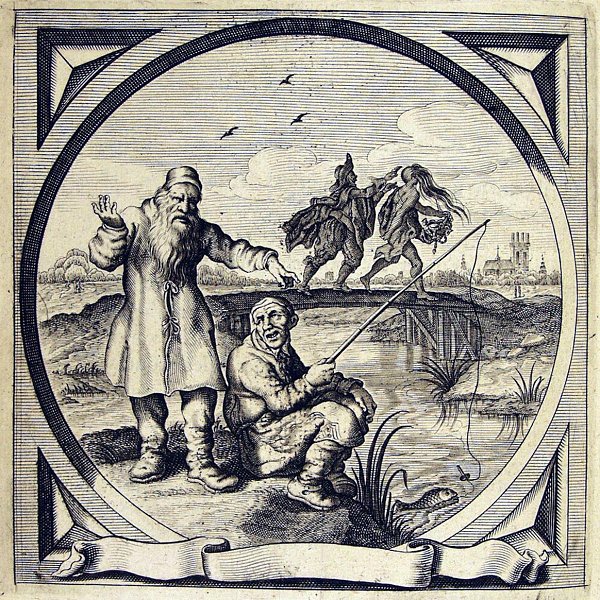
Treckt alst nopt VisscherDutch
Pull when it nibbles, fisherman.AI-generated
Description of the imageAI-generated
Within an oval frame set in a rectangular border with hatched corner spandrels, a riverside scene. At the left stands a tall old man in a long fur-trimmed coat and cap, with a long beard; his left hand is raised and his right arm stretches out, index finger pointing toward the water. Beside and in front of him a fisherman sits on the bank, legs drawn up, wearing a cap and loose jacket, his mouth open as he stares idly ahead; he holds a long fishing rod whose line runs down to the right, where a fish is visible at the water's edge taking the baited hook. Behind them a wooden bridge crosses the river; on it two figures run from left to right, a man in a plumed hat and cloak reaching after a fleeing female figure with long streaming hair blowing forward over her face, who carries something in her hand. In the right background a town skyline with church towers and spires; clouds and three small flying birds fill the sky. Beneath the oval, resting on the lower border, is an empty unrolled banderole.
Subscriptio



TranscriptionAI-generated
De gene die by den visscher staet, spreeckt,
TranslationAI-generated
The one who stands beside the fisherman speaks:
CommentaryAI-generated
45 passages · original left, translation right (click to fold)
Hoogd. Den es allezeit zu frü dünckt / der komt gewißlich zu spat.
High German: He to whom it always seems too early will certainly come too late.
Nederl. 'Tis kunst in tijdts jae seggen.
Dutch: It is an art to say yes in time.
Treckt alst nopt, Visscher.
Pull when it nibbles, fisherman.
Grijpt alst tijdt is.
Seize it when it is time.
Men moet sijn tobben uyt-setten terwijl het regent.
One must set out one's tubs while it is raining.
Men moet gapen alsser pap ghebodē wert.
One must open one's mouth when porridge is being offered.
Men moet grijpen alst tijdt is.
One must grasp when it is time.
Men moet mennen t'wijl de heuy lept.
One must drive (the cart) while the hay is being loaded.
Men moet seylen t'wijl de wint dient.
One must sail while the wind serves.
Hoedekens kinders waren noyt rijck.
Little-hat's children were never rich.
Het luck Is vlugh / Die het vat Die het hadt / Die het quist Die het mist.
Fortune is swift; he who catches it, he has had it; he who wastes it, he misses it.
Nederl. Het gheluck en staet niet stil voor yemants deur.
Dutch: Good fortune does not stand still before anyone's door.
Gaept alsmen u den lepel biet / Want namaels vrient en krijghje niet.
Open your mouth when the spoon is offered you, for afterwards, friend, you will get none.
Die tijdt heeft / en tijdt laet glyen / En kan sijn leven niet bedyen.
He who has time and lets time slip can never prosper in his life.
Die altijdt vroegh ghenoegh koomt / koomt veeltijts te laet.
He who always comes early enough often comes too late.
Die verslaept sijn ochtent-werck / bescheten is sijn dagh werck.
He who sleeps through his morning's work, his day's work is botched.
Lant koopen / en goet huwelick doen / en verschijnt alle dagh niet.
Buying land and making a good marriage do not turn up every day.
Ital. A ben fare non dar dimora Perche presto passa l'hora.
Italian: Do not delay in doing good, for the hour passes quickly.
Besogna pigliar le venture quando Iddio le manda.
One must take the chances when God sends them.
Chi tardi arriva, male allogia.
He who arrives late is poorly lodged.
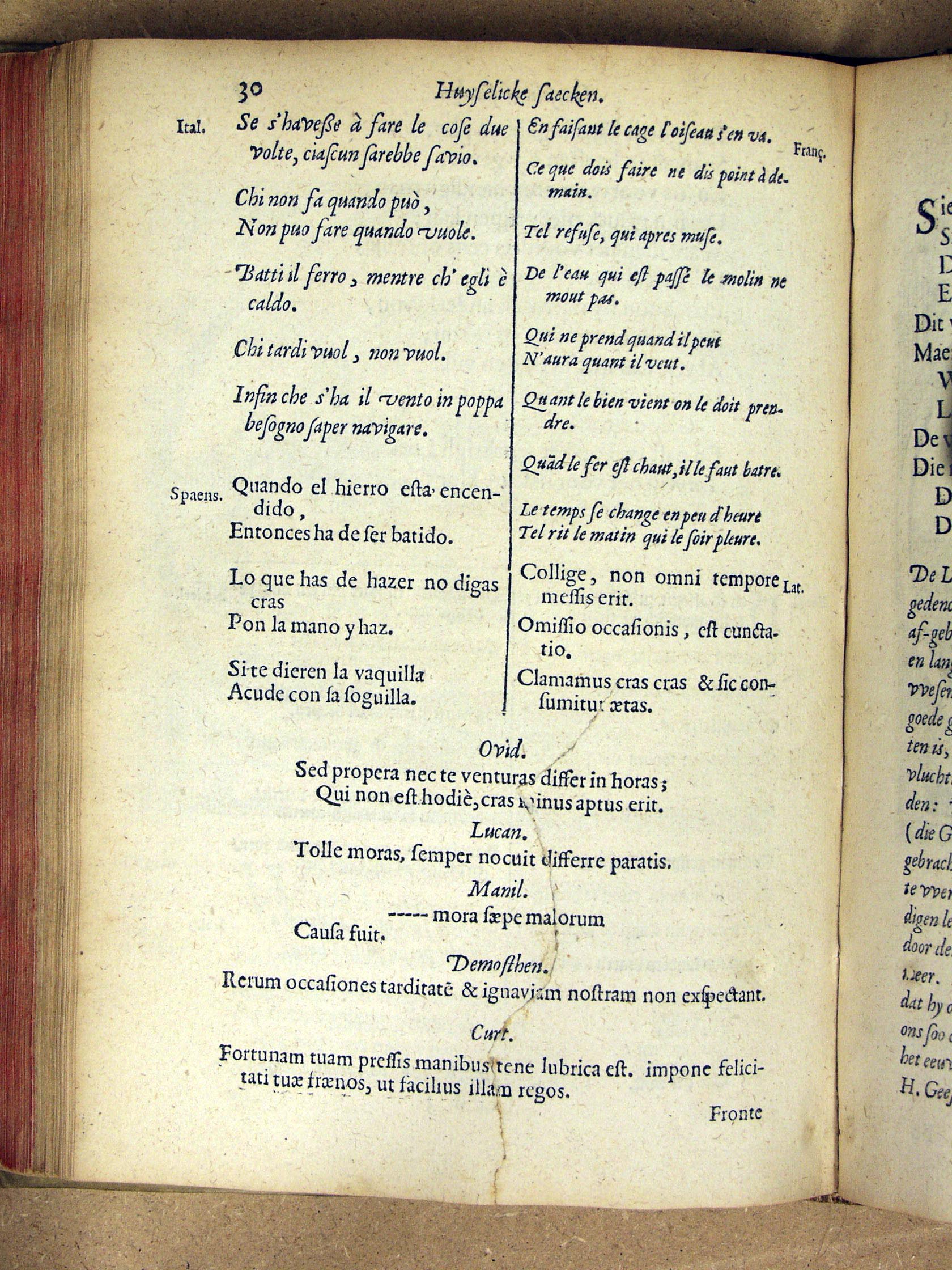
Se s'havesse à fare le cose due volte, ciascun sarebbe savio.
If one had to do things twice, everyone would be wise.
Chi non fa quando può, Non puo fare quando vuole.
He who does not act when he can, cannot act when he wants to.
Batti il ferro, mentre ch'egli è caldo.
Strike the iron while it is hot.
Chi tardi vuol, non vuol.
He who wants late does not want at all.
Infin che s'ha il vento in poppa besogno saper navigare.
As long as one has the wind astern, one must know how to sail.
Spaens. Quando el hierro esta encendido, Entonces ha de ser batido.
Spanish: When the iron is glowing, then it must be beaten.
Lo que has de hazer no digas cras Pon la mano y haz.
What you have to do, do not say 'tomorrow'; put your hand to it and do it.
Si te dieren la vaquilla Acude con sa soguilla.
If they give you the heifer, run up with the little rope.
Franç. En faisant le cage l'oiseau s'en va.
French: While one is making the cage, the bird flies away.
Ce que dois faire ne dis point à demain.
What you must do, do not put off until tomorrow.
Tel refuse, qui apres muse.
Such a one refuses who afterwards dawdles (and regrets it).
De l'eau qui est passé le molin ne mout pas.
With water that has passed by, the mill does not grind.
Qui ne prend quand il peut N'aura quant il veut.
He who does not take when he can will not have when he wishes.
Quant le bien vient on le doit prendre.
When the good comes, one must take it.
Quãd le fer est chaut, il le faut batre.
When the iron is hot, it must be struck.
Le temps se change en peu d'heure Tel rit le matin qui le soir pleure.
The weather changes in a short hour; he who laughs in the morning weeps in the evening.
Lat. Collige, non omni tempore messis erit.
Latin: Gather it in; there will not be a harvest at every season.
Omissio occasionis, est cunctatio.
The letting go of an opportunity is (mere) delay.
Clamamus cras cras & sic consumitur ætas.
We cry 'tomorrow, tomorrow', and thus our lifetime is consumed.
Ovid. Sed propera nec te venturas differ in horas; Qui non est hodiè, cras minus aptus erit.
Ovid: But make haste, and do not put yourself off to the hours to come; he who is not ready today will be less fit tomorrow.
Lucan. Tolle moras, semper nocuit differre paratis.
Lucan: Away with delays; postponement has always harmed those who are ready.
Manil. ----- mora sæpe malorum Causa fuit.
Manilius: ... delay has often been the cause of evils.
Demosthen. Rerum occasiones tarditatē & ignaviam nostram non exspectant.
Demosthenes: The opportunities of affairs do not wait for our slowness and sloth.
Curt. Fortunam tuam pressis manibus tene lubrica est. impone felicitati tuæ frænos, ut facilius illam regos.
Curtius: Hold your fortune with tight-pressed hands, it is slippery; put a bridle on your good luck, so that you may the more easily govern it.
De Leser sal, tot beter verstant van dese gelegentheyt, ghelieven te gedencken dat de Oude het Geluck, ofte goede Ghelegentheyt, hebben af-gebeelt in de gedaente van een vrouwe, van voren veel hayrs en lange tuyten hebbende, maer van achterē geheel kael en sonder hayr wesende; daer mede te kennen gevende den aert ende eygenschap van goede gelegentheyt, die alleen van voren, eñ niet van achteren te vatten is, het welck op verscheyde gevallen, en onder andere mede op de vluchtige gelegentheyt onses levens, niet sonder redē, kan gepast werden: want (gelijck een godtsaligh man wel geseydt heeft) de tijdt (die Godt almachtich uyt den afgront sijner eeuwicheyt heeft voort-gebracht) is het alder-kostelickste toe-val om het eeuwigh leven uyt te wercken, datmen oyt vondt; want aen den tijt deses tegenwoordigen levens hanght het eeuwighe, en als de tijdt eens voor yemant door den doodt is af-gesneden, soo en isser voor dien mensche geen tijt meer. Wat een groote genade isset dan van den Heere onsen Godt, dat hy ons noch telcken brengt van 't een jaer int ander, en verlenght ons soo onse daghen, ten eynde wy sulcx waernemende, des te beter het eeuwigh leven souden uyt-wercken? en sulcx te doen noemt de H. Geest de bequaemheyt des tijdts uyt te koopen. Col. 4. 5.
The Reader will please, for a better understanding of this matter, remember that the Ancients depicted Fortune, or good Occasion, in the shape of a woman having much hair and long tresses in front, but being altogether bald and hairless behind; thereby indicating the nature and property of good opportunity, which can only be grasped from the front and not from behind, which may, not without reason, be applied to various cases, and among others to the fleeting opportunity of our life: for (as a godly man has well said) time (which Almighty God brought forth out of the abyss of His eternity) is the most precious opportunity for working out eternal life that was ever found; for upon the time of this present life hangs eternity, and when once time has been cut off for someone by death, then for that person there is no more time. What a great mercy is it then from the Lord our God, that He still brings us each time from one year into another, and so prolongs our days, to the end that we, taking heed of this, should the better work out eternal life? And to do so the Holy Ghost calls redeeming the opportunity of the time. Colossians 4:5.
Iconclass
25F6(+451)fishes (+ animal in search of food)25H17meadow, pasture25H192polder, reclaimed land25H212brook25I1city-view in general; 'veduta'31A2512(+932)arm stretched forward (+ addressing)31A2512(+9324)arm stretched forward (+ warning, admonishing)31AA2512(+934)arm stretched forward - AA - both arms or hands (+ reaching for somebody or something, seizing something, touching)31AA27112running - AA - female human figure31D14adult man31D16old man41D267purse, money-bag43C128(+4161)fisherman (+ fishing-rod)46A161(+0)acquiring riches (+ variant)46C112bridge52E3Counsel; 'Consiglio' (Ripa)54B121(+112)'Occasio', 'Kairos'; 'Occasione' (Ripa) (+ partially clothed)54B1212Missing an Opportunity86(TRECKT ALST NOPT VISSCHER)proverbs, sayings, etc. (TRECKT ALST NOPT VISSCHER)
Suggested Iconclass codesAI-generated
Additional codes proposed for this emblem, not (yet) part of the indexing.
54B121'Occasio', 'Kairos'; 'Occasione' (Ripa)highThe commentary explicitly describes Fortune/good Occasion as a woman with long hair in front and bald behind, matching the fleeing female with streaming forelock on the bridge — the personification 'Occasio'/'Kairos'.
43C128fishermanhighA fisherman sits on the bank with rod and line hooking a fish, directly matching the correlate 'fisherman'.
54FFortune and MisfortunemediumThe whole moral concerns Fortune ('Fortune is swift; he who catches it, he has had it; he who wastes it, he misses it'), fitting 'Fortune and Misfortune'.
96A5(OCCASIO)Occasio as Roman personificationlowThe fleeing long-haired figure is the classical personification Occasio as described by the Ancients in the commentary, though she appears here in an emblematic rather than strictly Roman-mythological guise.
25I6landscape with bridge, viaduct or aqueductmediumThe scene is an outdoor riverside landscape with a wooden bridge crossing the river, matching 'landscape with bridge'.
46C112bridgelowA wooden bridge is a distinct element of the setting, corresponding to the generic correlate 'bridge'.
Relationships to the Adagia of ErasmusAI-generated
Suggested relationships between this emblem and adages in Erasmus’ Adagia.
- IV x 39 Capere crines – essay quotehigh
Erasmus's essay explains the phrase from the god Kairos, whom 'fingunt fronte capillata, occipitio calvo' — exactly the Latin motto 'Fronte capillata est' and the emblem's prose note that the Ancients depicted Occasion as a woman hairy in front and bald behind, who must be seized by the forelock.
- I vii 70 Nosce tempus – thematic inventiomedium
Erasmus's central adage on Occasio/kairos ('observe the due time; opportunity is of all things the chief') underlies the whole emblem: pull while the fish nibbles, mind the fleeting moment, 'take care of your affairs in time.'
- III ix 67 Premenda occasio – thematic inventiomedium
Erasmus glosses this as 'an opportunity once offered should not be allowed to slip through our hands' — precisely Cats's point that 'a good chance is slippery-smooth, it must be seized in haste' and that fortune, once let slip, is lost for life.
- IV iv 100 Nunc tuum ferrum in igni est – thematic inventiolow
The emblem's Italian and Spanish commentary proverbs 'Batti il ferro, mentre ch'egli è caldo' / 'Quando el hierro esta encendido, entonces ha de ser batido' correspond to Erasmus's Occasio-adage on the iron in the fire, which likewise ends with Alexander's 'by never procrastinating.'
- IV iii 86 Non semper erit aestas – thematic inventiolow
Erasmus's 'Summer will not last forever; make your nests' matches the emblem's Latin tag 'Collige, non omni tempore messis erit' and the warning that the chance to act does not recur.
- IV ii 53 Audi chelidonem – thematic inventiolow
Erasmus glosses the adage as 'in tempore curato tua negotia', which is almost verbatim the subscriptio's 'neemt in tijdts u saecken waer' (take care of your affairs in time).
Sources
Record ID: embstma_1288_emblem064
This emblem on the Iconclass site: https://iconclass.org/view/embstma_1288_emblem064
Copy: University Library, Glasgow, Stirling Maxwell 1288