Jacob Cats, Spiegel (The Hague, 1632)
Emblem 65

Pro camelo sarcinaLatin
A load to match the camel.AI-generated
Description of the imageAI-generated
Within a thick oval frame set in a square border with ornamental corner spandrels and an empty scroll-banderole below, a landscape is shown. At the right a large camel, loaded with a big bale strapped over its hump, moves forward on sandy ground; in the far right distance are ruined buildings. At the left a man in a plumed cap and short coat strides forward carrying a bundled pack in his arms; beside him, low on the ground, a turbaned figure crouches or kneels near the camel's tail. A further roped bale lies on the ground in the foreground. Birds fly in the cloudy sky above; low bushes and tufts of grass grow at the sides.
Subscriptio



TranscriptionAI-generated
Al schijnt de Kemel sonder geest, Al is het maer een lompich beest, Noch heeft het grof gedierte wat Dat oorboir is te zijn gevat; Want alsmen op sijn rugge leyt De packen voor hem toe-bereyt, Soo toont het beest sijn kloeck verstant, Want siet het knielt daer in het sant, En blijft soo liggen op den gront, Tot datmen seven-hondert pont Heeft op sijn bultich lijf getast, Want dat is juyst eens Kemels last; Doch meer en neemtet geensins aen, Maer gaet dan op sijn beenen staen; Dat is in sijne tael geseyt, My is genoegh op't lijf geleyt, Dus soo ghy wenst mijn goede reys, Soo laedt my niet, als nae den eys. Voorwaer soo dit wierd' nae gedaen Het souder dickmaels beter gaen, Want veeltijts door te grooten last En wort niet op den dienst gepast. Ey siet! wat heefter menigh man Meer ampten als hy dragen kan, Soo dat hy onder sijnen staet Gebocht, gebult, gebogen gaet, En efter wil hy grooter eer, En roept noch al geduerigh, Meer, Tot hem het pack ter neder druckt, Of met gewelt ter aerden ruckt. Ghy, zijdy wijs, beminde vrient, Beproeft wat u voor ladingh dient, Beproeft u schouders, eer ghy draeght, En wickt, al voorens eer ghy waeght, Want meer te willen alsmen kan Daer koomt of schaed' of schande van.
TranslationAI-generated
Though the camel seems without wit, though it is only a clumsy beast, yet the coarse creature has something worth grasping; for when one lays upon its back the packs prepared for it, the beast shows its shrewd understanding, for see, it kneels there in the sand and stays lying on the ground until one has piled seven hundred pounds on its humped body, for that is exactly a camel's load; but more it by no means accepts, and then rises on its legs; that is, said in its own language: enough has been laid on my body, so if you wish me a good journey, do not load me beyond measure. Truly, if this were imitated, things would often go better, for very often, through too great a burden, the task is not attended to. Alas, see how many a man has more offices than he can carry, so that under his station he goes bent, humped and bowed; and still he wants greater honour, and keeps crying out continually, More! until the pack presses him down or violently tears him to the ground. You, if you are wise, beloved friend, test what load suits you; test your shoulders before you carry, and weigh beforehand, before you venture; for wanting more than one can do brings either harm or shame.
CommentaryAI-generated
59 passages · original left, translation right (click to fold)
Nederl. Dat u te swaer om heffen is / dat laet liggen.
Dutch: What is too heavy for you to lift, let it lie.
Ne gladium tollas mulier. Ne sutor ultra crepidam.
Woman, do not take up the sword. / Let the cobbler not go beyond the shoe.
Vid. Hebraicum Adagium apud Drusium Decur. 1. prov. 5. citantem Leonem in descriptione Africæ lib. 2. Illud ferè, inquit, observant ut pro Cameli sarcinâ, id est, pro 700 libris Italicis tres aureos adnumerent.
See the Hebrew adage in Drusius, Decuria 1, proverb 5, citing Leo [Africanus] in his description of Africa, book 2. They generally observe, he says, that for a camel's load, that is, for 700 Italian pounds, they count out three gold pieces.
Horat. Versate diu quid ferre recusent, Quid valeant humeri.
Horace: Long consider what your shoulders refuse to bear, and what they are able to bear.
Senec. de Tranq. anim. cap. 4. Ante omnia necesse est seipsum æstimare, quia ferè plus nobis videmur posse, quam possumus. Alius eloquentiæ fiducia prolabitur, alius infirmum corpus laborioso oppressit officio, alius patrimonio suo plus imperavit quam ferre possit. &c.
Seneca, On Tranquillity of Mind, chapter 4: Before all else it is necessary to appraise oneself, because we generally seem to ourselves able to do more than we can. One man is ruined by confidence in his eloquence; another has crushed his weak body with a laborious office; another has demanded of his estate more than it can bear, etc.
Springht niet verder als u stock langh is.
Vrient, die hier staet aen dese sloot, My dunckt sy is u wat te groot; Al eer ghy dan u sprongh begint, Soo maeckt dat ghy u wel versint, Soo maeckt dat ghy de gronden weet, Soo maeckt dat ghy het water meet, Maer let voor al, ô goede man, Hoe ver u polse reycken kan, Want veel te pogen sonder raet, En ver te springen sonder maet, En saecken aengaen boven macht Dat brengter menigh in den gracht.
Do not jump further than your pole is long. Friend, you who stand here at this ditch, it seems to me it is somewhat too wide for you; so before you begin your leap, make sure you consider well, make sure you know the bottom, make sure you measure the water; but above all, good man, note how far your pole can reach; for attempting much without counsel, and jumping far without measure, and undertaking matters beyond one's power, that brings many a man into the canal.
Ne pennas nido majores extende.
Do not spread wings larger than your nest.
Wie gheen eyeren en heeft die broe den nest.
He who has no eggs, let him brood the nest.
A proud heart and a beggere purse wil not agree.
A proud heart and a beggar's purse will not agree.
Si bovem non habes, asinum agas.
If you have no ox, drive an ass.
Si ton revenu n'est capable de ta despence Rend ta despence capable de ton revenu.
Chacun estende la jambe selon la couverture.
Frere mesurez vous avec vostre compan.
If your income is not equal to your expense, make your expense equal to your income. / Let each stretch his leg according to the blanket. / Brother, measure yourself against your companion.
Wer nit kalck hat der muß mit leymen mauren.
Mit halbem kosten halt mann auch hauß.
Men muß sich nach der deck strecken.
Richts maul nach der taschen.
He who has no lime must build with clay. / With half the cost one also keeps house. / One must stretch oneself according to the blanket. / Set your mouth according to your purse.
Noscenda est mensura sui.
Tuo te pede metire.
Vbi incipit pauper divitem imitari, perit.
Ne supra pedem calceus.
Aviculæ nidulificant.
Pro opibus moenia.
Intra pelliculam tuam te contine.
Testudo intra tegmen suum collecta tuta est.
Tecum habita ut noris quam sit tibi curta supellex.
One must know one's own measure. / Measure yourself by your own foot. / When a poor man begins to imitate a rich one, he is ruined. / Let not the shoe be bigger than the foot. / Little birds build little nests. / Walls according to one's wealth. / Keep yourself within your own skin. / The tortoise, drawn up inside its shell, is safe. / Dwell with yourself, that you may know how scanty your furniture is.
Kerck nae werck.
Teer nae neer.
Maet houdt staet.
Niemant springe vorder als sijn pols vermagh.
Elck roeye met de riemen die hy heeft.
Haelt u zeyl niet te hoogh.
Kent staet / en houdt maet.
Laet den geck niet te veel uyt.
Kleyne vogelkens kleyne nestjens.
Springh niet verder als u stock langh is.
Church according to work (i.e. suit your building to your means). / Spend according to what comes down (your income). / Measure maintains estate. / Let no one jump further than his pole allows. / Let each row with the oars he has. / Do not hoist your sail too high. / Know your station and keep measure. / Do not let the fool out too much. / Little birds, little nests. / Do not jump further than your pole is long.
Cada uno estienda la pierna como tiene la cubierta.
Hermano medios con vuestro palmo.
Let each stretch his leg as far as his cover reaches. / Brother, measure with your own span.
A proud heart in a begger / is not unlicke a graet fire in a smal cottage which warmeth not the house but burneth it.
A proud heart in a beggar is not unlike a great fire in a small cottage, which does not warm the house but burns it.
Organunge giore khiosun. .i.
(Turkish) Let him stretch according to his own measure, i.e. [as the foregoing].
Besogna distendersi, quanto è lungo il lenzuolo.
Bisogna far la spesa secondo l'entrata.
E besogna far i bocconi à misura della bocca.
One must stretch oneself as far as the sheet is long. / One must spend according to one's income. / And one must make the mouthfuls to the measure of the mouth.
Μὴ ὑπὲρ τὸν πόδα ὑπόδημα.
Not a shoe bigger than the foot.
Tast geen root yser aen, of spouter op.
Lest daer ick over strate gingh, En lette vast op alle dingh, Sach ick aldaer een jongen staen Die greep in haest een yser aen, Een yser dat hy voor hem sach, Gelijck het by de smisse lach, De smit sijn vader stonter by, En trock den jongen aen de zy, En seyde, met een hardt verwijt, Wel, botte lecker, als ghy zijt, Zijt ghy een sone van een smit? Zijt ghy mijn kint, en doeje dit? Grijpt ghy uyt enckel onverstant, Tast ghy nae 'tyser metter hant Eer datje proeft en zijt gewis Oft heet, oft kout, of hoe het is?
Voorwaer dit is recht plompaerts werck, Ghy, neemt een beter oogh-gemerck, Want in een winckel van een smit Daer weet een yder mensche dit, Dat noyt een yser dient geraeckt Als van te voren nat gemaeckt, En geeft het dan een snar gedruys, Soo houdt voor al u vingers thuys.
Dit was nae mijn begrijp een dingh Dat vorder als de smisse gingh, Ick hebbet daerom hier geset, Dus dien het smaeckt, die draeghet met.
Do not touch red-hot iron, or else spit on it. Lately, as I went along the street and paid close attention to everything, I saw a boy standing there who hastily seized an iron, an iron that he saw before him, as it lay by the smithy. The smith, his father, stood by, and pulled the boy aside, and said, with a sharp reproof: Well, you dull fellow that you are, are you a smith's son? Are you my child, and do you do this? Do you grab out of sheer ignorance, do you reach for the iron with your hand before you test it and are sure whether it is hot or cold or how it is? Truly this is proper blockhead's work; you, take better notice; for in a smith's shop everyone knows this: that an iron should never be touched unless first made wet, and if it then gives a hissing noise, keep your fingers at home above all. This was, to my mind, a thing that went further than the smithy; I have therefore set it down here; so, whoever likes it, let him carry it with him.
In een smisse wat te raken / By Aptekers wat te smaken / In een spokers boeck te lesen / Kan niet als met hinder wesen.
Steeckt u in geen gat of siet er deur.
To touch something in a smithy, to taste something at the apothecary's, to read in a conjurer's book, can only be done with harm. / Do not stick yourself into any hole unless you see through it.
Quam quisque norit artem hanc exercent. Vid. Eras. ad hoc Adag.
Let each practise the craft he knows. See Erasmus on this adage.
'Tis quaet slijpen sonder water.
De Leser sal ghelieven (in plaetse van een plate, die hier nae-gelaten is) by inbeeldinge sich voor te stellen, een slijper met een drogen slijp-steen, klagende in voegen als hier is volgende.
Hoort vrienden, die my heden siet, Hoort toch den gront van mijn verdriet, Hoort, mach ick bidden, mijn geklach, Dat ick moet brengen aen den dach: Ick ben een jonck, en kloeck gesel, Ick kan mijn ambacht wonder wel, Ick hebbe vry geen slecht verstant, Ick ben oock veerdigh van der hant, Ick weet hoe stael, al isset fijn, Moet nae de kunst geslepen zijn; Maer siet, ô lieve mackers, siet, Ach! water dat en heb ick niet, Ach! water, dat is krachtich nat, Daer baet geen slijpen sonder dat, Daer baet geen kunst, of rappe voet, Daer niet te hebben hinder doet. Siet hoe het by de menschen staet, En hoe het in de werelt gaet! Al isser yemant kloeck en wijs, Waer krijght een schamel ruyter prijs? Want heeft hy maer een droogen steen Eylaes! soo staet hy daer alleen, Hy staet, eylacen, slecht en siet, Want sonder water slijptmen niet.
Of schoon de byen konstich zijn, Gaet neemt hun eens den rosmarijn, Gaet neemt hun bloemen ende kruyt, Siet al haer kunsten hebben uyt, Dat nut, dat net, dat aerdigh beest Dat mist terstont sijn kloecken geest.
Met visch wort visch gelockt, met vinckē vangtmē vinckē; Een penninck in de beurs en hoortmen nimmer klincken; Een boom wast alder-best daer meer geboomte staet; Het gelt is even soo, het wil een mede-maet.
It is bad grinding without water. The Reader will please (in place of a plate, which has here been omitted) imagine to himself a grinder with a dry grindstone, complaining in the manner that follows. Hear, friends, you who see me today, hear the ground of my grief, hear, I pray, my complaint which I must bring to light: I am a young and able fellow, I know my trade wonderfully well, I have truly no poor understanding, I am also nimble of hand, I know how steel, however fine, must be ground according to the art; but see, O dear mates, see: alas, water I have not! Alas, water, that is powerful wetness; without it no grinding avails, no art avails, nor nimble foot, where lacking it causes hindrance. See how it stands with people and how it goes in the world! Though someone be able and wise, where does a poor cavalier win a prize? For if he has but a dry stone, alas, there he stands alone; he stands, alas, plain and looking on, for without water one does not grind. Although the bees are skilful, go and take away their rosemary, go and take away their flowers and herbs; see, all their arts are at an end: that useful, neat, pretty creature at once loses its clever spirit. With fish one lures fish, with finches one catches finches; a single penny in the purse is never heard to clink; a tree grows best where more trees stand; money is just so, it wants a companion.
'Tis quaet kemmen daer gheen hayr en is.
Met ydele handen ist quaet havicken locken.
Die winnen wil moet by-setten.
'Tis quaet bry maecken van water alleen.
'Tis quaet koecken backen sonder byer of vet.
Een goet vyer maeckt een snellen kock.
It is bad combing where there is no hair. / With empty hands it is bad luring hawks. / He who wants to win must stake something. / It is bad making porridge of water alone. / It is bad baking cakes without beer or fat. / A good fire makes a quick cook.
Iammais on fit bon pottage avec de l'eau seule.
Il faut de l'argent pour commencer le jeu.
Il pesche en vain Qui n'amorce son haim.
Toute qualité perd son lustre ou il n'y à point des moyens.
Il n'y à point de plus penible soucy que d'estre en honneur avec pauvreté.
Les Industrieuses abeilles ne peuvent faire fruit sans fleurs.
Qui à chouette prend des autres oiseaux.
Qui à argent il à beau faire.
One never made good soup with water alone. / One needs money to begin the game. / He fishes in vain who does not bait his hook. / Every quality loses its lustre where there are no means. / There is no more painful care than to be in honour with poverty. / The industrious bees cannot bear fruit without flowers. / He who has an owl catches other birds. / He who has money can do things well.
Ny curdado mas penoso que tener honra y pobreza.
Ny la artificiosa enxambre puede sin flor sacar fruto.
Nunca buena olla con agua sola.
Nor is there more grievous care than to have honour and poverty. / Nor can the skilful swarm bring forth fruit without flowers. / Never a good stew with water alone.
Il fuogo, adiuta il cuogo.
Le chiave d'oro apre ogni porta.
I danari fanno correr i cavalli.
Quei chi han ducati, Signori son chiamati.
The fire helps the cook. / The golden key opens every door. / Money makes the horses run. / Those who have ducats are called lords.
Pauper eris semper, si pauper es Æmiliane.
You will always be poor, Aemilianus, if you are poor.
Niet te veel eyers onder eene hen.
(Een Huysman spreeckt)
Ick hebbe schier een staegh gekijf Met onse Trijn, dat grilligh wijf, Die seyt my, dat sy heeft een hen Soo goet als ick ter werelt ken; Een hen, die vast en seker broedt, En wonder wel haer jongens voedt, En daerom wil ons stuere Trijn ( En 'tkan of 'tmach niet anders zijn ) Dat ick mijn eyers allegaer Te broen sal leggen onder haer; Maer ick en kan het niet verstaen, En kanter daerom tegen aen, Ick segh ( en dat op goeden gront ) Te veel is altijt ongesont; Sal ick ons eyers allegaer, De hope van het lange jaer, Sal ick ons schat, ons gantsche kraem, In eenen klomp en al-te-saem Betrouwen aen een eenich hoen? Neen, dat en meyn' ick niet te doen; Kan niet een wesel of een kat, Een bontsinck, of een snoode rat, De broet-hen brengen inden noot, De broet-hen brengen in den doot? Kan niet een hont, of gortich swijn De doot van al ons voordeel zijn, Kan niet een ander ongeluck Ons brengen inden hoogsten druck?
Bedaert u dan, mijn lieve Trijn, Want dit en mach voorwaer niet zijn; Een eenich nest is haest gestoort, Een eenich beest is haest vermoort, En daerom dient ons goet verspreyt, En hier en elders wat geleyt. Een muys die maer een hol en heeft 'Tis wonder soose lange leeft.
Maer 'twijl de Landts-man, en sijn wijf, Hier over raken in gekijf, Vraeght ymant wat dit is geseyt? Siet, dus soo wortet uyt-geleyt.
Ghy koopman waeght niet allegaer Op eenen bodem uwe waer; En ghy rentier siet dat u gelt Niet al aen eenen zy getelt; En ghy die zijt in landen rijck, Betroutse niet op eenen dijck; Maer boven al, ghy machtich Vorst, Hoe seer dat ghy nae 'theerschen dorst, En hanght niet licht, hoe dattet gaet, Aen eenen velt-slagh uwen staet; Des werelts saecken al-te-mael Die sweven in te lossen schael, Om soo te wagen 'teener tijt Al wat ghy hebt, en wat ghy zijt. Ick segge daerom tot besluyt, Ick roepet met den landts-man uyt: Veel kabels zijn de schippers best, Dus niet te veel in eenen nest.
Not too many eggs under one hen. (A farmer speaks.) I have almost a constant quarrel with our Trijn, that whimsical woman, who tells me that she has a hen as good as any I know in the world; a hen that broods firmly and surely, and feeds her chicks wonderfully well; and therefore our sour Trijn insists (and it can and may not be otherwise) that I shall lay all my eggs under her to be hatched. But I cannot understand it, and therefore oppose it; I say (and that on good grounds) too much is always unhealthy. Shall I entrust all our eggs, the hope of the long year, shall I entrust our treasure, our whole stock, in one lump and all together, to a single fowl? No, that I do not mean to do. Can not a weasel or a cat, a polecat or a vile rat, bring the brooding hen into danger, bring the brooding hen to death? Can not a dog or a mangy pig be the death of all our profit? Can not some other mishap bring us into the deepest distress? Calm yourself then, my dear Trijn, for this truly may not be; a single nest is soon disturbed, a single beast is soon killed, and therefore our goods must be spread, and laid partly here and partly elsewhere. A mouse that has only one hole, it is a wonder it lives long. But while the countryman and his wife fall into quarrelling about this, does anyone ask what this means? See, thus it is expounded. You, merchant, do not risk all your wares in one bottom; and you, rentier, see that your money is not all counted out on one side; and you who are rich in lands, do not trust them to one dyke; but above all, you mighty Prince, however much you thirst to rule, do not lightly hang your estate, however it goes, on a single battle; the world's affairs altogether hover in a loose scale, so as to risk at one time all you have and all you are. I say therefore in conclusion, I cry it out with the countryman: many cables are best for the skipper, so not too much in one nest.
La vache ne scait que luy vaut sa queue, jusques qu'elle la perdue.
The cow does not know what her tail is worth to her until she has lost it.
Wat maeckt de koeye metten steert? S'en is haer niet een boone weert, My dunckt dat die haer niet en past, Sy dient het beest maer tot een last. Het is wel soo, dat yder lit Heeft sijn gebruyck en eygen wit; Het oor dat hoort, de tant die knaegt, Het ooge siet, de schenckel draegt, De voet is noodigh tot den trap, Maer waer toe dese wipper-wap? Dit heb ick dickmaels over-leyt, En dickmael over-luydt geseyt.
Doch lestmael quam ick op het lant, Daer ick veel schoone koeyen vant, Doch eene was haer steert gekort, Die stont met vliegen over-stort, En schoon sy dreygde mettet hooft, Haer dreygen wert niet eens gelooft; Het slim gespuys sat even stijf, En beet haer vinnigh in het lijf; Ick sach hier by een ander staen, Die wasser vry wat beter aen, Dewijl sy had een wacker dingh Dat haer van achter neder hingh, Daer mede sloegh sy hier en daer, Al waerse vliegen wert gewaer, Soo datter niet een kleyne mugh, Haer mochte dueren opten rugh.
Dit siende, sprack ick inden geest, Als inde plaetse van het beest; » Siet! niemant kent sijn eygen goet » Tot hy het eens ontberen moet.
What does the cow do with her tail? It is not worth a bean to her; it seems to me it does not suit her, it serves the beast only as a burden. It is indeed so, that every limb has its use and its own purpose: the ear hears, the tooth gnaws, the eye sees, the leg carries, the foot is needed for stepping; but what is this swish-swash for? This I have often pondered and often said aloud. But lately I came into the country, where I found many fine cows; but one of them had her tail docked, and she stood covered over with flies, and though she threatened with her head, her threatening was not believed at all; the wicked vermin sat just as fast and bit her fiercely in the body. I saw another standing nearby, who was considerably better off, since she had a brisk thing hanging down behind her, with which she struck here and there wherever she became aware of flies, so that not even a little gnat could last on her back. Seeing this, I spoke in spirit, as in the place of the beast: See! no one knows his own good until he must once do without it.
De koe en weet niet waer toe haer de steert dient / voor datse die quijt is.
The cow does not know what her tail serves her for until she has lost it.
La vache ne sçait que luy vaut sa queve jusques qu'elle la perdue.
Quant quelque chose nous defaut On sçait alors ce qu'elle vaut.
Chose perdue, Chose cognue, Apres domage Chacun est sage.
Si veux sçavoir que vaut un ducat cherche le à l'emprunter.
La santé ne s'estime point jusques au temps que l'on la perd.
Personne ne ressent la pauvreté comme celuy qui s'est veu riche.
The cow does not know what her tail is worth to her until she has lost it. / When something is lacking to us, then we know what it is worth. / A thing lost is a thing known; after the damage everyone is wise. / If you want to know what a ducat is worth, try to borrow one. / Health is not valued until the time one loses it. / No one feels poverty like him who has seen himself rich.
Si quieres saber quanto vale vn ducato, buscalo prestado.
Ni se estima la salud, hasta el tiempo que se pierde.
Ni quien sienta la pobreza come el que rico se vio.
If you want to know what a ducat is worth, seek to borrow one. / Nor is health valued until the time it is lost. / Nor does anyone feel poverty like him who has seen himself rich.
Malo accepto stultus sapit.
Once harm has been suffered, the fool becomes wise.
Se s'havesse à fare le cose due volte, ciascun sarebbe savio.
If one had to do things twice, everyone would be wise.
Horat. Virtutem incolumem odimus, Sublatum ex oculis quærimus invidi.
Horace: We hate virtue while it is safe among us; envious, we seek it when it is taken from our eyes.
Seneca. Carendo discimus quam cara amiserimus.
Seneca: By lacking things we learn how dear were the things we have lost.
Plaut. Tum demum homines nostra intelligimus bona, cum quæ in potestate habuimus ea amisimus.
Plautus: Only then do we men understand our blessings, when we have lost the things we had in our power.
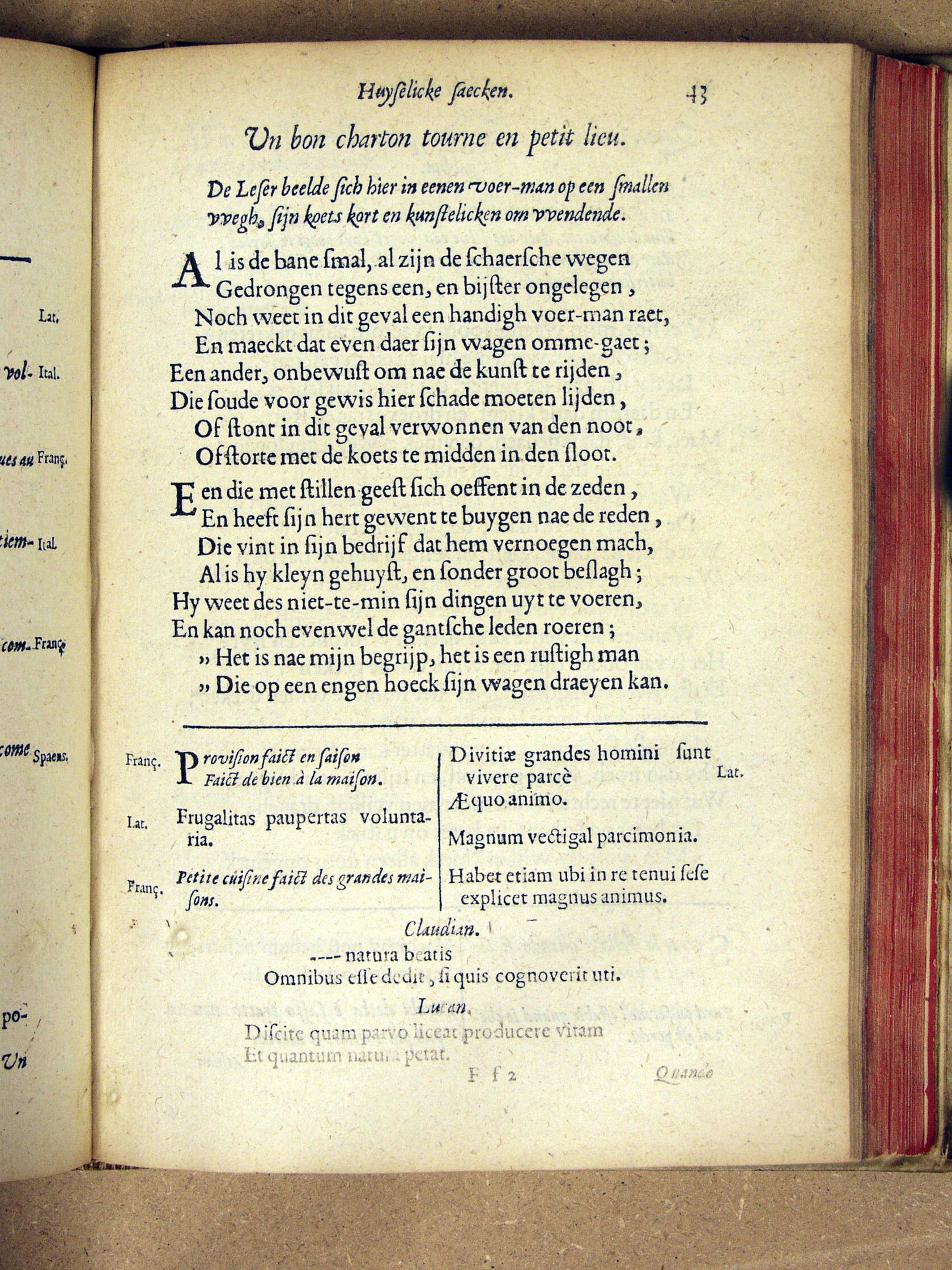
Un bon charton tourne en petit lieu.
(French motto) A good carter turns in a small space.
De Leser beelde sich hier in eenen voer-man op een smallen wegh, sijn koets kort en kunstelicken om wendende.
Al is de bane smal, al zijn de schaersche wegen Gedrongen tegens een, en bijster ongelegen, Noch weet in dit geval een handigh voer-man raet, En maeckt dat even daer sijn wagen omme-gaet; Een ander, onbewust om nae de kunst te rijden, Die soude voor gewis hier schade moeten lijden, Of stont in dit geval verwonnen van den noot, Of storte met de koets te midden in den sloot.
Een die met stillen geest sich oeffent in de zeden, En heeft sijn hert gewent te buygen nae de reden, Die vint in sijn bedrijf dat hem vernoegen mach, Al is hy kleyn gehuyst, en sonder groot beslagh; Hy weet des niet-te-min sijn dingen uyt te voeren, En kan noch evenwel de gantsche leden roeren; » Het is nae mijn begrijp, het is een rustigh man » Die op een engen hoeck sijn wagen draeyen kan.
Let the Reader imagine here a carter on a narrow road, turning his coach around short and skilfully. Though the track is narrow, though the scanty ways are crowded together and very inconvenient, yet in this case a handy carter knows a remedy, and manages that his wagon turns about right there; another, not knowing how to drive according to the art, would certainly have to suffer damage here, or in this case would be overcome by necessity, or would tumble with the coach into the middle of the ditch. One who with a quiet mind exercises himself in morals, and has accustomed his heart to bend to reason, finds in his occupation that which may content him, even though he is small-housed and without great display; he nevertheless knows how to carry out his affairs, and can still move all his limbs; to my mind he is a capable man who can turn his wagon in a narrow corner.
Provision faict en saison Faict de bien à la maison.
Petite cuisine faict des grandes maisons.
Provision made in season does good to the house. / A small kitchen makes great houses.
Frugalitas paupertas voluntaria.
Divitiæ grandes homini sunt vivere parcè Æquo animo.
Magnum vectigal parcimonia.
Habet etiam ubi in re tenui sese explicet magnus animus.
Frugality is voluntary poverty. / Great riches for a man are to live sparingly with an even mind. / Thrift is a great revenue. / Even in slender circumstances a great spirit has room to display itself.
Claudian. ---- natura beatis Omnibus esse dedit, si quis cognoverit uti.
Claudian: Nature has granted all men to be happy, if only one knows how to use it.
Lucan. Discite quam parvo liceat producere vitam Et quantum natura petat.
Lucan: Learn with how little life may be sustained, and how much nature demands.
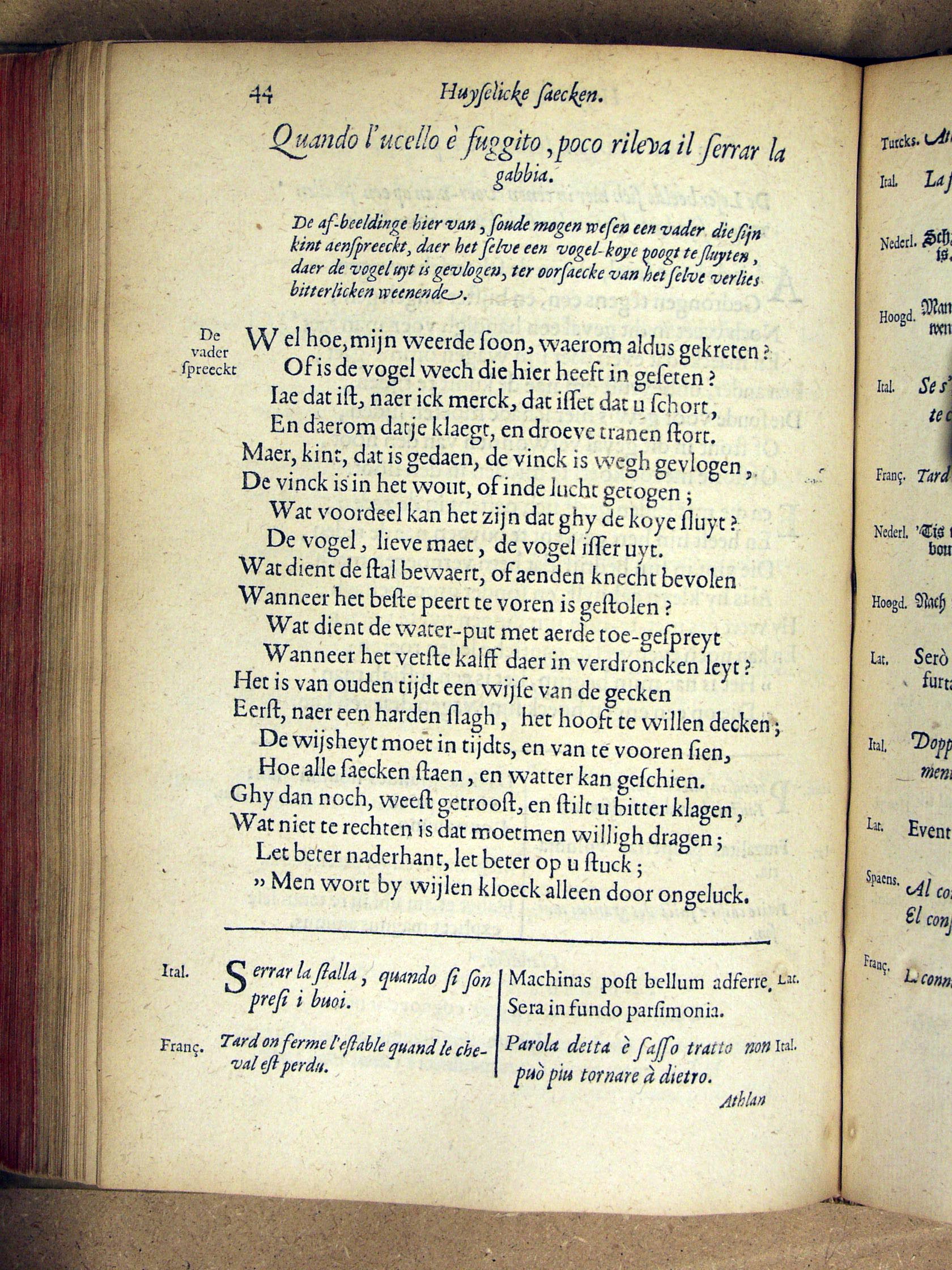
Quando l'ucello è fuggito, poco rileva il serrar la gabbia.
When the bird has flown, it matters little to shut the cage.
De af-beeldinge hier van, soude mogen wesen een vader die sijn kint aenspreeckt, daer het selve een vogel-koye poogt te sluyten, daer de vogel uyt is gevlogen, ter oorsaecke van het selve verlies bitterlicken weenende.
(De vader spreeckt)
Wel hoe, mijn weerde soon, waerom aldus gekreten? Of is de vogel wech die hier heeft in geseten? Iae dat ist, naer ick merck, dat isset dat u schort, En daerom datje klaegt, en droeve tranen stort. Maer, kint, dat is gedaen, de vinck is wegh gevlogen, De vinck is in het wout, of inde lucht getogen; Wat voordeel kan het zijn dat ghy de koye sluyt? De vogel, lieve maet, de vogel isser uyt. Wat dient de stal bewaert, of aenden knecht bevolen Wanneer het beste peert te voren is gestolen? Wat dient de water-put met aerde toe-gespreyt Wanneer het vetste kalff daer in verdroncken leyt? Het is van ouden tijdt een wijse van de gecken Eerst, naer een harden slagh, het hooft te willen decken; De wijsheyt moet in tijdts, en van te vooren sien, Hoe alle saecken staen, en watter kan geschien. Ghy dan noch, weest getroost, en stilt u bitter klagen, Wat niet te rechten is dat moetmen willigh dragen; Let beter naderhant, let beter op u stuck; » Men wort by wijlen kloeck alleen door ongeluck.
The illustration of this might be a father who addresses his child, while the child tries to shut a birdcage out of which the bird has flown, weeping bitterly on account of that very loss. (The father speaks.) Well now, my worthy son, why this crying? Or is the bird gone that sat here within? Yes, that it is, as I perceive; that is what ails you, and that is why you complain and shed sad tears. But, child, that is done; the finch has flown away, the finch has gone into the wood or into the air. What profit can it be that you shut the cage? The bird, dear fellow, the bird is out of it. What use is it to guard the stable, or to charge the servant with it, when the best horse has already been stolen? What use is it to cover the well with earth when the fattest calf lies drowned in it? It is an old-time custom of fools to want to cover the head only after a hard blow; wisdom must see in time and beforehand how all matters stand, and what may happen. You then, be comforted, and still your bitter complaining; what cannot be set right must be willingly borne; take better heed afterwards, pay better attention to your task; one is sometimes made clever only by misfortune.
Serrar la stalla, quando si son presi i buoi.
Parola detta è sasso tratto non può piu tornare à dietro.
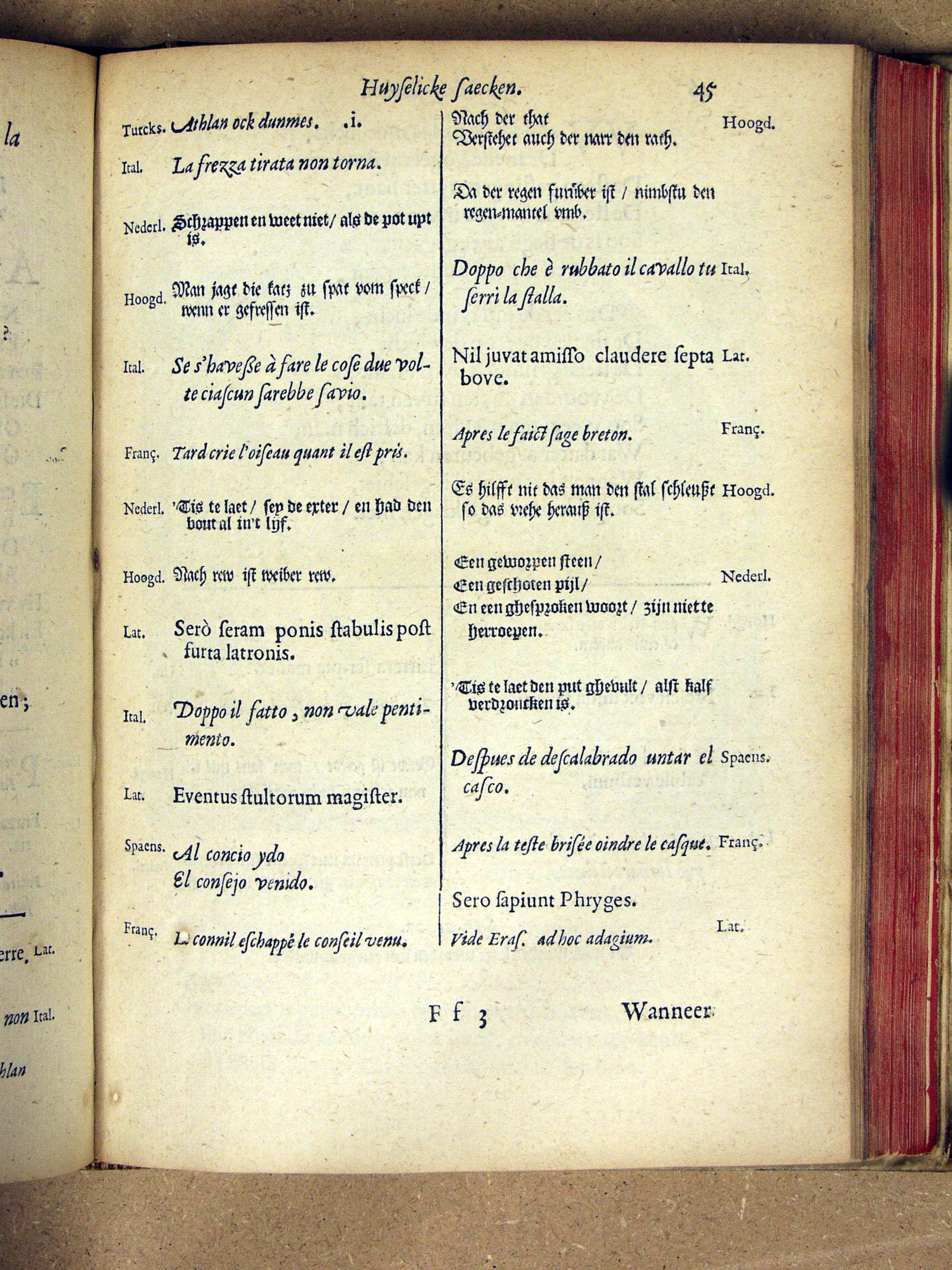
La frezza tirata non torna.
Doppo che è rubbato il cavallo tu serri la stalla.
Doppo il fatto, non vale pentimento.
To shut the stable when the oxen have been taken. / A word spoken is a stone thrown: it can no longer come back. / The arrow shot does not return. / After the horse has been stolen you shut the stable. / After the deed, repentance is worth nothing.
Tard on ferme l'estable quand le cheval est perdu.
Tard crie l'oiseau quant il est pris.
Le connil eschappé le conseil venu.
Apres le faict sage breton.
Apres la teste brisée oindre le casque.
Too late one shuts the stable when the horse is lost. / Too late cries the bird when it is caught. / The rabbit escaped, the counsel come. / After the deed, the Breton is wise. / After the head is broken, to anoint the helmet.
Machinas post bellum adferre. Sera in fundo parsimonia.
Serò seram ponis stabulis post furta latronis.
Eventus stultorum magister.
Nil juvat amisso claudere septa bove.
Sero sapiunt Phryges. Vide Eras. ad hoc adagium.
To bring up siege engines after the war. / Thrift at the bottom of the purse comes too late. / Too late do you put a lock on the stable after the thief's thefts. / The outcome is the teacher of fools. / It is of no use to close the enclosure when the ox is lost. / The Phrygians grow wise too late. See Erasmus on this adage.
Athlan ock dunmes. .i.
(Turkish) The arrow once shot does not return, i.e. [as the foregoing].
Schrappen en weet niet / als de pot uyt is.
'Tis te laet / sey de exter / en had den bout al in't lijf.
Een geworpen steen / Een geschoten pijl / En een ghesproken woort / zijn niet te herroepen.
'Tis te laet den put ghevult / alst kalf verdroncken is.
Scraping is of no use when the pot is empty. / 'It is too late,' said the magpie, and already had the bolt in her body. / A thrown stone, a shot arrow, and a spoken word are not to be recalled. / It is too late to fill the well when the calf is drowned.
Man jagt die katz zu spat vom speck / wenn er gefressen ist.
Nach rew ist weiber rew.
Nach der that Verstehet auch der narr den rath.
Da der regen furuber ist / nimbstu den regen-mantel umb.
Es hilfft nit das man den stal schleußt so das viehe herauß ist.
One chases the cat from the bacon too late, when it has been eaten. / Later repentance is women's repentance. / After the deed even the fool understands the advice. / When the rain is over, you put on your raincoat. / It does not help to shut the stable when the cattle are out.
Al concio ydo El consejo venido.
Despues de descalabrado untar el casco.
The occasion gone, the counsel come. / After the head is broken, to anoint the skull.
Wanneer de pijl is inde lucht, De snelle vogel op de vlucht, De steen geslingert uytter hant, De stemme buyten uwen tant, Soo is de slagh alree gegaen, En daer en is geen houwen aen.
Dus eer de pijl is inde lucht, De snelle vogel op de vlucht, De steen geslingert uytter hant, De woorden buyten uwen tant, Soo weegt ten naeusten, deftich man, Wat datter af gebeuren kan; Want als het onheyl is geschiet, Soo geldt ontijdigh klagen niet.
When the arrow is in the air, the swift bird on the wing, the stone slung from the hand, the voice outside your teeth, then the blow has already gone, and there is no holding it. So before the arrow is in the air, the swift bird on the wing, the stone slung from the hand, the words outside your teeth, then weigh most carefully, worthy man, what may come of it; for when the mischief has happened, untimely complaining avails nothing.
Wann das wordt heraus ist / so ist es eines andern.
Geredt ist geredt / man kans mit keinem schwam mehr abwisschen.
When the word is out, it belongs to another. / Spoken is spoken; one can no longer wipe it off with any sponge.
Nescit vox missa reverti.
Et semel emissum volat irrevocabile verbum.
De scripto hoc magis.
Littera scripta manet.
A word once sent forth does not know how to return. / And the word once let go flies away irrevocable. / This is still more true of what is written. / The written letter remains.
Parola detta, è sasso tratto non può tornare à dietro.
Parli poco, ma scribi meno.
A word spoken is a stone thrown: it cannot come back. / Speak little, but write less.
Heeft yemant met spreken sich vergist / Ten wort met geen sponsy uytgewist.
Syr. 21. 27. De wijse weghen hare woorden met een gout-wichte.
If anyone has erred in speaking, it is not wiped out with any sponge. / Sirach 21:27: The wise weigh their words with a gold-weight.
Iconclass
86(PRO CAMELO SARCINA)proverbs, sayings, etc. (PRO CAMELO SARCINA)
Suggested Iconclass codesAI-generated
Additional codes proposed for this emblem, not (yet) part of the indexing.
46C133pack-animalhighThe correlate 'pack-animal' exactly matches the loaded camel carrying a strapped bale across the sandy ground.
46C13animal mounts; pack-animalsmediumThe broader category 'animal mounts; pack-animals' covers the scene of men loading bales onto a camel.
54A43Temperance, Moderation; 'Misura' (Ripa)high'Temperance, Moderation; Misura' matches the commentary's central lesson of keeping measure — 'stretch your leg according to the blanket', 'measure maintains estate', not undertaking more than one can bear.
52A53Self-knowledgemedium'Self-knowledge' matches Seneca's 'before all else it is necessary to appraise oneself' and the repeated maxim 'one must know one's own measure / measure yourself by your own foot'.
Relationships to the Adagia of ErasmusAI-generated
Suggested relationships between this emblem and adages in Erasmus’ Adagia.
- II v 51 Ne gladium tollas mulier – thematic inventiohigh
The emblem's Latin commentary quotes the adage verbatim ('Ne gladium tollas mulier') immediately after the motto, using Erasmus' lesson — do not take on a burden of business beyond your strength — as a gloss on the camel's measured load.
- II v 46 Ne supra pedem calceus – thematic inventiohigh
The commentary quotes both the Latin headword 'Ne supra pedem calceus' and its Greek form 'Μὴ ὑπὲρ τὸν πόδα ὑπόδημα', exactly Erasmus' adage, applied to not undertaking more than one's station or strength permits.
- I vi 92 Intra tuam pelliculam te contine – thematic inventiohigh
The Latin commentary list includes 'Intra pelliculam tuam te contine', Erasmus' adage warning against forgetting one's condition and attempting more than one's powers — precisely the emblem's moral of a load matched to the bearer.
- I vi 87 Tecum habita – essay quotehigh
The commentary quotes 'Tecum habita ut noris quam sit tibi curta supellex', the Persius line that forms the substance of Erasmus' adage essay on living within one's own means.
- I vii 62 Efficimus pro nostris opibus moenia – essay quotehigh
The commentary has both 'Pro opibus moenia' (the adage itself) and 'Aviculae nidulificant' / 'Kleyne vogelkens kleyne nestjens', which render the closing sentence of Erasmus' essay, 'Pusillae aviculae pusillos nidulos construunt'.
- I i 28 Sero sapiunt Phryges – thematic inventiohigh
The commentary on shutting the stable after the horse is stolen cites the adage explicitly with a reference to Erasmus: 'Sero sapiunt Phryges. Vide Eras. ad hoc adagium.'
- II ii 82 Quam quisque norit artem, in hac se exerceat – thematic inventiohigh
The commentary quotes 'Quam quisque norit artem hanc exercent' with the explicit note 'Vid. Eras. ad hoc Adag.', invoking Erasmus' adage against meddling beyond one's own competence (also echoed by 'Ne sutor ultra crepidam').
- V i 4 Mus non uni fidit antro – thematic inventiohigh
The 'Niet te veel eyers onder eene hen' section ends with 'Een muys die maer een hol en heeft / 'Tis wonder soose lange leeft', a direct rendering of the proverb Erasmus treats here ('it's an unhappy mouse that has but one hole'), and the whole passage urges spreading one's risks as Erasmus' essay does.
- III viii 87 Ultra vires nihil aggrediendum – thematic inventiohigh
Erasmus' adage ('no one should seek a battle beyond his strength') states exactly the emblem's lesson: 'meer te willen alsmen kan / Daer koomt of schaed' of schande van', reinforced by the Horatian 'Versate diu quid ferre recusent, quid valeant humeri'.
- I vi 88 Messe tenus propria vive – thematic inventiohigh
The polyglot commentary ('Si ton revenu n'est capable de ta despence...', 'Teer nae neer', 'Bisogna far la spesa secondo l'entrata') repeats Erasmus' precept to spend according to one's resources; Erasmus' essay on the ptochalazon (proud beggar) matches the English 'A proud heart and a beggar's purse will not agree'.
- I vi 95 Nosce teipsum – thematic inventiomedium
The commentary's 'Noscenda est mensura sui' and 'Tuo te pede metire', together with the subscriptio's 'Beproeft u schouders, eer ghy draeght', apply the Delphic maxim as Erasmus expounds it, against self-flattery and overreaching.
- II viii 52 Equo senescenti minora cicela admove – thematic inventiomedium
Erasmus' adage that the burden must be scaled to the beast's declining strength is the same animal-and-load imagery as the camel that accepts exactly seven hundred pounds and no more.
- I ix 58 Camelus vel scabiosa complurium asinorum gestat onera – thematic inventiomedium
The only Erasmian adage specifically on the camel's carrying capacity, matching the emblem's picture of the loaded camel and its proverbial 'camel's load' (700 pounds).
- III iii 79 Mus non ingrediens antrum cucurbitam ferebat – thematic inventiomedium
Erasmus glosses this adage as applying to one 'who attempts tasks beyond his strength' — exactly the emblem's warning against taking on more offices and burdens than one can carry.
- I v 67 Funem abrumpere nimium tendendo – thematic inventiomedium
The image of the rope that snaps when overstretched parallels the emblem's man crushed or torn to the ground by a pack piled beyond measure.
- IV v 77 Arcus tensus rumpitur – thematic inventiomedium
Erasmus' adage that the over-strung bow breaks expresses the same principle of strength overtaxed that the camel's refusal of extra weight illustrates.
- IV v 89 Oportet agrum imbecilliorem esse – thematic inventiomedium
Erasmus' essay ('the land should be weaker than the farmer... praise large estates, cultivate a small one') teaches exactly the emblem's measure-your-means doctrine, echoed in 'Kerck nae werck' and 'Maet houdt staet'.
- II iii 70 Antequam incipias, consulta – thematic inventiomedium
The 'pole-vault over the ditch' commentary ('maeckt dat ghy u wel versint... wickt, al voorens eer ghy waeght') restates Erasmus' precept of deliberating before acting.
- I vi 96 Ne quid nimis – thematic inventiolow
The whole cluster of proverbs on measure ('Kent staet / en houdt maet', 'Chacun estende la jambe selon la couverture') rests on the classic maxim of moderation that Erasmus treats here.
- III v 8 Camelus desiderans cornua etiam aures perdidit – thematic inventiolow
Another camel adage with the same moral of greedy overreaching punished — close to the emblem's man who 'keeps crying out continually, More!' until the pack throws him down.
- I vi 86 In se descendere – thematic inventiolow
Erasmus' adage on inspecting oneself stands behind the Senecan passage quoted in the commentary ('ante omnia necesse est seipsum aestimare') and the exhortation to test one's own shoulders.
- I i 31 Malo accepto stultus sapit – thematic inventiomedium
The commentary quotes this Erasmian adage verbatim ('Malo accepto stultus sapit') in the section on the cow's tail and on learning only after loss; it was not among the retrieved candidates.
- III vi 17 Post bellum auxilium – thematic inventiolow
The commentary's 'Machinas post bellum adferre' and the whole bird-flown-cage/stable-after-theft cluster correspond to Erasmus' adage on help that comes too late, grouped by him with 'Sero sapiunt Phryges'.
Sources
Record ID: embstma_1288_emblem065
This emblem on the Iconclass site: https://iconclass.org/view/embstma_1288_emblem065
Copy: University Library, Glasgow, Stirling Maxwell 1288