III v 1 Risus Sardonius A sardonic laugh
Σαρδώνιος γέλως, id est, Sardonius risus. De risu ficto, aut amarulento, aut insano denique. Et sensus & origo proverbii adeo varie tractatur ab autoribus, ut verear, ne risus hic Sardonius non citra risum legatur, tamen accingemur referre quaedam. Zenodotus in Collectaneis suis Aeschylum citat, qui huiusmodi fermè tradiderit in opere De paroemiis, Gentem esse quandam Carthaginensium coloniam, quae Sardonem regionem inhabitet, ei morem esse, senes septuagesimum praetergressos annum Saturno sacrificare, ridentes interim, ac mutuo sese complexantes. Nam turpe ducebant, in funere aut eiulatum aedere, aut lachrymas profundere. Hinc adsimulatum risum, Sardonium vocari coeptum. Timaeus apud eundem Zenodotum ait, Sardoniis consuetudinem fuisse, ut filii parentes iam grandaevos iuxta fossam, aut praecipitium, in quo sepeliendi forent, collocarent, atque inde fustibus caedentes, in eam darent praecipites. At illi interim pereuntes ridebant, existimantes eam mortem felicem atque egregiam, quod liberorum impietate interirent. Sunt qui dicant, in Sardorum insula herbam nasci quandam, cui Sardoae cognomen sit, Apiastro similem. Eam sapore quidem esse dulcem, verum gustatam, ora hominum in rictus dolore contrahere, ut veluti ridentes emoriantur. Hoc sensisse videtur Solinus, cumque hoc Servius grammaticus enarrans hunc ex Virgiliana Thyrside locum: Imò ego Sardois videar tibi amarior herbis. Atque his fermè confinia tradit Lycophronis interpres de risu Sardonio. Servium secutus Latinus Drepanus in Panegyrico, Serenos ergo, inquit, vultus induebamus, & ad illorum vicem, qui degustato Sardorum graminum succo feruntur in morte ridere, imitabamur laeta maerentes. Neque rursum desunt, qui Sardonium risum cognominatum autumant, ἀπὸ τοῦ σεσηρέναι τοὺς ὀδόντας, quod dentes aperiat atque renudet, cuiusmodi risus esse solet eorum, qui non ex animo rident. Hinc & iocus ille parasiti Plautini conquerentis, quod suis dictis nullo pacto iuvenes arrisissent, ac non saltem canes fuissent imitati, ut dentes ostenderent. Et Apuleius, Restrictis forte si labellis riseris. Id genus risum descripsit Homer. Iliados ο. de Iunone loquens, Η δ᾽ ἐγέλασσε Χείλεσιν, οὐδὲ μὲτωπον ἐπ᾽ ὀφρύσι κυανὲησιν ἰάνθη. id est, Illa quidem labiis ridebat, nubila porrò Frons minime renitebat: Ad id facit quod scribit Aristophanes in Pace, Ηγριωμένους ἐπ᾽ ἀλλήλοισι καὶ σεσκηρότας. id est, Invicem in se exasperatis osque diducentibus. A canibus ducta metaphora, quibus hoc irae indicium est, nudare dentes. Quem morem aiunt equis etiam inesse, si quando parant mordere: unde vulgo nunc risum huiusmodi, risum equinum vocant. Rursum alii perhibent, apud Sardinies fuisse receptum, ut ex captivis pulcherrimos quosque ac natu maximos, qui septuagesimum excessissent annum, Saturno mactaret, ridentes in morte, propterea quod id forte ac virile videretur. Citatur auctor Clearchus, Carthagine sollemnem fuisse morem, ut in magnis votis puerum Saturni manibus imponerent. Hius statua fingebatur aerea, manibus porrectis. Sub eo fornax erat, ea succendebatur, puer itaque ignis vapore contractus ac tortus, ridentis speciem exhibebat. Denique et Simonidem allegat Zenodotus novae fabulae auctorem. Ait enim Talum quempiam aereum virum priusquam in Cretam pervenirer, in Sardinia accessisse, ubi non paucos mortales neci dedit. Qui cum morientes ringerentur, risus imaginem quandam exhibentes, proverbio locum fecerunt. Addunt nonnulli, cum a Sardiniis in Cretam transmittere vetaretur, illum in ignem desiliisse, quandoquidem aerei corporis erat, deinde Sardinios pectori suo admotos necare solitum. Emoriebantur autem volut in amplexu, ac ridentibus adsimiles, nimirum rictu incendii vi dicucto. De hoc Talo ridicula narratur fabula. Aiunt enim hunc a Vulcano ex aere fuisse fabrefactum, Minoique dono missum ad Cretensis insulae tutelam. Erat autem illi unica duntaxat vena, eaque a summa cervice, ad imos usque talos porrecta. Ter in singulos dies insulam obibat, excubias agens. Itaque et Argo navem a Colchide cum Iasone redeuntem vetuit in portum Cretensem appellere. Sed a Medea deceptus periit, ut nonnulli dicunt, dato veneno, quod insaniam immitteret, ut aliis placet, cum illa pollicita se illum immortalem redditurum, clavum qui summae venae erat adfixus, eduxit, atque ita sanguine totoque corporis humore defluente periit. Rursum alii tradunt interisse percussum arcu a Paeante circa talum. Dioscorides libro sexto inter venena prodidit herbae speciem esse quandam, quam quidam ranunculam appellant Latine, Graeci batrachion: eam a regione, in qua copiosius provenit, Sardoam, sive Sardoniam dicunt, quae pota sive comesa mentem adimat, labiisque contractis risus speciem praebeat. Atque inde in hominum vitam sinistri omnis venisse de risu Sardonio proverbium. Meminit huius herbae et Plin. lib. 25. circa fin. Strabo lib. Geographiae 11. scribit in Cambysena, quae flumen Alazonium accolit, aranearum genus quoddam nasci, quod alios ridendo cogat emori, alios flendo desiderio suorum. Quidam addunt de Tarcotella, cuius morsum interitus cum risu sequatur. Quin et Aristoteles De partibus animalium lib. 3. ait, ictu etiam traiecta praecordia, in proeliis risum attulisse literis proditum esse, idque accidere calore, quem moveat vulnus. Mortuus est et Zeuxis pictor ridendo, dum sine fine ridet anum a se pictam, et Chrysippus conspiciens asinum vescentem ficis. M. Tullius Epist. fam. lib. 7. ad Fabium Gallum. Videris, inquit, mihi vereri, nesi istum habuerimus, rideamus, γέλωτα σαρδώνιον, significans futurum, ut si Caesar rerum potiretur, multis adridere atque applaudere cogerentur, quae magnopere displicerent. Lucianus in Asino, σαρδώνιον γελῶντες ἔλεγον, id est, Sardonice ridentes aiebant. Risum innuit contumeliosum et subsannantem. idem alibi: ὁ δάμις δὲ τὸ σαρδώνιον ἐπιγελῶν ἔτι μᾶλλον παρώχυνε, id est, Damis autem Sardonio arridens risu, magis etiam irritavit. In eodem sensu videtur usurpatum et a Platone lib. De repub. 1. cum scribit Thrasymachum, quem amarulentum et arrogantem ubique facit, Sardonice risisse, Καὶ ὃς ἀκούσας ἀνεκάγχασέ τε μάλα σαρδώνιον καὶ εἶπεν, id est, Hic ille auditis edito cachinno, valde Sardonice risit, ac dixit. Homerus item aliquot locis huius risus mentionem facit in Odysseae Υ. narrans quemadmodum e procis quispiam, puta Ctesippus Ulyssem in aedibus suis habitu specieque mendici sedentem, arrepto e sportula bovis pede petisset, atque ille capite commodum deflexo declinasset ictum: Μείδησε δὲ θυμῷ Σαρδώνιον μάλα τοῖον. Quo loco Eustathius interpres admonet eum ridere risum Sardonium, qui diductis modo labris rideat, ceterum intus aut ira, aut molestia discruciatus. Veteres enim risum Sardonium vocasse, quoties aliquis despectim non solum ridet, sed etiam irridet: dictum autem παρὰ τὸ σεσηρέναι τὰ χείλη. i. à diducendo labia. Quomodo fere rident, qui apud sese perniciem alicui destinant, quemadmodum Ulysses mox sublaturus e medio procos, idque iam tum in animo statuens, risit risum quendam subamarulentum. Consimilem risum risit apud Hesiodum Iuppiter iratus Prometheo propter ignem furto sublatum. Carmen adscripsimus, quod quidem est in primo libro operis cui titulus, ἔργα καὶ ἡμέραι. Τὸν δὲ χολωσάμενος προσέφη νεφεληγέρετα ζεύς. Ιαπετιονίδη πάντων περὶ μήδεα εἰδὼς Χαίρεις πῦρ κλέψας καὶ ἐμὰς φρένας ὑπεροπεύσας. Σοί τ᾽ αὐτῷ μέγα πῆμα καὶ ἀνδράσιν ἐσσομένοισι, Τοῖς δ᾽ ἐγὼ ἀντὶ πυρὸς δώσω κακὸν ᾧ κεν ἅπαντες Τέρπονται κατα θυμὸν εὸν, κακὸν ἀμφαγαπῶντες. Ως ἔφατ᾽ ἐκ δ᾽ ἐγέλασσε παρὴρ ἀνδρῶν τε θεῶν τε. id est, Huic animo infensus, qui nubila colligit, inquit, Proles Iapeti multo technisque dolisque Inter mortales unus doctissimus omnes, Imposuisse mihi gaudes, ignemque tulisse. Nempe ingens atroxque malum, et tibi, postquefuturis, Quis ego pro rapto igne malum dabo, quo simul omnes Gaudebunt, propriumque malum fovisse libebit, Sic fatus, risitque parens hominumque, Deumque. Risum hunc fatalem interpretantur, quoties imminet pernicies a fatis destinata. Cuiusmodi fuit et ille procorum, quem describit Homerus eodem libro, quem paulo ante citavimus, alioque retulimus loco: Μνηστῆρσι δὲ πάλλας ἀθήνη Ασβεστον γέλον ὦρσε, παρέπλαγξεν δὲ νόημα, Οἵ δ᾽ ἤδη γναθμοῖσι γελοίων ἀλλοτρίοισιν, Αἱμοφόρυκτα δὲ δὴ κρέα ἤσθιον, ἄσσε δ᾽ ἄρα σφέων Δακρυόφιν πίμπλαντο, γόον δ᾽ ὠΐσατο θυμός. Diva procis movit validum Tritonia risum Haud compescendum, ac animum stupefecit, at illi Iam malis sine mente quidem risere alienis, Carnis frusta & cruda & sanguinolenta vorantes. Interea lacrimis implentur lumina, fletum Sensit & ipse animus. Opinamur et Sardonium risum accipiendum, quem Homerus Iliados H. tribuit Aiaci singulare certamen ineunti: Τοῖος ἄρ αἴας ὦρτο πελώριος, ἕρκος ἀχαιῶν Μειδίοων βλοσυροῖσι προσώποισιν. id est, Sic ingens Aiax surgebat murus Achiuum Terribili ridens vultu. In vetustissimis quibusda in Hesiodum commentariis epigramma reperitur, quo proverbium de risu Sardonio non ineleganter explicatur, id est huiusmodi. Σαρδὼ τίς ἐστι νῆσος ἰβηροτρόφος Εν ᾗ βότνη φθαρτικὴ γῆς ἐκτρέχει Σελινοειδὴς σαρδάνη κεκλημένη. Βεβρομένη δὲ τοῖς ἀπείροις αὐτίκα Σπασμούς τε ποιεῖ καὶ γελώτων ἐμφάσεις, Καὶ πότμος εὐθὺς καὶ γελάσιμος μόλος Αλλοι δὲ φασι σαρδανοὺς τοὺς βαρβάρους Γηρῶντας αὐτῶν τοὺς γενάρχους ἐσχάτους Αγειν λαβόντας εἰς ἀπόκρημνον τόπον, Κτείνειν τε τούτους ἔν τε ῥοπάλοις καὶ λίθοις, Επειτα ῥίπτειν ἐκ πετρῶν τοὺς ἀθλίους Γελῶντας εἰκῆ παιδιαῖς πατροκτόνοις. Αλλοις δὲ τοὺς θνήσκοντας αῤέσκει πλέον Γελᾶν, ορῶντας τεκνικὰς παροινίας, Καὶ τὰς κυκλόστρας καὶ στροφὰς τῶν πραγμάτων Id quoque nos nostro more propter imperitiores Latinum fecimus, hoc modo: Quaedam insula est vocata Sardo Hiberiae, In qua herba perniciosa surgit e solo, Cui Sardanae nomen, apiastri praeferens Figuram, at ea comesa ab imprudentibus Mox ora contrahit, atque risus exhibet Speciem, deinde protinus mors occupat Imitata risum. Ceterum sunt qui ferant Gentem esse quandam Sardanorum barbaram. Aetate qui fessos parentes in loca Praerupta raptos deferant, atque ibi neci Saxisque fustibusque dent miserrtmos Ex arduis subinde praecipitent petris. At inter isthaec impiis rident iocis, Luduntque temere parricidis lusibus. Aliis magis probatur haec sentetia, Rtdere eos qui sic necantur, quippe qui Spectent suorum pignorum vaesaniam, Citasque rerum et aestuarias vices. Pausanias in Phocaicis tradit, Sardoam insulam serpentes gignere innoxios. Praeterea eam a venenis herbarum prorsus immunem esse, nisi quod unam alit exitialem, apii specie, quae iuxta fontes quidem proveniat, non inficiat tamen fontium aquas: eam qui ederint, ait ridentes emori. Atque hinc Homerum, et post Homerum alios adagium induxisse, ut dicerent eos ridere risum Sardonium, qui risum riderent τὸν ἐπὶ οὐδενὶ ὑγιῆ, hoc est, omnino insanum. Itaque non absurde videtur accipi posse risus Sardonius, pro risu demente, quoties instanti bus malis insane ridetur. Siquidem legimus C. Gracchum in ambiendo magistratu repulsum, adversus inimicos insolentius ridentes in clamasse, eos Sardonium ridere risum, ignaros quam magnis tenebris ex suis actibus circumfunderentur. Hoc in Gracchorum vita Plutarchus. Idem in commentario de superstitione: Ενταῦθα τοίνυν σκόπει τὸν ἄθεον, γελῶντα μὲν μανι- κὸν καὶ σαρδώνιον γέλωτα. i. Hic itaque considera eum, qui nullos credit esse Deos, insanum quidem et Sardonium ridentem risum. Interpres quisperiam Hesiodi, risum Sardonium interpretatur, risum πλατὺν.. id est, amplum, ubi quis ore vehementer diducto ridet, quem eundem, opinamur, γέλωτα συγκρούσιον appellant, id est, risum concutientem. Cui quidem interpretamento suffragatur ipsius etymologia vocabuli, quam paulo superius ostendimus: ἀπὸ τοῦ σεσηρέναι τοὺς ὀδόντας. Postremo non omnino videbitur absurde Sardonius risus accommodari posse, ad risum luctuosum ac tristem, cuiusmodi tribuit Homerus Iliados Z. Andromachae, tamquam is indicium fuerit animi, morte Hectoris praesagientis: Η δ᾽ ἄραμιν κυώδεϊ δέξατο κόλπῳ Δακρυοεν γελάσασα. id est, Illa sinu accepit spiranti, flebile ridens. Eudemus in collectaneis dictionum rhet. air placere nonnullis, ut de risu contumedlioso accipiatur, ubi quis despectum contemptumque ridet, de quo proverbium etiam fertur: Αφ᾽ ὕψους καταγελᾶς μου. i. E sublimi me derides. Addit idem lapidis esse genus, qui risus Sardonius appelletur. Suidas scribit hinc etiam verbum effictum, ut σαρδάζειν dicantur, qui Sardonium rideant risum. Sed iamdudum libet a risu Sardonio discedere, idque faciemus, si prius illud addiderimus, epithetum hoc Sardonium variis formis inveniri apud auctores. Apud Lucianum et Ciceronem σαρδώνιον legimus, apud Homerum σαρδάνιον, apud Verg. Sardoum, apud Lycophronis enarratorem σάρδιον γέλωτα, apud Plutarchum σαρδιανὸς, εἶ τίς ἐστι τῆς ψυχῆς σαρδιανὸς γέλως. i. Si quis est animi Sardianus risus. Stephanus indicavit dici σαρ- δωνικὸν & σαρδιανικὸν. Tametsi non omnia ab eadem vocemanant. Nam a Sardo sive Sardon insula, cui quondam nomen fuerat Ichnusae, deducitur Sardonius, Sardous et Sardonicus. A Sardos Illyriae civitate proficiscitur σαρδηνοὶ, unde, sicuti credimus, mutato h in α, σαρδάνιοι. A Sardis Lydiae oppido Sardianos et Sardianicus, Ex his succurrit coniectura in epigrammate Graeco, quod modo citavimus, non legendum fortassis, ἰβηρο- τρόφος, sed ἰλλυροτρόφος. Usurpavit adagium Saluianus libro 7. Sardonicis quodammodo herbis, omnem Romanorum populum putes saturatum: moritur & ridet.
Σαρδώνιος γέλως, A sardonic laugh. Said of a pretended, bitter, or mad laugh. Both the meaning and the source of the proverb are so variously described by authors that I fear this account of a 'sardonic laugh' cannot be read without arousing laughter, but we shall brace ourselves to relate a few points. Zenodotus in his Collected Proverbs quotes Aeschylus, who reported roughly as follows in his work On Proverbs: 'There is a people who inhabit the area of Sardon, a colony of the Carthaginians; it is their custom to sacrifice to Saturn old men who have exceeded the age of seventy, and to laugh and embrace each other while doing so. For they believed it was unseemly to utter lamentations at a funeral or to shed tears. This is how a feigned laugh came to be called "sardonic."' According to the same Zenodotus, Timaeus says that it was the custom of the Sardinians for sons to set parents who had reached a great age on the edge of a precipice or a pit in which they were to be buried, and then, felling them with cudgels, to knock them headlong into it. But the parents laughed as they died, reckoning this was a happy and noble death because their children, in killing them, had lost respect for them. There are some who say that a certain herb is found on the island of the Sards, called 'Sardinian grass,' rather like wild parsley. It has a sweet taste, but after it is swallowed it twists men's mouths in a grimace of pain, so that they die apparently laughing. This is what Solinus seems to have meant, and Servius the grammarian too when he was explaining this line from the Thyrsis of Virgil: 'Now let me seem to you more bitter than Sardinian herbs.' And the commentator of Lycophron, talking about the sardonic laugh, reports something quite similar, following Servius. Latinus Drepanus says in his Panegyric: 'So we put on calm faces, and, after the manner of those who have tasted the juice of Sardinian herbs and are said to laugh in death, feigned joys as we mourned.' And there are also some who think that a 'sardonic' laugh is so called 'because it opens and uncovers the teeth,' as the laugh of those who laugh insincerely usually does. And this is the source of that joke by the parasite of Plautus who complained that young people never laughed at what he said and would not even imitate dogs and show their teeth. And there is Apuleius: 'If you laugh perhaps with distended lips.' Homer described this sort of laugh speaking of Juno in the Iliad book 15: 'She was laughing indeed with her lips, but her clouded face shone not at all.' Consistent with this is what Aristophanes writes in the Peace: '[When your allies saw] you growing angry with each other and baring your teeth.' The image is taken from dogs for whom it is a sign of anger to bare the teeth. This is a habit, they say, in horses too, whenever they are about to bite: whence in common language nowadays they call this sort of laugh a 'horse laugh.' On the other hand, others consider it was the custom among the Sardinians that they should offer to Saturn all the handsomest of their captives and all the oldest who had passed their seventieth year, and that these should laugh as they died because this seemed strong and manly. The writer Clitarchus is quoted as saying it was a solemn custom at Carthage, when great vows were made, to place a child in Saturn's hands. A bronze statue would be made of this god, with hands outstretched. Beneath it was a furnace; this was kindled from below, and so the child, made to wriggle and twist by the heat of the fire, had the appearance of one who was laughing. Finally Zenodotus names Simonides too as the source of a strange story. For he says that Talus, a figure of a man made of bronze, before he arrived in Crete, landed in Sardinia, where he put not a few mortals to death. Since these showed their teeth as they died with an appearance of laughter, they gave rise to the proverbial expression. Several add that, being prevented from leaving Sardinia for Crete, he leapt into a fire, for he had a body of bronze, then held the Sardinians close to his chest and killed them. They died as it were in his embrace, and with lips distended by the heat of the fire, like men laughing. A ridiculous tale is told of this Talus. They say that he was fashioned out of bronze by Vulcan and sent as a gift for Minos to guard the island of Crete. However he had a single blood-vessel, and this extended from the top of his head to his heels. He travelled three times each day around the island, keeping watch.
It was thus that he prevented the ship Argo from putting into a Cretan port when it was returning from Colchis with Jason. But he was deceived by Medea and perished, as some say, by the poison she gave him, which caused insanity; according to others, she promised she would make him immortal and pulled out the nail fixed in the extremity of the blood-vessel. So he died as the blood and all the humours of the body consequently flowed away. Yet again, others report that he died when shot in the heel by Poias. Dioscorides stated in book 6, speaking of poisons, that there was a species of grass which some call ranunculus in Latin and batrachion in Greek; it is called Sardoan, or Sardonian, from the region in which it grows most abundantly. When eaten or drunk, it can cause madness, and gives the appearance of a smile by compressing the lips. This, he says, is how that proverb of sinister omen about the 'sardonic laugh' was born. Pliny too mentions this herb in book 25 near the end. Strabo, in book 11 of his Geography, writes that in Cambysena, which lies along the river Alazon, a certain species of spider is found which can drive some to death from laughing and others from weeping for the loss of their loved ones. Certain authors mention besides the tarcotella, whose bite is followed by death with laughing. And does not Aristotle say, in book 3 of On the Parts of Animals, it is recorded that in fighting the piercing of the diaphragm by a thrust appeared to cause laughter and that this happens because of the heat that the wound can produce. Zeuxis the painter and Chrysippus both died from laughing, the former when he was unable to stop laughing at the old woman he had painted, and the latter when he saw an ass eating figs. Cicero says in book 7 of his Letters to Friends, writing to Fabius Gallius: 'You seem to me to be afraid that, if we have him, we may have to laugh "with a sardonic laugh,"' meaning that, if Caesar were to gain power, they would be obliged to smile on and applaud many things of which they strongly disapproved. Lucian, in the Ass, has: 'Thus they spoke, laughing sardonically,' meaning an insolent and mocking laugh. In another place the same author says: 'But Damis, laughing with a sardonic laugh, caused even more irritation.' The expression seems to be used in the same sense by Plato too in book 1 of the Republic, when he writes that Thrasymachus, whom he portrays everywhere as very bitter and arrogant, 'laughed sardonically': 'When he heard these words, he spoke with a loud and very sardonic laugh.' Homer too makes mention of this laugh in some passages in book 20 of the Odyssey. He tells how one of the suitors, namely Ctesippus, attacked Ulysses, who was sitting in his house disguised as a beggar, with the hoof of an ox snatched out of the provision basket, and how Ulysses, turning his head away in good time, deflected the blow: 'And in his heart he smiled a right grim and bitter smile ...' The commentator Eustathius here points out that one who laughs a 'sardonic laugh' laughs only with distended lips and inwardly is tormented with anger or disgust. For the ancients called it a sardonic laugh every time someone not only laughed with contempt but also jeered; the expression comes 'from the distending of the lips.' This is more or less how people laugh who are planning among themselves to kill someone, like Ulysses when he was just about to murder the suitors, and as he decided on this in his mind, he laughed a certain, somewhat bitter laugh. In Hesiod, Jupiter laughs with a similar laugh when he is enraged with Prometheus because of the theft of fire. I have appended the verses, which are in the first book of the work entitled Works and Days:
He who gathers the clouds said to him in anger:
Son of Iapetus, by far in cunning and deceit
The one most skilled among all mortals,
You rejoice to have cheated me and to have stolen the fire;
Truly this shall be a great and cruel plague both to you and to posterity,
To whom I shall give as the price for the theft of fire an evil in which all
Will rejoice, at the same time embracing it to their own destruction.
Thus spoke the father of men and gods, and laughed.
The commentators understand a laugh as fateful in this way whenever a calamity determined by the fates threatens. Such was the laugh of the suitors that Homer describes in the same book that we referred to shortly before and quoted for support in another place:
The divine Tritonia roused loud laughter,
And numbed their barely constrained wits; and they
Laughed dementedly now with alien lips.
The pieces of meat they devoured were raw and bleeding.
Meanwhile their eyes were filled with tears, and lamentation
Overwhelmed their very spirits.
I believe we should take as 'sardonic' the laugh that Homer attributes to Ajax as he is about to fight in single combat in the Iliad, book vii: 'Just so huge Ajax sprang up, the bulwark of the Achaians, / With a smile on his grim face .. .' In certain very old commentaries on Hesiod, I have found an epigram, in which the saying about the 'sardonic laugh' is quite elegantly explained. This too, as is my practice for the less learned, I have rendered roughly into Latin:
There is a certain island called Iberian Sardinia,
Where a noxious weed grows.
It is called Sardinian, looks like the wild parsley,
But when it is eaten by imprudent people
The mouth is presently twisted and shows the likeness of a laugh,
Then death lays hold straightway,
With a simulacrum of a laugh. But there are those who say
There is a barbarous tribe of Sardinians
Who abduct their age-stricken parents,
Carry them off to rocky places and there put them to death
With stones and with clubs; these wretched folk
They thereupon throw down from steep rocks.
While this goes on, they laugh with godless jokes,
And heedlessly play at parricidal games.
This phrase is thought by others to mean rather
That those who are thus put to death laugh, because
They observe the folly of their children,
And the swift and fretful changes of the world.
According to Pausanias in his Phocians the island of Sardinia breeds snakes that are harmless. Further it is entirely free of plant poisons, except that it supports one fatal one which looks like parsley and which, though it grows near springs, does not infect the water of the springs; any who eat it die laughing. And this, he says, is where Homer and others after Homer derived the adage whereby they could say 'they laugh a sardonic laugh,' for those who gave a laugh 'in no healthy manner,' that is, one that was completely senseless. So, not unreasonably, the expression 'sardonic laugh' seems to be usable for the mindless laugh which occurs whenever someone laughs stupidly as evil threatens. For we read indeed that when Caius Gracchus, canvassing for the magistracy, had been defeated, he shouted to some enemies who were laughing most insolently, that they were laughing a sardonic laugh, not knowing into what great darkness they would be plunged by the measures he had taken. This story is told by Plutarch in his lives of the Gracchi, and in his essay 'On Superstition' also: 'Note therefore on these occasions that the man who believes there are no gods laughs with a mad, sardonic laugh.' One commentator of Hesiod interprets a sardonic laugh as 'broad,' that is, a full laugh, where someone laughs with his mouth broadly distended; I think they mean the same by 'jarring laughter,' that is, a discordant laugh. This interpretation is supported indeed by the etymology of the word itself, which I showed just above is because it opens and uncovers the teeth. Finally it will not seem entirely inappropriate that the expression 'sardonic laugh' could be applied to a sad and mournful laugh such as Homer attributes, in the Iliad book vi, to Andromache, as if it were the sign of a mind foreseeing the death of Hector: 'She clasped him to her fragrant bosom, / Laughing through her tears.' Eudemus the rhetorician, in his Miscellany of Rhetorical Sayings, says several authors agree that it may be used of an insolent laugh in which someone laughs disdainfully and contemptuously; whence indeed the proverb is derived: 'You mock me from your lofty height.' The same author adds that there is a kind of stone called the 'sardonic laugh.' Suidas writes that there is even a verb derived from the proverb, so that those who laugh sardonically are said to [greek] . Now I want to stop talking about the sardonic laugh, but before I do, I shall add that this adjective 'sardonic' is found in various forms in the classical writers. In Lucian and Cicero we read [greek], in Homer[greek], in Virgil sardous, in the commentator of Lycophron [greek], in Plutarch [greek]: 'If there is such a thing as a sardonic laugh in the mind.' Stephanus showed that [greek], and [greek] were used: 'However, not all these forms come from the same word. For it is from the island of Sardo or Sardon, which formerly had the name Ichnusa, that Sardonius, Sardous, and Sardonicus are derived. It is from Sardos, a city in Illyria, that [greek] originates' - whence, I suppose, with a change of [greek] to [greek], we have [greek] - 'From Sardis, a town in Lydia, we have Sardianos and Sardianicus.' From these points a conjecture comes to mind: in the Greek epigram which I have just quoted, we should read perhaps not [greek] 'mother of Iberians,' but [greek] 'mother of Illyrians.' Salvianus used the adage in his seventh book: 'You would think the whole Roman nation was sated somehow with Sardinian grass: it is dying and it laughs.'



III v 2 Facta iuvenum, consilia mediocrum, vota senum Deeds of the young, advice of the middle-aged, prayers of the old
Celebratur hic versus moralis apud Graecos: Εργα νέων, βουλαὶ δὲ μέσων, εὐχαὶ δὲ γερόντων. id est, Facta iuvenum, consilia mediocrium, vota senum. Huius adagii meminit Aristophanes Grammaticus. Hyperides in oratione contra Autoclem ex Hesiodo citavit. Nam illius creditur esse carmen. Sensus pro se liquet, nempe ad rem gerendam adhibendos iuvenes. Nam viribus aetas ea praepollet. In consilium adsciscendos mediocris aetatis viros, propterea quod in his nonnihil detrito virium vigore, valet tamen usu rerum aucta prudentia. Senes utpote religiosi solent a superis optima precari. Ceterum neque viribus iam utiles, neque mente satis constantes aetatis vitio. Euripides in Melanippo apud Stobaeum: Παλαιὸς αἶνος, ἔργα μὲν νεωτέρων, Βουλαὶ δ᾽ ἔχουσι τῶν γεραιτέρων κράτος id est, Dictum est vetustum, Factaiuvenum, ceterum Magis valent consilia natu grandium. Idem innuit Pindarus cum ait: Νεότητι μὲν αῤήσει θρασος δεινῶν πολεμῶν. id est, Iuventuti congruit audacia crudelium bellorum. Item Homerus Iliados *p. docet in bello requiri vires, in consultationibus orationem: Εν γὰρ χερσὶ τέλος πολέμου, ἐπέων δ᾽ ἐνί βουλῇ Τῷ οὔτι χρὴ μῦθον ὀφέλλειν, ἀλλὰ μάχεσθαι. id est, Bella manu constant, at consultatio dictis. Illic pugnandum est, neque prosunt aspera dicta. Apud eundem Nestor in consiliis praecipuus, bello inutilis. Plutarchus in commentario, cui titulus: Εἰ πρεσβυτέρῳ πολιτευτέον. Καὶ μάλιστα σώζεται πόλις, ἔνθα βουλαὶ γέροντων, καὶ νέων ἀνδρῶν ἀριστευουσι αἰχμαὶ. i. Et maxime servatur civitas, ubi consilia senum, et iuvenum virorum praecellunt lanceae. Aeschines in oratione contra Ctesiphontem testatur, hoc Solonis legibus fuisse cautum, ut in consultatione natu maximus primus diceret. Et apud Athenienses olim fuisse morem, ut praeco facturus dicendi facultatem ita sonaret: τὶς ἀγορεύειν βούλεται τῶν ὑπὲρ πεντάκοντα ἔτη γεγονότων; id est, Quis vult contionari ex iis, qui quinquagesimum excesserunt annum?
This line of moralizing verse is famous among the Greeks: [greek], [greek] 'Prayers of the old, advice of men, deeds of youth.' Aristophanes the grammarian recalls this adage. Hyperides quotes it from Hesiod in his speech against Autocles, because the verse is thought to be by him. The meaning is clear enough in itself, that young people should of course be employed in action, because that age excels in physical strength. Men of middle age should be admitted in counsel because in their case, although their physical energy is somewhat lessened, their increased wisdom in the practice of affairs is valuable. Old people, being religious, are accustomed to pray for the best from the gods, and moreover no longer have either useful strength or sufficient constancy of mind through the weakness of age. In Euripides' Melanippus as quoted by Stobaeus: 'It's an old saying, deeds are the province of youth, / But mature people give the best advice.' The same is implied by Pindar when he says: 'The daring needed for cruel battles goes with youth.' And Homer, in the Iliad book 16, tells us that strength is needed in battle and in deliberations ability to speak:
Battles depend upon hands, but deliberations upon words.
There it is a matter of fighting, and harsh words are of no avail.
In Homer too Nestor is foremost in councils, but useless in battle. Plutarch, in the essay entitled 'Whether an Older Man Should Engage in Public Affairs,' says: 'And the state is best preserved when the advice of the aged and the spears of the young have supremacy.' In the speech against Ctesiphon, Aeschines affirms that it was provided in Solon's laws that the oldest should be the first to speak in deliberations. And it was formerly the custom among the Athenians that the public crier, when opening a debate to the floor, should pronounce these words: 'Who wishes to address the assembly from among those who have passed their fiftieth year?'
Facsimile: 
Iconclass: 31D120:54D2 Youth, Adolescence, 'Iuventus'; 'Adolescenza', 'Gioventù' (Ripa)❧Action; 'Operatione manifesta' (Ripa) 31D140:52E3 Adulthood, Majority; 'Virilità' (Ripa)❧Counsel; 'Consiglio' (Ripa) 31D160:12B211 Old Age, 'Senectus'; 'Vecchiezza' (Ripa)❧prayer ~ non-Christian religions
Loci Communes: Alibi diminutum alibi redditum (Diminished in one place, restored in another, Diminué ici, rendu là)
III v 3 Silentii tutum praemium Safety is silence's reward
Σιγῆς ἀκίνδυνον γέρας. id est, Tutum silentii praemium. Aristides in defenfione Periclis ex Cio quopiam poeta citat. Plutarchus in apohthegmatis Augusto Caesari adscribit, qui Athenodori consilium opprobrans subiecerit, ἐστι καὶ σιγῆς ἀκίνυνον γέρας versus integer talis videtur, Ακίνδυνον γὰρ εστὶ τῆς σιγῆς γέρας. id est, Vacat pericio praemium silentii. Usurpat Horatius Odarum lib. 3.Est et fideli tuta silentio Merces. Silendo nemo peccat, loquendo persaepe. Iam olim in proverbio est, nobilis illa Simonidis sentetia, quae celebratur et apud Latinos proverbii loco. Nam nulli tacuisse nocet, nocet esse locuium. Etiamsi Valerius Max. lib. 6. cap. 2. sententiam hanc tribuit Xenocrati. Quid, inquit, Xenocratis responsum quam laudabile? Cum maledico sermoni quorundam summo silentio interesset, uno ex his quaerente, cur solus linguam suam cohiberet: Quia dixisse me, inquit, aliquando paenituit, tacuisse numquam.
Σιγῆς ἀκίνδυνον γέρας, The reward of silence is safety. Aristides quotes this in his defence of Pericles from some poet from Cios. Plutarch, in his 'Sayings of Romans' attributes it to Augustus Caesar, who approved some advice of Athenodorus and added: 'The value of silence is that it brings no risk.' The complete verse seems to go like this: 'The reward of silence is the absence of risk.' Horace uses it in book 3 of the Odes: 'There is a sure reward for faithful silence too.' Nobody sins by keeping silent, but often by speaking. And this noble saying of Simonides was already a proverb long before it also became well known as a proverb among the Romans: 'For to keep silent does no harm; what harms is talking.' However Valerius Maximus, in book 7 chapter 2, attributed this saying to Xenocrates. He says: 'What of Xenocrates' most praiseworthy answer? When he responded with complete silence to the abuse of certain people and someone asked him why he alone restrained his tongue, he said, "Because I have sometimes regretted speaking, but never keeping silence."'
Facsimile:

Silentii praemium tutum: Printer's device 0316
Iconclass: 22D9 silence 31B62359 being silent 52DD3 Taciturnity; 'Secretezza', 'Secretezza overo Taciturnità' (Ripa) 54D5 Safety 55A12 Reward, 'Praemium'; 'Premio', 'Remuneratione' (Ripa)
Loci Communes: Laudata (Praised things, Choses louées)
III v 4 Felicitas multos habet amicos Good fortune has many friends
Εὐτυχία πολύφιλος, id est, Felicitas multos habet amicos. Similimum illi, quod alibi retulimus: Τῶν εὐτυχούντων πάντες εἰσὶ συγγενεῖς. id est, Felicibus cognatus est vel quilibet. Notior est sententia, quam ut requirat interpretem. Contra in rebus adversis aut nulli, aut pauci sunt amici. Pindarus in Nemeis Oda X. Οἴχεται τιμὰ φίλων τατωμένῳ Φωτὶ, παῦροι δ᾽ ἐν πόνῳ πιστοὶ βροτῶν Καμάτου μεταλαμβάνειν. id est, Perit honor amicorum afflicto viro, paucique in rebus adversis fidi mortales ad laboris societatem.
Εὐτυχία πολύφιλος, Good fortune has many friends. Very similar to one we have noted elsewhere: Τῶν εὐτυχούντων πάντες εἰσὶ συγγενεῖς 'To those who prosper all men are akin'; the meaning is too well known to need an interpreter. On the other hand, in adversity friends are few or none at all; Pindar in the tenth Nemean, says: 'The respect of friends is lost when a man falls into misfortune, and when things go wrong few mortals are loyal enough to be companions in trouble.'
Facsimile:
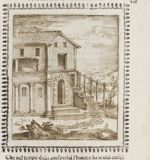
Felicitatem multos habere amicos: Maccio, Emblemata (Bologna, 1628), emblem 70
Iconclass: 51H4:33A5 Plenitude❧friends 54F12 Luck, Fortune, Lot; 'Fato', 'Fortuna', 'Fortuna aurea', 'Fortuna buona', 'Fortuna pacifica overo clemente', 'Sorte' (Ripa)
Loci Communes: Amicitia (Friendship, Amitié)
III v 5 Stulto ne permittas digitum Don't let a fool have your finger
Εὐήθει δάκτυλον μὴ δείξῃς, ἴνα μὴ τὴν παλάμην κατατίῃ, id est, Stulto digitum ne ostenderis, ut ne palmam etiam devoret. Nihil permittendum imprudentibus, quantumvis pusillum. Siquidem in maximis laedunt, si vel tantillum commiseris. Sapit et hoc vulgus.
Εὐήθει δάκτυλον μὴ δείξῃς, ἴνα μὴ τὴν παλάμην κατατίῃ, You should not show your finger to a fool, lest he devour your whole hand. No licence, however small, should be given to the foolhardy. They can harm you even in the most important affairs, if you entrust the least thing to them. This one too smacks of the common herd.
Facsimile:
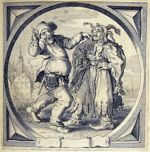
Stulto ne permittas digitum: Cats, Spiegel (The Hague, 1632), emblem 103
Iconclass: 31A2245 hand 31A2246 fingers 31A2543(+92) gripping someone by the hand or the wrist; clasped hands (+ relations with aggressive, hostile character (expressive connotations))
Loci Communes: Multi - in stupidos (Many people - against the stupid, Beaucoup de gens - contre les sots)
III v 6 Opta vicino, ut habeat, magis autem ollae Wish for something for the neighbour, but more for the pot
Εὔχου τὸ πλησίον ἔχειν, ἐπὶ πλέον δὲ τῇ χύτρᾳ. i. Opta ut proximus habeat, magis autem ut olla. Potissimum est habere domi, quibus est opus. Proximum, vicinum habere divitem, a quo possis petere. Videtur e vulgi faece haustum.
Εὔχου τὸ πλησίον ἔχειν, ἐπὶ πλέον δὲ τῇ χύτρᾳ, Wish that the neighbour has something, but that the pot has more. The most important is for you yourself to possess what is necessary. The next most important is to have a wealthy neighbour, from whom you can beg. It seems to be drawn from the common dregs.
Facsimile:
Iconclass: 41C27(POT) kitchen-utensils: pot 55B:56B3 Possession❧Satisfaction, Contentment; 'Contento' (Ripa) 55B1:33A7 Wealth, Opulence; 'Opulenza', 'Richezza' (Ripa)❧neighbour
Loci Communes: Proprii commodi studium (Pursuit of one's own advantage, Recherche de son propre intérêt)
III v 7 Habet et musca splenem Even a fly has a spleen
Εχει καὶ ἡ μῦια σπλῆνα, id est, Habet et musca splenem. Similimum illi: Et pueri nasum Rhinocerotis habent. Item: illi ἔνεστι καὶ μύρμηκι χολός. i. In est et formicae bilis. Olet faecem.
Εχει καὶ ἡ μῦια σπλῆνα, Even a fly has a spleen. Very like that other one: 'And children have the nose of a rhinoceros.' Or again: 'There is gall even in an ant.' It smacks of the dregs.
Facsimile:
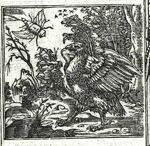
A minimis quoque timendum: Alciatus, Emblemata (Padua, 1621), col. 711 a, emblem 185 uses the imagery of an angry insect and its comment quotes the adage
A minimis quoque timendum: Alciatus, Emblemata (Lyon, 1551), emblem 168 uses the imagery of an angry insect
A minimum quoque sibi timendum: Schoonhovius, Emblemata (Gouda, 1618), emblem 15 uses the imagery of a small animals attacking very large ones
Iconclass: 25F711(FLY) insects: fly 31A22323(+0) spleen (+ variant)
Loci Communes: Ultio malefacti (Vengeance for a wrongdoing, Vengeance d'un méfait)
III v 8 Camelus desiderans cornua etiam aures perdidit The camel asked for horns and lost his ears too
Η κάμηλος ἐπιθυμήσασα κεράτων, καὶ τὰ ὦτα προσαπώλεσεν, id est, Camelus dum affectat cornua, et aures insuper perdidit. Convenit in eos, qui dum peregrina sectantur, vesua quidem tuentur. Sumptum ex apologo de camelis, qui per oratorem cornua a Iove postularunt, ille offensus stulta postulatione aures quoque resecuit, et hoc Apostolii videtur.
Η κάμηλος ἐπιθυμήσασα κεράτων, καὶ τὰ ὦτα προσαπώλεσεν, While the camel was coveting horns, he lost his ears as well. This is suitable for people who run after exotic things and do not protect their own. Derived from the fable of the camels, who, through a spokesman, demanded horns from Jove. The god was offended by the silly demand and deprived them of ears too. This one it seems is also from Apostolius.
Facsimile:
Iconclass: 25F24(CAMEL)(+333) hoofed animals: camel (+ ears of an animal) 51AA4:25F24(CAMEL)(+332) Nothingness, Absence❧hoofed animals: camel (+ antlers; horn) 55CC11 Greed, Covetousness, Cupidity; 'Cupidità' (Ripa)
Loci Communes: Malum accersitum aut retortum (Evil brought upon oneself or turned back, Mal attiré ou retourné)
III v 9 Hercules et simia Hercules and an ape
Ηρακλῆς καὶ πίθηκος. i. Hercules & simia. De minime congruentibus. Simia dolis valet, Hercules viribus antecedit. Affine illi: Formicae camelus. Nota est fabula de fratribus Perperis, quos Hercules comprehensos à clava suspendit. Eos ferunt versos in Simios.
Ηρακλῆς καὶ πίθηκος, Hercules and an ape. Said of those who are completely incompatible. The ape's power lies in deceit, Hercules excels in strength. Very close to 'A camel to an ant.' There is a well-known story about the brothers Perperi, whom Hercules tied together and hung up from his club. It is said they were turned into apes.
Facsimile: 
Iconclass: 25F22 monkeys, apes 51BB2 Dissimilarity, Unlikeness 54A7 Strength, Power; 'Fortezza', 'Fortezza d'Animo e di corpo', 'Fortezza del corpo congiunta con la generosità dell'animo', 'Fortezza & valore del corpo congiunto con la prudenza & virtù del animo', 'Forza' (Ripa) 57AA6131 Guile, Artfulness, Craftiness, Deceitfulness 94L (story of) Hercules (Heracles)
Loci Communes: Excellentia, inaequalitas (Excellence, inequality, Excellence, inégalité)
III v 10 Aut manenti vincendum aut moriendum He must stay and conquer or die
Η μένοντα ἀποθανεῖν, ἢ νικᾶν, id est, Oportet aut manentem vincere, aut interire. Dici solitum, ubi certa stat sententia, aut negotium aliquod absolvere, aut immori. Translatum ab instituto Lacedaemoniorum, qui hoc animo proelium inibant, ut aut victores redirent domum, aut victi occumberent. Celebratum est Lacaenae cuiusdam apophthegma, quae silio tradens clypeum dixerit: ἢ τὰν, ἢ ἐπὶ τᾶς, aut hunc, aut super hunc. Laconice significans, aut referendum clypeum, aut in eo moriendum.
Η μένοντα ἀποθανεῖν, ἢ νικᾶν, He must stay and conquer, or he must die. Usually said when it is felt for certain either that some business must be resolved or that one must die in the attempt. A figure of speech derived from the tradition of the Spartans, who went into battle with the intention of returning home conquerors or dying in defeat. There is a famous saying pronounced by a Spartan mother as she gave her son his shield: 'With this, or on this,' meaning, in the laconic Spartan way, you must bring the shield back or you must be brought back dead on it.
Facsimile:

Erit altera merces: Giovio, Dialogo dell' Imprese (Lyon, 1574), emblem 35 uses the imagery of the branch of palm (victory) and cypress (coffin) to express the adage's moral
Iconclass: 31E death of human being 33B9 flight, running away; pursuing 53A22 Stability, Firmness; 'Fermezza', 'Stabilimento', 'Stabilità' (Ripa) 54F2 Victory
III v 11 Maritimus cum sis, ne velis fieri terrestris Since you are a seaman, don't try to become a landsman
Θαλάττιος δ᾽ ὢν, μήποτε χερσαῖος γένου, id est: Si sis marinus, abstine a terrestribus. Admonet non mutandam conditionem, ne in melius quidem. Verum unicuique tuendum id vitae genus, ad quod vel institutus a natura videtur, vel in quod casu in cidit. Mutuo sumptum ex apologo quodam Aesopico, qui fertur huiusmodi: Cancer quidam relicto mari, coepit in agro quodam pasci. Ibi forte conspectus a vulpe, protinus arreptus ac devoratus est. Itaque periturus sero deploravit stultitiam suam, quod marini generis cum esset ad terrestrium animantium partes desciscere voluerit. Est apologus non dissimilis de lupo tibiis canente, ac mox canibus irruentibus deplorante, quod ex coco factus esset tibicen. Hermolaus Barbarus ad Picum invertit non ineleganter proverbium: χερσαῖος ὢν μὲ ζήτει θάλασσαν, id est, Terrestris cum sis, ne quaesieris mare.
Θαλάττιος δ᾽ ὢν, μήποτε χερσαῖος γένου, If you are a seaman keep away from landsmen's affairs. This adage advises us not to change our condition, not even into something better. Indeed each one should maintain the kind of life into which he either seems to have been placed by nature, or has fallen by chance. The adage was borrowed from a fable of Aesop, which goes like this. A certain crab left the sea and began to feed in a field. There by chance he was spotted by a fox, and immediately seized and eaten. And so, on the point of death, he deplored too late his folly because, when he was a sea creature, he wanted to defect and join the party of the land animals. There is a similar fable about a wolf playing the flute and then, when attacked by dogs, bewailing the fact that from a butcher he had become a flute-player. Ermolao Barbaro, writing to Pico, reversed the proverb elegantly: 'When you are a landsman, you should not look to go to sea.'
Facsimile:
Iconclass: 34B11(+9512):25F23(WOLF) dog (+ animal(s) attacking)❧beasts of prey, predatory animals: wolf 25F23(FOX)(+9512):25F716(CRAB) ?❧crustaceans: crab 46C2711 seaman 48C7351 flute, aulos, tibia 51KK2 Immutability
Loci Communes: Mutati instituti (A changed custom, Une coutume changée)
III v 12 Thynni more Squinting like a tunny fish
Θύννου δίκην. i. Thynni more, videre dicuntur, qui limis aut altero oculo oblique inspiciunt, Aeschylus apud Athenaeum libro septimo: Τὸ σκαιὸν ὄμμα παραβαλὼν θύννου δίκην. id est, Oculum sinistrum admoliens Thynni modo. Siquidem Aristoteles indicat Thynnos non cernere nisi laevo oculo, ut ibidem citat Athenaeus, cum paulo superius ex eodem auctore dixerit illum cernere dextro, sinistro caecutire. Plinius libro 9. cap. 15. dicit illos utroque hebetes esse, dextro tamen plus cernere. Refertur idem versus ex eodem auctore apud Plutarchum in dialogo De comparatione terrestrium ac marinorum. Addit eum piscem altero oculo caecutire,, eoque cum immigrant in mare adhaerent terris ad dextram, cum emigrant, contra. Potest 7 ad eos referri, qui acriter ac diligenter inspiciunt. Persius: Non secus ac si oculo rubricam dirigat uno. Idque Aristoteles Sectionis 31. probl. 3. & 4. vere putat evenire, propterea quod oculorum initia ab eodem dependeant. Unde fit, ut altero occluso, vis illa, quae duos movebat, ad unum conferatur, hoc acrior, quo contractior.
Θύννου δίκην, Like a tunny fish. People are said to be looking like a tunny when they squint or peer sideways with one eye. Aeschylus is quoted by Athenaeus in book 7: 'Casting awry his left eye upon it, like a tunny' - for Aristotle states that tunny only look with the left eye, as Athenaeus quotes him here, although just before that, quoting the same author, he has said that it sees with the right eye and is half blind in the left. Pliny says, in book 9 chapter 15, that they have weak sight in both eyes, but see more with the right. The same verse is repeated from the same author by Plutarch in his dialogue 'On Comparing Land and Sea Animals.' He adds that these fish have such poor sight in the one eye, that as they swim towards the sea they hug the right bank, and as they come back the reverse. The adage can also be applied to those who scrutinize keenly and carefully. Persius says: 'As straight as if he is setting a ruddle cord with one eye.' And Aristotle says in Problems 3 and 4 of section 31 that he thinks this happens 'because the eyes arise from the same point' [in the brain]. The result is that, when one eye is closed, the force that drove both is bestowed on one, the more keen because the more concentrated.
Facsimile:
Iconclass: 25F62(TUNNY) bony fishes: tunny 31A4112 cross-eyed; squint
Loci Communes: Diligentiae (Diligence, Diligence)
III v 13 Canis reversus ad vomitum A dog goes back to his vomit
Κύων ἐπὶ τὸ ἲδιον ἐξέραμα, id est, Canis ad proprium vomitum. Quadrat in eos, qui relabuntur in eadem flagitia, a quibus aliquando sunt expiati. Refertur in epist. D. Petri, his quidem verbis: Συμβέβηκε δὲ αὐτοῖς, τὸ τῆς ἀληθοῦς παροιμΐας, κύων ἐπιστρέψας ἐπὶ τὸ ἲδιον ἐξεραμα, καὶ ὗς λουσαμένη εἰς κύλισμα βορβόρου, id est, Accidit autem illis illud veri proverbii: Canis reversus ad proprium vomitum, et sus lota ad volutationem ceni. Sumpta videlicet metaphora à canibus resorbentibus quod evomuerint, et suibus ab amne protinus ad coenum recurrentibus. In eadem sententiam Hebraeus ille παροιμιόγραφος, Sicut canis qui revertitur ad vomitum suum, sic imprudens qui iterat stultitiam. Namhunc, ni fallor, locum Petrus designavit.
Κύων ἐπὶ τὸ ἲδιον ἐξέραμα, A dog to his own vomit. This fits those who fall back into the same crimes, crimes for which they have already paid the penalty. There is a passage in the Epistle of St Peter in these words: 'For them the proverb has proved true: "The dog turns back to his own vomit, and the sow is washed only to wallow in the mire."' The figure appears to be taken from dogs who swallow again what they have vomited up, and pigs who run straight from the stream to the mud. The Hebrew author of Proverbs expresses the same idea: 'Like a dog that returns to his vomit is a fool that repeats his folly.' Peter was alluding to this passage, if I am not mistaken.
Facsimile:
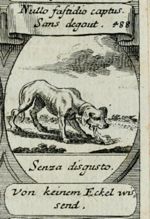
Nullo fastidio captus - Von keinem Eckel wissend: Woytt, Emblematischer Parnassus (Augsburg, 1727), emblem 488 uses the adage's imagery
Iconclass: 34B11(+945):31A63(+0) dog (+ animals eating and drinking)❧vomiting (+ variant) 51B61:52CC41 Repetition❧Error; 'Errore' (Ripa)
Collectanea (1500): 750
Loci Communes: Iteratus error (A repeated error, Erreur répétée)
III v 14 Cani das paleas, asino ossa You are giving chaff to the dog and bones to the ass
Κυνὶ διδως ἄχυρα, ὄνῳ δὲ ὀστέα. Cani das paleas, asino vero osse. Cum res praepostere distribuuntur. Veluti si quis indocto munus mittar literarium, erudito flosculos, aut gladium, balteumve, militi librum. Siquidem munera hoc ipso sunt iugrata, quod apta non sunt. Intetdum vertunturin contumeliam.
Κυνὶ διδως ἄχυρα, ὄνῳ δὲ ὀστέα, You are giving chaff to the dog but bones to the ass. Said when things are distributed the wrong way. For example if someone sends a gift of a literary work to someone who is uneducated, flowers or a sword or a belt to a scholar, a book to a soldier, or hunting dogs to a bishop. Such gifts are unwelcome for the good reason that they are not suitable. Sometimes they are given in order to insult.
Facsimile:
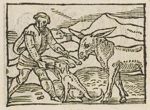
L'homme sçauant pouure est, l'ignorant riche: La Perrière, Le theatre des bons engins (Lyon, 1545), emblem 46's pictura is an illustration of the adage
Iconclass: 52CC41:41C111 Error; 'Errore' (Ripa)❧giving food 46C13142(+745):41C692(BONE)(+0) ass, donkey (+ animals eating and drinking)❧kinds of meat (BONE) (+ variant) 34B11(+945):47I17(CHAFF) dog (+ animals eating and drinking)❧agricultural products and by-products (CHAFF)
Loci Communes: Absurda, indecora, seu praepostera (Absurd, unbecoming, or preposterous things, Choses absurdes, inconvenantes ou déplacées)
III v 15 Praemovere venatum To disturb the prey
Προσοβεῖν τὴν θήραν, id est, Praeturbare feram. Aristides in Pericle citat ex Platone, ὧ τε οὕτω γ᾽ ἂν ἅ φησιν αὐτοὺς ἀνεσόβει τὴν θήραν. i. Igitur ad eum modum, quod ipse ait, turbavit venationem. Ceterum verba Platonis in Lyside sic habent, ποίος τις οὖν ἄν σοι δοκῇ θηρευτὴς εἶναι, εἰ ἀνασοβοι θηρεύων καὶ δυσαλωτέραν τὴν ἄγραν ποιοι;. i. Qualis igitur tibi videatur esse venator, si inter venandum excitet feram, et captum reddat difficiliorem? Dici solitum apparet, ubi quis non satis dissimulat quia molitur. Quemadmodum usu venit, ut fera tumultu excitata intellectis insidiis, subducat sese.
[greek], To scare away the prey. Aristides, in his Pericles, quotes from Plato 'And so in this way, as he himself says, he disturbed the game.' Further, there is a passage of Plato in his Lysis as follows: 'What sort of hunter would he seem to you to be if, during the hunt, he disturbed the beast and made the capture more difficult?' It seems to be said usually when someone does not conceal sufficiently what he is plotting. In this way the animal, disturbed by the turmoil, usually becomes aware of the trap and escapes.
Facsimile: 
Iconclass: 25F(+5212) animals (+ running animal) 43C111 game, hunted animals 51AA7:52DD1 Imperfection, Incompleteness; 'Imperfettione' (Ripa)❧Secrecy, Latency, Concealment; 'Secretezza' (Ripa)
Loci Communes: Festinatio praepropera (Overhasty haste, Précipitation excessive)
III v 16 Rectam ingredi viam To walk a straight path
Τὴν ὀρθὴν βαδίζειν ὁδόν. id est, Rectam ambulare viam dicitur, qui nusquam deflectit ab honesto. Aristides in Pericle: ὥς τε βαδίζειν τεταγμένα καὶ τὴν ὀρθὴν σώζειν κατα τὴν παροιμίαν. id est, Ut ordine incedatur et recta servetur via, iuxta proverbium. Philon de humanitate: ὁδον γὰρ οἷα λεωφόρον ἄγουσαν ἐφ ὁσίοτητα ταύτην ἀπίστατο id est, Viam enim publicam quae ad aequitatem duceret, didicerat hanc. Plautus in Cassina. Nunc ego pol in rectam redii semitam. Item paulo post. Scien. de via in semitam regredere. Iubet autem ancilla, ut qui impradens verum effutiverat, redeat ad simulationem, quam instituerat.
[greek], To walk a straight path. This is said of someone who never deviates from the honest path. Aristides in his Pericles: 'To proceed in an orderly manner, and keep to the right road, as the proverb says.' Philo in his 'On Humanity': 'For the public way, which leads to justice, this he had learned.' Plautus in the Casina: 'Now I'm on the right road at last,' and a little later: 'You are leaving the highway for the bypath deliberately.' The servant-girl is telling him, after he had imprudently blurted out the truth, to go back to the lie that he had started with.
III v 17 Αὐτόθην κατάβαλλε Lay it down on the spot
Αὐτόθεν κατάβαλλε, id est. Hoc ipso depohe loco. Aristides in Pericle: περὶ μὲν δὴ λάλων πλᾶτων καὶ ἀργῶν καὶ δειλῶν αὐτόθεν κατάβαλλε, μή που τις καὶ τρῶας ἐγείρησι θεὸς ἄλλος. id est, Iam de loquacibus, ó Plato, ignavis ac timidis, ptotinus depone, ne fortis aliquis deus alius Troianos erigat. Interpres indicat proverbium esse, sumptumque a victoribus qui vetant, ne victus aliquo discedat, sed inibi porrigat herbam, et victorem agnoscat, ac victoriae praemium persolvat. Usus erit quoties statim et absque mora iubemus aliquid exhiberi, veluti probarionem eius quod dixerit aliquis, vel promissum, vel specimen artis in quo glorietur sese pollere. Usurpatur et apud Platonem.
[greek], Lay it down on the spot. Aristides in the Pericles: 'Drop this talk straightway now about the chatterers, the idle, and the fainthearted, O Plato, lest perchance some other god should raise up the Trojans.' The scholiast indicates this is a proverb taken from victors who prevent the conquered opponent from escaping by any means, but demand that he offer grass on the spot, acknowledge the victor, and pay for the prize of victory. It will be used whenever we order something to be shown immediately and without delay, either proof of what someone has said, or a promise, or a sample of craft in which someone boasts of his ability. It is used in Plato too.
Facsimile:
Iconclass: 45I71 the defeated before the victor 45L21 delivering levied goods 51AA4:51FF521 Nothingness, Absence❧Delay
Loci Communes: Vincere et vinci (To conquer and to be conquered, Vaincre et être vaincu)
III v 18 Ostium obdite profani Shut the door, ye profane
Θύρας ἐπίθεσθε βέβηλοι. id est, Fores occludite quique profani. Sumpta est allusio ex Orpheo, cuius hoc citatur carmen: Θέγξομαι οἶς θέμις ἐστὶ, θύρας ἐπίθεσθε βέβηλοι. id est, Fas quibus est audire loquar, vos turba profana. - Obturate fores. Iubet ut profani ostium auribus imponant, ne quid arcani sermonis poisit ingredi. Aristides in Pericle: λέγων δὴ ταῦτα πρὸς οὕς ἔξεστι, τῶν δὲ βεβήλων ὀλίγος ὁ λόγος πάντως. id est, Loquar haec apud eos, quibus audire fas est. Profanorum autem levis omnino ratio est, Conveniet uti, si quando significa bimus nos de rebus arduis et arcanis locuturos esse. Huc respexit Horatius, cum scribit in Odis: Odi profanum vulgus, & arceo, Favete linguis, carmina non prius Audita, musarum sacerdos Virginibus puerisque canto. Ovidius: Lingua favens adsit nostrorum oblita laborum Quae puto dedidicit iam bona verba loqui. Ante sacrificium praeco clamore solebat iubere populum favere linguis, hoc est, verba boni omnis loqui, unde & faventia dicitur bona ominatio. Item Seneca de philosophia agens: Et ipsam ut Deos, & professores eius ut antistites colite, & quoties sacrarum literarum mentio intervenerit, favete linguis. Hoc verbum non ut plerique existimant à favore trahitur, sed imperatur silentium, ut rire peragi possit sacrum, nulla voce mala obstrepente. Sed plusculum habebit gratiae, si per ironiam adhibeatur, veluti si quis recitaturus sophisticas aliquas Scotistarum argutias, ita praefetur, θύρας ἐπίθεσθε βέβηλοι. Ad hunc modum non semel usurpavit Lucianus.
[greek], Close tight your doors, any who are unconsecrated. The allusion is to Orpheus, from whom this verse is quoted: [greek] I shall speak to those for whom it is lawful to hear; you, the unconsecrated crowd, / Close your doors ...' He commands that profane people should put a door on their ears, so that none of the secret words may enter. Aristides in his Pericles: 'I speak these things among those for whom it is lawful to hear, for the profane are of no account at all.' It will be appropriate to use at times when we want to indicate that we are about to speak of difficult and arcane matters. This is what Horace was thinking of when he wrote in his Odes:
I hate the vulgar crowd and hold aloof;
Take care what you say, for I, priest of the Muses,
Sing songs not heard before
To virgins and young boys.
And Ovid:
Let a propitious tongue speak which thinks no more of my labours,
For mine, I think, has forgotten how to utter auspicious words.
Before a sacrifice the public crier would order the populace to 'be favourable with your tongues,' that is, to speak words of good omen, whence faventia is also said for 'good prognostication.' Then there is Seneca, speaking of Philosophy: 'Worship her too like the gods, and her teachers like priests, and speak favourably whenever mention of sacred scriptures occurs. This word favete is not, as many think, derived from favor "good-will," but commands silence, so that a sacred rite can be carried through without being hindered by any ill-omened voice.' However, it will appear rather more witty if it is used ironically, as for example if someone who is about to recite some sophistic Scotist quibblings announces them thus: 'Close tight your doors, any who are unconsecrated.' Lucian used the expression in this way more than once.
Facsimile:
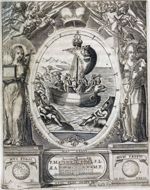
Favete linguis: Anonymous, Templum Gratiarum (Passau, 1633), emblem 23
Iconclass: 52DD1:12B2 Secrecy, Latency, Concealment; 'Secretezza' (Ripa)❧ritual practices ~ non-Christian religions 12B42 ritual practices ~ puberty and initiation ('rites of passage') (non-Christian religions) 41A322 closing, shutting the door 53B7 Observance, Fulfilment
Loci Communes: Occulta (Hidden things, Choses cachées); Vis injustia (Unjust force, Force injuste)
III v 19 Ad restim funiculum Cord to rope
Επὶ σπείρᾳ σχοινίον. id est, Ad restim funiculum, subaudiendum addis, aut reddis, ubi quis iisdem rebus abundat, aut similia similibus pensat. Cognatum illi: λῖνον λίνῳ συνάπτεις. id est, Linum annectis lino. Veluti si quis mendacium attexat mendacio, dolum dolo, nugamentum nugamento.
'[greek], Cord to rope. 'You are joining' is understood, or 'You are rendering cord for rope'; said when someone repeats the same things or makes self-evident comparisons. It is related to 'You join thread with thread,' as when someone adds lie to lie, fraud to fraud, triviality to triviality.
Facsimile:
Iconclass: 47D8(CORD) tools, aids, implements ~ crafts and industries (CORD) 47D8(ROPE) tools, aids, implements ~ crafts and industries: rope 49C212 logic, 'Logica'; 'Logica' (Ripa) 51B2 Similarity, Likeness 51B61 Repetition
Loci Communes: Taedium ex iteratione (Tedium from repetition, Lassitude due à la répétition)
III v 20 Salem et fabam Salt and a bean
Αλα καὶ κύαμον. id est, Salem & fabam, subaudiendum proposuerunt, aut si quod aliud ad sententiam magis appositum verbum. Diogenianus admonet dici solitum de his, qui fingerent se scire quippiam, quod nescirent, atque hinc esse natum proverbium, quod olim mosfuerit, ut divini salem et fabam proponerent. Quo quoniam dubitabam diversum ne esset ab illo, quod in prima retulimus Chiliade, an non, hic repetendum duxi. Nam hoc modo citatum invenio in vetustis Graecorum exemplaribus.
[greek], Salt and a bean, understanding proposuerunt 'they set out' or any other word more appropriate to the context. Diogenianus informs us that it was said of those who pretended to know something that they did not know, and the proverb arises from the fact that formerly soothsayers set out salt and a bean. Because I was in some doubt whether or not this was different from the one which I noted in the first chiliad, I thought it should be repeated here, for I find it quoted in this form in some old copies of the Greek writers.
Facsimile: 
Iconclass: 25G4(BEAN) plants and herbs: bean 41C661 salt 52A5 Knowledge; 'Cognitione', 'Cognitione delle cose' (Ripa) 52AA5 Ignorance; 'Ignoranza', 'Ignoranza di tutte le cose', 'Ignoranza in un ricco senza lettere' (Ripa) 57AA611 Dissimulation, Hypocrisy; 'Hippocresia', 'Simulatione' (Ripa)
Collectanea (1500): 715
Loci Communes: Simulatio, dissimulatio (Pretense, dissimulation, Simulation, dissimulation)
III v 21 Εκπερδικίσαι To fly away
Εκπερδικισαι, Graeci proverbiali metaphora vocant elabi, ac suffugere. Aristophanes in Avibus: Ως παρ᾽ ἡμῖν οὐδὲν αἰσχρόν ἐστιν ἐκπερδικίσαι. id est, Quippe apud nos turpe non est, suffugere de cassibus. Ductum est ab avibus, quae nonnumquam elabuntur e retibus, seu laqueis. Aiunt autem perdicem praecipuae calliditatis ad id, ut aucupum manus effugiat. Qua quidem de re libet ipsius Aristotelis verba subscribere, quae scripta sunt libro De natura animantium nono, καὶ οὐκ ἐν τῳ αν τῷ τίκτουσι καὶ ἐπωάζουσιν, ἵνα μὴ τις κατανόησῃ τὸν τόπον πλείω χρόνον προσεδρεύοντων, ὅταν δέ τις θηρεύῃ περιπεσὼν τῇ νεοττίᾳ, προκυλινδεῖται ἡ πέρδιξ τοῦ θηρεύοντος, ὡς ἐπίληπτος οὖσα καὶ ἐπισπᾶται ὡς ληψόμενον ἐφ᾽ ἑαυτὴν, ἕως ἂν διαδράσκῃ τῶν νεοτῶν ἕκαστος. μετὰ δὲ ταῦτα ἀναπτασα αὐτὴ ἀνασκαλεῖται πάλιν. id est, Nec eodem in loco pariunt, et incubant ova, ne quis animadvertat, si diutius in eodem assideant loco. Porro cum inter venandum inciderit quispiam in nidum, praevoluitur perdix ad pedes venantis, perinde quasi capienda sit, ad eumque modum illum allicit ad sese quasi capturum, donec interim pulli sigillatim effugerint. Quod ubi factum est, et ipsa subuolans pullos revoeat. Hactenus Aristoteles. Neque vero gravabimur adscribere, quod in candem ferme sententiam scribit Plutarchus libro cui titulum fecit: πότερα τῶν ζώων φρονιμώτερα, τὰ χερσαῖα ἢ τὰ χερσαῖα ἢ τὰ θαλάττια. i. Utra animalia sunt prudentiora, terrestria an marina: Αλλην δὲ πανουργείαν ὁμοῦ μετὰ τοῦ φιλοστόργου πέρδικες ἐπιδείκνυντο. τοὺς μὲν νεοττοὺς ἐθίζουσιν μηδέπω φεύγειν δυναμένους ὅτ᾽ ἂν διώκωνται καταβαλόντας ὑπτίους ἑαυτοὺς βῶλον τινα ἢ συφφε τὸν ἄνω προΐσχεσθαι τοῦ σώματος, οἵον ἐπιλυγαζομένους. Αὗται δὲ τοὺς διώκοντας ὑπάγουσιν ἄλλη, καὶ περισπῶσιν ἑαυτὰς ἐμποδὼν διαπετόμεναι καὶ κατα μικρὸν ἐξανιστάμεναι, μέχρις ἂν οὕτως ἁλισκομένων δόξαν ἐνδιδώσαι μακρὰν ἐποσπάσωσι τῶν νεοττῶν. id est, Aiam vero calliditatem una cum prolis amore coniunctam perdices exhibent. Nam pullos adhuc involucres consuefaciunt, ut supinos prosternant sese, glebam aut palearum tegumentum aliquod impositum corpori sustinentes, atque ita veluti obtecti deliteant, ipsae interim venantem alio abducunt hac arie. Alliciunt illum ad sese, provolantes ad pedes, ac paulatim prodeuntes, ac tamdiu spem ostendunt capiendi sui, donec eum procul a pullis abstraxerint. Ex his verbis satis liquet, quid sibi velit ἐκπερδικίσαι nimirum elabi, perdicum arte ingenioque. Interim allusum est ad cauponem quendam nsigniter improbum, cui nomen inditum Perdix, quod claudicaret. Eius meminit Aristophanes in Avibus.
[greek] is what the Greeks say, in a proverbial metaphor, for 'to slip out,' or 'evade.' Aristophanes in the Birds: 'To be sure, among us there is no shame in evading snares.' It is derived from birds who often escape from nets or snares; for they say the perdix 'partridge' is particularly clever at escaping from the hands of the fowlers. On this subject it is well to set out here the words of Aristotle himself which are in book 9 of the Nature of Animals:
And they do not lay their eggs and incubate them in the same place, lest
anyone should notice that they have been sitting for a rather long time in the
same place. Further, when someone comes upon a nest during a hunt, the
partridge throws herself at the feet of the hunter, just as if she intended to
be caught, and in this way attracts him towards herself, making him think he
can capture her, until the chicks can escape in the interval one by one. When
this is achieved, she flies away and calls the chicks to herself.
That is what Aristotle has to say. And I shall be happy to add to this passage what Plutarch writes along just the same lines in the book he entitled 'Whether Land or Sea Animals Are Cleverer':
But another kind of cleverness is shown, along with love of their young, by
partridges. For they accustom their young, while they are still flightless, to
lie flat on their backs holding a lump of earth or some covering of straw over
their bodies, and thus covered to remain hidden, whilst they themselves draw
the hunter off somewhere else by the following deception. They attract him
towards themselves, flying in front of his feet and continually keeping a little
ahead of him, offering hope of being caught only until they draw him away
from the chicks.
From these words, I think, it is clear enough what is meant by [greek]: truly, to escape by the art of the partridge. At the same time, there is an allusion to a certain notably dishonest shopkeeper, who was given the name Partridge because he limped. Aristophanes recalls him in the Birds.
Facsimile:
Iconclass: 25F38(PARTRIDGE)(+4) walker and runner birds: partridge (+ animal behaviour) 54FF1:43C131 Failure❧finch trap, finchery
Loci Communes: Elabendi (Slipping away, escaping, S'échapper)
III v 22 Munus Levidensae A threadbare present
Munus Levidensae. Cicero proverbiali nimirum figura vocat munus vile, minimique pretii, cuiusmodi vulgaribus amicis missitare divites consueverunt. Sic enim scribit ad Dolabellam, lib. Famil. epist. 9. Oratiunculam pro Deiotaro quam requirebas, habebam mecum, quod non putaram. Itaque eam tibi misi. Quam velim sic legas, ut causam tenuem et inopem, nec scriptione magnopere dign im. Sed ego hospiti veteri et amico, munusculum mittere volui Levidensae crasso filo, cuiusmodi ipsius solent esse munera. Servius ostendit Levidensam vestis genus esse vile, raro, tenuique textu. Queondam inter hospitum xenia, vestes in primis erant. Unde & apud Iuvenalem queritur quispiam vestes donari, villo crasso, coloreque malo: Et male percussus textoris pectine Galli. Proinde M. Tullius orationem suam parum elaboratam atque expolitam, Levidensae munus appellat. Elegantur accommodabitur ad munus leviculum, aut offic ium vulgare, non admodum ex animo, neque diligenter praestitum amico cuipiam vulgari. Huic diversum est illud: πελλήναῖα χιτὼν, id est, Pellenaea tunica. Et συλόσωντος χλαμύς, id est, Sylosontis chlamys.
A 'threadbare present' is what Cicero, using a doubtless proverbial figure, called a mean present, the cheapest sort, such as rich people were accustomed to send often to their plebeian friends. This is what he writes to Dolabella in book 9 of his Letters to Friends: 'The little speech on behalf of Deiotarus, that you were asking for, I had with me - though I did not think I had - and so I have sent it to you. I would like you to read it as a meagre, poor example, not really worth the writing. But to an old guest and friend I wanted to send a threadbare little present, of coarse material, such as his own presents are wont to be.' Servius shows that the 'levidensa' is a poor kind of garment, of loose thin weave. At one time garments were among the principal presents given to guests. Hence in Juvenal too someone complains that he is sometimes given garments of coarse hair and bad colour: 'And ill combed by the Gallic weaver.' In like manner Marcus Tullius calls his undeveloped, unpolished speech a 'present of a threadbare garment.' This can be applied nicely to the small present or trivial service, offered quite unwillingly and thoughtlessly, to some plebeian friend. This is quite different from [greek] 'A tunic Pellene-style,' and [greek] 'Syloson's cloak.'
Facsimile:
Iconclass: 54BB6:33A4 Worthlessness❧bringing gifts; exchanging gifts
Collectanea (1500): 295
Loci Communes: Contemptus et vilitatis (Contempt and worthlessness, Mépris et bassesse)
III v 23 Multi discipuli praestantiores magistris Many pupils surpass their teachers
M. Tullius libro Epist. familia. 9. scribens Varroni senarium quendam refert, haud dum scimus ex quod poeta. Cuius sen tentia etiam hodiernis temporibus vulgo celebratissima fertur. Advenit, inquit, Dolobella. Eum puto magistrum fore. Πολλοὶ μαθηταὶ κρείσσονες διδασκάλων. id est, Plerique discipuli magistros anteeunt. Ad varios usus potest accommodari, vel ad simplicem sensum, puta frequenter evenire, ut discipulus eruditione superet eum, a quo literas, aut artem quampiam didicit. Aut per iocum, cum significabimus, improbitate vinci, qui malitiae doctor fuit: veluti si quis deciperetur ab eo, cui viam ac rationem imponendi demonstrasset aliquando. Sive cum quis ordine conditioneque inferior, tamen plus valet, quam is, qui non parere, sed imperare videtur.
Marcus Tullius in book 9 of his Letters to Friends, writing to Varro, quotes a verse - from which poet I do not yet know. Even nowadays his aphorism is very commonly repeated among ordinary people. He says: 'Dolabella is coming. I think he will be my teacher: [greek] "Many pupils excel their teachers."' This can be adapted to various uses; perhaps in the plain sense, for example that it quite often happens that the pupil surpasses in learning the one from whom he learnt his letters or some skill. Or jokingly when we want to imply that someone who was a teacher of deceit is the victim of dishonesty; for example, if someone is cheated by the person to whom he had once demonstrated ways and means of deception. Or when someone of lower class and condition has more power than one who is thought to be the master not the servant.
Facsimile: 
Iconclass: 49B241 child teaching teacher, parents, or other adults 51E2 Superiority 57AA6131 Guile, Artfulness, Craftiness, Deceitfulness
Loci Communes: Excellentia, inaequalitas (Excellence, inequality, Excellence, inégalité)
III v 24 Ad Herculis columnas To the pillars of Hercules
Ηράκλειαι στηλαί, iam olim in proverbio sunt, ut admonet Plindari interpres. Sic enim vulgo dici solere, τὰ πείρα γαδείων οὐ περατὰ, id est, Quae ultra Gades, inaccessa. Quo sigmsicant, ultra columnas Herculis non esse quo progrediare. Columnas has Hercules ibi fixisse dicitur, cum boves vestigaret Getyonis, tamquam illic esset suprema orbis meta. Pindarus in Nemeis: γαδείρων τὸ πρὸς ζοφον οὐ περατὸν, id est, Non ulterior accessus ad occidentem, ultra Gadira. Item alibi: Εἰ δ᾽ ὤν καλὸς ἕρδων τ᾽ ἐοικότα μορφᾷ, Ανερέαις ὑπερτάταις ἐπεβα Παῖς ἀριστοφάνευς, οὐκ ἔτι πρόσω ἀβάταν ἅλα κιόνων Υπὲρ ἡρακλέους περᾶν εὐμαρὲς, Ηρως θεὸς ἃς ἔθηκε ναυτιλίαις ἔσχάτας. Sentit Aristophanis filium ad extremam pervenisse laudem, ultra quam non possit crescere: qui quidem egregiae formae, facta adiunxerit illustria. Quod si quis praeterea quidquam laudis requirat, id perinde esse, ac si quis ultra columnas ab Hercule fixas conetur transire. Rursus in Olympiis hymno tertio: Νῦν τε πρὸς ἐσχατίαν θήρων ἀρεταῖσιν ἱκάνων ἅπτεται Οἰκόθεν ἡρακλέος στηλᾶν, τὸ πρόσω δ᾽ ἐστι σοφοῖς ἄβατον κᾀσόφοις. id est, Nunc sane ad extremos limites virtutibus perveniens Theron, attingit a domo Herculis columnas. Quod autem ultra est, sapientibus pariter, et insipientibus inaccessum. Consimilem in modum usus est Gregorius Nazianzenus in Monodia, sentiens Basilium eo perfectionis pervenisse, ut longius progredi negatum esset humanae naturae. Heraclides Ponticus in allegotiis Homeri, improbos Homeri poematis interpretes exigendos putat: ὑπὲρ ἡρακλέους ἐσχάτας σταήλας καὶ τὴν ἄβατον ὠκεανοῦ θὰασσαμ. id est, Ultra Herculis extremas columnas, et inaccessum Occani mare.
'[greek], The pillars of Hercules. They were proverbial in former times, as the scholiast of Pindar shows, for it used to be said popularly, 'The regions beyond Gades are inaccessible.' By this they meant that beyond the pillars of Hercules there was nowhere further to go. Hercules is said to have placed these pillars there when he was seeking the cattle of Geryon, as if that point was the extreme end of the world. Pindar in the Nemeans: 'There is nowhere to go further west beyond Gades.' And in another passage: 'But if the son of Aristophanes, being fair to look upon and doing deeds that befit the fairness of his form, embarked on the highest achievement of manly prowess, he cannot easily sail further across the trackless sea beyond the pillars of Heracles, which that hero and god set up [as farfamed witnesses] of the furthest limit of voyaging.' He means that the son of Aristophanes, having joined illustrious deeds to exceptional beauty, has achieved the highest glory, which he cannot surpass. For if anyone should seek further glory, it would be as if someone should try to go beyond the pillars set up by Hercules. Again, in the third Olympian: 'Now reaching by his deeds of courage right to the extreme limits, Theron arrives from his home at the pillars of Hercules. What is beyond, to the wise as to the foolish, is inaccessible.' In an exactly similar way Gregory of Nazianzus used it in his Monodia, meaning that Basil had reached such a point of perfection that human nature was debarred from going further. Heraclides Ponticus, in his Allegories of Homer, thinks that bad interpreters of the poems of Homer should be thrust 'beyond the outermost pillars of Hercules and the inaccessible sea of Oceanus.'
Facsimile:
Iconclass: 25H23241 pillars of Hercules 51I1 Limited, Defined Space 94L521 Hercules thrusts the rocks Calpe and Abyla apart, or forces the two rocks into temporary union
Loci Communes: Perficiendi sive absolvendi (Finishing, completing, Achever, accomplir)
III v 25 Ariolari Crystal-gazing
Ariolari proverbio dicebatur, qui nihil adferret certi, nihilque praesentis emolumenti, verum in diem modo pollicitaretur. Ita Dorio leno in Phormione Terent. adulescenti Phaedriae pecuniam daturum se promittenti, dicentique, Non mihi credis? respondit, Ariolare. Item Sannio in Adelphis, Sed ego haec ariolor. Sumptum à divinis qui praedicunt eventura. Futurorum autem nulla certa cognitio, quemadmodum eleganter dictum est à Pindaro, Τῶν μελλόντὼν τετύφλονται φράδαι, Πολλὰ δὲ ἀνθρώποις παρὰ γνώμαν ἔπεσεν. Quorum carminum haec sententia, caecam esse rerum futurarum scientiam. Mortalibus autem multa praeter spem evenire.
A person was said proverbially to be 'crystal-gazing' if he offered nothing certain, brought no immediate gain, but only kept making promises day after day. Thus, in Terence's Phormio, when the young man, Phaedria, promises Dorio, the pimp, that he will give him money and says, 'Don't you believe me?' Dorio replies, 'Crystal-gazing!' Sannio too in the Adelphoe: 'But I am talking like a crystal-gazer.' The word is derived from soothsayers who predict what will happen. But of future things there is no certain knowledge, as is elegantly stated by Pindar:
Knowledge of future things is wrapped in darkness,
But for mortals many things will come to pass beyond their hopes.
Facsimile:
Iconclass: 13E21 divination with crystal sphere 57AA61:53D2 Dishonesty, Falsety❧Promise; 'Promissione' (Ripa)
Loci Communes: Magnifica promissa (Magnificent promises, Promesses magnifiques)
III v 26 Ciceris emptor A buyer of chickpeas
Equidem arbitramur et illud inter prouctbia referendum, quod ait Horat. In Arte poet. Ciceris et nucis emptor, infimae sortis hominem, deque ima plebe quempiam significans: Offenduntur enim quibus est equus, et pater, et res. Nec si quid fracti ciceris probat et nucis emptor, Aequis accipiunt animis, donant vecorona.
For my part I think this expression too, used by Horace in his Art of Poetry, is to be counted as a proverb, 'A buyer of chickpeas and nuts,' meaning the most humble sort of man, someone of the lowest class: 'For people with horses, fathers, and substance take offence and do not greet with equanimity, or reward with a crown, anything the buyer of cracked chickpeas and chestnuts recommends.'
Facsimile:
Iconclass: 25G2111(CHICKPEA) seed (CHICKPEA) 46A154 generally despised professions, 'unehrliche Leute' 46B221 street-trader
Loci Communes: Contemptus et vilitatis (Contempt and worthlessness, Mépris et bassesse)
III v 27 Nemo quenquam ire prohibet publica via No one stops anyone from walking on the public road
Proverbii speciem habet et illud Plautinum ex Curculione: Nemo ire quemquam prohibet publica via. Quo significant rerum communium aequalem omnibus usum esse, neque cuiquam vertendum vitio, quod ius publicum concedit. Plautus ad sensum turpiculum deflexit, nempe ad usum scorti publicitus prostantis. Videtur autem effictum ad imitationem Pythagorici symboli iubentis: τῆς λεωφόρου βαδίζειν. id est, Publicam ingredi viam, aut contra τῆς λεωφόρου μὴ βαδίζειν. Quo quidem respexisse videtur Flaccus in Artepoetica, cum ait: Publica materies privati iuris erit, si Nec circa vilem patulumque moraberis orbem, Nec verbum virbo curabis reddere.
Plautus' expression in the Curculio looks like a proverb too: 'No one stops anyone from walking on the public road.' By this they mean that public property is for the use of everyone equally, and that what the public law allows is not to be imputed to anyone as a crime. Plautus gave a somewhat disgusting turn to it, namely to using the services of a prostitute selling herself in public. It seems to have been formed in imitation of the Pythagorean precept which commands us [greek] 'To walk by the public way,' or the opposite, [greek] 'Not to walk in the public highway.' Flaccus seems to me to be harking back to this when he says in his Art of poetry:
You will gain private rights on public property if
You do not linger on the banal and beaten path
Or try to translate word for word .. .
III v 28 Hinc belli initium This is where the war begins
Inter proverbia quae sumuntur ex allusionibus auctorum, nobis non videtur illud silentio peaetereundum, quod ex Thucydide usurpavit Lucianus in Pseudomante: καὶ κατὰ τὸν θουκυδίδην ἄρχεται ὁ πόλεμος ἐνθένδε ἤδη. id est, Et iuxta Thucydidem, iam hinc belli initium. Id ad varios usus poterit accommodari, sive cum ad incipiendum negotium adcingi significamus, sive cum alicunde natam simultatem innuimus, ac tumultum retum exortum. Ad eundem Thucydidis locum, non dubium quin alluserit Aristoph. in Acharnensibus: Κᾀντεύθεν ἀρχὴ ἡ τοῦ πολέμου Atque illud, kanteu)qen, eo loco frequentius iterat, quo magis consentaneum, illum allusione ad iocum abusum fuisse.
Among the proverbs which are taken from writers' allusions, I think I should not pass over in silence one from Thucydides that Lucian used in his False Prophet: 'And in the words of Thucydides "Here beginneth the war."' This can be adapted to various uses, either when we mean girding ourselves to begin some business, or when we imply that something has generated dissension and unrest has broken out. It was to the same passage in Thucydides, no doubt, that Aristophanes alluded in the Acharnians: 'And hence the beginning of the war.' And he repeats this word [greek] in this passage quite often to make it clearer that he has made the allusion for a joke.
III v 29 Inanium inania consilia Futile advice from futile people
Κένοὶ κενὰ βουλεύονται, id est, Inanium inania consilia. καὶ κενοὶ κενὰ λογίζονται, id est, Inanium inanes cogitationes, cum quis sua spe frustratur. Cognatum est, μωρὰ μωρὸς λέγει, id est, Fatuus fatua loquitur. Natum aiunt ex eventu. Nam Archias stipulatus a Demettio quingenta auri talenta, ut Cyprum proderet, re deprehensa, arrepto fune ex his, quibus tenduntur tentoriatentoria, suspendit sese. Refertur in Graecorum collectaneis.
[greek], Futile advice from futile people, and [greek] , Useless ideas of useless people. Said when someone is foiled in his hopes; related to [greek] 'A fool says foolish things.' It is said to have arisen from an actual event: Archias demanded from Demetrius a promise of five hundred talents to betray Cyprus; when the affair was discovered, he snatched a rope from those who were pitching tents and hanged himself. To be found in the Greek Collections.
Facsimile: 
Iconclass: 51CC19:52E3 No Result, Lack of Result, Inefficacy, Futility❧Counsel; 'Consiglio' (Ripa)
Loci Communes: Similitudinis et congruentiae (Similarity and congruence, Similitude et convenance)
III v 30 Nutricum more male Badly, like foster mothers
Καθ᾽ ὥσπερ αἱ τίτθαιγε σιτίζεις κακῶς id est: Pascis profecto more nutricum male. In vetustissimis quibusdam proverbiorum collectaneis reperitur, quae quidam Plutarcho tribuunt. Extat autem apud Aristophanem in Equitib. qui quidem et metaphorae rationem explicat his versibus: Καθ᾽ ὥσπερ αἱ τίτθαι γε σιτίζεις κακῶς Μασώμενος γὰρ τῷ μὲν ὀλίγον ἐντιθεῖς, Αὐτὸς δ᾽ ἐκείνου τριπλάσιον κατεσπαρας. id est, Pascis profecto more nutricum male. Nam ubi manderis, paulum huic in os dein inseris. Ipse ast prae illo vel triplum glutis cibi. Conveniet igitur in eos, qui de lucro paululum aliquid impertiunt sociis. Aut qui sic facultates alienas administrant, ut maximam partem in suos convertant usus, id quod hodieque tutorum vulgus factitat.
[greek], You are a poor provider, after the manner of foster mothers indeed. I found this in some very ancient Collected Proverbs that some attribute to Plutarch. It can be found, however, in the Knights of Aristophanes who, in addition, explains the metaphorical sense with these lines:
You are a poor provider, after the manner of foster mothers indeed.
For you chew it and put a little in his mouth,
But you yourself gobble at least three times more food than he does.
So this will be suitable for people who give a small share of their profit to their associates; or those who administer other people's property and so divert the greatest part to their own uses, which is what the common run of guardians do nowadays too.
Facsimile:
Iconclass: 42B222 stepmother 55CC11 Greed, Covetousness, Cupidity; 'Cupidità' (Ripa) 57AA65 Selfishness; 'Interesse', 'Interesse proprio' (Ripa)
Loci Communes: Rapacitas et avaritia (Rapacity and greed, Rapacité et avarice)
III v 31 Amphictyonum consessus An assembly of Amphictyons
Αμφικτυονικόν συνέδριον, id est, Amphictyonicus consessus. De frequenti gravium virorum conventu. Ductum a conventu illo Graecorum olim celebratissimo, qui Amphictyone Deucalionis filio, qui cum rerum potiretur, gentes Graecanicas dicitur convocasse, ut citatur auctor Theopompus in 8. historiarum lib. ac testatur Pausanias in Phocaicis. Porro populi, qui in id consilii convenire soleant, numerantur 12. Iones, Dores, Perrhaebi, Boeoti, Magnetes, Achaei, Phthii, Molienses, Dolopes, Aeneanes, Delphi, Phocenses. Vel inde nomen inditum Amphictyonum, quod undecumque ad id consilium ex omni Graecia conveniretur, ut placet Anaximeni, et Androtioni in Atticarum descriptione rerum, apud Pausaniam, in eo quem modo ostendimus loeo. Quo quidem et alia complura super hac re non indigna lectu referuntur, si quis forte requiret. Nos ad enarrationem proverbii putamus haec esse satis. Venustius fuerit adagium, si per ironiam torqueatur ad indoctorum conventum, qui sibi tamen Solones esse videantur.
[greek], An Amphictyonian assembly. Said of crowded meetings of important people. Derived from the meeting of the Greeks, which was formerly very famous, called the Council of the Amphictyons. Either it was named after Amphictyon son of Deucalion, who is said, when he came to power, to have called the Greek peoples together; the authority for this is Theopompus in his Histories book 8, supported by Pausanias in his Phocians. The peoples who used to meet in this council, I may add, were twelve in number: the Ionians, Dorians, Perrhaebians, Boeotians, Magnetes, Achaeans, Phthians, Malians, Dolopians, Aeneans, Delphians, and Phocians. Or the name Amphictyons, 'surrounding peoples,' was given because they came to this council from all parts of Greece, as Anaximenes and Androtion say in Pausanias' Description of Greece in the passage I have just pointed out. Here in fact many other things worth reading on this subject are related, if anyone perchance should seek them. I think this is sufficient for the explanation of the proverb. The adage would be wittier if turned ironically to apply to an assembly of ignoramuses who think nevertheless that they are Solons.
Facsimile:
Iconclass: 32B2(AMPHICTYONS)(+0) historical peoples and nationalities (AMPHICTYONS) (+ variant) 46A63 meeting, assembly 53C11 Authority, Power; 'Dominio', 'Giurisdittione' (Ripa)
Loci Communes: Fides et gravitas (Trust and seriousness, Confiance et gravité)
III v 32 Etiam capillus unus Even a single hair
Celebratur et Mimus Publianus admodum proverbiali specie: Etiam capillus unus habet umbraem suam. Quantumvis pusillum commodum iuvat quantumlibet exiguum delictum nocet.
The mime Publianus too, if I am not mistaken, is well known for an image which is certainly proverbial: 'Even a single hair has its shadow.' The smallest thing can give pleasure, the slightest fault can do harm.
Facsimile: 
Iconclass: 51BB61:31A53 Singularity, Uniqueness❧hairdress 22C81 shadow of an object 51GG1 Littleness, Smallness 56B1 Pleasure, Enjoyment, Joy; 'Allegrezza', 'Allegrezza da le medaglie', 'Allegrezza, letitia e giubilo', 'Diletto', 'Piacere', 'Piacere honesto' (Ripa) 56BB1 Pain, Sorrow, Sadness; 'Dolore', 'Dolore di Zeusi' (Ripa)
Loci Communes: Anceps et dubius (Doubtful and uncertain, Incertain et douteux)
III v 33 Xenocratis caseolus Xenocrates' scrap of cheese
Ξενοκράτους τυρίον, id est, Xenocratis caseolus. De cibo, qui perquam diu durat, priusquam absumatur. Quamquam nihil vetat, quo minus ad alia quoque transferatur, puta ad veestem, ad librum, ad pecuniolam, aut simile quidpiam, quo sic parce, circumspecteque quispiam utitur, ut quam diutissime duret. Sumptum adagium ab admirabili Xenocratis philosophi frugalitate. Quem tradunt saepenumero obsonia iam rancida facta abiecisse, neque rarenter evenisse, ut cum cadum aliquem relinire vellet, iam vinum reperiret in acorem versum. Proinde proverbium apposite dicetur in sordidos quosdam, quibus hic mos, omnem penum eousque servare, quoad fuerit corruptus, perinde quasi nefas sit, rebus sinceris, et integris frui. Adagium refertur in Stobaei collectaneis.
[greek], Xenocrates' scrap of cheese. Said of food which lasts a long time before it is finished. However nothing prevents us from transposing it to other things too, such as clothing, a book, small change, or anything like this which someone uses so sparingly and carefully that it lasts as long as possible. The adage is derived from the astonishing frugality of the philosopher Xenocrates. It is told that he often threw out food because it had already gone rancid, and it happened not infrequently, when he wished to open a wine-jar, that he would find the wine had already turned sour. Therefore the proverb will be used appropriately of certain mean types who have this habit of keeping every sort of food until it is rotten, as if it is a crime to enjoy pure and wholesome things. The adage is recorded in Stobaeus' Collectanea.
Facsimile:
Iconclass: 41C6412 cheese 55CC1 Saving, Frugality, Parsimony; 'Parsimonia' (Ripa) 49C3:98B(XENOCRATES) scholar, philosopher❧(story of) Xenocrates
Loci Communes: Frugalitas (Frugality, Frugalité)
III v 34 Aperto pectore Open-heartedly
Aperto pectore dicimus, pro eo quod est, vehementer ex animo citraque fucum, quasi renudatis animi penetralibus. M. Tullius in libello De amicitia: In qua nisi, ut dicitur, apertum pectus videas, tuumque ostendas, nihil fidum. Plinius iunior Fabato: Epistorlarum quas mihi, ut ais, aperto pectore scripsisti, oblivisci iubes: at ego nullarum libentius memini. Allusum est autem ad Momi dictum, qui fenestras in hominum pectore desiderasse fingitur, quo liceret inspicere, quidnam in specubus illis reconditum esset. Persius in quinta Satyra: Ut quantum mihi te sinuoso in pectore fixi Voce traham pura, totumque haec verba resignent Quod latet arcana non enarrabile fibra. Similiter apud Nasonem Phoebus: Aspice vultus Ecce meos, utinamque oculos in pectore posses Inserere, & patrias intus deprendere curas.
We say 'With open breast' of anything which comes passionately, from the heart, with no pretence, as if the inmost parts of the soul were open to view. Marcus Tullius in his book On Friendship: 'In this, unless you see, as they say, an open breast, and show your own, there is no trust.' And the younger Pliny writing to Fabatus: 'The letters that you have written to me, as you say, with open breast, you command me to forget. But there are none that I remember with greater pleasure.' The phrase is an allusion to the words of Momus, who is said to have wanted to make openings in men's breasts so that what was hidden in those cavities could be examined. Persius in his fifth Satire: 'So that I may proclaim with a clear voice how firmly I have planted you in the depths of my heart, and so that these words may reveal everything that lies hidden and ineffable in my soul.' Likewise Phoebus in Naso:
Behold, look at
My face, would that with your eyes you could pierce my breast,
And understand the father's cares that are within.
Facsimile:
Reprehendere proclive: et animum apertum esse debere: Junius, Emblemata (Antwerp, 1565), emblem 1
Iconclass: 57A6131:31A2221 Guilelessness, Artlessness, Openness, Ingenuousness❧heart 92G441 Momus finding fault with the gods
Loci Communes: Libertas, veritas (Freedom, truth, Liberté, vérité)
III v 35 Ad calcem pervenire To reach the chalk mark
Ad calcem pervenire, pro eo quod est, ad metam finemque. Proverbialem habet figuram, quoties ad aliud quippiam deflectitur, quam ad corpus humanum. M. Tullius lib. De amicitia, Ut cum aequalibus possis vivere, cum quibus tanquam è carceribus emissus, cum iisdem ad calcem, ut dicitur, pervenire. Idem De senectute, Nec vero velim quasi decurso spacio à calce ad carceres revocari. Ad hanc attinent formam etiam illa, Usque ad plaudite, id est, usque ad extremum finem. Idem in eodem sermone, In quocunque fuerit actu probetur. Nec sapienti usque ad Plaudite vivendum. Rursum alibi, Quibus qui splendide usi sunt, hi mihi videntur fabula aetatis peregisse, neque tanquam inexercitati histriones, in extremo actu corruisse. Rursum aliàs eodem in opere: Extremum actum tanquam ab inerte poeta esse neglectum. Quanquam huius generis alibi à nobis facta mentio.
'To reach the chalk mark' is said for reaching a goal, and an end. This has a proverbial quality when it is turned to something other than the human body. Marcus Tullius On Friendship: 'As you may be able to live with your equals, having been, as it were, sent off from the starting boxes with them, so you may be able with these same people, as the saying is, ad calcem ... pervenire "to reach the goal." ' And the same author On Old Age: 'Nor would I wish, having as it were run the whole course, to be called back to the starting boxes from the line.' To this kind are related the following: 'Right up to the call for applause,' that is, 'Up to the very end.' The same author in the same speech: 'Let him win approval for whatever part of the play he appears in; and it is not for the wise man to continue right up to the call for applause.' Again, in another passage: 'Those who have put these to noble use seem to me to have played through the drama of life and to have avoided collapsing in the final scene like inexperienced actors.' Yet again elsewhere in the same work: "The final act is neglected, as if it were by a careless poet.' However, I have noted this sort in another place.
Facsimile:
Iconclass: 31A2742 reaching for something 25D12(CHALK):49D321 kinds of non-precious stone: chalk❧straight line 54C12 Purpose, Aim
Loci Communes: Perficiendi sive absolvendi - ab initio ad finem (Finishing, completing - from beginning to end, Achever, accomplir - du début à la fin)
III v 36 Bellum omnium pater War is the father of all things
Ο πόλεμος ἁπάντων πατήρ, id est, Bellum omnium pater. Lucian. veluti proverhio iactatum refert, in commentario de ratione conseribendae historiae: μᾶλλον δὲ θουκυδίδαι καὶ ἡρόδοτοι καὶ ξενοφῶντες, ἡμῖν ἅπαντές. κιὰ ὡς ἔοικεν ἀληθὲς ἄρ᾽ ἦν, ἐκεῖνο τὸ, πόλεμος ἁπάντῶν πατὴρ, εἴγε καὶ συγγραφέας τοσούτους ακμέφυσεν, ὑπὸ μΐᾳ τῇ πληγῇ. id est, quin potius Thucydides, Herodoti, Xenophontes nobis erant omnes. Adeo, ut verum esse videretur illud, quod dicitur, Bellum rerum omnium pater: siquidem tam multos scriptores pro duxit unico ictu. Proverbium ideo dictum est, quod bellum omnium rerum novandarum autor est, ut ex eo veluti nata videantur universa. Nisi quis malit ad philosophorumum quorundam decretum referre, qui dixerunt, rerum summain è lite progigni.
'[greek], War is the father of all things. Lucian tells us in his essay How History Should he Written that this was uttered by way of a proverb: 'Better still, they are all a Thucydides, a Herodotus, a Xenophon to us. So much so that the saying would seem to be true that [greek] "War is the father of all things" since it produced so many writers at a single stroke.' It was spoken as a proverb therefore, because war is the cause of the renewal of all things, so that every thing seems to be born from it. But some may prefer to relate it to the statement of certain philosophers who said that everything is generated by strife.
III v 37 Phaniae ianua The doors of Phanias
Φανίου θύρα, id est, Phaniae ianua. Eustathius in Odys. w. ostendit dictum de his, qui simulant sese congestas opes habere, quae nusquam sunt. Ductum a Phania quodam, qui falsam dese praebuerit opinionem, quasi multam divitiarum vim domi constructam ac reconditam haberet. Diximus alibi de Phani ianua, in proverbio Phani ostium, quod an idem sit cum hoc, nec ne, viderint docti.
[greek], The doors of Phanias. Eustathius, on the Odyssey book 24, shows that this was said of those who pretend they have accumulations of wealth which do not exist. Derived from a certain Phanias who created a false reputation for himself as having great store of wealth hidden in his house. I have mentioned 'The doors of Phanias' elsewhere in the proverb 'Phanus' front door.' Scholars will decide whether that is the same as this one or not.
Facsimile:
Iconclass: 41A3221 closed door 48C1622:46A1632 vault ~ architecture❧money-chest, treasure-chest, money-box 57AA622:59B3 Mendacity❧Repute, Renown; 'Splendore del nome' (Ripa) 55B1 Wealth, Opulence; 'Opulenza', 'Richezza' (Ripa)
Loci Communes: Arrogantia jactantiaque (Arrogance and boastfulness, Arrogance et vantardise)
III v 38 Εκλινίσαι To slip through the net
Εκλινίσαι, Proverbiali figura dictum ostendit Eustathius in 3. Iliad. Sumpta mertaphora a piscibus, qui suffugiunt a retibus, quive ab hamo elabuntur. Nam lina retia di cuntur etiam Latinis, ut Maroni: Humida linatrahunt. Inest autem piscibus quibusdam genuina quaedam calliditas è retium extis elabendi, quemadmodum eleganter de Cestreo narrat Oppianus lib. iii. Sed carmen ipsum, quandoquidem autor non admodum adhuc vulgatus est, adscribere praestat: Κεστρεὺς μὲν πλεκτῇσιν ἐν ἀνκοίνῃσι λίνοιο Ελκόμενος, δόλον ὄτι περίδρομον ἠγνοίησεν. Υψι δ᾽ ἀναθρώσκει λελιημένος ὕδατος ἄκρου, Ορθὸς ἄνω σπεύδων ὅσσον σθένος ἅλματι κούφῳ Ορμῆσαι, βουλῆς δὲ σάοφρονος οὐκ ἐμάτησεν. Πολλακι γὰρ ῥιπῇσι καὶ ὕστατα πείσματα φελλῶν Ρηΐδίως ὑπερᾶλτο καὶ ἐξήλυξε μόροιο. Εἰ δ᾽ ὅ δ᾽ ἐφορμηθείς πρῶτον στόλον αὖτις ὀλισθῇ. Ες βρόχον οὐκ ἔτ᾽ ἔπειτα βιάζεται, οὔδ᾽ ἀνορούει Αχνύμενος, πείρῃ δὲ μαθών ἀποπάυεται ὁρμῆς. id est, Cestreus dum trahstur sinuosis aequore textis, Haud illum qua suffugiat, latet, arsque dolusque, Subsilit in sublime alacet, saltuque citato Viribus eniti quantum valet omnibus, undas Emicat in summas sublato corpore toto. Ingenio fortunafavet, nam suberae saepe Quae summos tollunt funes, retinacula cassis Transilit, et fatum elabens fugit improbve atrum. Sin primum expertus subsultum, in retia rursum Delapsus recidat, iam nec pugnare laborat Anxius, aut frustra niti, doctusque periclo Nec iactat sese, nequesursum promicat umquam. De permultis item aliis piscibus ad eundem commemorat modum, quibus artibus elabantur capti. Sed reliqua persequi praelongum. Illud non iniucundum scitu, quod de pisce Torpedine narrat poeta Claudianus, quemadmodum illigatus hamo, subducat sese, vi veneni per linum atque harundinem ad piscatoris usque manum immissa. Carmen sic habet. quur enim graver adscribere, tam elegans, tamque festivum? Si quando vestita cibis incautior ara Hauserit, et curvis frenari senserit hamis, Non fugit aut vano conatur vellere morsu, Sed propius nigrae iungit se callida setae, Et meminit captiva sui, longeque per undas Pigra venenatis effundit flumina venis, Per setam vis alta meat, fluctusque relinquit Absentem vinctur a virum, metuendus ab imis Emicat horror aquis, et pendula fila secutus Transit arundineos arcano frigore nodos, Victricemque ligat concreto sanguine dextram. Damnosum piscator onus, praedamque rebellem Iactat, et amissa redit exarmatus habena, Aristophanis interpres putat ab avibus traductum. Consimili figura Persius satyra 5. Ne trepidare velis, atque arctos rodere casses.
'[greek], To slip through the net. Eustathius, writing on the third book of the Iliad, shows that this was used as a proverbial figure. The metaphor is based on fish which escape from the nets, or slip off the hook. For nets are called Una by the Romans too, as in Maro: Humida lina trahunt 'They drag their wet nets.' Some fish have a real innate ability to slip out of the mesh of nets, as Oppian tells us in his stylish account of the grey mullet. But since the author has not been published at all so far, it is better to give the text of the poem:
When the grey mullet is caught in the rippling mesh,
It is well aware of the skill and guile by which it may escape;
It shoots upward, striving with all its might
To rise straight up with a rapid leap,
Its whole body flashing up to the tops of the waves.
And luck favours skill, for often, jumping over the corks
To which the topmost strings are tied and the cords of the net,
The impudent fish slips away escaping its dark fate.
But if from its first upward leap it falls back again into the nets,
In anguish it makes no further effort to fight,
No more vain leaps, but learning from its trials
It ceases to torment itself and rises up no more.
He records in the same way the tricks by which many other fish escape when caught; but it would take too long to set forth all the rest. The poet Claudian's account of the torpedo 'electric ray' is amusing to know: how, when caught on the bait, it can get away by the power of the poison that it sends through the line and the rod all the way to the fisherman's hand. The poem goes like this - and why should I not set it out, since it is so neat and so witty?
If incautiously it takes a bait that hides the bronze hook
And feels the pull of the curved barbs,
It does not swim away nor try to pluck it out with vain biting;
But cunningly moves closer to the dark line and, though a prisoner,
Remembers its power and emits from its poisonous veins
A deadening shock which spreads far through the water.
The power of the poison creeps up the line and leaves the sea,
To overcome the fisherman despite his distance. The fearful horror
Rises from the deep waters and climbing up the hanging line,
Jumps over the knots of the cane rod with its mysterious coldness,
And in the very moment of victory congeals the blood in the captor's hand.
The fisherman casts away the dangerous burden
And throws away his rebel prey, returning home disarmed without his rod.
The scholiast of Aristophanes believes the expression is derived from birds. Persius' fifth Satire has a very similar figure: 'So that you do not want to thrash about or gnaw at the tight-drawn nets.'
Facsimile: 
Iconclass: 25F6(+5253) fishes (+ animal rotating, twisting) 44G316(+0) escape, escape attempts (+ variant)
Loci Communes: Elabendi (Slipping away, escaping, S'échapper)
III v 39 Αἰγυπτιάζειν To talk Egyptian
Αἰγυπτιάζειν dicebantur astuti et impostores. Sumptum à moribus eius gentis. Theocritus en ἐν συρακουσίαις. Οὐδεὶς κακοεργὸς Δαλεῖται τὸν ἴοντα παρέρπων αἰγυπτιστί. id est Laedit sceleratus Astu Aegyptiaco obrepens iam nemo, nocetve. De moribus Aegyptiorum testatur et illud ex Aeschylo, quod alibi retulimus: Δεινοὶ πλέκειν τὰς μηχανὰς αἰγυπτιοι. id est, Aegyptii miri struendis artibus. Citat hoc proverbium Synesius in Encomio Caluitii. Quamquam nonnumquam αἰγυ- πτιάζειν, accipi solet, pro eo, quod est adurere, ut in hoc carmine: Χροὰν δὲ τὴν σὴν ἥλιος λάμπων φλογὶ Αἰγυπτιὰσει. id est, Tuum colorem Phoebus ardens ignetio Flammis aduret.
[greek], To talk Egyptian is what astute liars were said to do. It comes from the customs of that people. Theocritus in the Syracusan Women: 'No villain wounds / Or harms, creeping up with Egyptian cunning.' On Egyptian habits we also have this witness from Aeschylus that I have noted elsewhere: 'The Egyptians are astonishing at heaping up contrivances.' This proverb is referred to by Synesius in his Eulogy of Baldness. However, [greek] is sometimes taken to mean 'to set fire to,' as in this poem: 'Burning Phoebus sets your complexion afire / With his fiery flames.'
Facsimile: 
Iconclass: 31B6235 speaking 32B32(EGYPTIAN) African peoples, Africans (EGYPTIAN) 57AA6221 Lie; 'Bugia' (Ripa)
Loci Communes: Inconstantiae, perfidiae, versutiae (Inconstancy, treachery, cunning, Inconstance, perfidie, ruse)
III v 40 Ne bolus quidem relictus Not one bite left
Οὐδ᾽ ἔγκαφος λέλειπται, id est, Ne bolus quidem relictus est, hoc est, nec vel pusillum. Eustathius enarrans tertium Odysseae librum, citat hunc Eupolidis versum: Οὐχί λέλειπται τῶν ἐμῶν οὐδ᾽ ἔγκαφος. id est, Nec bolus e meis relictus rebus est. Nam ἔγκαφος, id apud Graecos significat, quod nos vulgata voce magis, quam Latina, morsellum dicimus, a verbo κάπτω, quia est avide comedo.
[greek], Not one bite left; that is, not even a small amount. Eustathius, in his commentary on the third book of the Odyssey, quotes this line by Eupolis: [greek]'Not a morsel is left of my possessions.' For [greek] means in Greek what we call, in the vernacular more than in Latin, a morsel; it comes from the verb [greek], which is 'to eat greedily.'
Facsimile:
Iconclass: 51II2 Emptiness, Void 55BB2 Scarcity; 'Carestia' (Ripa)
Loci Communes: Internitio (Utter destruction, Extermination totale)
III v 41 Rex aut asinus A king or an ass
Βασιλεὺς ἤ ὄνος, id est, Rex, aut asinus, hoc est, aut victor, aut victus. Simile illi: ἢ τρὶς ἓξ ἢ τρεῖς κύβοι, aut ter sex, aut tres tali. Eustathius Odysseae 6. enarrans librum, ostendit metaphoram ductam ab his, qui ludunt sphaera, quibus qui vicisset, rex appellabatur, qui victus fuisset, huic asino nomen erat. Plato in Theaeteto: ὁ δὲ ἁμαρτὼν, καθεδεῖται ὥσπερ φασὶν οἱ σφαιρίζοντες, ὄνος. ὅς δ᾽ ἂν περιγίνηται ἀναμάρτητος, βασιλεὺς ἡμῶν. id est, Qui aberrarit, is desidebit, quemadmodum dicunt ii, qui sphaera ludunt, asinus: qui vero nihil aberrans vicerit, rex noster esto. Iulius Pollux lib. de rerum vocabulis 9. sphaera ludendi quatuor modos commemorat, quorum primus appellatur ἐπίσκυρος, alter φανίδα, seu φανιδου, tertius ἀποῤῥαξις, quartus οὐρανία. Quorum postremum, nam is ad proverbium proprie facit, describit his verbis: ἡ δὲ οὐρανία. ὁ μὲν ἀνακλάσας αὐτὸν, ἀποῤῥίπτει τὴν σφαῖραν εἰς τὸν οὐρανὸν. τοις δὲ ἦν ἁλωμένοις φιλοτιμΐα πρὶν εἰς γὴν αὐτὴν ἐμπεσεῖν, ἁπρᾶσαι, ὅ περ ἔοικεν ὅμηρος ἐν φαίαξιν ὑποδηλοῦν. ὁπότε μέντοι πρὸς τὸν τοιχον τὴν σφαῖραν ἀντιπέμψειεν, τὸ πλῆθος τοῦ πηδημάτων ἐλογιζετο, καὶ ὁ μὲν ἡττόμενος ὄνος ἐκαλειτο καὶ πᾶν ἐποίει τὸ προσταχθὲν, ὁ δὲ νικὼν βασλεύς τε ἦν καὶ ἐπέταττεν. id est, Urania vero lusus sic habet: Aliquis resupinans sese, sphaeram in caelum mittit. Reliquis autem certamen erat ut eam prius quam in terram recideret, raperent, id quod in phaeacibus significare videtur Homerus. Sane vero cum adversus parietem sphaeram misissent, numerus subsultuum cesebatur. Et qui victus fuisset, is asin us appellabatur: et quid quid imperatum esset, faciebat. Rursum qui vicisset, is et rex erat, et imperabat. Hactenus Iulius. Porro locus, quem ex Homero citat, est Odysseae θ. ad hunc modum: Τὸν ῥὰ περιστρέψας ἧκε στιβαρῆς ἀπὸ χειρὸς Βόμβησεν δὲ λίθος κατα δ᾽ ἔπτηξαν ποτὶ γαίῃ Φαίηκες δολιχήρετμοι ναυσίκλυτοι ἄνδρες Λαος ὑπαὶ ῥιπῆς, ὁ δ᾽ ὑπέρπτατο σήματα πάντων. id est, Versatum hunc valida submisit in aera dextra. Intonuit lapis. Ast in humum formidine sidunt Phaeaces gens gnara maris, ratibusque superba Ob saxi iactum, verum id proculomnis signa Transvolat. Ab hac forma non videtur alienum quod est apud Plautum in Poenulo: Rexsum, si ego illum hodie hominem ad me illexero. Licebit uti cum significabimus, iaciendam aleam, quae vel summos reddat, vel infimos.
[greek], A king or an ass. That is, either victor or vanquished. Similar to [greek] 'Either three sixes or three ones.' Eustathius, commenting on book 6 of the Odyssey, shows that the metaphor is drawn from people playing with a ball; they called the winner the king and the loser was dubbed the ass. Plato in the Theaetetus: 'Anyone who makes a mistake will sit idle, the ass, as they say in a ball game; but the one who makes no mistake and wins, let him be our king.' Julius Pollux, in book 9 of his Vocabulary, mentions four types of ball game: the first is called [greek], the second [greek] or [greek], the third [greek], and the fourth o[greek]. The last of these, the one relevant to the proverb, he describes in these terms:
But the game of Urania is played like this. One person, bending backwards,
sends the ball skywards. For the others, it was a competition to snatch it away
before it fell back to the ground, which is what Homer seems to mean when he
refers to the Phaeacians. Clearly, however, when they threw the ball against
the wall, they counted the number of bounces. The one who lost was called
the Ass and did whatever was commanded. On the other hand the winner was
the King and gave the commands.
This is what Pollux has to say. I add the passage which he quotes from Homer's Odyssey book 8, as follows:
This with a whirl he sent from his stout hand, and the stone hummed as it
flew; and down they crouched to the earth, the Phaeacians of the long oars,
men famed for their ships, beneath the rush of the stone. Past the marks of
all it flew .. .
Not unlike this form of the proverb, seemingly, is another which is in Plautus' Carthaginian: I am king, if I can entice that man to me today.' It will be appropriate to use it when we mean taking a risk which makes us winners or losers.
Facsimile:
Iconclass: 43C41 ball games 44B113 king 45I6 victor (after the battle) 45I7 the defeated (after the battle) 46C13142 ass, donkey
Loci Communes: Experientae seu pericliationis (Experience or risk-taking, Expérience ou mise à l'épreuve)
III v 42 Stellis signare To go by the stars
Αστροις συμειοῦσθαι τὴν ὁδόν, id est, Stellis viam signare dicuntur, qui notulis quibusdam et coniecturis rem alioqui pervestigatu difficilem inquirunt. Eustathius exponens quintum Odysseae librum, admonet convenire in eos, qui longam ac desertam ingrediuntur viam. Sumpta metaphora a nautis, qui in nocturna navigatione viam stellarum observatione coniectant. Quemadmodum apud Homerum Ulysses Odysseae lib. v. Αὐτὰρ ὁ πηδαλίῳ ἰθύνετο τεχνηέντως Ημενος. οὐδέ οἱ ὕπνος ἐπὶ βλεφάροισιν ἔπιπτε Πληιάδας δ᾽ ἐσορῶντι, καὶ ὀψὲ δύοντα βοώτην Αρκτόνθ᾽, ἥν καὶ ἅμαξαν ἐπίκλησιν καλέουσιν. id est, At clavo ille sedens, navim mira arteregebat, Numquam corripuit nutantia lumina somnus. Verum Pleiadas spectat, serique Boeten Occasus, ursamque alio cognomine currum. Allusit huc eleganter M. Tull. lib. Acad. quaest. 4. cum ait: Absoluti sapientis esse, non duci opinionibus, sed certo verum tenere idque ductu et indicio Cynosurae, quae quod minore orbe circumferatur, utpote polo vicinior, certius monstrat viam, etiamsi minus sit conspicua. At nondum perfecte sapientem, dum ubique quod probabile videtur, amplectitur, interdum errantem, veluti Helicen sequi, quae ut clarior est, et magis oculis perspicua, ita non perinde certa viae monstratrix, quod latiore ambitu circumagatur, eo quod a polo seu vertice mundi longius absit. Verba Ciceronis sunt haec. Nec tamen ego is sum, qui nihil umquam falsi adprobem, qui numquam adsentiar, qui nihil opiner. Sed quaerimus de sapiente. Ego vero ipse et magnus quidem sum opinator, non enim sum sapiens, et meas cogitationes sic dirigo, non ad illam parvulam Cynosuram: Qua fidunt duce nocturna Phoenices in alto, Ut ait Aratus, eoque directus gubernant, quod eam tenent, Quae cursu interiore, brevi convertitur orbe: Sed ad Helicen et clarissimos septentriones, id est, rationes has latiore specie non ad tenue elimatas. Eo fit ut errem, et vager latius. Scimus factam alibi huius proverbii mentionem, verum quoniam nacti eramus quaedam non indigna cognitu, visum est hic repetere.
[greek], To plot a journey by the stars. Said of those who inquire into something that is difficult to investigate in other ways, using certain small signs and conjectures. Eustathius, expounding the fifth book of the Odyssey, tells us that it fits those who are setting out on a long and remote journey. The figure is borrowed from sailors who estimate their course on night voyages by observing the stars, just like Ulysses in Homer's Odyssey, book 5:
He sat and guided his ship skilfully with the steering oar,
Sleep never overcame his tired eyes.
But he watches the Pleiads, and late-setting Bootes,
And the Bear, which is also called the Plough .. .
Marcus Tullius alluded neatly to this in book 4 of the Academic Questions when he says the completely wise man is not led by opinions, but holds firmly to the truth, and does so led and guided by the Little Bear. This constellation, being carried round in a smaller orbit since it is closer to the pole, shows the way more surely, even if it is less bright. But the man who has not yet achieved complete wisdom and who, meanwhile, embraces at every moment what seems probable as he wanders, follows the Great Bear, which, although brighter and easier to see, is yet not such a certain indicator of the way because it follows a wider orbit and goes further away from the pole or axis of the world. These are Cicero's words:
Nor am I such that I never accept anything false, never agree, never have an
opinion. But we are asking about the wise man. I myself on the other hand am
very inclined to conjecture; for I am not a wise man, and I direct my thoughts,
not by the Little Bear - 'In whom up in the heavens the Phoenicians put their
trust as a night-time guide,' as Aratus says, and steer the more straightly
because they hold to her 'Who goes around the inner course and the short
orbit' - but by the Great Bear and the brightest northern stars, that is, by
arguments of the broader sort, not worn thin by filing down. This is why I
may make mistakes and wander rather far from the point.
I know I have mentioned this proverb elsewhere, but since I have found some passages worth knowing, it seemed right to come back to it here.
Facsimile: 
Iconclass: 46C2821 position-finding with the help of the stars or the sun 53A22:52A6 Stability, Firmness; 'Fermezza', 'Stabilimento', 'Stabilità' (Ripa)❧Truth; 'Verità' (Ripa)
Loci Communes: Conjecturae (Conjectures, Conjectures)
III v 43 Sambucam citius caloni aptaveris Sooner tune a harp
Adagii speciem prae se gerit Persianum illud carmen? Sambucam citius caloni aptaver is alto: Cuius usus incidet, si quando significabimus, aliquem a disciplina percipienda, sive munere gerendo nimis alienum esse. Siquidem Sambuca organum est musicorum, quod haudquaquam congruat caloni. Quamquam Athen. lib. 14. indicat et bellicum instrumentum dici Sambucam, quod machinae in morem admovebatur hostium moenibus. Calones a. vocantur militum ministri, qui vallos ac ligna gestitant. Unde et nomen inditum autumnant grammatici. Porro, cum milites sint imperiti musices, multo magis calones. Quamquam potest non absurde accipi de sambuca militari machina, quae ritu organi musici, chordis quibusdam intenditur. Ad hanc intendendam haud quaquam idonei sunt calones, utpotete stolidi, & ob id ipsum ad infima ministeria retrusi, quod disciplinae militari prorsum rudes sint et indociles. Unde Persius non citra ἔμφασιν addidit: alto, propterea quod homines praelongi etiam proverbio vaecordiae notantur, ἄνους ὁ μακρός.
There is a verse of Persius which has the appearance of an adage: 'You could sooner tune a harp for a lanky horse-boy.' This will serve when we want to indicate that someone is too unsuited to learning a subject or doing a job. For a sambuca is a musical instrument, which is in no way appropriate for a horse-boy. However Athenaeus, in book 14, points out that there is a military device also called a sambuca which was moved up to enemy walls like a siege machine, and calories was the word for military auxiliaries who carried timbers for fortifications and firewood - grammarians assert this was the origin of their name. On the other hand, soldiers are unskilled as musicians, and auxiliaries even more so. However, there is no inconsistency if the proverb is taken to mean the sambuca as military machine, which is prepared for use, like the musical instrument, by tightening a number of cords. Auxiliaries are not at all fitted for preparing this machine, because they are unintelligent, and confined to the meanest tasks for this very reason that they are altogether untrained and untrainable in military science. So Persius strengthened the idea of the proverb, when he added alto 'lanky,' because exceptionally tall men are also branded proverbially for their foolishness - [greek] 'Big and foolish'!
Facsimile:
Iconclass: 45C6 camp followers 47I2271(+21) stall, stable (+ men (labourers)) 48C7511:48C7326(SAMBUCA) tuning an instrument❧other string instruments (SAMBUCA) (SAMBUCA) 48C7322 harp 54BB3 Inutility, Noxiousness; 'Nocumento', 'Nocumento d'ogni cosa' (Ripa)
Collectanea (1500): 271
Loci Communes: Impossibilia (Impossible things, Choses impossibles)
III v 44 Nostrae farinae Same flour as we are
Erusdem farinae dicuntur, inter quos est indiscreta similitudo. Quod enim aqua ad aquam collata, idem ad farinam farina. Persius in quinta Satyra: Nostrae paullo ante farinae Pelliculam veterem retines. Perinde quasi dicat. Nostri gregis, nostrae conditionis. Pertinet ad illam classem, Eadem cera, et idem pulvis, de quibus alibi dictum est. Simili tropo Seneca dixit. Eius dem notae lib. 3. epist. 24. His adicias et illud eiusdem notae licet, tantam hominum imprudentiam esse, imo dementiam, ut quidam timore mortis cogantur ad mortem.
People are said to be of the same flour when they are indistinguishable. 'Like as two bags of flour' means the same as 'Like as two puddles of water.' Persius in his fifth Satire: 'You keep the same old skin / Though you were of the same flour as I a while ago.' Exactly as he might say 'same flock as I am,' 'same sort as I am.' It belongs to a group which I have already mentioned: 'The same wax,' 'The same dust.' Using a similar figure, 'of the same stamp' Seneca said in book 3, letter 24: 'To these you can add this, which is of the same stamp: "The foolishness, even madness, of men is such that some are driven to death by the fear of death."'
Facsimile:
Iconclass: 51B2:41C611 Similarity, Likeness❧kinds of flour or grain
Loci Communes: Similitudinis et congruentiae (Similarity and congruence, Similitude et convenance)
III v 45 Nullo scopo iaculari Shooting aimlessly
Ασκοπα τοξεύειν, id est, Absque scopo Iaculari dicuntur, qui nihil certi propositum habent, quod sequantur, et ad quod instituti, consiliique sui rationes referant. Lucianus in Toxaride, ἐπειδὴ νῦν ἄσκοπα τε τοξεύκαμεν, αὖθις ἑλόμενοι διαιτητὴν, ἄλλους ἐπ᾽ ἐκείνῳ εἴπωμεν φίλους. id est, Quoniam in praesentia nullo proposito scopo iaculati sumus, denuo, adscito arbitro, alia amicorum paria apud illum referamus. Persius Satyra 3. Est aliquid quo tendis, et in quod dirigis arcum? An passim sequeris coruos, testaque lutoque? Securus, quo pes ferat.
[greek], Shooting without a target, is said of those who have no certain objectives to pursue or nothing by which they can justify the arguments for what they undertake and deliberate. Lucian in the Toxaris: 'Because in the present matter [greek] 'we have shot aimlessly,' let us once again accept a judge and refer other pairs of friends to him.' Persius in his third Satire:
Is there anything you are heading for, at which you aim your bow?
Or do you follow the crows hither and thither, with bricks or mud
Not caring where your foot may fall?
Facsimile:
Iconclass: 43C42 sharpshooting (~ games of skill) 51AA4:43C424 Nothingness, Absence❧target (~ sharpshooting)
Loci Communes: Incertus eventus (Uncertain outcome, Issue incertaine)
III v 46 De pulmone revellere To pluck from the lung
Dubium non est quin ad proverbiorum formam pertineat et illud Persianum: De pul mone revellere, pro eo quod est, stultum, et arrogantem opinionem animo eximere: Dum veteres avi as tibi de pulmone revello: Tumorem, animique fastum in pulmone collocant, unde μέγα πνέειν apud Graecos. Et idem Persius alibi: Grande aliquid, quod pulmo animae praelargus anhelet.
There is no doubt that this expression too from Persius belongs in the category of proverbs, 'To pluck from the lung,' meaning to remove a silly and arrogant opinion from the mind: 'While I pluck these old prejudices from your lung.' Excitement and pride are located in the lungs. Hence [greek] 'to be high spirited' in Greek. And the same occurs elsewhere in Persius: 'Something great, which an exceptionally capacious lung may breathe in.'
Facsimile: 
Iconclass: 31A2222 lungs, bronchia 31A2747 drawing, pulling something 57AA644 Arrogance; 'Arroganza' (Ripa) 57AA645 Boast; 'Iattanza' (Ripa)
Loci Communes: Arrogantia jactantiaque (Arrogance and boastfulness, Arrogance et vantardise)
III v 47 Quos non tollerent centum Aegyptii They wouldn't be lifted by a hundred Egyptians
Οὕ οὐκ ἄραιντ᾽ ἂν οὐδ᾽ ἑκατὸν αἰγύπτιοι. id est, Quos ferre nec centum queant Aegyptii. De molestis dici solitum, ac moribus intolerandis, seu fastu praeturgidis. Inde ductum quod Aegyptii plerique gestandis oneribus quaestum non satis honestum factitare consueverint, unde & ἀχθοφοροι, dicti, in iocum proverbialem abierunt. Refertur adagium ab Eudemo in collectaneis dictionum Rhetoricarum, et item a Suida. Exstat apud Aristophanem in Ranis ad hunc modum: Δύ᾽ ἅρματ᾽ αἰσέθηκε καὶ νεκρὼ δύω, Οὑς οὐκ ἂν ἄραιντ᾽ οὐδ᾽ ἑκατὸν αἰγύπτιοι. id est, Duo plaustra, duoque item imposuit cadavera, Quae ferre nec centum queant Aegyptii. Idem in Avibus: Οὐκ αἰύπτιοι πλινθοφόρος. id est, Non Aegypttus lateriger. Consimili modo Lucillus apud Nonium: Quem neque Lucanis oriundi montibus tauri Ducere pro telo validis cervicibus possent. Rursum idem alibi: Hunc iuga mulorum, pro telo ducere centum. Non possint.
[greek], Whom not a hundred Egyptians would be able to lift. Used to be said of those with disgusting and unbearable habits, or those who were swollen with arrogance. It came about because most Egyptians were accustomed to earn a rather disreputable living transporting loads, whence the so-called [greek]. 'load carriers' became a proverbial joke. The adage is mentioned by Eudemus in his Miscellany of Rhetorical Sayings, and by Suidas too. But it is found in Aristophanes' Frogs, as follows: 'He threw in two wagons and two corpses, / That a hundred Egyptians would not be able to carry.' The same in the Birds: 'No Egyptian carrying bricks .. .' In a very similar figure Lucilius, quoted by Nonius: 'Whom not even bulls born in the Lucanian hills / Can pull by the yoke on their powerful backs.' And the same author elsewhere: "This one a hundred teams of mules yoked together could not drag.'
Facsimile:
Iconclass: 32B32(EGYPTIAN) African peoples, Africans (EGYPTIAN) 46C5136 porter, bearer 57AA645 Boast; 'Iattanza' (Ripa)
Loci Communes: Molesti intolerabiles (Unbearable, troublesome people, Gens insupportables)
III v 48 Aegyptius laterifer An Egyptian brick-carrier
Αἰγύπτιος πλινθοφόρος, id est, Aegyptius laterum gestator. Suidas nominatim proverbii titulo refert. Exstat autem apud Aristophanem in Auibus: ibi quaerit quispiam quis composuisset equum Durium in arce Palladis, centum cubitorum? Cui respondetur: Ορνιθες, οὐδεὶς ἄλλος, οὐκ αἰγύπτιος Πλινθοφόρος, οὐ λιθουργὸς. id est, Aues, nec alius ullus, haud AEgyptius Laterifer, aut faber lapidarius. Quadrare videtur in sordidum atque infimae sortis hominem, in quem usum etiam Carum vilitas usurpata est: aut in eum, qui molestis negotiis premitur. Admonuimus modo Aegyptios in vulgi fabulam, ac risum abiisse, quod asinorum ritu vectandis corpore oneribus quaestum facerent. Ad quem laborem hoc exercitatiores illos fuisse, conicimus, quod in effodiendis lacunis, limoque exportando, ac lateribus argillaceis, huiusmodi opera potissimum opus erat apud Aegyptios, ob limum, quem invehit Nilus. Nam illic passeres aut hirundines monstrarunt artem e luto construendi parietes. Argumento est, quod Hebraei cum apud illos agerent, adacti sunt luto, lateribusque gestandis servilem operam praestare Pharaoni. De mulis marianis alibi reperies.
[greek], An Egyptian carrier of bricks. Suidas mentions this explicitly as a proverb. It occurs in Aristophanes' Birds, where someone asks who could have placed the horse Durius a hundred cubits high on the fortress of Pallas. The answer given is: 'The birds, and no other, no Egyptian / Brick-carrier, or stone worker.' The expression seems to be suitable for a mean man, one of the lowest sort, a sense for which 'cheap as Carians' is also used; or for someone who is besieged by troublesome business. We have just noted that the Egyptians became the subject of popular tales and jokes because they earned their living carrying loads on their backs like asses. In such work they were more experienced for this reason, I suppose, that this sort of labourer was absolutely necessary in Egypt for digging out ponds and carrying away mud and clay bricks because of the mud brought down by the Nile. There, I believe, sparrows and swallows showed them the art of building walls from mud. The proof of this is that the Hebrews, when they lived among the Egyptians, were forced to do slave labour for the Pharaoh by carrying mud and bricks. You will find something on Marian mules elsewhere.6
Facsimile:
Iconclass: 32B32(EGYPTIAN) African peoples, Africans (EGYPTIAN) 46A15 the poor 47G312(+65) brick-layer at work (+ transport of products ~ crafts, industries, agriculture)
Loci Communes: Molesti intolerabiles (Unbearable, troublesome people, Gens insupportables)
III v 49 Coenare me doce Teach me to eat
Δειπνεῖν με δίδασκε. id est, Cenare me doce. Proverbiali figura dictum est ab Aristophane in Ranis. Tempestiviter usurpabitur, si quando docere, praeire, aut etiam refellere conatur aliquem imperitus negotii, de quo disceptatur. Verba sunt Bacchi ad Herculem de tragoediis iudicantem, cum exercitatior esset in vorandis tauris, quam pensiculandis poetarum carminibus.
[greek], Teach me to eat. This was used as a proverbial figure by Aristophanes in his Frogs. It can be used opportunely whenever a person unskilled in a matter about which there is dispute tries to teach or command or even refute someone. They are the words of Bacchus to Hercules when he was making judgments about tragedies, because he was more practised in devouring bulls than in evaluating the verses of poets.
Facsimile:
Iconclass: 49A(+0):41C11 education (+ variant)❧eating 52AA5:48A2 Ignorance; 'Ignoranza', 'Ignoranza di tutte le cose', 'Ignoranza in un ricco senza lettere' (Ripa)❧criticizing and discussing art, art criticism 52AA53 Lack of Self-knowledge
Loci Communes: Temeritas (Recklessness, Témérité)
III v 50 Rhamnusius Rhamnusius
Ραμνούσιος. id est, Rhamnusius. Eudemus in dictionibus Rhet. admonet, id cognominis olim ceu proverbio, additum sapientibus ac moderatis viris. Nec explicat adagii rationem. Unde coniectare licet, vel ab eius gentis morib. dictum, vel à dea Rhamnusia quae modum in omni negotio docet adhibendum. Quemadmodum alias fusius a nobis ostensum est.
'[greek], Rhamnusius. Eudemus in his Rhetorical Sayings tells us this name used to be given as a sort of proverbial nickname to wise and moderate men. But he does not explain how it became proverbial. We may suppose therefore, either that the term comes from the customs of that people, or from the goddess Rhamnusia, who commends us to show moderation in all affairs. We have discussed this at greater length elsewhere.
III v 51 Papae Myxus Blow-me-down Myxus!
Βαβαὶ μύξος. id est, Papae Myxus. In gloriosos & iactabundos dici consuevit. Nam βαβαὶ stuporis et admirationis significationem habet. Myxus aunt sacerdos quispiam fuit Dianae, gioriosus et magniloquus: qui se fingebat omnia mirati. Refertur a Suida, et Zenodoto.
[greek], Blow-me-down Myxus! Used to be said with reference to swaggerers and boasters. [greek] is an exclamation of stupefaction and wonder, and Myxus was some pretentious, pompous priest of Diana, who pretended to be astonished at everything. It is recorded by Suidas and Zenodotus.
Facsimile: 
Iconclass: 12E51:98B(MYXUS) priest ~ Greek religion❧male persons from classical history (MYXUS) 57AA645 Boast; 'Iattanza' (Ripa)
Loci Communes: Philautia (Self-love, Amour-propre)
III v 52 Lenticulam angulo tenes You've got hold of the lentil by the point
Φακοῦ γωνίας κρατεῖς. id est, Lentem angulo tenes. De negotio quod fieri nullo pacto queat, propterea quia hoc leguminis genus angulis careat. Refertur a Suida, ne quis contemnat.
[greek], You've got hold of the lentil by the point. Said of business which simply cannot be done, because this type of legume has no points. It is recorded by Suidas, in case anyone thinks it should not be considered.
Facsimile:
Iconclass: 49D42(+0):25G2111(LENTIL) corner ~ stereometry (+ variant)❧seed (LENTIL) 49D31(+0):25G2111(LENTIL) point (~ planimetry, geometry) (+ variant)❧seed (LENTIL) 52BB42 Impossibility
Loci Communes: Impossibilia (Impossible things, Choses impossibles)
III v 53 Patrocli occasio The opportunity of Patroclus
Πατροκλέους πρόφασις, id est, Patrocli occasio, siuc praetextus. Diogenianus ostendit dici solere de iis, qui cum ob metum non ausint proprias deplorare calamitates, deflent eas sub praetextu luctus alieni. Plutarchus in commentario cui titulus, Quomodo quis se citra invidiam laudare possit: καὶ μὴ δοκῶμεν πάτροκον πρόφασιν, σφᾶς δ᾽ αὐτοὺς δὶ ἐκείνων ἐπαι- νεῖν. id est, Ne videamur Patroclum occasionem, sed nos ipsos per illos laudare. Agit enim de iis, qui laudandis aliis suas ipsorumlaudes insinuant. Opinamur sumptum a Patrocli moribus, in quem aliquoties iocatur Aristophanes.
[greek], The opportunity or 'pretext' of Patroclus. Diogenianus shows that this is customarily said of those who do not dare because of fear to lament their own misfortunes but weep for them under pretext of mourning for someone else. In the essay entitled 'On Inoffensive Selfpraise,' Plutarch says: 'And so that we do not appear to be using [greek] "Patroclus as a pretext," and actually praising ourselves through them .. . For he is talking about those who imply praise of themselves as they praise others. Derived I think from the character of Patroclus whom Aristophanes jokes about several times.
Facsimile:
Iconclass: 31A(+9411):95A(PATROCLUS) the (nude) human figure; 'Corpo humano' (Ripa) (+ grieving, mourning, lamenting, bewailing)❧the Greek heroic legends (PATROCLUS): heroes (PATROCLUS) 57AA611 Dissimulation, Hypocrisy; 'Hippocresia', 'Simulatione' (Ripa)
Loci Communes: Simulatio, dissimulatio (Pretense, dissimulation, Simulation, dissimulation)
III v 54 Exiguum oboli precium Small value even for an obol
Μικρὸν τοῦ ὀβολοῦ τίμιον, id est, Exiguum oboli pretium. Suidas citat ex Maryca Eupolidis, convenire in homines nequam, nihilique. Quanquam nihil obstat, quominus ad rem contemptam transferatur. Meminit & Eudemus. De similibus multa retulimus antea, obolaris homo, homo tressis, homo trioboli, homo vix dupondio aestimandus. Iustinianus iuvenes primum ad iuris studium ingressos dupondios appellari voluit, velut extremae classis. Nam qui iam profecissent, prolytas ac lytas apellavit, quasi dimissos.
[greek], Small value even for an obol. Suidas, quoting from the Maricas of Eupolis, says that this can be used of worthless and goodfor-nothing men. But there is nothing to prevent it being used figuratively of a thing which is despised. Eudemus recalls it too. We have noted many expressions of this sort before: a penny-ha'penny man, a three-farthing man, a fourpenny-ha'penny man, a man scarcely worth two farthings. Justinian wanted to call young men just entering on the study of law 'twofarthing types,' as being of the lowest class. Those who had already made some progress he called prolytae and lytae 'discharged,' as it were.
Facsimile:
Iconclass: 46B311 coin 54BB6 Worthlessness
Loci Communes: Contemptus et vilitatis (Contempt and worthlessness, Mépris et bassesse)
III v 55 Pedum visa est via The path has been looked at
Τῶν ποδῶν ἐῶραται ὁδός. id est, Pedum visa est via. De negocio cuius aliquando periculum feceris. Sumptum à viatoribus. Terentius in Phormione: Ah non ita: Factum est periculum, iam pedum visa est via.
[greek], That path has been looked at, of an undertaking which you have already tried; derived from travellers. Terence in the Phormio: 'Ah, not like that. It has been tried. That path has been looked at.'
Facsimile:
Iconclass: 23A31:54D11 past❧Attempt, Trial
Loci Communes: Imperitia (Inexperience, lack of skill, Inexpérience)
III v 56 Phoenicum pacta Phoenicians' bargain
Φοινίκων συνθῆκαι, id est, Phoenicum conventa. Phoenices qui Carthagine potiti sunt, cum primum ad eam appulissent regionem, postularunt ab iis, qui id temporis Libyam incolebant, ut sibi liceret diem et noctem hospitio terrae uti. Quod cum impetrassent, iamque exacto concessi temporis spatio, iuberentur excedere finibus, recusarunt, affirmantes se pactos ut sibi fas esset illic noctesque ac dies commorari: videlicet ambiguitatem vocum ad suum commodum detorquentes. Unde proverbium esse natum aiunt, de pactis insidiosis et astutis. Auctores Suidas ac Diogenianus. Quin in totum omnes Phoenices dicti sunt, qui quaestus essent avidi. Unde Pindarus in Pythiis hymno secundo: φοίνισσαν ἐμπολὰν, id est, Phoeniciam negotiationem dixit. Et interpres citat in comico quopiam, εὐθὺς φοῖνιξ γένομαι. id est, Protinus Phoenix fio. Item ex Sophocle. Ωνὴν ἔθου καὶ πρᾶσιν ὡς φοῖνιξ ἀνὴρ. id est, Phoenix ut vir, coepit emere ac vendere. Postremo Plato libr. de Repub. 3. de his agens, qui putant magistratui convenire mendacium, inquit: μηδὲν καλὸν, ἀλλὰ φοινικικόντι, id est, Nihil pulchri est, sed potius Phoenicense quiddam.
[greek], Contracts of Phoenicians. The Phoenicians who took possession of Carthage, on first landing in that region, asked the people who inhabited Libya at that time to be allowed to enjoy the hospitality of the land for a day and a night. Having obtained this, and having been ordered after the allowed time had passed to move beyond the frontiers, they declined asserting they had made an agreement that it was their right to stay there both night and day. Clearly, they misused the ambiguity of the words to their own advantage. From this, it is agreed, was derived the proverbial expression about treacherous and cunning bargains. The authorities are Suidas and Diogenianus. What is more, Phoenician is in general a term for everyone who is greedy for profit. Hence Pindar, in the second Pythian Ode, said 'Phoenician business.' And the scholiast quotes from some comic writer: 'Straightway I become Phoenix.' And this from Sophocles: 'As a man, Phoenix began to buy and sell.' Finally Plato, in the third book of the Republic, talking of those who think that lying is proper for magistrates, says: 'There is nothing noble in this, but rather something Phoenician.'
Facsimile:
Iconclass: 32B33(PHOENICIANS) Asian peoples, Asians (PHOENICIANS) 46B91 fraudulence, swindling 55CC11 Greed, Covetousness, Cupidity; 'Cupidità' (Ripa) 57AA613 Cunning, Slyness; 'Astutia ingannevole' (Ripa)
Collectanea (1500): 692
Loci Communes: Inconstantiae, perfidiae, versutiae (Inconstancy, treachery, cunning, Inconstance, perfidie, ruse)
III v 57 Pusillus quantus Molon Short as Molon
Μικρὸς ἡλίκος μόλον, id est, Pusillus ut Molon. De vehementer brevi statura corporis homuncionibus. Suidas ostendit duos fuisse Molones, nota corporis brevitate, quorum alter histrio fuerit, alter fur, honesti scilicet quaestus uterque.
[greek], Short as Molon. Said of little men of extremely small stature. Suidas states there were two persons called Molon, whose shortness was, I suppose, notorious; one of them was an actor, the other a thief, clearly both honourable professions.
Facsimile:
Iconclass: 31A422 dwarfs 48C8521:98B(MOLON) actor (on the stage)❧male persons from classical history (MOLON) 44G54:98B(MOLON) thief❧male persons from classical history (MOLON)
Loci Communes: Praelongi (Very long, protracted things, Choses très longues)
III v 58 Per antiquum diem In olden time
Διὰ παλαιᾶς ἡμέρας. De re admodum obsoleta priscaque. Refertur a Diogeniano. Finitimum illi, quod hodie non inscite iactatur in scholis philosophorum: Magno Platonis anno.
[greek], Going back to ancient days. Said of something completely worn out, ancient; recorded by Diogenianus. It is very close to one which is tossed around nowadays, not inappropriately, in the schools of philosophy: 'In the great year of Plato.'
Facsimile:
Iconclass: 23A31 past 51FF51 Oldness
Loci Communes: Ingrata ob vetustatem (Unpleasant because of age, Déplaisant à cause de l'ancienneté)
III v 59 Perierunt bona It is the end of good things
Εῤῥει τὰ καλὰ, id est, Perierunt honesta. Hippocrates Mindaro Lacedaemoniorum duci fuit ab epistolis, eo interfecto ab Atheniensibus Hippocrates in Lacedaemonem huiusmodi scripsit epistolam: ἔῤῥει τὰ καλὰ, μΐνδαρος δ᾽ ἐπέσσυται, significans interfecto duce rem esse deploratam. Adagium recenset Diogenianus, historiam recenset Xenophon in παρα- λειπομένοις, lib. 1. Graeca sevario constant: Periere honesta, Mindarus sublatus est.
[greek], It is the end of worthy things. Hippocrates was secretary to Mindarus, leader of the Spartans. When the latter was killed by the Athenians, he wrote a letter to Sparta along these lines: [greek], , meaning that the cause was lost with the death of the leader. The adage is recorded by Diogenianus; the story is recounted by Xenophon in the Paralipomena book 1. The Greek words above make a senarius: 'It is the end of worthy things, Mindarus is gone.'
III v 60 Qui nimium properat, serius absoluit More haste less speed
Plato in Dialogo, cui titulus, De regno: πεποίηκε γὰρ ἡμᾶς καὶ νῦν παθεῖν τὸ κατὰ τὴν παροιμΐαν πάθος. ποῖον; οὐχ ὑσύχους εὖ διαιροῦντας, ἡνυκέναι βραδύτερον. id est, Fecit enim ut nunc quoque nobis acciderit, quod proverbio dicitur: quod nam? ut dum parum recte per otium dividimus, serius perfecerimus. Idem in vii. De repub. lib. allusit ad proverbium: σπεύδων γὰρ ἔφην, ταχὺ πάντα διελθεῖν, μᾶλλων βραδήνω. id est, Dum festino, inquit, omnia celeriter percurrere, tardior sum. Idem in Cratylo simile quiddam habet: ἵνα μὴ ὄφλωμεν ὥσπερ οἱ ἐν αἰγίνῃ νύκτωρ περιίοντες, ὀψὲ ὁδοῦ καὶ ἡμεῖς ἐπὶ τὰ πράγματα δόξωμεν αὐτῇ τῇ ἀληθείᾳ, οὕτῳ πῶς ἐλελυθέναι ὀψαίτερον τοῦ δέοντος. id est, Ne nobis usu veniat, ut quemadmodum qui apud Aeginetas noctu obambulant, serius perficiunt iter, itidem nos ad rem ipsa veritate serius quam oportet pervenisse videamur. Scitum est et illud divi August. adversus Petilianum, iis qui perturbatione aliqua festinant, usu venire nonnumquam ut vestem aut calceos perverse induant, quae res postea moram afferat. Idem usu venit his qui multa simul agere conantur, neque quidquam assequuntur. Plato lib. De rep. iii. ὅτι εἷς ἔκαστος, ἓν μὲν ἂν ἐπιτήδευμα καλῶς ἐπιτηδεύοι, πολλὰ δὲ οὒ, ἀλλ᾽ εἰ τοῦτο ἐπιχειροι πολλῶν ἐφαπτόμενος, πάντων ἀποτυγχάνοι ἂν. id est, Unusquisque recte, unum studium exerceat, multa nequaquam. Imo si id tentarit, multa aggressus, omnibus frustrabitur. Idem eiusdem operis libr. 10. docet idem accidere iis qui non veritate, sed fucis ac malis artibus, properant ad honorem: οὐχ οἱ μὲν δεινοί τε καὶ ἄδικοι δρῶσιν ὅπερ οἳ δρομεῖς, ὅσιο ἂν θέωσιν εὖ ἀπὸ τὸν κάτω, ἀπὸ δὲ τὸν ἄνω μη; τὸ μὲν πρῶτον ὀξέως ἀποπηδῶσι, τελευ- τῶντες δὲ καταγέλοστοι γίγνοντες, τὰ ὦτα ἐπὶ ὤμων ἔχοντες καὶ ἀστεφάνωτοι ἀποτρέχοντες. id est, An non isti artifices et iniusti idem faciunt, quod solent cursores quidam, qui bene quidem currunt ab inferiore loco, a superiore vero nequaquam. Primum quidem celeriter prosiliunt, ceterum in fine cursus ridiculi sunt, atque auriculas in humeris habentes incoronati semet ab ripiunt. Monet adagium instituendae rei non tam celeritatem, quam curam adhibendam esse, ne postea sit in mora, quod in operis ingressu fuerit erratum. Obnoxii sunt huis proverbio quidam, qui compendii causa, Graecanica literatura praeterita, protinus ad philosophiae studium insiliunt, ac dum stulte captant compendium, in maximum incidunt dispendium. Fit enim, ut hi dum repente philosophi student evadere, nunquam philosophiae scientiam assequantur, cumque se iam ad metam pervenisse credunt, denuo ad carceres sit redeundum, denuoque à linea, quemadmodum Graeci dicunt, exordiendum. Item in re bellica plus efficit Fabii cunctatio, quàm M . Minutii praeceps temeritas. Siquidem is unus Hannibalem multis iam praeliis invictum, non viribus, sed lentitudine superavit. De quo praeclare Ennius apud M. Tullium in Catone maiore: Unus homo nobis cunctando restituit rem. Non ponebat enim rumores ante salutem.
Plato in his dialogue entitled The Statesman says: For that has even now resulted in our experiencing what is said proverbially. What is that? By making incorrect distinctions too hastily, we have taken longer to finish. The same author alludes to the proverb in the seventh book of the Republic: 'In my haste, he said, to run over everything quickly, I am slower.' And in the Cratylus he has something similar: 'Lest it happen to us, like night wanderers on Aegina who complete their journey too late, that we too appear to reach the point in very truth later than we should.' Well known too is what St Augustine says in Against Petilianus, that it often happens to those who are in a hurry because of some disturbance 'that they put their clothes or their shoes on the wrong way,' which later causes delay. The same happens to those who try to do many things at once and achieve none of them. Plato, book 3 of the Republic, says: 'Let each one pursue one study properly, never many; for if someone tries, having tackled many, he will be frustrated in all.' In the same work, book 10, he tells us the same happens to those who rush to gain honour not by truth but by pretences and deceits: 'And do not some dishonest craftsmen do the same as certain runners, who run well from the starting point, but not at all well after the turn. At first indeed they shoot out in front rapidly, but then at the end of the race they are laughable, and drag themselves off uncrowned with their heads between their shoulders.' The adage warns us that something should be undertaken not with speed but with care, lest later it should be delayed because there was a mistake at the beginning of the task. This proverb applies to those who for the sake of economy pass by Greek literature and plunge straight into the study of philosophy, but as they foolishly economize, they run into the greatest expense. For it turns out that while these people are eager to become instant philosophers they never achieve a knowledge of philosophy, and when they think they have already reached the finishing line, they have to go back again to the starting boxes, and, as the Greeks say, begin again from scratch. In military matters, too, more was achieved by the delays of Fabius than by the hasty temerity of Marcus Minutius. For the former alone overcame Hannibal, undefeated at that time in many battles, not by force but by delaying methods. This is admirably narrated by Ennius as quoted by Marcus Tullius in his Elder Cato:
One man, by delay, restored the situation for us,
For he did not put popular reputation before salvation.
Facsimile: 
Iconclass: 51M11 Swiftness, Speed; 'Agilità', 'Celerità', 'Velocità' (Ripa) 51M12 Haste
Loci Communes: Festinatio praepropera (Overhasty haste, Précipitation excessive)
III v 61 Ultra catalogum Beyond the count
Υπὲρ τὸ κατάλογον ζῇ, id est, Ultra catalogum vivit. De eo dicebatur, qui multum aetatis viveret, ut iam praescriptum illum annorum numerum praeterisse videretur. Est ni fallimur, apud Lucianum. Refertur à Suida.
'[greek], He is living beyond the count. Used to be said of one who lived to a great age, as if he were considered to have exceeded the prescribed number of years. It is to be found, if I am not mistaken, in Lucian. Reported by Suidas.
Facsimile:
Iconclass: 31D160 Old Age, 'Senectus'; 'Vecchiezza' (Ripa) 31D91 long life 49D53 counting, calculating
Loci Communes: Longae vitae (A long life, Longue vie)
III v 62 Ultra peram sapere To have tastes beyond one's wallet
Υπὲρ τὴν πῆραν φρονεῖν, id est, Ultra peram esse sollicitum. Proverbiali figura dictum apud Lucianum in Timone: ὀλιγαρκῆ γὰρ καὶ μέτριον χρὴ εἶναι τὸν φιλοσοφοῦντα, καὶ μηδὲν ὑπὲρ τὴν πήραν φρονεῖν. id est, Oportet enim philosophum paucis contentum ac frugalem esse, neque quidquam ultra peram quaerere. Quadrabit vel in philosophum, vel in pauperem, sed praecipue in Christianum, quem Iesus vetat cogitare de crastino. Confine illi, Vita doliaris.
'[greek], To be desirous of things beyond one's wallet. Said by way of a proverbial figure in Lucian's Timon: 'It is essential for the philosopher to be content with few things and to be frugal, and not "To have wants beyond his wallet."' It will be fitting for a philosopher or a poor person, but especially for a Christian, whom Jesus forbids to think of the morrow. Very close to 'Life in a tub.'
Facsimile:
Iconclass: 54AA43:55CC11 Intemperance, Immoderation❧Greed, Covetousness, Cupidity; 'Cupidità' (Ripa)
Loci Communes: Arrogantia jactantiaque (Arrogance and boastfulness, Arrogance et vantardise)
III v 63 Virgo primum Like a virgin the first time
Παρθένον τὰ πρῶτα. id est, Virgo primum. De iis dici solitum, qui rem paternam profunderent. Haud scio an inde ductum, qui virgines adhuc rudes, & meretricii quaestus ignarae, facile sui copiam faciunt. Postea quo plus auferant praemii, difficiles sese praebent. Itidem adulescentes nuper nacti facultates, prius quam intelligant quid sit pecunia, largius effundunt. Et prima vitae pars, quae quidem est optima, stultissime nobis conteritur.
[greek], Like a virgin the first time. Said of those who have squandered their patrimony. Probably it arose because virgins are so inexperienced and ignorant of how harlots make their living that they give themselves away easily. Later, in order to receive more, they prove difficult. Likewise young people, who have recently been given allowances and before they understand what money is, spend too lavishly. And the earliest part of life, which is indeed the best, we waste in gross stupidity.
Facsimile:
Iconclass: 42C2 initiation usages for young women 54AA31 Inexperience 55C11 Squandering, Extravagance, Prodigality, Waste; 'Prodigalità' (Ripa)
Loci Communes: Liberalitas (Generosity, Générosité)
III v 64 Vir videbatur navis supplicans scopulo The man looked like a ship beseeching a rock
Ανὴρ ἔοικε ναῦς ἱκετεύειν πέτραν. id est, Vir visus esse navis est obsecrans petram. De stupidis ac stolidis, quibus aliud pro alio videtur, dictum indicat Suidas, ducta metaphora a nave, quae impingit in scopulum.
'[greek], The man looked like a ship beseeching a rock. Suidas indicates this was said of stupid, obtuse people who mistake one thing for another, the figure being derived from a ship striking a rock.
Facsimile: 
Iconclass: 46C291 shipwreck 52AA1 Stupidity, Poverty of Intellect; 'Stupidità overo Stolidità' (Ripa)
Loci Communes: Multi - in stupidos (Many people - against the stupid, Beaucoup de gens - contre les sots)
III v 65 Viro esurienti necesse est furari A hungry man must needs be a thief
Πεινῶντι κλέπτειν ἐστ᾽ ἀναγκαίως ἔχον. id est, Famelicus vir esse fur ax cogitur. Suidas proverbii nomine refert, quod congruat in eos, qui extrema adacti necessitate, quid faciunt. Veluti si qui confiteatur se mentitum, dicat, quid facerem, aut quid mentiendum erat, aut in summam veniendum infamiam, πεινῶντι κλέπτειν. Aut si quis avidus gloriae, aliena pro suis edat, cum ipse de suo nihil possit egregium edere.
[greek] A starving man is forced to be a thief. Suidas classifies this as a proverb suited to those who are driven by extreme necessity to do something. For example, someone who confesses he has lied, may say, 'What was I to do? Either I had to lie or descend to the worst disgrace. A hungry man must steal.' Or someone greedy for fame may publish other people's work as his, because he can produce nothing outstanding of his own.
III v 66 Vixit, dum vixit, bene While he lived, he lived well
Vixit, dum vixit, bene. Est in Hecyra Terentiana. Proverbiale fuisse, vel senex indicat, rogans num praeter unam sententiam nihil attulisset. Convenit in eos, qui molliter, ac suaviter vivunt, atque faciunt sumptus, ut non multum iuvent heredem. Est autem amphibologia in verbo vivere, quod interdum simpliciter vivere est, ut apud Catullum: Vivamus mea Lesbia, atque amemus.
As long as he lived, he lived well. This is in Terence's Mother-in-law. Some old man indicates that it was proverbial when he asks someone whether he had brought anything other than this one aphorism. It suits those who live at ease and pleasantly, or spend freely so that they give no great pleasure to their heir. However, there is an ambiguity in the verb vivere, which is sometimes simply 'to live' and sometimes 'to enjoy life' as in Catullus: 'Let us live, Lesbia mine, and let us love.'
Facsimile:
Dum vixit vixit bene: Meisner, Politica Politica (Nürnberg, 1700), emblem 488
Dum vixit vixit bene: Visscher, Sinnepoppen (Amsterdam, 1614), emblem 182
Iconclass: 55C11 Squandering, Extravagance, Prodigality, Waste; 'Prodigalità' (Ripa) 55C21 Generosity, Liberality; 'Generosità', 'Liberalità' (Ripa)
Loci Communes: Luxus et mollicies (Luxury and softness, Luxe et mollesse)
III v 67 Fumantem nasum ursi ne tentaveris Do not touch the nose of a bear when it is fuming
Proverbii speciem habet et illud apud Martialem. Rabido ne perditus ore Fumantem nasum viut tentaver is ursi. Sit placidus licet, et lambat digitosque manusque Si dolor et bilis, si iusta coegerit ira, Ursus erit, vacua dentes in pelle fatiges. Admonet non esse tentandos, qui possint nocere. Consimili modo Synesius in Encomio Caluitii scripsit. Canem naribus prendere, pro eo quia est, Provocare mordacem, et nociturum. Hac parte corporis icta potissimum ursos irritari docent bestiarii.
This is a line in Martial which has the appearance of a proverb:
Wretch with foaming mouth, do not
Touch the fuming nose of a living bear.
Allow him to be quiet, let him lick fingers and hands.
If grief and pain, or just anger compel him,
He will be a bear. You should exercise your teeth on an empty skin.
It warns us that those who can harm us are not to be tempted. In exactly the same way, Synesius wrote in his Praise of Baldness: 'To take a dog by the nose,' meaning to provoke one who would bite and will injure. Bears are particularly enraged when struck on this part of the body, so the bestiaries tell us.
Facsimile:
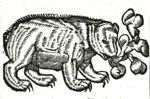
Horrent commota moveri: Paradin, Les devises héroïques (Antwerp, 1563), emblem 46 uses the imagery of an angry bear
Iconclass: 25F23(BEAR)(+335) beasts of prey, predatory animals: bear (+ snout, jaw, beak, nib) 25F23(BEAR)(+49) beasts of prey, predatory animals: bear (+ audible means of communication of animal(s): roaring, crying, singing, barking, mewing, neighing, chirping, etc.) 56E2 Rage, Anger
Collectanea (1500): 662
Loci Communes: Ultio malefacti (Vengeance for a wrongdoing, Vengeance d'un méfait)
III v 68 Muris in morem Mouse fashion
Plautus in Captivi duo, Quasi mures semper edimus alienum cibum. In parasitos dictum, quibus iucundum est aliena vivere quadra, Non conveniunt, nec in una sede morantur, libertas & cibus alienus, quod eleganter indicat apologus Aesopicus de mure sylvestri & domestico. Quin & Graecis proverbiali verbo, μυσπολεῖν dicuntur, qui muris in morem cibi causa obambulant oberrantque. Indicavit hoc Hesychius.
Plautus in the Two Captives: 'Like mice, we are always eating someone else's food.' Said of parasites, whose delight is 'to live at another person's table.' Freedom and eating another person's food do not go together, nor are they to be found in the same place, as is neatly shown in Aesop's fable of the country mouse and the town mouse. Further, the Greeks have a proverbial word [greek] 'to scurry around like a mouse,' for those who walk up and down and wander around like mice in search of food. It was indicated as such by Hesychius.
Facsimile:
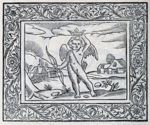
Nec in una sede morantur: Peacham, Minerva Britanna (London, 1612), emblem 193 quotes the comment
Iconclass: 25F26(MOUSE)(+451) rodents: mouse (+ animal in search of food) 57AA6122 Sponging, Parasitizing
Loci Communes: Subitum exitium (Sudden destruction, Ruine soudaine)
III v 69 E tribus malis unum One of three penalties
Τῶν τριῶν κακῶν ἒν, id est, Trium malorum unum. Suidas proverbium indicat apud Menandurm exstitisse. Sumptum autem a Theramene, qui cuidam e tribus malis unum indixerit, e quibus quia vellet eligeret. Unde et Aristophanes apud eundem Suidam in Triphalete: ἐγὼ γὰρ ἀπὸ θηραμένους δέδοικα τὸ τρία ταῦτα. id est, Ego enim a Theramene merui tria haec. Quae sint autem ea tria, quaere in proverbio: τὰ τρία τῶν εἰς θάνατον. Id usurpavit Alexander in Aepolis. Aristides ait oraculum solere tradi obsignatum, quod qui solveret prius quam fas esset, unum è tribus malis illum manebat, aut oculorum orbatio, aut manus, aut linguae iactura. Sunt qui dicant iis, qui sententia capitali damnati fuissent, tria solere deferri, gladium, laqueum, et aconitum.
[greek], One of three penalties. Suidas states that the proverb survived in Menander. However it derives from Theramenes, who imposed on a certain person one of three penalties, from which he might choose which he wanted. This is the source too for Aristophanes in the Triphales, as quoted by the same Suidas: 'For I was made to fear [greek] "these three things" by Theramenes.' What these three things may be, you may seek in the proverb [greek]'Three ways to die.' Alexander used this in his Goatherds. Aristides says that an oracle used to be given under seal, and if anyone opened it before the right time, one of three penalties awaited him, removal of his eyes, or of a hand, or loss of his tongue. Some say that those who were sentenced to capital punishment were offered three means, the sword, the noose, or poison.
Facsimile:
Iconclass: 44G37 public punishment (death not intended or involved) 53A11:44G34 Choice; 'Elettione' (Ripa)❧death penalty, execution 44G321:31E2333 instruments of torture, execution or punishment❧violent death by poison 44G321:31E234631 instruments of torture, execution or punishment❧violent death by sword 44G321:31E2355 instruments of torture, execution or punishment❧violent death by hanging 44G33:31A2212 torture❧eyes 44G33:31A22141 torture❧tongue 44G33:31A2245 torture❧hand
Loci Communes: Infortunii sive exitii (Misfortune or ruin, Malheur ou ruine)
III v 70 Quam facile vulpes pyrum comest As easily as a fox eats a pear
Plautus in Mostellaria: Tam facile vinces, quàm vulpes pyrum comest. De re factu proclivi. Quod nihil negotii sit vulpi dentatissimae, pyrum edere.
Plautus in his Haunted House: 'You will win, as easily as a fox eats a pear.' Said of something easy to do. For it is no work at all for a well-toothed fox to eat a pear.
Facsimile:
Iconclass: 25F23(FOX)(+452):25G21(PEAR) beasts of prey, predatory animals: fox (+ animal with prey)❧fruits: pear 54D4 Facility
Loci Communes: Proclivitas (contra) (Propensity (against), Penchant (contre))
III v 71 Contrahere supercilium, inflare buccas Contracting the brow, inflating the cheeks
Οφρῦς ἀνασπῶντες καὶ γναθους φυσῶντες. id est, Adductis superciliis, et inflatis buccis. In fastuosos ac turgidos dictum Suidas admonet. Siquidem in superciliis, sicut alias ostendimus, arrogantiae sedes. Horatius inflatas buccas ad iracundiae retulit argumentum: Quin Iuppiter ambas Iratus buccas inflet. Divus Augustinus in libris Confessionum: Buccis typho crepantibus. Quo loco nonnulli perperam typo legunt. Mirum est autem Augustinum voce Graecanica tantopere delectatum, ut cum fastum dicere posset typhum dicere maluerit, nisi quod caiam usu Latio donata videbatur. Traductum a ranis, quae periram inflantur. Notus est apologus Aesopicus de rana per arrogantiam dirupta. Horatius: Crescentem tumidis infla sermonibus utrem.
'[greek], With knitted brow and puffed out cheeks. Used of pompous and bombastic individuals, Suidas tells us. For it is in the brow, as we have shown elsewhere, that the seat of arrogance is found. Horace took puffed-out cheeks as a sign of anger: 'That Jupiter should not / Puff out both cheeks in anger.' St Augustine, in his Confessions, has 'cheeks bursting with typhus "arrogance."' Some people wrongly read typus 'mark of a blow' here. But it is surprising that Augustine should have been so pleased with a Greek word that, when he could have said fastus 'haughtiness,' 'arrogance' he preferred to say typhus, unless it was because it appeared to be already accepted as Latin usage. The figure is derived from frogs, which blow themselves up with anger. There is a well-known fable of Aesop about a frog which burst with arrogance. And Horace writes: 'Inflate the swelling bag with pompous utterances.'
Facsimile: 
Iconclass: 25F51(FROG)(+21) tailless amphibians: frog (+ young animal) 31B6215(+9212) frowned eyebrows (+ challenging) 31B6241(+9212) cheeks rounded (+ challenging) 57AA644 Arrogance; 'Arroganza' (Ripa) 57AA647 Hybris
Loci Communes: Tristitia, laetitia (Sadness, joy, Tristesse, joie)
III v 72 Sus comessatur A swine revelling
ὗς ἐκώμασεν, id est, Sus saltavit, aut comessatur. Diogenianus ostendit dici solitum de iis, qui praeter decorum quidpiam facerent, quique rexum successu praeter meritum obiecto, semet insolentius efferunt. Attingunt et Suid as et Zenodotus. Est autem Graecis κωμάζειν iuvenum amantium morc coronis, cantilenis, saltationibus, ceterisque iuvenilibus nugis lascivire, et in domos alienas irrumpere. Irrumpunt & sues, unde Theocritus in Syracusis: Αθρόος ἄχλος ὠθεῦνθ᾽ ὥσπερ ὕες. id est, Turba simul conferta suum more irruit. Ceterum qui rusticiore sunt ingenio, mirum quam haec dedeceant. Locus erit ubi natura saevus, et agrestis adfectat videri festivus.
[greek], A swine danced, or A swine revelling. Diogenianus declares this was said of those who committed some impropriety and who, when the objection is made that things have turned out better than they deserve, are all the more insolently proud of themselves. Both Suidas and Zenodotus mention it. For the Greeks [greek] 'to revel' is to disport oneself like young lovers with wreaths, songs, dances, and all the other juvenile nonsense, and to burst into other people's houses. Swine burst in too. Hence Theocritus in the Syracusan Women: 'A dense crowd all together like swine bursting in.' But it is wonderful how little those of rather rustic nature are suited to these things. There will be a place for this adage when someone who is savage and coarse by nature tries to seem witty.
Facsimile:
Iconclass: 46A153 'bambochades', revellers 47I212(+9525):43C9 pig (+ some other movements of animal(s))❧dancing 56B42 Coarseness, Rusticity
Collectanea (1500): 688
Loci Communes: Absurda, indecora, seu praepostera (Absurd, unbecoming, or preposterous things, Choses absurdes, inconvenantes ou déplacées)
III v 73 Dat veniam corvis, vexat censura columbas The laws absolve ravens and harass doves
Non tam ovum ovo simile quam illud proverbii speciem prae se fert, quod est apud Iuvenalem: Dat veniam coruis, vexat censura columbas. Poena legum exercetur in humiles quospiam, et a quibus ob ingenii mansuetudinem aliquid emolumenti potest auferri. Rapacibus ignoscitur Sumptum est ab apophthegmate Anacharsidis, qui hoc dicto elusit studium Solonis in conscribendis legibus, quemadmodum refert Plutarchus in vita Solonis: ὅς τοὺς νόμους τοῖς ἀραχνίοις ὁμοίους ἔφασκεν. καὶ γὰρ ἐκείνους ἐὰν μὲν ἐμπεσῆ τὶ κοῦφον καὶ ἀσθενὲς, στέγειν, ἐὰν δὲ μεῖζον, διακόψαν οἴχεται. i. Leges aranearum telis adsimiles dicebat, propterea quod in illas si quod levius, aut imbecillum incurrerit, haeret: sin maius aliquid, dissecat, ac fugit. Ad eandem pertinet sententiam quod in Phormione ait Terentius: Quia non rete accipitri tenditur, neque miluio, Qui male faciunt nobis, illis, qui nihil faciunt, tenditur. Quia enim in illis fructus est, in illis opera luditur.
There is a line in Juvenal which bears a closer resemblance to a proverb than one egg to another: 'The laws absolve ravens and harass doves.' The penalty of the laws is employed against some humble folk, from whom, because of their gentleness of character, some gain can be extracted. The greedy are forgiven. The adage comes from a maxim of Anacharsis who said this in mockery of Solon's care in writing his laws, as Plutarch relates in his life of Solon: 'He used to say that the laws are like the webs of spiders, because if anything lightweight or feeble runs into them, it sticks, but if it is something larger, it cuts through and gets away.' The same meaning is contained in what Terence says in his Phormio:
Because a net is not spread for a kite or a hawk,
Birds which are harmful, it is spread for harmless ones.
The latter are profitable, the former are a waste of labour.
Facsimile:
Iconclass: 25F32(RAVEN) song-birds: raven 25F39(DOVE) other birds: dove 25F713(+4712) spiders (+ animals nesting; making nests, lodges, webs, etc.) 44G69 bad, corrupt judge 46A23 contrast between important and unimportant people; the inferior before the superior, the weak before the mighty 59CC21 Inequality, Inequity, Iniquity; 'Iniquità' (Ripa)
Collectanea (1500): 149
III v 74 Sutorium atramentum Cobbler's blacking
M. Tullius libro epistolarum nono ad Paetum: Iam pater eius accusatus est a M. Antonio: sutorio atramento absolutus putatur. Subesse videtur proverbium. Sentit, opinor, hominem absolutum fuisse, iudicum corruptela, non citra infamiam. Est enim huiusmodi sutorium atramentum, ut neque magnopere atram imptimat notam, neque nullam tamen illinat maculam. Infamiam enim atramenti symbolo poetae significant, ut Horatius: Hic nigraesuccus loliginis, haee est Aerugo mera. Is quidem sucus quidam et, quem plerisque mollium piscium, maxime Sepiis inesse scripsit Aristoteles libro De partibus animalium quarto: eum tunica contineri membranea, emitti vero sistula quadam, quem effundunt in metu, et aquam infuscant, ne queant deprehendi. Rursus Horatius: Sed velitti tractat a notam labemque remittunt. Atramenta, fere scriptores carmine foedo Splendida facta linunt. Ceterum quod Graeci Chalcanthum appellant, Cornelius Celsus fere vertit sutorium atramentum, cuius frequenter meminit in medicinis, praescrtim libro 5. Colligitur ex aere. Unde Graecis nomen χάλκανθος, quasi dicas flos aeris. Unde suspicamur magis dici maculam, quam aegre possis diluere. Nam atramentum quod scriptorium vocant, facilius diluitur, nec inhaeret corio. Plinius in epistola simili figura dixit: Vitelliana cicatrice stigmosum.
Marcus Tullius to Paetus in book 9 of his Letters to Friends: 'Now his father has been accused by Marcus Antonius: it is thought he was acquitted with the use of some cobbler's blacking.' There seems to be a proverb underlying this. He means, I think, that the man was acquitted, not without scandal, by bribing the judges. For cobbler's blacking is such that it does not make an excessively black mark, nor on the other hand does it leave no blemish at all. So scandal is symbolized in the poets by blacking; Horace, for example: 'This is the juice of the black cuttle-fish, this is / Pure venom.' This juice is of a type that is to be found in many sorts of soft fish, especially cuttle-fish, according to Aristotle in book 4 of On the Parts of Animals: 'It is contained in an inner bag of skin and emitted through a tube; they squirt it out when afraid, and darken the water so that they cannot be caught.' Horace again:
But as inks when handled leave a mark and a stain,
So writers often besmirch the splendid achievements of others
With shameful verse.
Finally, what the Greeks call chalcanthum Cornelius Celsus translates roughly as sutorium atramentum 'cobbler's blacking/ which he recalls frequently among his treatments, especially in book 5. It is gathered from bronze. Whence the Greek term [greek], in other words 'flower of bronze.' Which makes me suspect that 'cobbler's blacking' means rather a stain which is removed with difficulty. For the black called 'writers' black' is more easily washed off and does not adhere to the skin. Pliny used a similar figure in one of his letters: 'Marked with a Vitellian scar.'
Facsimile:
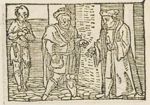
L'argent content faict playder Aduocatz: La Perrière, Le theatre des bons engins (Lyon, 1545), emblem 66
Iconclass: 41D2332:22C4(BLACK) shoes, sandals❧colours, pigments, and paints: black 44G69 bad, corrupt judge 46B911 bribery 47H73 shoe-maker, cobbler
Collectanea (1500): 36
Loci Communes: Probrum, gloria (Disgrace, glory, Honte, gloire)
III v 75 Surda testimonia Deaf testimonies
Κωφαὶ μαρτυρίαι. i. Surda testimonia, dicuntur quae feruntur per tabulas, propterea quod hae rogatae nihil respondeant. Ut non discrepet ab illo: Muti magistri. Unde surdis agere testimoniis proverbio dicuntur, qui vel procul absentes, vel vita defunctos modo citant, ne queant deprehendi.
[greek], Deaf testimonies, so-called, are those which are given on tablets, because, if a question is addressed to them, they give no answer, so that this adage does not differ from 'Silent teachers.' This is why people are said proverbially to 'plead a case on deaf testimonies' when they quote only those who are far away or those who are dead, so that they cannot be apprehended.
Facsimile:
Iconclass: 31A412 deaf, deafness 44G152 documents (~ witnesses)
Collectanea (1500): 481
Loci Communes: Imposturae (Impostures, Impostures)
III v 76 Perdere naulum To throw away the fare
Iuvenalis in Satyra, cui initium: Stemmata quid faciunt. Praeconem Chaerippe tuis circumspice pannis, Cum Pansa eripiat, quidquid tibi Nacta reliquit, Iamquetace, furor est post omnia perdere naulum. Domitius Calderin us, ut inter recentiores haudquaquam malus auctor, admonet proverbium esse in eum, quicum multa amiserit, reliquum etiam velit perdere. Sumptam autem metaphoram a mercatoribus, qui cum navigant, si minus, quantum cupiunt, lucrari possunt, student ut saltem recuperent ex mercibus divenditis, quantum pro vectura navali solverunt. Aristippus interrogatus a quodam, num esset ubique ridens: οὐκ οὖν, ἔφη, παραπόλλυμι τὸ ναῦλον, εἴγε πανταχοῦ εἰμὶ. i. Naulum igitur non perdo, inquit, si quidem ubique sum. Refertur a Plutarcho in commentatio, cui titulus: ὅτι διδακτὴ ἀρετή.
In the Satire of Juvenal which begins 'What can pedigrees do?'
Look round for an auctioneer, Charippus, for your rags,
Since Pansa snatches away whatever Natta left you,
And keep quiet now, it is madness to throw away the fare after
everything else.
Domizio Calderini, by no means a bad authority among the moderns, tells us this is a proverb directed against someone who has lost a great deal and wants to throw away even what is left. The figure is derived from traders, who, if they have been able to make less profit on their voyages than they want, strive to recuperate from the goods they retail at least enough to pay off the cost of the sea transport. When Aristippus was asked by someone whether he was ubiquitous, he said with a laugh, 'Well then, I do not lose my fare,' he said, 'if indeed I am ubiquitous.' The story is told by Plutarch in his essay entitled 'Whether Virtue Can Be Taught.'
Facsimile: 
Iconclass: 46B44 paying (~ commerce) (here also repayment of debt, etc.) 46B472:46C5 loss (~ commerce)❧travelling; tourism
Loci Communes: Internitio (Utter destruction, Extermination totale)
III v 77 Siculissare To behave like a Sicilian
Σικελίζειν. i. Siculissare. Eudemus indicat antiquitus usurparum, pro eo quod est: Austerum esse, tetricumque. Et eum quidem in modum Epicharm um usum esse. Ceterum aliis placere magis referendum ad improbos et vafros. Non dubium quin ab eius genus moribus sit sumptum. At Athenaeus Dipnosophistarum libro primo indicat, adagium natum ab Androne Siculo, qui morem invexerit ad tibiam saltandi, gesticulandique.
[greek], To behave like a Sicilian. Eudemus indicates this was used in antiquity for strict, harsh behaviour, and that Epicharmus indeed used it in this way. But in fact others hold it should be used rather of dishonest and crafty individuals. There is no doubt but that it arose from the character of that nation. But Athenaeus, in the first book of the Doctors at Dinner, says that the adage arose from a Sicilian called Andron who introduced the fashion of dancing and pantomiming to the flute.
Facsimile:
Iconclass: 32B311(SICILIAN) indigenous European peoples (SICILIAN) 43C911 man dancing alone 48C8544 pantomime, dumb show, masque 53C13 Sternness; 'Rigore' (Ripa) 57AA6131 Guile, Artfulness, Craftiness, Deceitfulness
Loci Communes: Luxus et mollicies (Luxury and softness, Luxe et mollesse)
III v 78 Sedens columba A sitting dove
Ημένη πελειὰς, id est, Sedens columba. Suidas proverbii titulo commemorat, indicatque dici solitum, de supra modum mansuetis ac simplicibus. Nam columbae cum avolant, fallunt ceteras pernicitate volatus: cum sedent, nihil mitius, aut simplicius. Neque quidquam habent, quo se tueantur adversus miluios et accipitres, praeter alarum velocitatem. Videtur dici posse et in eos, qui simplicitatem simulant, quo magis imponant, propterea quod mos sit aucupibus, exoculatam columbam in reti ponere, quae subsultans, ceteras columbas alliciat. Ea Graecis dicitur παλεύτρια, à verbo παλεύειν, quod est seducere, sive in laqueum illicere. Aristophanes in Auibus de columbis loquens: Καὶ ἐπαναγκάζει παλεύειν δεδεμένας ἐν δικτύῳ. id est, Et cogit paleutriam agere, alligatas in reti. Vide lector num legendum sit ἠμμένη, id est, illaqueata, id enim patitur, quo fallat alias.
'[greek], A sitting dove. Suidas records this explicitly as a proverbial expression and indicates that it was said of excessively mild and guileless people. For when doves fly off, they outstrip all others with the speed of their flight, but when they are sitting, there is nothing gentler or sweeter. Nor do they have any means of defence against kites and hawks apart from the speed of their wings. It seems to me it can also be said of those who pretend to be guileless in order to be more successful in their deceitfulness, because it is the habit of bird-catchers to put in the net a blinded dove, which flutters up and down and attracts other doves. This bird is called by the Greeks [greek], a decoy, from the verb [greek] 'to catch by decoy-birds,' that is 'to lead astray' or 'to entice into the net.' Aristophanes, talking of doves, in the Birds: [greek] 'And makes them act as decoys entangled in the net.' The reader may consider whether one should read [greek] 'enmeshed' here, because this makes sense, whereas there would be none otherwise.
Facsimile:
Iconclass: 25F39(DOVE)(+535) other birds: dove (+ sitting animal) 43C132(+0) duck decoy (+ variant) 51AA4:54E41 Nothingness, Absence❧Self-defence 57AA6131 Guile, Artfulness, Craftiness, Deceitfulness
Loci Communes: Mansuetudo (Gentleness, Douceur)
III v 79 Simia barbata seu caudata A monkey with a beard, or with a tail
Πίθηκος πώγων᾽ ἔχων i. Simia barbam portans. Aristophanes: ἐν ἀχαρνεύσιν, ὦ πίθηκε τὸν πώγων᾽ ἔχων. Interpres admonuit allusum esse ad illud Archilochium: τοίην δ᾽ ὦ πίθηκε τὴν πηγὴν ἔχων. i. Talem ô simia caudam habens. Dici solitum de ridiculis. Regulus Rusticum Stoicorum simium dixit, contumeliae gratia, ut refert Plinius in Epistolis: opinamur quod barba & pallio Stoicum ageret verius, quam moribus. Idem Aristophanes alio quodam loco quosdam δημοπιθήκους appellat, quasi populi simias. Est autem hoc animal natura γελωτοποιὸν, nec in alium usum videtur natum, cum nec valeat ad esum ut oves, nec ad aedium custodiam ut canes, nec ad onera gestanda ut equi. Athenaeus libro decimoquarto narrat Anacharsim philosophum, genere Scytham, cum in convivium inducerentur homines ad risum movendum edocti, solum omnium non risisse. Tandem cum inducerentur simiae, coepit ridere, rogatus causam. Hae, inquit, natura sunt γελωτοποιοὶ, illi fingunt.
[greek], A monkey with a beard. Aristophanes in the Acharnians: [greek] 'Oh monkey, what a beard!' From the scholiast I learned that this is an allusion to the saying of Archilochus: 'O monkey, what a tail you have!' Used to be said of absurd people. Regulus called Rusticus the 'Stoics' monkey' as an insult, as Pliny relates in his Letters, I think because he acted the Stoic more with his beard and his cloak than in his morals. Aristophanes again, in another passage, calls certain people [greek] 'monkeys of the people,' as it were. This animal is by nature [greek] 'a buffoon,' and seems to have been created for no other purpose, for it is of no use for eating like sheep, nor for guarding the house like dogs, nor for carrying burdens like horses. Athenaeus in book 14 tells a story about the philosopher Anacharsis, a Scythian by race, who was the only one, when skilled comedians were brought in at a banquet, not to laugh. Later, when some monkeys were brought in, he began to laugh, and when asked the reason he said, "These are funny by nature, the others are feigning it.'
Facsimile:
Iconclass: 25F22:31A534 monkeys, apes❧beard 25F22(+343) monkeys, apes (+ tail of an animal) 52AA511 Ridiculousness
Loci Communes: Simulatio, dissimulatio (Pretense, dissimulation, Simulation, dissimulation)
III v 80 Sibi canere Singing your own song
Εαυτῷ ψάλλειν, id est, Sibiipsi canere, dicitur qui non ad alienum arbitrium facit quippiam, sed animo obsequens suo. In Platonis convivio iubent tibicinam sibiipsi canere. Et cantor quispiam, Antigenidas opinamur, iubet discipulum, quod populo non admodum gratus esset, sibi canere et Musis. M. Tullius in Bruto: Id enim est summi oratoris, summum oratorem populo videri. Quare tibicen Antigenidas dixerit ducipulo sane frigenti ad populum: Mihi cane et Musis: ego huic Brute dicenti ut solet, apud multitudinem, Mihi cane et populo dixerim. Divus Hieronymus ad Ismeniam refert, huius discipulum. Atque is non iussus est sibi canere, sed praeceptori, qui poterat iudicare.
'[greek], Singing for oneself. People are said to sing for themselves if they do something, not at another person's behest, but following their own will. In Plato's Banquet they order the flute-girl to pipe for herself. And a certain singer, Antigenidas I think, because his pupil was not sufficiently popular with the audience, orders him to sing for him and for the Muses. Marcus Tullius in the Brutus: 'For it is the mark of the greatest orator to be recognized as the greatest by the people. Thus while the flute-player Antigenidas may very well have said to his pupil, when he was coldly received by the audience, "Sing for me and for the Muses," to the man, my dear Brutus, who usually addresses a large crowd, I would say, "Sing for me and for the people."' St Jerome identifies the pupil of Antigenidas, if I am not mistaken, as Ismenias. And the latter is not ordered to 'sing for himself but for his teacher, so that he can judge him.
Facsimile:
Iconclass: 48C7551 singer without accompaniment 52A53 Self-knowledge
Collectanea (1500): 348
Loci Communes: Proprii commodi studium (Pursuit of one's own advantage, Recherche de son propre intérêt)
III v 81 Si leonina pellis non satis est, vulpina addenda If the lion's skin is not enough, a fox's must be added
Αν ἡ λεονταὴ μὴ ἐξικηται, τὴν ἀλωπεκὴ πρόσαψον, id est, Si leonis exuvium non sufficit, adde vulpinum. Cum viribus res obtineri non potest dolus adhibendus. Adagium natum est ex apophthegmate Lysandri. Nam is, quemadmodum in eius vita memorat Plutarchus, irridere solitus est, quivelut ab Hercule prognati bellum apertis viribus, citraque dolum gerendum esse censebant, cum ipse magis existimaret boni ducis officium esse, quo leonina pellis non attingeret, eo contendendum adsuta vulpina. Quod quidem propemodum indicat & Maro, cum ait: Dolus an virtus, quis in hoste requiret? Adagium refertur a Zenodoto. Huic adfine est quod apud Plutarchum in vita Syllae Carbo dixisse memoratur. Cum enim Sylla non solum aperto Marte, sed dolis bellum gereret, ait: ὡς ἀλώπεκι καὶ λέοντι πολεμῶν ἐν τῇ σύλλα ψυχῇ κατοικοῦσιν, ὑπὸ τῆς ἀλώπεκος ἀνιε τὸ μᾶλλον. id est, quod bellum gerens cum vulpe, ac leone, quorum utrumque habitabat in animo Syllae, à vulpe vehementius angeretur. Apud Aristophanem quidam dicitur κυναλώπηξ, quod caninam impudentiam cum vulpina astutia coniunxisset.
Αν ἡ λεονταὴ μὴ ἐξικηται, τὴν ἀλωπεκὴ πρόσαψον, If a lion's skin is not enough, add a fox's. When something cannot be gained by force, guile is called for. The proverb arose from a saying of Lysander. For, as Plutarch recalls in the life of Lysander, he used to ridicule those who, as if they were descendants of Hercules, thought they should wage war by frank use of force and without deceit, whereas he held that it was more the duty of a good leader, where the lion's skin would not reach, to patch it out with a fox's. This is almost the same idea as Maro alludes to as well when he says: 'Cunning or courage, which is desirable in an enemy?' The adage is recorded by Zenodotus. It is similar to something which Plutarch recalls Carbo saying in the life of Sulla. Because Sulla carried on the war not only with open force but also by cunning, he says: 'He waged war both as a fox and as a lion, for his mind was of the nature of both, but he was more strongly affected by the fox's.' In Aristophanes someone is said to be κυναλώπηξ 'a fox-dog,' because he combined the shamelessness of the dog and the cunning of the fox.
Facsimile: 
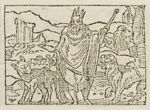
A qui le Prince doibt ressembler: La Perrière, Le theatre des bons engins (Lyon, 1545), emblem 22 uses the imagery of a king holding both a lion and a fox on a leash
Iconclass: 25F23(FOX)(+351) beasts of prey, predatory animals: fox (+ skin, fleece, hide, fur, leather) 25F23(LION)(+351) beasts of prey, predatory animals: lion (+ skin, fleece, hide, fur, leather) 57AA6131 Guile, Artfulness, Craftiness, Deceitfulness 54A7 Strength, Power; 'Fortezza', 'Fortezza d'Animo e di corpo', 'Fortezza del corpo congiunta con la generosità dell'animo', 'Fortezza & valore del corpo congiunto con la prudenza & virtù del animo', 'Forza' (Ripa)
Loci Communes: Inconstantiae, perfidiae, versutiae (Inconstancy, treachery, cunning, Inconstance, perfidie, ruse)
III v 82 Siculus milus A Sicilian soldier
Σικελὸς στρατιώτης, id est, Siculus miles. In peregrinum, ac mercenarium militem proverbiali ioco dicebatur, propterea quod Siculi temporibus Hieronis exotico milite plerumque uterentur, auctore Zenodoto. Conveniet in hominem lucri gratia nullum ministerii genus recusantem. Adfine est illi, quod de Care dictum est alibi.
[greek], A Sicilian soldier. This was said by way of proverbial banter against a foreign mercenary soldier because in the time of Hiero the Sicilians commonly made use of foreign infantry, as Zenodotus tells us. Appropriate for a man who is willing to undertake any sort of service for love of gain. It is close to what we have said elsewhere about the Carian.
Facsimile:
Iconclass: 32B311(SICILIAN) indigenous European peoples (SICILIAN)
Loci Communes: Contemptus et vilitatis (Contempt and worthlessness, Mépris et bassesse)
III v 83 Pro bonis glomi Reels for good deeds
Αντ᾽ ἀγαθῶν ἀγαθίδες. i. Pro bonis glomi. Dici consuevit, ubi quis beneficium, quod in alium contulisset, cumulate, cumque fenore reciperet. Agathides enim Graecis glomi dicuntur: verum allusionis decus in voce Graeca est, quod in sermone Latino reddi non potest. Meminit Suidas.
[greek], Reels for good deeds. This was customarily said whenever someone was rewarded abundantly and with interest for a benefit he had conferred on someone else. For agathides is the Greek word for glomi 'reels,' but there is an ornament of word-play in the Greek expression which cannot be rendered in Latin. Suidas records it.
Facsimile:
Iconclass: 55A12 Reward, 'Praemium'; 'Premio', 'Remuneratione' (Ripa) 57A8 Gratitude; 'Gratitudine', 'Memoria grata de beneficii ricevuti' (Ripa)
Loci Communes: Gratitudo (Gratitude, Gratitude); Pensatio beneficii vel officii (Repayment of a favor or duty, Rétribution d'un bienfait ou d'un devoir)
III v 84 Sine pennis volare haud facile est It is not easy to fly without feathers
Manet etiam hodiernis temporibus vulgo celebre, quod est in Poenulo Plautina. Sine pennis volare haud facile est. Idem in Asinaria: Defraudem te ego? Age sis, sine pennis vola. Locum habet, cum deesse significamus adminicula, sine quibus negotium peragi non possit. Reperitur apud idoneos auctores. Accidere alas, pro eo, quod est, adimere materiam, facultatemque conandi quippiam. Et: Addere alas. Horatius simili forma dicit Decidere pennas: Unde simul primum me dimisere Philippi, Decisis humilem pennis. Et Cicero ad Atticum libro quarto: Qui mihi pennas inciderant, nolunt easdem renasci. Idem in Academicis dixit: In cidere nervos, pro adimere vires. Cognatum est illi, quod alibi retulimus: εἰς πῦρ ξαίνειν, id est, Ignem dividere. Quod pro impossibili retulit Plato lib. De legibus 6. ὀλίγου δὲ ποιεῖν τὸν νομοθέτην τὸ τῶν παιζοντων εἰς πῦρ ξαινειν, i. Ut propemodum legum conditor faciat, quod solent, qui ludunt, in ignem impingentes ictum, hoc est, inaniter laboraret: quod ignis mox in se coeat. Eius generis est illud apud Platonem in Eryxia: καταμαθὼν δὲ αὐτὸν ἐγὼ ὅτι ἴσον εἴη πεῖσαι, ὅπερ ἂν τὸ λεγόμενον λίθον ἐψῆσαι. i. Ubi cognovissem tale esse hominis ingenium, ut illi suadere nihil aliud fuerit, quam lapidem decoquere. Haec fatemur aliis locis tempestivius potuisse dici, sed non omnia locis omnibus occurrunt.
Still well known popularly these days is this proverb from Plautus' Carthaginian: 'It is not easy to fly without feathers.' We find the same in the Comedy of Asses: 'Would I cheat you? Come on, please! Fly without feathers!' It comes in appropriately when we say that certain aids are missing without which some business cannot be completed. Among respectable authors we find accidere alas 'to cut off the wings' as an expression for taking away the material or the means to undertake anything, and addere alas 'to add wings.' Horace, using a similar expression, said decidere pennas 'to clip the wings':
As soon as the battle of Philippi discharged me,
Brought down with my wings clipped ...
And Cicero says in the Letters to Atticus, book 4: 'Those who had cut off my wings do not want them to grow again.' In the Academic Questions the same author said 'to cut the sinews' for taking away one's strength. This is similar to an expression we have noted elsewhere, [greek] 'To divide fire,' which Plato used in the Laws book 6 to mean the impossible: 'With the result that the maker of laws does precisely what those people do who make a game of thrashing at a fire,' that is, he wastes his labour, because fire immediately runs together again. Another expression of the same sort is found in Plato's Eryxias: 'Then I recognized that the man's mind was such that persuading him would be no different from cooking a stone.' I confess these passages could have been quoted more opportunely in other places, but they do not all come to mind on all occasions.
Facsimile:
Iconclass: 31A2762 flying 51AA4:25F3(+352) Nothingness, Absence❧birds (+ feathers) 52BB42 Impossibility
Collectanea (1500): 210
Loci Communes: Impossibilia (Impossible things, Choses impossibles)
III v 85 Siphniassare To give a Siphnian wave
Σιφνιάζειν, id est, Siphniassare. Suidas indicat proverbio dici solere, pro eo, quod est manum admovere postico: sumptum esse a moribus Siphniorum, qui libidinis causa id factitare consueverint. Est autem Siphnus insula quaepiam, haud procul a Creta, cui quondam nomen fuerit Merope, vel hoc nobilis elogio, una è Cycladibus. Refert eam & Plinius libro quarto, cap. 12. Proverbium indicat & Stephanus.
[greek], To give a Siphnian wave. Suidas indicates this is a proverbial expression for waving the hand towards the backside, and that it was derived from a custom of the Siphnians, who used to do it as a lewd gesture. Siphnos is an island not far from Crete, one of the Cyclades, whose name at one time was apparently Merope, and was well known for this expression. Pliny mentions it too in book 4, chapter 12. Stephanus also mentions the proverb.
Facsimile:
Iconclass: 31A2515(+9):33C4 arm held downwards (+ expressive connotations)❧coitus, cohabiting, sexual intercourse 57AA51 Licentiousness, Lasciviousness; 'Lascivia', 'Licenza' (Ripa)
Loci Communes: Intemperantia, libido (Intemperance, lust, Intempérance, désir)
III v 86 Iuxta melam With a probe
Κατὰ μήλην, id est, Iuxta melam. Suidas ostendit proverbio dici solere, ubi quis incerta coniecturis prosequeretur. Sumpta metaphora a medicis ulcus internum immisso per fauces instrumento quopiam explorantibus. Id enim instrumentum μήλην vocant, & μηλῶσαι, ad hunc modum tentare.
Κατὰ μήλην, With a probe. Suidas shows this is a proverbial expression used when someone pursues uncertain ideas by guessing. The metaphor is derived from doctors examining an internal sore by inserting an instrument into the throat. This instrument is called a [greek], and [greek] is to probe in this way.
Facsimile:
Iconclass: 49G313 examining the tongue of patient
Loci Communes: Diligentiae (Diligence, Diligence)
III v 87 Non idem sunt scriptura et Leucaeus Leucaeus and his writings are not the same
Γραφή τε καὶ λευκᾶρος οὐ ταὐτὸν, id est, Scriptura et Leucaeus non sunt idem, aut con conveniunt. Ubi quis aliud scribit, aliud facit, aut dicit. Recte iacietur in eos, qui stare pactis nolunt. Nam haec plerumque syngraphis constant. Aut in eos, quorum vita non congruit cum libris editis. Versus Graecus constabit si addas le/gein. Conicere licet Leucaeum fuisse malae fidei scribam.
Γραφή τε καὶ λευκᾶρος οὐ ταὐτὸν, Leucaeus and his writings are not the same, or do not agree. Said when someone writes one thing and does or says another. This would be justly uttered in reproach of those who will not stand by agreements, for these often consist of written bonds, or against those whose lives do not match up to their published books. The Greek will make a line of verse if you add [greek] 'say.' We may suppose that Leucaeus was some dishonest scribe.
Facsimile:
Iconclass: 49L111 secretary, scribe 51BB2:31B6235:49L11 Dissimilarity, Unlikeness❧speaking❧handwriting, writing as activity 57AA622 Mendacity 98B(LEUCAEUS)3 male persons from classical history (LEUCAEUS) - representations to which the NAME of a person from classical history may be attached
Loci Communes: Inconstantiae, perfidiae, versutiae (Inconstancy, treachery, cunning, Inconstance, perfidie, ruse)
III v 88 Bellicum canere. Receptui canere To give the signal for war. To sound the retreat
Alias admonuimus, ferme proverbiales esse metaphoras, quae sumuntur a bello, veluti Bellicum canere pro eo, quod est, animare atque exhortari. M. Tullius Philipp. 7. Bellicum me cecinisse dicunt: Item Canere classicum dicitur, qui excitat dissidium. Receptui canere, pro finire. M. Tullius Philippica 12. Quis enim revocante et receptui canente senatu properet dimicare? Quintilianus libro 12. cap. quae postfinem studia. Quare antequam in has aetatis veniat insidias, receptui canet, et in portum integra nave perveniet. Signa canant apud Martialem, id est, iam congrediamur: et apud Plautum, Collatis signis depugnare: apud eundem Versis gladiis depugnare. Quin hoc ipsum collatis signis haud dubie proverbii speciem habet, cum significamus seriam et exactam de re disceptationem, ut M. Tullius in epistolis ad Atticum. Ut cum Maphragone signis collatis. Apud Iuvenalem: - Haec tuba rixa. Id est, hoc belli initium.
Elsewhere I have pointed out how close to proverbs are metaphors taken from war, such as 'To give the signal for war,' for 'to encourage,' 'to exhort.' Marcus Tullius, in his Philippics book 7, says 'They say I gave the signal for war.' And someone who is said to 'Sound the trumpet,' is stirring up dissension. 'To sound the retreat,' for 'to finish,' is found in Marcus Tullius Philippics book 12: 'For who can hasten to war when the senate sounds the recall and the retreat?' Quintilian, book 12 in the chapter 'What studies after the end,' says: 'Wherefore, before he comes to these snares of age, let him sound the retreat and enter port with his ship entire.' 'Let the trumpets sound,' in Martial, means 'Now let us make love together.' In Plautus we have Collatis signis depugnare 'To close standards and fight it out,' and in the same author Versis gladiis depugnare 'To fight it out at the point of our swords.' Moreover, this same expression, collatis signis, has unquestionably the appearance of a proverb when we mean a serious and precise debate about something, as Marcus Tullius does in his Letters to Atticus: 'So that [I may settle it] with Maphrago in a pitched battle.' In Juvenal 'this trumpet of discord' is 'this beginning of the war.'
Facsimile: 
Iconclass: 45H11 signal to attack 45L13 retreat of the defeated
Collectanea (1500): 72, 73, 766
Loci Communes: Incitare (To incite, Inciter); Perficiendi sive absolvendi (Finishing, completing, Achever, accomplir)
III v 89 Pithon formosus Pretty monkey
Πίθων καλὸς id est, Pithon formosus. Conveniet ubi quis per adulationem falso laudatur. Pindarus in Pythiis hymno secundo, καλός τοι πίθων παρὰ παισὶν ἀεὶ καλὸς, id est, Formosus Pithon semper apud pueros formosus. Interpres ostendit sumptum a pueris adulantibus simiae, subinde dictitantibus καλὸς πίθων. Videtur autem Pithon esse diminutivum huius dictionis πίθηκος, quasi dicas simiolus. Taxat Pindarus oblique quendam, vel quia ab indoctis laudatus tolleret cristas, vel quod ipse adularetur Hieroni, laudans non laudanda. Est autem φιλαυτία a peculiaris huic animanti, adeo ut laudes sentiant et speculis delectentur, et suos catulos contrectari gaudeant, ipsique suos catulos complexu enecent. Ad gratiam loqui veteres dicebant χαριγλωπτεῖν, quo verbo usum Aeschylum in Prometheo vincto, docet Athenaeus libro 4. Eodem referente qui iucunda potius quam vera loqui studio habebant, ἡδυγλωπτεῖν, dicebantur.
Πίθων καλὸς, Pretty monkey. This will be appropriate when someone is praised falsely through flattery. In Pindar's second Pythian Ode:
The monkey is 'pretty,' always 'pretty' in the eyes of children.
The scholiast shows that this is taken from children who repeatedly say 'Pretty monkey' when they are petting a monkey. And it is apparent that pithon is a diminutive of the word καλὸς πίθων - 'little ape,' as it were. Pindar is criticizing someone indirectly, either because he put on airs when flattered by ignorant people, or because he himself was flattering Hiero, praising the unpraiseworthy. But these animals have a particular φιλαυτία 'self-love,' so that they are sensitive to praise, and take pleasure in mirrors, and enjoy allowing their young to be touched, and themselves tire their young with their embraces. For 'speaking to please' the ancients said 'to talk pleasantly,' a word which Aeschylus used in his Prometheus according to Athenaeus book 4. According to the same source, those who were more concerned to be witty than truthful were said to 'speak sweetly.'
Facsimile:
Iconclass: 25F22(+21) monkeys, apes (+ young animal) 25F22(+422) monkeys, apes (+ animal 'educating the young', playing with young) 34A1 friendship between man and animal; caressing, petting 57AA6121 Flattery; 'Adulatione' (Ripa)
III v 90 Semel rubidus ac decies pallidus Once flushed, but ten times pale
Απαξ πυῤῥὸς καὶ δέκατον χλωρὸς, id est, Semel rubidus, & decies pallidus. Suidas admonet dictum de iis, qui mutuum accipiunt, quos necesse est crebro tum rubescere pudore, tum metu pallescere. Rubescere, dum petunt mutuum, pallescere, dum solvendo non sunt, et metuunt, ne trahantur in ius, aut in nervum.
Απαξ πυῤῥὸς καὶ δέκατον χλωρὸς, Once flushed and ten times pale. Suidas tells us this is said of those who obtain a loan, and who of necessity must in quick succession first blush with shame, then go pale with fear. They blush as they ask for the loan; they go pale while they are insolvent and fear to be taken to court or to prison.
Facsimile:
Iconclass: 31B624:22C4(RED) morphology of facial expression ~ cheeks❧colours, pigments, and paints: red 31B624:22C4(WHITE) morphology of facial expression ~ cheeks❧colours, pigments, and paints: white 55C3 Lending, Letting 56DD1 Fear, Dread; 'Paura', 'Timidità o Timore', 'Timore' (Ripa) 57A4 Shame
Loci Communes: Usura (Interest, usury, Usure)
III v 91 Semper seni iuvenculam subiice To an old man always join a young girl
Αεὶ γέροντι νέαν ὐπερβάλλειν κόρην. id est, Semper puellam virginem subice seni. Senarius proverbialis admonens, ut provectioris aetatis viri puellam ducant magis, quam anum, ne si frigus accesserit frigori, languente Venere, steriles exsistant nuptiae. Quanquam non inepte trahetur ad alios item usus, quoties significabimus ita rerum coniunctionem temperandam, ut quod alibi diminutum sit, aliunde suppleatur: videlicet, ut seni convictor addatur iuvenis, quo senilis aetatis tristitiam huius hilaritas moderetur: rursum iuventutis exsultantiam, senilis severitas temperet. Item, ut loquaculus adiungatur, plus satis taciturno, audaculus timido, pauper diviti. Proverbii meminit Diogenianus.
Αεὶ γέροντι νέαν ὐπερβάλλειν κόρην, To an old man always join a young virgin. A proverbial senarius counselling that men of more advanced age should marry a girl rather than an old woman, lest, frigidity being added to frigidity, Venus languish and the marriage prove sterile. But it may be applied aptly in other ways too, whenever we want to indicate that the association of things should be adjusted in such a way that what may be diminished on the one hand may be increased on the other. So that, for example, a young companion might be associated with an old man and the gaiety of the former would limit the melancholy of old age, or contrariwise the sternness of age would temper the liveliness of youth. Or again, a chatterer might be joined to one who is too taciturn, a rash man to a timid one, a poor person to a rich one. The proverb is recalled by Diogenianus.
Facsimile:
Iconclass: 31D13 adolescent, young woman, maiden 31D16 old man 42A190 'Sterilità' (Ripa) 42AA190 'Sterilità' (Ripa) - AA - sterile man 42D311 married couple of unequal age 54DD52:58AA2 Risk; 'Ardire ultimo & necessario' (Ripa)❧Non-procreation
Loci Communes: Alibi diminutum alibi redditum (Diminished in one place, restored in another, Diminué ici, rendu là)
III v 92 Semper superioris anni proventus melior Last year's harvest was always the best
Αεὶ τὰ πέρυσι βελτίω. id est: Superior annus semper anteponitur. Cum praesentia displicent, et anteferuntur anteacta. Diogenianus admonet id acclamatum ab Atheniensibus in rebus Macedonicis. Sumpta metaphora ab agricolis, qui semper de praesentis anni fructibus quaeruntur apud dominos. Huc pertinet illud Horatianum. Laudator temporis acti Se puero.
Αεὶ τὰ πέρυσι βελτίω, The previous year was always better. Said when present affairs are not pleasing and past ones are preferred. Diogenianus tells us this was the cry of the Athenians under Macedonian government. The figure is borrowed from farmers, who always complain to their landlords about the present year's harvest. There is a phrase of Horace that is pertinent here: 'An apologist of times past / When he was a boy.'
III v 93 Sacra nihil sunt The sacrifices are nothing
Τὰ θύματα οὐδὲν ἐστὶν, πλὴν γένεια καὶ κέρατα, id est, Sacra nihil sunt praeter malas et cornua, de victimis macilentis. Trahetur inconcinniter ad cibum minime esculentum. Refertur è Suida.
Τὰ θύματα οὐδὲν ἐστὶν, πλὴν γένεια καὶ κέρατα, The sacrifices are nothing but jawbones and horns. Said of lean victims. It may be applied quite aptly to food which is inedible. It is reported by Suidas.
Facsimile:
Iconclass: 51AA4 Nothingness, Absence 54BB6:12B2121 Worthlessness❧animal sacrifice ~ non-Christian religions
Loci Communes: Sordes et parcimonia (Meanness and stinginess, Bassesse et avarice)
III v 94 Scytharum solitudo The wilderness of the Scythians
Σκυθῶν ἐρημΐα. i. Scytharum solitudo, pro summis calamitatibus, exitioque dictum est, apud Aristophanem ἐν ἀχαρυεῦσι, Εξολέσθαι συμπλακέντα τῇ σκυθῶν ἐρημΐᾳ., id est: Impeditum deperire Scythicae solitudini. Quo loco commentator indicat proverbium dici solitum de ingenti solitudine: ductum autem inde, quod Scythae nullis certis sedibus utantur, sed vagi ferantur in plaustris. Eamque ob causam, regio feris abundat. Meminit adagii et Q. Curtius libro rerum ab Alexandro gestarum septimo, apud quem Scitharum legatus ad hunc loquitur modum: Scitharum solitudine Graecis etiam proverbiis audio eludi. Nos deserta et humano cultu vacua magis quam utbes et opulentos agros sequimur. Usurpat et Plutarchus in libro de Stoicis contrarietatibus, quem admodum ante retulimus in proverbio: In caput praecipitari.
Σκυθῶν ἐρημΐα, The wilderness of the Scythians. There is an expression in Aristophanes' Acharnians for the greatest disasters and ruin:
To perish trapped in the Scythian wilderness.
At this point the scholiast indicates that the proverb was usually used of some vast desert. It is derived from the fact that the Scythians used no fixed abodes, but travelled about in wagons, and for this reason the country abounds in wild animals. Quintus Curtius also recalls the adage in book 7 of the Deeds of Alexander. An ambassador of the Scythians speaks in these words:
I hear that Scythian deserts are mocked by the Greeks even in proverbs. We
seek out empty places devoid of human cultivation rather than cities and rich
fields. Plutarch uses the expression too in his book 'On the Contradictions of the Stoics,' as we noted in the proverb 'To be pitched head foremost.'
Facsimile: 
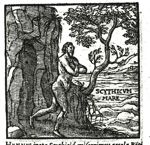
Omnia mea mecum porto: Alciatus, Emblemata (Leiden, 1591), emblem 37
Iconclass: 32B2(SCYTHIANS) historical peoples: Scythians 46A83 solitary living
III v 95 Scindere glaciem To break the ice
Scindere glaciem, est aperite viam, et in incipiendo negotio priorem esse. Translatum a nautis, quorum unus aliquis praemittitur, qui flumine concreto, glaciem praerumpat, reliquisque viam aperiat.
To break the ice is to open the way and to be the first in beginning a task. A figure derived from boatmen, who send one of their number ahead to break up the ice on a frozen river and open the way for the others.
Facsimile:
Iconclass: 26D41 drift ice 31A2746 breaking something 54DD3 Start
Loci Communes: Perficiendi sive absolvendi - ab initio ad finem (Finishing, completing - from beginning to end, Achever, accomplir - du début à la fin)
III v 96 Vivus fueris vel cepe solum accipiens You would have been alive if only you had accepted the onion
Ζωὸς γενήσῃ, κρομμύου μόνον λαβών. id est: Si cepe tantum sumpseris, iam vixeris. Zenodotus et Suidas ostendit in eos dici solitum, qui e re quapiam pusilla, magnam opinionem consequuntur. Natum apparet ab aegroto, qui medico porrigente cepe, renaluerit, herbam alioqui plebeiam, nec eam admodum salubrem corpori.
Ζωὸς γενήσῃ, κρομμύου μόνον λαβών, If only you had taken the onion, you would be alive now. Zenodotus and Suidas declare that this used to be said about those who form a great expectation from some trifling thing. It seems to have arisen from the case of a sick man who was restored to health when the doctor offered an onion, a rather vulgar plant and not one particularly healthy for the body.
Facsimile:
Iconclass: 25G22(ONION) (non-fruit) products of plants or trees: onion 49G25 recovery, convalescence of sick person 52B3 Expectation
Loci Communes: Cum auxilio ; citra auxilium (With help; without help, Avec aide ; sans aide); Excellentia, inaequalitas (Excellence, inequality, Excellence, inégalité)
III v 97 Sapientes tyranni sapientum congressu Kings become wise through association with the wise
Σοφοὶ τὺραννοι τῶν σοφῶν συνουσίᾳ, id est, Commercio sapientium princeps sapit. Zenodotus citat ex Aiace Locrensi, addens eundem versiculum, à Platone citatum esse Euripidis nomine. Certe huius nomine comperimus adductum libro de Rep. octavo, Σοφοὶ τύραννοι τῇ σοφῶν συνουσίᾳ. Quo magis admiror quare A. Gellius citet ex Theaeteto Platonis, nisi forte scribarum vitio pro Theage depravatum est Theaeteto, nam & in Theage refertur. Aulus Gellius libro decimotertio ostendit eundem apud utrumque fuisse, apud Sophoclem, in eiusdem nominis fabula, & apud Euripidem. Quemadmodum & alii nonnulli versus apud Euripidem inveniuntur, quos eosdem apud Sophoclem, & Aeschylum licet invenire. Porrò versiculum, quem modo citavimus, Gellius notae vetustatis esse dicit, ut intelligas velut in proverbium abiisse. Atque utinam quàm est graviter simul & eleganter scriptus, tam placeret aetatis nostrae principibus, in quos illud fere dixeris: Μωροὶ τύραννοι τῶν κολάκων συνουσίᾳ.
Σοφοὶ τὺραννοι τῶν σοφῶν συνουσίᾳ, The prince acquires wisdom by dealing with the wise. Zenodotus quotes this from Ajax the Locrian, adding that the same line of verse was quoted by Plato under the name of Euripides, and in fact I have found it mentioned under his name in the Republic book 8: 'Kings are wise through conversation with the wise.' I am all the more surprised that Aulus Gellius refers to the Theaetetus of Plato, unless through an error of the scribes 'Theages' has been corrupted to 'Theaetetus,' for it is also reported in the Theages. Aulus Gellius declares in book 13 that this same proverb was in both authors, in Sophocles in a play of the same name, and in Euripides, just as several other lines of verse are found in Euripides which are also to be found in Sophocles and Aeschylus. Moreover Gellius says the line that we have just quoted is 'of known antiquity,' so that you can deduce that it had become a proverb. And if only it were as welcome to the princes of our age as it is weighty and elegant, for of them you could quite well say: [greek] 'Kings become foolish through conversation with flatterers.'
Facsimile:
Iconclass: 44B113 king 52A51 Wisdom; 'Sapienza', 'Sapienza humana', 'Sapienza vera' (Ripa) 52AA51:57AA6121 Folly, Foolishness; 'Pazzia', 'Sciocchezza', 'Stoltitia' (Ripa)❧Flattery; 'Adulatione' (Ripa) 56F23:31B7 Friendship; 'Amicitia' (Ripa)❧wise man
Loci Communes: Amicitia (Friendship, Amitié)
III v 98 Leonis exuvium super crocoton A lion's skin over a saffron dress
Λεοντὴ επὶ κροκωτῳ, id est, Leonis exuvium super crocoton. Cum duo quaepiam copulantur, quorum alterum cum altero nequaquam congruit. Sumptum à Baccho, qui hoc ornatu descendit ad inferos apud Aristophanem, ut veste muliebri, delicataque indutus esset, eique vesti leonis exuvium impositum gestaret, quo videlicet Hercules creditus, formidabilis videretur inferis. Hunc igitur ad eum modum adornatum, sic in Ranis ridet Hercules, Αλλ᾽ οὐχ οἷος τ᾽ εἴμ᾽ ἀποσοβῆσαι τὸν γέλων Ορῶν λεοντὴν ἐπὶ κροκοτῷ κειμένην. id est, Risum profecto haud sum potis compescere Crocoton additum leontae conspicans.
Λεοντὴ επὶ κροκωτῳ, A lion's skin over a saffron dress. Said when two entirely unsuited things are brought together. It is derived from Bacchus who, in Aristophanes, goes down into Hades attired thus: he put on a charming woman's dress and over this garb he draped a lion's skin so that, if you please, he would be believed in Hades to be the fearful Hercules. Adorned in this way, he is also mocked in the Frogs by Hercules:
I can hardly restrain my laughter
Seeing the dress worn with the lion's skin.'
It will be aptly quoted against certain monks or scholastics who in public wear the insignia of their rule and in private act like soldiers, or those who are severe of face and effeminate in their ways.
Facsimile:
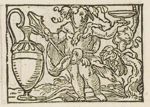
Difficile est de changer sa nature: La Perrière, Le theatre des bons engins (Lyon, 1545), emblem 48 uses the imagery of Bacchus borrowing attributes from Hercules as described in the adage's comment
Iconclass: 11P31521:45B monk(s), friar(s)❧the soldier; the soldier's life 25F23(LION)(+351) beasts of prey, predatory animals: lion (+ skin, fleece, hide, fur, leather) 41D211(+82) dress, gown (+ women's clothes) 51BB2 Dissimilarity, Unlikeness 52AA511 Ridiculousness
Loci Communes: Absurda, indecora, seu praepostera (Absurd, unbecoming, or preposterous things, Choses absurdes, inconvenantes ou déplacées)
III v 99 Quod scis, nescis What you know, you do not know
Quod scis, nescis. Terentius in Eunucho: Tu pol si sapis, quod scis, nescias. Idem in Seipsum excruciante: Nescias quod scis, si sapis. Donatus admonet esse proverbium. Sumptum à dialecticorum ludis, in quibus huiusmodi quidam scyrpi proponi solent: Facio, & non facio: Sum amicus, & non sum amicus: Audio, & non audio. Cuius generis etiam initio operis fecimus mentionem, admonentes omneis huiusmodi figuras, quae κατ᾽ ἐναντίωσιν sumuntur, ad proverbiorum cognationem pertinere. Quale est & Plautinum illud: Ubi sum, ibi non sum. Hoc iam prima, quod aiunt, fronte videtur aenigma. Sed interpretatur: Ubi non sum, ibi est animus. Itaque proverbio certam in tacendo fidem significamus, dum quis quod scit, perinde continet ac dissimulat, quasi nesciat.
What you know, you do not know. Terence, in the Eunuchus: 'You, if you are wise by heaven, what you know, you do not know.' The same author in the Heautontimorumenos: 'You will ignore what you know, if you are wise.' Donatus informs us that this is a proverb derived from the games of the dialecticians, in which riddles like this are propounded: I do and do not, I am a friend and not a friend, I hear and do not hear.' We mentioned this type right at the beginning of this work pointing out that all figures of this sort which are formed by linking opposites belong to the family of proverbs. Such is this one from Plautus: 'Where I am, I am not.' This, on the face of it, as they say, seems to be a riddle. But its meaning is: T am not where my mind is.' So by this proverb we signify a promise to keep silence, when someone keeps back and hides what he knows as if he does not know.
Facsimile:
Iconclass: 43C59 puzzle, riddle, conundrum, enigma 49C112 'Dialectica' (~ trivium); 'Dialettica' (Ripa)
Loci Communes: Laudata (Praised things, Choses louées)
III v 100 Nec aures habeo, nec tango I neither hear nor touch
Nec aures habere, nec tactum proverbio dicebatur, cui in manifestis ab omnibus reclamabatur. Hieronymus in praefatione declamationis, de matre et filia reconcilianda. (Cur autem verear appellare declamationem, cum ipse quodam in loco nominatim hoc argumentum exercitii causa confictum a se subsignificet?) Posteaquam enim, inquit, arguendo crimina, factus sum criminosus, et iuxta tritum vulgi sermone proverbium, iurgantibus et negantibus cunctis, nec aures me credo habere, nec tango id est, taceam necesse est, et quod audio, tangoque, quasi nesciam. Potest videri sumptum ex Aristophanis Thesmophoriazusis: μήτ᾽ ἀκούω μήτ᾽ ὁρῶ. i. Neque audio neque video.
'Having no hearing or touch,' was said proverbially of a person who was caught red-handed, and was the object of protests from everyone. In the preface of his declamation about reconciling a mother and a daughter (for why should I not call this a declamation, when he himself indicates at one point explicitly that this material was put together by himself as an exercise?) Jerome says: 'Because I tried to convict crime I have myself been made out a criminal. It is like the popular proverb: "As all the world disputes it and denies it, I believe it too that I have no ears, and do not touch them."' that is, I must keep silence and what I hear and touch must be as if I do not know.' This may come from Aristophanes' Thesmophoriazusae: 'I neither hear nor see.'
Facsimile: 
Iconclass: 51AA4:31A32 Nothingness, Absence❧hearing, listening (one of the five senses) 51AA4:31A35 Nothingness, Absence❧touch, feeling (one of the five senses)
Loci Communes: Cedendum multitudini (One must yield to the crowd, Il faut céder à la foule)