Jacob Cats, Spiegel (The Hague, 1632)
Emblem 81
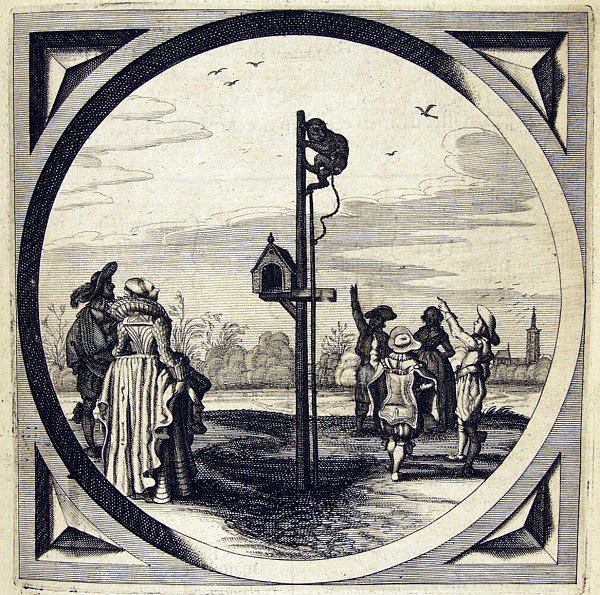
La scimia quanto piu in alto sale Tanto piu scuopere le sue vergogneItalian
The higher the ape climbs, the more it uncovers its shameful parts.AI-generated
Description of the imageAI-generated
Within a square frame enclosing a large oval border, an outdoor scene: in the centre of a flat landscape stands a tall wooden mast with a horizontal cross-piece, to which a small gabled birdhouse is attached. A monkey has climbed almost to the top of the pole, clinging to it with its hindquarters and tail exposed to the viewers below. At the left, with their backs turned, stand a man in a plumed hat and cloak and a richly dressed woman in a wide farthingale skirt and ruff. At the right a group of four or five figures, men in hats and a woman, look upward; two of them raise an arm and point toward the ape. In the distance are shrubs, trees, and a town skyline with a church tower; birds fly in the clouded sky.
Subscriptio


TranscriptionAI-generated
Fop siende dat het volck veel sach nae groote staten, Gingh met een luchten sin sijn oude neeringh laten, Hy maeckte flucx een vrient, die kroot hem boven aen, Daer sach hem yder mensch gelijck een wonder staen; Stracx wort hy bijster trots, want in sijn prachtich wesen Daer was sijn moedigh hart, als in een boeck, te lesen, Sijn huys-raet, sijn gesin, sijn wijf, sijn eyge kleet, Gaen alle buyten schreef, en uytter-maten breet. Maer siet! alwaer men koomt om wijsen raet te plegen, Daer staet de goede man in alle dingh verlegen, Daer hapert sijn verstant, daer is hy maer een kint, Soo datmen geen vernuft, in al sijn hersens vint; Siet daer sijn achtbaerheyt van stonden aen vervallen, Want die Fop innigh kent en acht hem niet met allen; 'Tis seker, als een aep wil klimmen in den spriet Dan isset datmen eerst sijn naeckte billen siet.
TranslationAI-generated
Fop, seeing that the people looked much towards high positions, light-heartedly gave up his old trade; he quickly made himself a friend who pushed him up to the top, and there every man beheld him standing like a wonder. At once he grew exceedingly proud, for in his splendid bearing his haughty heart could be read as in a book: his furniture, his household, his wife, his own clothing all go beyond measure and are extravagantly wide. But look! wherever one comes to take wise counsel, there the good man stands embarrassed in everything; there his understanding fails, there he is but a child, so that no good sense is found in all his brains. See there his dignity fallen at once, for whoever knows Fop inwardly esteems him not at all. It is certain: when an ape wants to climb the mast, then it is his bare buttocks that one sees first.
CommentaryAI-generated
9 passages · original left, translation right (click to fold)
Men kent een mans { wijsheyt, betalen, gedult, nederigheyt, rijckdom } als hy { een hooft, ghelooft, in noot, groot, doot } is.
One knows a man's wisdom when he is a head (chief); his paying when he is trusted (given credit); his patience when he is in need; his humility when he is great; his riches when he is dead.
Lat. Magistratus virum arguit.
Latin. The magistracy (public office) shows what the man is.
Griecx. Ἀρχὴ ἄνδρα δείκνυσιν.
Greek. Office reveals the man.
Nederl. Men kent een man niet eer / Voor hy komt tot eer.
Dutch. One does not know a man until he comes to honour.
Ital. Chi asnio è, & cervo si crede / Al saltar della fossa ne avede.
Italian. He who is an ass and believes himself a stag finds it out when he has to leap the ditch.
Offices are given but not discretion. Engels.
Offices are given, but not discretion. (English.)
Hoe een dwaes meer kalt / Hoe hem meer ontvalt. Nederl.
The more a fool talks, the more he gives himself away. (Dutch.)
Perlucet omne regiæ vitrum domus. Seneca. Lat.
The whole house of a king is transparent glass. Seneca. (Latin.)
Apage pereat anno citius qui majora se concupiscit. Lucianus Deorum Dialog.
Away with him! may he perish a year the sooner who covets things greater than himself. Lucian, Dialogues of the Gods.
Iconclass
86(LA SCIMIA QUANTO PIU IN ALTO SALE TANTO PIU SCUOPERE LE SUE VERGOGNE)proverbs, sayings, etc. (LA SCIMIA QUANTO PIU IN ALTO SALE TANTO PIU SCUOPERE LE SUE VERGOGNE)
Suggested Iconclass codesAI-generated
Additional codes proposed for this emblem, not (yet) part of the indexing.
86proverbs, sayings, etc.highThe image illustrates a proverbial saying (the higher the ape climbs, the more it shows its behind), and the commentary is a string of proverbs in several languages, matching 'proverbs, sayings, etc.'
86(...)proverbs, sayings, etc. (with TEXT)mediumThe emblem's proverb is accompanied by explicit proverbial texts in Latin, Greek, Dutch, Italian and English, fitting 'proverbs, sayings, etc. (with TEXT)'.
56F11Ambition; 'Ambitione', 'Amor di Fama' (Ripa)mediumThe climbing ape exposing itself and the quotation condemning him 'who covets things greater than himself' personify Ambition ('Ambitione', 'Amor di Fama').
44G13magistracy, judgeslowThe commentary's core maxims ('the magistracy shows what the man is', 'office reveals the man') concern magistracy/public office, though no judge is actually depicted.
Relationships to the Adagia of ErasmusAI-generated
Suggested relationships between this emblem and adages in Erasmus’ Adagia.
- I x 76 Magistratus virum indicat – direct mottohigh
The emblem's own Latin and Greek commentary glosses give exactly this adage: 'Magistratus virum arguit' / 'Ἀρχὴ ἄνδρα δείκνυσιν', which is Erasmus's adage 'Magistratus virum indicat' (ἀρχὴ ἄνδρα δείκνυσι); the whole emblem (Fop exposed by high office) is its illustration.
- I vii 10 Simia in purpura – thematic inventiohigh
Erasmus's 'empurpled ape' is precisely the figure of the unworthy man raised to dignity whose true nature shows through his finery; the emblem literally pictures an ape climbing to a high place and Fop's extravagant clothes and household betraying his emptiness.
- II viii 95 Tragica simia – thematic inventiohigh
Erasmus explains the 'tragical ape' as a man who holds high office and wealth though undeserving, a mere semblance of a man; this is exactly Fop, the ape who, pushed to the top, proves to be 'but a child' in counsel.
- I vi 93 Pennas nido maiores extendere – thematic inventiomedium
The moral that one should not stretch beyond one's inherited station matches Fop abandoning his old trade to rise above himself, and the Lucian tag quoted in the commentary ('may he perish who covets things greater than himself').
- I vi 16 Ne sutor ultra crepidam – thematic inventiomedium
The subscriptio's turning point is that Fop 'gave up his old trade' for an office in which his understanding fails — the classic warning that one should not judge or act beyond one's own craft and competence.
- I iii 66 Induitis me leonis exuvium – thematic inventiomedium
Erasmus applies the lionskin to those who undertake a task beyond their powers and bear themselves more grandly than their rank warrants — the ass-in-lionskin pattern underlying the emblem's ape-on-the-mast and Fop's inflated bearing.
- III iii 28 Hic Rhodus, hic saltus – thematic inventiomedium
The Italian proverb cited in the commentary ('he who is an ass and thinks himself a stag finds out at the leap of the ditch') makes the same point as Erasmus's adage: the boaster is exposed when required to perform on the spot.
- II ii 91 In seditione vel Androclides belli ducem agit – thematic inventiolow
Erasmus's adage concerns mean and contemptible men who by accident or patronage obtain high place, which is Fop's career — raised to the top by a well-placed 'friend' rather than by merit.
Sources
Record ID: embstma_1288_emblem081
This emblem on the Iconclass site: https://iconclass.org/view/embstma_1288_emblem081
Copy: University Library, Glasgow, Stirling Maxwell 1288