Geffrey Whitney, A choice of emblemes (Leiden, 1586)
Emblem 41
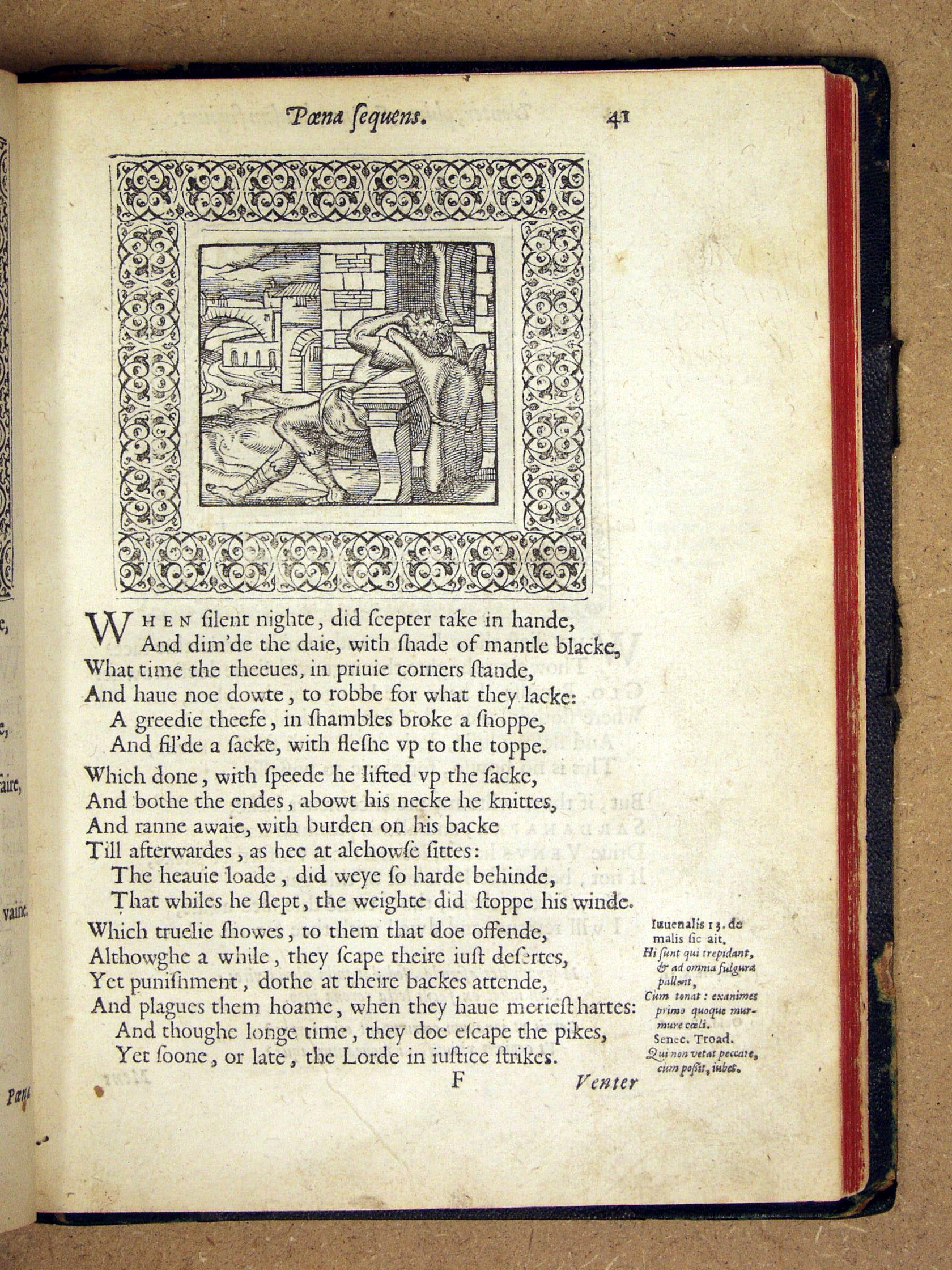
A thief is choked by the piece of meat he has stolen

Poena sequensLatin
Punishment following
- Interpretation
- Thief strangled (Punishment following)
- Interpretation (German)
- Strafe
Subscriptio
TranscriptionAI-generated
WHEN silent nighte, did scepter take in hande, And dim'de the daie, with shade of mantle blacke, What time the theeues, in priuie corners stande, And haue noe dowte, to robbe for what they lacke: A greedie theefe, in shambles broke a shoppe, And fil'de a sacke, with fleshe vp to the toppe. Which done, with speede he lifted vp the sacke, And bothe the endes, abowt his necke he knittes, And ranne awaie, with burden on his backe Till afterwardes, as hee at alehowse sittes: The heauie loade, did weye so harde behinde, That whiles he slept, the weighte did stoppe his winde. Which truelie showes, to them that doe offende, Althowghe a while, they scape theire iust desertes, Yet punishment, dothe at theire backes attende, And plagues them hoame, when they haue meriest hartes: And thoughe longe time, they doe escape the pikes, Yet soone, or late, the Lorde in iustice strikes.
TranslationAI-generated
When silent night took the sceptre in hand, and dimmed the day with the shade of a black mantle, at the time when thieves stand in private corners and have no fear of robbing for what they lack: a greedy thief broke into a shop in the shambles and filled a sack with flesh up to the top. Which done, he quickly lifted up the sack and knotted both its ends about his neck, and ran away with the burden on his back; till afterwards, as he sat at an alehouse, the heavy load weighed so hard behind him that while he slept the weight stopped his breath. Which truly shows to those who offend that, although for a while they escape their just deserts, yet punishment attends at their backs and plagues them home when they have the merriest hearts: and though for a long time they escape the pikes, yet sooner or later the Lord strikes in justice.
CommentaryAI-generated
1 passages · original left, translation right (click to fold)
Iuuenalis 13. de malis sic ait. Hi sunt qui trepidant, & ad omnia fulgura pallent, Cùm tonat: exanimes prima quoque murmure cœli. Senec. Troad. Qui non vetat peccare, cùm possit, iubes.
Juvenal, Satire 13, speaks thus of the wicked: These are they who tremble and grow pale at every lightning flash, when it thunders: lifeless even at the first murmur of the sky. Seneca, Troades: He who does not forbid sin when he could, commands it.
Notes and related emblems
- Related emblem in another book: embmne_sam1569_emblem150
Iconclass
11A3God's wrath25H213river25H217river bank25I1451bridge in city across river, canal, etc.31A2352sitting on an elevation31A2531hand(s) bent towards the head31A2626(+53)sitting or lying with one leg stretched forward and the other leg drawn up (+ sitting)31A534beard31B12(+0)sleeping in chair (+ variant)31D14adult man31E2354violent death by strangling41A72seating furniture41C691slaughtered ox or pig44G3044G54thief46C1211(+0)carrying something in basket, bag, rucksack, etc. (+ variant)47D8(ROPE)tools, aids, implements ~ crafts and industries: rope57BB13(+4)Punishment; 'Castigo', 'Pena', 'Punitione' (Ripa) (+ emblematical representation of concept)86(POENA SEQUENS)proverbs, sayings, etc. (POENA SEQUENS)
Suggested Iconclass codesAI-generated
Additional codes proposed for this emblem, not (yet) part of the indexing.
41A777container of textile material: bag, sack, netmediumThe correlate 'container of textile material: bag, sack, net' matches the large bulging sack slung at the seated man's back and knotted about his neck.
56DD1Fear, Dread; 'Paura', 'Timidità o Timore', 'Timore' (Ripa)mediumThe correlate 'Fear, Dread' fits the commentary's theme of the wicked who tremble and grow pale at every lightning flash, lifeless at the first murmur of the sky.
Relationships to the Adagia of ErasmusAI-generated
Suggested relationships between this emblem and adages in Erasmus’ Adagia.
- I x 58 Sero Jupiter diphtheram inspexit – thematic inventiohigh
Erasmus explains this adage as applying to those 'who do at length pay the penalty for their misdeeds, though late in the day' — exactly the emblem's moral that 'though longe time, they doe escape the pikes, / Yet soone, or late, the Lorde in iustice strikes.'
- II vi 11 Reperit Deus nocentem – thematic inventiohigh
The adage is used 'when retribution at last overtakes the wicked, as though sent from on high,' and quotes Homer's 'though Jove does not punish at once, punish he will in the end' — the precise doctrine of 'Poena sequens' and of the Lord striking late but surely.
- I x 82 Dii laneos habent pedes – thematic inventiomedium
The proverbial 'woollen-footed gods' signifies divine vengeance that approaches silently and unnoticed but arrives nonetheless — the emblem's thief who sleeps unaware while his own burden kills him.
- II v 14 Anus simia sero quidem – thematic inventiomedium
Erasmus glosses it as 'when some cunning fellow, who has long escaped detection, pays the penalty at last... sooner or later some accident brings hidden villainy into the open' — matching the thief who robs by night with impunity until an accident kills him.
- II vi 38 Adrastia Nemesis. Rhamnusia Nemesis – thematic inventiomedium
Nemesis Adrasteia is so named 'because no guilty person has ever escaped the punishment he deserves, although sometimes she is slow in overtaking' — the personified 'punishment that attends at their backs' of Whitney's subscriptio.
- I viii 96 Virum improbum vel mus mordeat – thematic inventiomedium
The adage means 'somehow or other the wicked do not escape punishment but pay the proper penalty in some way' — here the agent of vengeance is nothing more than the thief's own sack, as trivially as a mouse's bite.
- I vii 82 Male parta male dilabuntur – thematic inventiomedium
The stolen sack of flesh becomes the instrument of the thief's own destruction, a literal enactment of 'ill gotten ill spent'; Erasmus groups this adage under Ultio malefacti with the same moral.
- II x 36 Mali bibunt improbitatis fecem – thematic inventiolow
Erasmus: 'the pain of punishment follows pleasure that results from crime' — the emblem's thief enjoys his booty at the alehouse and is then plagued 'when they haue meriest hartes'.
- IV iv 82 Sero molunt Deorum molae – thematic inventiomedium
Erasmus's adage that the mills of the gods grind slowly (but grind exceeding small) is the classic proverbial formulation of the emblem's lesson that punishment, though delayed, inevitably follows the offender.
Sources
Record ID: embstma_1667_emblem041
This emblem on the Iconclass site: https://iconclass.org/view/embstma_1667_emblem041
Copy: University Library, Glasgow, Stirling Maxwell 1667