Jacob Cats, Spiegel (The Hague, 1632)
Emblem 90
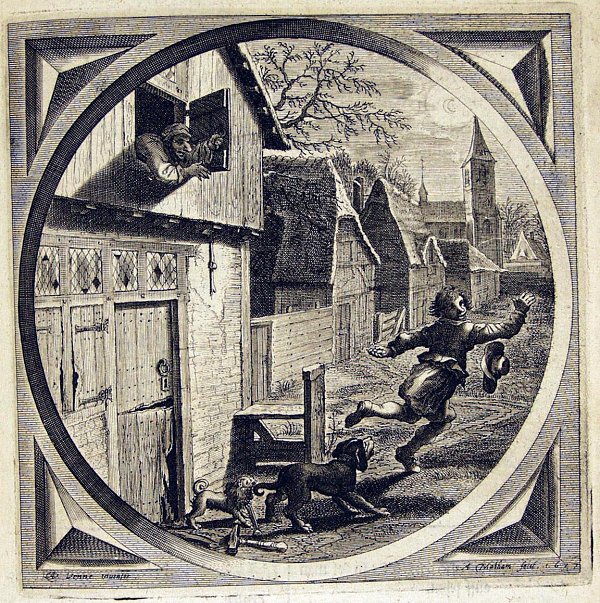
Als oude honden bassen ist tijt uyt te sienDutch
When old dogs bark, it is time to look out.AI-generated
Description of the imageAI-generated
A night scene in a village street, shown within a large oval frame set in a rectangular border with corner spandrels. At the left stands a timber-and-plaster house; from an open upper-storey window a man in a nightcap leans out, pointing with one arm toward the street. Below him are a shuttered leaded window and a heavy wooden door with a lock and a hanging key. In the foreground two dogs bark: a large hound with floppy ears lunges forward, head raised, and beside it a small shaggy lapdog yaps; on the ground lie a bottle and some scattered tools or sticks, near a low bench or stool and a post. At the right a bareheaded man in a doublet and breeches runs away with arms flung out, his hat flying off behind him. Behind them stretch thatched village houses and a church tower, with a crescent moon and a bare tree in the sky above.
Subscriptio


TranscriptionAI-generated
De huysman die uyt de venster siet, spreeckt. Schoon Leeutje staet en keft, oock somtijts gantsche nachten, Tis efter sonder gront daer op te willen achten, Het dingh is jonck en mal, het bast om 'kweet niet wat, Al hoortet maer een muys, al sietet maer een kat; Maer 'tis een ander saeck met onsen ouden Wachter, Want als die gaende wort, dan schuylter onraet achter; Het is een loose gast, en daerom bast hy niet, Voor dat hy yemant vreemts, of yet bysonders siet; Ick houd' het beest in eer, vermits sijn oude dagen, En mits het sich verstaet op alle slimme lagen; Dies als ick inder nacht verneme sijn geluyt Soo loop ick uyt het bedt, en kijck te venster uyt; Daer word' ick dan gewaer een deel onguere streken, Misschien een stouten boef die pooght in huys te breken, Of wel een hoender-dief, die houdt hem wonder stil, Of een die inden hof de freuyten stelen wil. Daer hapert altijt wat als oude honden bassen, En 'tis de rechte stont om op het stuck te passen; De tijdt heeft wonder in, want oock een lompich beest Wort door de jaren kloeck, en krijgt een snegen geest. Maer siet! hier was een dief, dan hy is nu geweecken, Ick denck hy vreest den hont, of heeft my hooren spreecken; Wel dat hy henen gae, sijn aenslagh is belet, En ick gae wederom my duycken in het bedt. Een woort noch evenwel, dat had ick u te seggen, Wilt dat te mijner eer in uwen boesem leggen: Gebruyckt de rappe jeught, wanneer ghy wilt de daedt; Maer soeckje goet beleydt, soo let op ouden raedt.
TranslationAI-generated
The householder who looks out of the window speaks. The little lion (lapdog) stands yapping, sometimes whole nights long, / yet there is no ground to pay any heed to it, / the thing is young and foolish, it barks at I know not what, / though it only hears a mouse, though it only sees a cat; / but it is a different matter with our old Watcher, / for when he gets going, then there is mischief behind it; / he is a sly fellow, and therefore he does not bark / until he sees some stranger or something unusual; / I hold the beast in honour, because of his old age, / and because he understands all sly ambushes; / therefore when in the night I hear his voice / I jump out of bed and look out of the window; / then I become aware of a deal of ugly doings, / perhaps a bold rogue who tries to break into the house, / or else a chicken-thief, who keeps himself wonderfully quiet, / or one who means to steal the fruit in the garden. / Something is always amiss when old dogs bark, / and it is just the moment to attend to the matter; / time holds wonders in it, for even a clumsy beast / grows clever through the years and gets a shrewd wit. / But see! here was a thief, but now he has fled, / I think he fears the dog, or has heard me speak; / well, let him be off, his attempt is foiled, / and I go back to burrow into my bed. / One word more, however, that I had to tell you, / be pleased, to my honour, to lay it in your bosom: / use nimble youth when you want the deed done; / but if you seek good management, then heed old counsel.
CommentaryAI-generated
30 passages · original left, translation right (click to fold)
Hoogd. Wen der alte hund bilst / so sol man auff sehen.
High German: When the old dog barks, one should look out.
Franç. L'abbay du vieil chien doit on croire.
French: One must believe the barking of the old dog.
Spaens. Cane vecchio non baja indarno.
(labelled 'Spanish', but Italian): An old dog does not bark in vain.
Franç. Il n'est abbay que du vieil chien.
French: There is no barking like that of the old dog.
El perro vieio si ladra da conseio.
Spanish: If the old dog barks, he gives counsel.
Quant le vieil chien abbaye il donne conseil.
When the old dog barks he gives counsel.
De jeune faucon la volee, Faict rarement bonne journee.
The flight of a young falcon rarely makes a good day's work.
Nederl. De jonge dwasen / Meynen dat de oude rasen / Maer d'oude hebben meer vergeten / Als de jonge dwasen weten.
Dutch: The young fools think that the old ones rave, but the old have forgotten more than the young fools know.
Au conseil oy le vieil.
In council, listen to the old man.
Il n'est que vieux chien pour chasser à plaisir.
There is nothing like an old dog for hunting with pleasure.
Den slagh der grijsen / Machmen voor ijsen.
At the blow of the grey-haired one may well shudder.
Oude honden en hoozen nae geen wis wis.
Old dogs do not come at any 'wis wis' (whistling/calling).
Ital. Gallina giouane per far uova è vecchia per covare.
Italian: A young hen for laying eggs, an old one for brooding.
Del vieio el conseio.
Spanish: From the old man, counsel.
Een oude kat speelt met geen balleken.
An old cat does not play with a little ball.
Lat. Consule queis ætas longa magistra fuit.
Latin: Consult those for whom long age has been a teacher.
Een oude vos is qualick te bedriegen.
An old fox is hard to deceive.
Een oude ratte wil niet inde val.
An old rat will not go into the trap.
Senum consilia, Iuvenum lanceæ. Eras.
The counsels of old men, the lances of young men. Erasmus.
Solo il bue vecchio move le carre arrestate.
Italian: Only the old ox moves the carts that are stuck.
Nederl. Met jonge te krijgen / Met oude te raden.
Dutch: With the young to make war, with the old to take counsel.
Senum voces fatidicæ. Richt. Axiom. Hist. 30.
The words of old men are prophetic. Richter, Axiomata Historica 30.
Franç. Il faut long temps pour toucher le poux au monde.
French: It takes a long time to feel the world's pulse.
Sapientiæ ætas condimentum est. Plaut.
Age is the seasoning of wisdom. Plautus.
Plautus. Sapere ista ætate decet qui sunt capite candido.
Plautus: Those who have a white head ought at that age to be wise.
Ovid. Adde, quod est senibus rerum prudentia major.
Ovid: Add that old men have the greater practical wisdom.
Ἔργα νέων, βουλαὶ δὲ μέσων, εὐχαὶ δὲ γερόντων.
Deeds of the young, counsels of the middle-aged, prayers of the old.
Facta juvenum, consilia mediocrium Vota senum.
The deeds of the young, the counsels of the middle-aged, the prayers of the old.
Nazianz. Consilijs nihil utilius meliusve paternis Pluraque canities novit quam læta iuventus Tempus enim historiæ pater est, materque vicissim. Historia est Sophiæ.
Gregory Nazianzen: Nothing is more useful or better than a father's counsels, and grey hair knows more than merry youth; for time is the father of history, and in turn history is the mother of wisdom.
Hoogd. Wen der alte hund bilst / so sol man auff sehen. — Franç. L'abbay du vieil chien doit on croire. — Spaens. Cane vecchio non baja indarno. — El perro vieio si ladra da conseio. — Franç. Il n'est abbay que du vieil chien. — Quant le vieil chien abbaye il donne conseil. — Franç. De jeune faucon la volee, Faict rarement bonne journee. — Nederl. De jonge dwasen / Meynen dat de oude rasen / Maer d'oude hebben meer vergeten / Als de jonge dwasen weten. — Franç. Au conseil oy le vieil. — Il n'est que vieux chien pour chasser à plaisir. — Nederl. Den slagh der grijsen / Machmen voor ijsen. — Nederl. Oude honden en hoozen nae geen wis wis. — Ital. Gallina giouane per far uova è vecchia per covare. — Spaens. Del vieio el conseio. — Nederl. Een oude kat speelt met geen balleken. — Lat. Consule queis ætas longa magistra fuit. — Nederl. Een oude vos is qualick te bedriegen. — Een oude ratte wil niet inde val. — Senum consilia, Iuvenum lanceæ. Eras. — Ital. Solo il bue vecchio move le carre arrestate. — Nederl. Met jonge te krijgen / Met oude te raden. — Richt. Lat. Senum voces fatidicæ. Axiom. Hist. 30. — Franç. Il faut long temps pour toucher le poux au monde. — Sapientiæ ætas condimentum est. Plaut. — Plautus. Sapere ista ætate decet qui sunt capite candido. — Ovid. Adde, quod est senibus rerum prudentia major. — Ἔργα νέων, βουλαὶ δὲ μέσων, εὐχαὶ δὲ γερόντων. Facta juvenum, consilia mediocrium Vota senum. — Nazianz. Consilijs nihil utilius meliusve paternis Pluraque canities novit quam læta iuventus Tempus enim historiæ pater est, materque vicissim. Historia est Sophiæ.
The complete multilingual collection of proverbs and sententiae appended to the emblem, in German, French, Spanish, Italian, Dutch, Latin and Greek, all to the effect that the barking of an old dog is to be trusted and that the counsel of the aged is worth more than the vigour of the young.
Iconclass
86(ALS OUDE HONDEN BASSEN IST TIJT UYT TE SIEN)proverbs, sayings, etc. (ALS OUDE HONDEN BASSEN IST TIJT UYT TE SIEN)
Suggested Iconclass codesAI-generated
Additional codes proposed for this emblem, not (yet) part of the indexing.
23R14nighthighThe correlate 'night' matches the depicted nocturnal village street with crescent moon and sleepers roused from bed.
41D252(NIGHT-CAP)nightwear: night-caphighThe correlate 'nightwear: night-cap' directly matches the man leaning from the upper window wearing a nightcap.
86proverbs, sayings, etc.highThe correlate 'proverbs, sayings, etc.' fits an emblem whose whole commentary is a multilingual collection of proverbs about the old dog's barking.
52E3Counsel; 'Consiglio' (Ripa)mediumThe correlate 'Counsel' matches the emblem's moral that the barking of the old dog, like the advice of the aged, should be heeded ('from the old man, counsel').
Relationships to the Adagia of ErasmusAI-generated
Suggested relationships between this emblem and adages in Erasmus’ Adagia.
- I x 17 Annosa vulpes haud capitur laqueo – thematic inventiohigh
The emblem's appended proverb-collection includes exactly this commonplace in vernacular form ('Een oude vos is qualick te bedriegen'; 'Een oude ratte wil niet inde val'), and the subscriptio praises the old watchdog because 'he understands all sly ambushes' — the same point as Erasmus's adage on prudentia senilis.
- II x 99 Senecta leonis praestantior hinnulorum juventa – thematic inventiohigh
The emblem opposes the young, foolish lapdog ('Leeutje') that yaps at nothing to the shrewd old 'Wachter' whose bark always signals real danger — precisely Erasmus's point that the old age of a vigorous animal/man is worth more than the vigour of the young.
- I viii 60 Senesco semper multa addiscens – thematic inventiomedium
The subscriptio's moral — 'time holds wonders in it, for even a clumsy beast grows clever through the years' — and the appended Latin tags ('Consule queis aetas longa magistra fuit'; Ovid's 'senibus rerum prudentia major') restate Erasmus's adage that wisdom is acquired through long experience of life.
- III ix 57 Aetate prudentiores reddimur – thematic inventiomedium
Erasmus's adage on growing wiser with age matches the emblem's conclusion that one should use youth for action but follow old counsel for good management.
- III ix 66 Senum prudentia – thematic inventiolow
Erasmus's 'wisdom of the aged' commonplace underlies the emblem's praise of the old dog that knows every trick, and its closing advice to heed 'ouden raedt'.
- III x 74 Senum prudentia – thematic inventiolow
The grey-haired remain fit for service through experience, matching the emblem's 'Den slagh der grijsen / Machmen voor ijsen' and the honour paid to the aged watchdog.
- IV ii 68 In sola Sparta expedit senescere – thematic inventiolow
The speaker's declaration 'Ick houd' het beest in eer, vermits sijn oude dagen' echoes the adage's theme that old age deserves honour and respect.
- I iii 92 Φίλαυτοι – direct mottomedium
This Erasmian adage (Greek and Latin 'Facta iuvenum, consilia mediocrium, vota senum') is quoted verbatim in the emblem's appended sententiae, and its sense — deeds for the young, counsel for the old — is the explicit moral of the subscriptio's last couplet.
Sources
Record ID: embstma_1288_emblem090
This emblem on the Iconclass site: https://iconclass.org/view/embstma_1288_emblem090
Copy: University Library, Glasgow, Stirling Maxwell 1288