Jacob Cats, Spiegel (The Hague, 1632)
Emblem 79
One man is shearing a sheep while another man tries to shear a screaming pig

Assay rumori, é poca lanaItalian
Much noise, and little wool.AI-generated
Description of the imageAI-generated
An outdoor village scene in an oval frame. Two peasants sit side by side on low stools. At the left a man in a broad-brimmed hat holds a sheep lying quietly across his lap and clips it with shears; another sheep stands behind him and a second sheep's head appears beside the stool. At the right a bare-headed man struggles with a large pig on his lap: the animal kicks and twists with its legs in the air while he grips it with one hand and holds shears in the other. Tufts of wool and bristles lie scattered on the ground, and a hat lies in the foreground. Behind, at the left, two men in cloaks stand talking and gesturing; in the middle distance a village with a church tower; at the right a tall house with a woman leaning from an upper window, a doorway, and a wooden tub on the ground. Birds fly in the sky. A blank scroll runs across the bottom; an engraver's monogram appears at lower right.
Subscriptio




TranscriptionAI-generated
Hier scheerter een het schaep, een ander scheert het vercken; Ey laet ons, met gemack, hier op een weynigh mercken: My dunckt (naer ick het vat) dat hier wat omme-gaet, Daer op in aller ernst by ons te letten staet. De man, die aen het swijn sijn voordeel meynt te vinden, Die gaet hem, soo ghy siet, veel moeyten onder-winden, Hy denckt (gelijck het schijnt) dit is het vetste beest, Hier is het dickste speck, hier is de reusel meest. Maer dit onstuymigh dier is qualijck om bestieren, Het vult de gantsche lucht met schreeuwen ende tieren, Het schopt, en slaet, en woelt, en worstelt metten man; Soo dat hy van het werck geen meester worden kan: Nu, op dit luyd' geschreeu, soo wert een yder gaende, Een yder loopter toe, een yder blijfter staende, En siet den handel aen, en, soo die voordeel gaf, Gewis men sach den man het gantsche voordeel af; Maer nu sijn gants bedrijf is moeyte, sonder baten, Soo wortet al-te-mael voor hem alleen gelaten: In plaetse van gewin, soo wert de man bespot, Dat is voor desen tijt sijn ongeluckich lot. En siet! naer dit gewoel, naer dit verdrietich scheeren, Soo krijgt de goede vrient noch wol, noch sachte veeren, Maer niet als enckel hayr, en borstels van het swijn, Dit is de gantsche loon van al de lange pijn. Maer let eens op den vrient die 'tschaepje heeft gekoren, Op dat sijn ruyge vacht door hem mocht zijn geschoren; Het dier en worstelt niet, maer ligt geduerich stil, Dies treft hy mette schaer alwaer hy maer en wil; Men hoorter geen geschreeu, soo datter van bezijden Hem niemant van het volck de winst en kan benijden; 'tIs sacht al wat hy raeckt, en niet als enckel wol, Dies krijgt hy hand', en schoot, ja gantsche manden vol. Wat isser menich mensch die sijn geheele leden In eenich swaer bedrijf, met onlust, gaet besteden! En, als hy langen tijt ten suersten heeft gesweet, Soo vint hy anders niet als enckel herten-leet. Een ander onder dies heeft yet ter hant genomen, En is daer, met gemack, tot sijnen wensch gekomen: Soo veel is goet beleyt, wanneer men yet bestaet, Soo veel is goet beleyt, soo veel is wijs beraet. Wel aen dan, sooje wilt u scheeren wel besteden, Soo kiest doch eenich beest dat wol heeft op de leden; Want als ghy daer in feylt, of inde keuse mist, Soo isset al bekaeyt, en achter 't net gevist. Doch onder dit beslach verneemt men vreemde saken, Die wy, met ons verstant, niet recht en konnen raken; Dat geenen heeft verrijckt, heeft desen uyt-geput; Dat elck is even nae, is elck niet even nut.
TranslationAI-generated
Here one man shears the sheep, another shears the pig; come, let us quietly observe this a little: it seems to me that something is going on here which we ought in all earnest to attend to. The man who thinks to find his profit in the pig takes much trouble upon himself; he thinks this is the fattest beast, here is the thickest bacon, here the most lard. But this unruly animal is hard to manage; it fills the whole air with screaming and raging, it kicks and strikes and heaves and wrestles with the man, so that he cannot master the job. Now at this loud screaming everyone comes running, everyone stands about and watches the business; and if it brought profit, surely people would take the whole profit from him; but now that his whole undertaking is trouble without gain, it is left to him alone. Instead of gain the man is mocked; that is for this time his unlucky lot. And see, after all this commotion, after this vexatious shearing, the good friend gets neither wool nor soft feathers, but nothing except hair and bristles of the pig: that is the whole reward of all the long pain. But look at the friend who chose the little sheep so that its shaggy fleece might be shorn: the animal does not struggle but lies still, so he strikes with the shears wherever he pleases; no screaming is heard, so that nobody standing by can envy him his gain; all he touches is soft, nothing but pure wool, and so he gets hands and lap and whole baskets full. How many a man spends all his strength on some heavy trade with displeasure, and when he has sweated bitterly for a long time finds nothing but heartache. Another meanwhile has taken up something and has come easily to his wish: so much depends on good management when one undertakes anything, so much on wise deliberation. Well then, if you would spend your shearing well, choose some beast that has wool on its limbs; for if you fail in that, or miss in the choice, all is spoiled and you have fished behind the net. Yet in this business one perceives strange things which we with our understanding cannot rightly grasp: what has enriched one man has exhausted another; what is equally near to each is not equally useful to each.
CommentaryAI-generated
2 passages · original left, translation right (click to fold)
Quædam non tam magna sunt negotia, quam fæcunda & quæ multum negotij ferunt, & hæc fugienda sunt. SENECA.
Some businesses are not so great as they are prolific, and they bring much trouble; and these are to be avoided. Seneca.
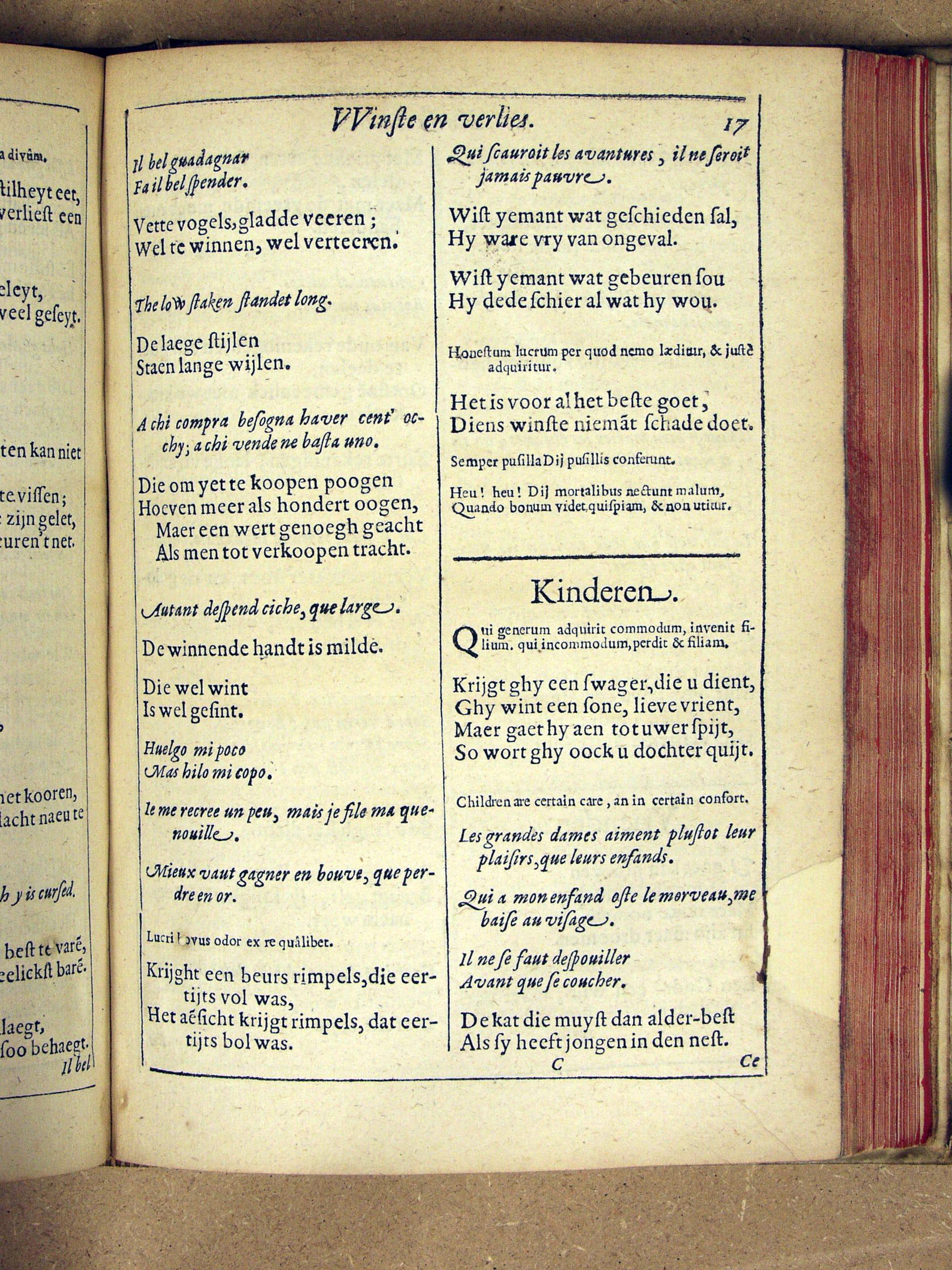
Al te wijs kan niet beginnen, Al te geck kan niet versinnen, Tusschen mal, en tusschen vroet, Wint men wel het meeste goet. Hy moet wagen Die wil bejagen. Die dit en gint geduerigh schromen, Hoe konnen die tot rijckdom komen? Gatto guantato non prese mai sorci. 'tMach waeyen, stil zijn, vloeyen, of ebben, Die niet en waegt en sal niet hebben. Sumptum faciat oportet is qui lucrum quærit. Rien ne s'acquiert sans avanture, & rien se conserve sans industrie. Sonder wagen niet vergaren, Sonder wijsheyt niet bewaren. Chi guarda a ogni piuma, non fa mai letto. Die elcke veer wil sien en raken, Hoe kan die oyt een bedde maken? Qui n'a guere, N'a guerre. Neeringh en is geen erf. Qui perd le sien, perd le sens. Heer uyt, Eer uyt. Ach! sensus cum re consiliumque perit. Die water deert, Water weert. Alle officien zijn smeerigh, sey des kosters wijf, en kreegh een eynde keers uyt de kerck. Inde rommelinge ist vet. By 'tvolck is de neeringh, sey de mossel-man, en hy quam met sijn mosselen inde kerck. Qui eget, in turbâ versetur. Wijs en rijck, Is Godt gelijck. Wie vis voor visschers deur wil vangen, Die mocht sijn net wel elders hangen. Il ne faict bon chasser par une montagne trop frequentee. De beste jagers sullen jagen Daer sy geen jagers eerst en sagen. Ficus sunt avibus gratæ, at plantare recusant. De vogels willen korsen eten, Schoon datse van gheen planten weten. De kat wou wel den vis genaken, Maer vreest haer pooten nat te maken. Ce n'est pas gain Quant on pipe son prochain. Dit oude woort duert heden noch, Men doet geen voordeel met bedroch. Peu de vin, vens le vin: Beaucoup de vin, gardes le vin. Qui a un an veut estre riche, a la moitié on le pend. Die binnens jaers wil alles vangen, Die mocht wel voor den winter hangen. Qui se mesle de plusieurs affaires, donne beaucoup de prise a la fortune sur luy. Qui beaucoup embrasse, peu estreint. Die veel om-vaemen Weynich versaemen. Au pauvre un œuf Vaut un bœuf. Pauperi ovum, ovis. Avec l'eau qui est passé le molin ne moult pas. Met verloopen water en maelt geen meul. Por el dinero Bayla el perro. Pour de l'argent danse le chien. Elck spreeckt van de mart nae hy verkocht heeft. Agricola semper in futurum dives est. Aquila non venatur muscas. Ne croy pas a celuy qui vient de la foire, mais a celuy qui y retourne. Gelooft hun niet te veel die van den jaer-mart komen, Want voor haer listigh woort is noch al vry te schromen, Maer, vrienden, so ghy wilt hier in een vaster raet, Soo let, tot u bericht, wie datter weder gaet. Se vuoi del tuo mestier cavar guadagno, D'un tuo maggiore non ti far compagno. Zijt ghy een esel inder daet, En neemt geen leeu tot mede-maet. Waer ghy den gront niet klaer en siet, En gaet daer in het water niet. Tusschen neus, en tusschen lippen, Kan een goede kans ontglippen. Gagner par escus, hazarder par liarts. Die met kroonen winnen, en stuyvers wagen, Die zijn bevrijt voor harde slagen. La fortune se lasse de vous suivre, car vous allez trop viste. Riche ou pendu, dict le soldat pillard. Lancksamen rijckdom is saligst. Essai guadagna, chi vano sperar perde. Een schaft is beter in de hant, Als seven gansen opte strant. Een stille mool en maeckt geen meel. Een vos die slaept, een drooge keel. Light gaynes make heavye purses. Die geenen ael weet op te langen En plach geen kabeljaeu te vangen. Majora perdes, parva ni servaveris. Chi non stima un quadrino, non lo vale. Du petit vient on au grand. Qui faict la maille vile Iamais amasse mile. Wie worter tot yets groots ghebracht Die eerst het kleyntje niet en acht? Riche rarement on vit Qui mesprise le petit. Ce qui est gagné par taborijn, passe par la fluste. Het staet geschreven opten vloer, Gelijck het quam, also het voer. Het staet geschreven opten heert, Soo gewonnen, soo verteert. Qui hante le moulin s'Enfarine a la fin. Onder het zeyltjen ist goet roeyen, Want 'tsal niemant licht vermoeyen. Ne uni navi facultates. Mus non uni fidit antro. Niet al de eyers onder eene hen. Soo ghy op 't kleyntje niet en let, Het groote wort u los geset. A la poule serre luy le poing, elle te serrera le cul. Die wel aen sijnen acker doet, Die doet gewis hem weder goet. Groote visschen scheuren 't net, Soo ghy daer niet op en let. Qui veut prendre un oiseau, il ne le faut pas effaroucher. Geen vogels mogen sy verschricken Die op de vogels willen micken. Die jaegt met katten, En vangt maer ratten. Brant laet yet, Maer water niet. Die altijt wil voordeel doen, moet lombaert houwen. Daer zijnder die soo veel met spijker-rapen winnen, als sy met den brant verliesen. Geen vogel vloogh oyt so hoogh, of hy moest sijn kost op d'aerden soecken. Armoede is leuyheyts loon. De grasse matinée, Robbe deschirée. Godt gheeft de vogelen den kost, maer sy moetender om vliegen. De vogels krijgen wel den kost, Maer zijn van moeyte niet verlost. Tonans conantem adjuvat. Serpens, nisi serpentem diglutiat, non fit draco. Ten zy de slang verslint een slang, Sy wort gheen draeck haer leven langh. Een raef moet nutten sonder krassen, Een hont moet knagen sonder bassen. Heeft yemant ghelt dat schoone blinckt, Die maecke dattet niet en klinckt. The stil sow eateth up al the draffe. Gaen uwe saken naer u wenschen, Danckt Godt, maer pocht niet by de menschen, Wint ghy, soo laet van roemen af; Een stille seugh die eet den draf. l'Argent qui ne sonne, est le meilleur. Le sage n'expose sa fortune a l'envie. Soo dickwils als 'tschaepje bleet, verliestet een beetjen. Possideat tacitè, si quæ sint munera divûm. 'tIs best dat 'tschaep in stilheyt eet, Want als het bleet, 'tverliest een beet. Een ey dat noch is ongeleyt, Daer van en dient niet veel geseyt. En grand torrent Grand poisson on prend. Ghy segt ons, vrient, ten kan niet missen, In groote waters groote vissen; Maer hier op dient te zijn gelet, De groote vissen scheuren 't net. Vn fol, ou beste, Faict bien conqueste, Mais bon mesnage, Est faict de sage. Men wint, of verliest, Nae dat men kiest. Het zy in 't velt, of in het kooren, Een recht wey-man placht naeu te spooren. The fox fareth wel, when he is cursed. De vos die placht dan best te varen, Wanneer de boeren leelickst baren. Benijt is beter als beklaegt, Wanneer het Godt alsoo behaegt. Il bel guadagnar Fa il bel spender. Vette vogels, gladde veeren; Wel te winnen, wel verteeren. The low staken standet long. De laege stijlen Staen lange wijlen. A chi compra besogna haver cent' occhi; a chi vende ne basta uno. Die om yet te koopen poogen Hoeven meer als hondert oogen, Maer een wert genoegh geacht Als men tot verkoopen tracht. Autant despend chiche, que large. De winnende handt is milde. Die wel wint Is wel gesint. Huelgo mi poco Mas hilo mi copo. Ie me recree un peu, mais je file ma quenouille. Mieux vaut gagner en bouve, que perdre en or. Lucri bonus odor ex re quâlibet. Krijght een beurs rimpels, die eertijts vol was, Het aensicht krijgt rimpels, dat eertijts bol was. Qui scauroit les avantures, il ne seroit jamais pauvre. Wist yemant wat geschieden sal, Hy ware vry van ongeval. Wist yemant wat gebeuren sou Hy dede schier al wat hy wou. Honestum lucrum per quod nemo læditur, & justè adquiritur. Het is voor al het beste goet, Diens winste niemant schade doet. Semper pusilla Dij pusillis conferunt. Heu! heu! Dij mortalibus nectunt malum, Quando bonum videt quispiam, & non utitur. Kinderen. Qui generum adquirit commodum, invenit filium. qui incommodum, perdit & filiam. Krijgt ghy een swager, die u dient, Ghy wint een sone, lieve vrient, Maer gaet hy aen tot uwer spijt, So wort ghy oock u dochter quijt. Children are certain care, and incertain confort. Les grandes dames aiment plustot leur plaisirs, que leurs enfands. Qui a mon enfand oste le morveau, me baise au visage. Il ne se faut despouiller Avant que se coucher. De kat die muyst dan alder-best Als sy heeft jongen in den nest. Ce que l'enfand oit au foyer, il le rend a la porte. Het kint dat buyten spelen gaet, Seyt hoe het inden huyse staet. Quando fanciulli stan cheti, han fatto qualche male. Als de kinders stille zijn, dan hebbense quaet gedaen. Il faut si bien marier ses enfants, qu'ils n'ayent que faire de leur peres. Chi ha polli ha pipite. La fille n'est que pour enrichir les maisons estrangeres. Qui pert son pere, pert honneur, Qui perd sa mere, il perd douceur. Scheyt u vader uyter tijt, Kint, ghy zijt u eere quijt; Maer indien u moeder rust, Ghy verliest u herten-lust. Vrienden. U goet kan groeyen Door oude moeyen; Maer oude oomen En zijn maer droomen. Een Godt, een wijf, maer veel vrienden. Met vrienden eeten, drincken, wandelen, Maer met de vreemde moet men handelen. A cuentas viejas Baraias nuevas. Van oude rekeningen, en out goet te deelen, Ontstaen gemeenlick nieuwe krackeelen. Korte rekeningen, lange vriendtschap. Chi si fida, rimane ingannato. Veel spreeckter stout, en 'tis gelogen, Wie veel betrout, wort licht bedrogen. Sopra negro non é colore, Sopra vertu non é honore, Sopra peccato non é dolore, Sopra figliuoli non é amore. Vrient, Soo langh het dient. Een lege beurs die noem ick leer, Brengt gelt, sy krijght haer eer-naem weer. Guardati d'aceto, de vin dolce. De soetste wijn, De felst' asijn. En partage lit & jambon, On cognoit son compagnon. Nulli non magno constitit & bona noverca. Parente con parente Guay chi non ha niente. Vrienden zijn vrienden, maer wee diese van doen heeft. Amy de table Est variable. Een tafel-vrient Soo langh alst dient. Con il buen sol Estiende se el caracol. Avec le soleil, le limaçon s'estend. Wie vrientschap aen een vrient verwijt, Die is sijn vrient, en vrientschap quijt. Ie nie l'amy qui couvre avec Les aisles, & mord avec le becq. Ten is geen vrients, maer een linckers treck, Die deckt met de vleugels, en bijt metten beck. Wt dat men spreeckt, of dat men schrijft, En uyt den handel die men drijft, Wt vrienden daer men mede paert, Daer kent men uyt der menschen aert. Stultus quod perdat habet; quod, in id quod oportet, impendat non habet. Chi te fa carezze piu che suole O tradito t'ha o tradir te vuole. Vleyt yemant soeter als hy plach, Hy wil bedriegen, soo hy mach. A casa de tu tia Mas no cada dia. A casa de tu hermano Mas no cada serano. Een vrient besoecken houtmen goet, Indien men 't niet te veel en doet; Maer soo het alle daegh geschiet, Soo waer het vry al beter niet. Il ne faut pas, tant baiser son amy a la bouche, que le cœur luy en face mal. Weet, vrient, dat hart, en dickmael kussen De vriendtschap wel placht uyt te blussen; Wel kust dan met een heusschen mont; Te veel is hier oock ongesont. Al is u vrient al suycker-soet, Weet dat ghy hem niet eten moet. Beleefde lieden moet men mijden, En 'twilligh peert niet over-rijden. Noyt moet men van een eerlick man Al nemen wat men krijgen kan. No seras amado, Si de ti solo tienes cuydado. 'tIs wonder so hy vrienden heeft, Die altijt neemt, en nimmer geeft. Tu ne seras point aimé si tu as soing de toy seulement. Que Dieu ne donne point tant de biens a noz amys, qu'ils nous mescognoissent. Il est bien fol, qui s'oublie. Die kooren voor een ander meet, Is dwaes, indien hy sich vergeet. Wie ist die elders water giet, Die brant in sijne wooningh siet? Mijn hemde Is my naerder als mijn knie. Pain d'autruy, pain de douleur, encore si ton pere mesme te le donne. Ne quid exspectes amicos facere, quod per te queas. Non trovi amico piu fidato e caro, Che mi sovenga con il mio denaro. Ten naesten watere, als 't brant is. Puta vitem tuam manu tuâ, non alienâ. Non scabat caput tuum, præter ungues tuos. SIN-SPREVCKEN, Genomen uyt Arabische en Saraceensche Schrijvers. Initium Sapientiæ est timor DEI. Godes vreese is 'tbeginsel der wijsheyt. Cujus concupiscentia vincit intellectum (seu rationem) is perit. Wiens vernuft door de begeerlickheyt verwonnen wert, die gaet verloren. Abstinere à concupiscentijs, est divitem esse. Van lusten sich t'onthouwen, is rijck te wesen. Sapientissimus hominum est, qui fines respicit. Die op het eynde aller dingen let, is onder de wijse te rekenen. Qui non discernit bonum a malo, adjunge eum bestijs. Die 'tgoet van 'tquaet niet en onderscheyt, stelt dien by de beesten. Contentus esto eo quod Deus tibi impertit; & eris dives. Verneught u met 'tgeene u Godt verleent, en ghy sult rijck wesen. Accende lucernam tuam ante tenebras. Id est; illumina te operibus bonis, antequàm superveniat tibi mors. Ontsteeckt uwe lampe eer het duyster is. dat is; maeckt u beroepinge seker met goede wercken voor uwe af-lijvicheyt. Quando non evenit tibi quod vis; velis, quod evenit. Als u niet en geschiet dat gy wilt, wilt dan dat u geschiet. Quando audiveris virum loquentem de te bonum, quod in te non est, ne credas: loquetur enim & malum de te, quod in te non est. Als ghy yemant hoort spreken van deugden die in u niet en zijn, soo en gelooft hem niet; want deselve sal oock spreken van gebreken die ghy niet en hebt. Reges judicant terram, sapientes judicant ipsos reges. De koningen oordeelen het aertrijck, de wijse de koningen. Homo sapiens est, quamdiu quærit sapientiam: ubi autem se putat ad ejus culmen pervenisse, desipit. De mensche is wijs, soo lange hy nae wijsheyt soeckt; maer als hy meynt dat hy die bekomen heeft, soo begint hy te dwasen. Qui non vincit luctum patientiâ, ejus mœror longus erit. Die sijn rouwe door ghedult niet en kan versetten, diens droefheyt sal lang-wijligh wesen. Ne crede te sapientem esse, donec eo animi robore fueris, ut possis regere cupiditates. En beelt u niet in dat ghy wijs zijt, eer ghy u begeerlickheden bestieren kondt. Arabs interroganti, quodnam bellum honestissimum esset? illud, inquit, quod contra voluptatem geritur. Een Arabier gevraegt zijnde, welcke de eerlickste oorloge waere? die teghens de wel-lust gevoert wert, antwoorde hy. Idem Arabs rogatus, quid esset fiducia in Deum? quâ Deo, inquit, fretus homo res suas omnes ei committit. De selve ghevraegt wesende wat het zy op Godt te vertrouwen? als de mensche, op den selven steunende, alle sijn saecken hem is bevelende; was sijn antwoorde. Nemo, inquit sapiens ille Arabs, me dilexit, quem non vicissim dilexerim sincerè, per omnem vitam meam. nemo me odio prosecutus est, pro quo non oraverim Deum, ut illi meliorem mentem daret. Niemant (seyde deselve) en heeft my oyt bemint, dien ick niet wederom oprechtelicken lief en hebbe gehadt mijn gantsche leven langh, niemant en heeft my oyt gehaet, voor wien ick Godt niet en hebbe gebeden, dat hy hem beter sinnen wilde verleenen. Principium luctus est, diligere mundum. De werelt lief hebben, is 'tbeginsel van droefheyt. Qui se-ipsum habet pro sapiente; habet eum Deus & homines pro ignaro. Die sich selven voor wijs acht, dien achten Godt ende de menschen voor dwaes. Non est Sapiens sapiens, donec cupiditates suas omnes vincat. Niemant isser wijs, ten zy saecke hy alle sijne begeerlickheden t'onder heeft. Perfectio est in tribus rebus, quæ sunt: Devotio in religione, patientia in adversis, & prudentia in vitâ. De vol-maecktheyt bestaet in drie saecken, en die zijn dese: Innigheyt in Gods-dienst, gedult in tegen-spoet, en wijsheyt in den loop des levens. Doctus sine opere, ut nubes est sine pluvia. Een gheleert man die niet uyt en werckt, is als een wolcke sonder regen. Dives sine liberalitate, est ut arbor sine fructu. Een rijck man sonder mildicheyt, is als een boom sonder vruchten. Obstrue quinque fenestras, ut luceat domus, & habitans eam. id est, Observa (vel coerce) quinque sensus corporis ut luceat anima tua in luce vitæ. Stopt vijf vensters, op dat het huys glans hebbe, en die het bewoont. dat is, Let en bedwinght uwe vijf uytterlicke sinnen, op dat de ziele lichte in het licht des levens. Occlude ostium tuum adversus raptores. id est, Claude sensus tuos contra peccatum, ne te capiant hostes tui. Sluyt u deure tegens de stroopers. dat is, Versekert u sinnen tegens de sonde, op dat u vyanden u niet en betrappen. Cui Deus largitur animum bonum, is est ex filijs futuri sæculi. Hy, dien Godt een goet gemoedt geeft, is van de kinderen der toekomender eeuwe. Ne gaude cum ceciderit inimicus tuus: nam nescis quid tibi eventurum sit. En verblijt u niet, soo u vyant valt, want gy en weet niet wat u overkomen sal. Deus alta deprimit, & depressa exaltat, quocirca deprime te ipsum, ut ipse te exaltet. Godt druckt hooge dingen neder, en verheft de nederighe: ghy, daerom vernedert u, op dat hy u verhooge. Ne aliorum vitia patefacito, ne Deus tua patefaciat. En openbaert eens anders gebreken niet; ten eynde Godt de uwe niet bloot en legge. Interrogatus sapiens Arabs, quis felicissime negotiaretur? Is, inquit, qui vendit bona peritura, hoc animo ut sibi comparet stabilia & duratura. Een van de Arabische wijsen ghevraegt zijnde, wie alder-gheluckigst koop-handel dreef? Die (seyde hy) dewelcke verganckelijcke goederen verkoopt, met meyninge om de eeuwige en altijt-geduerige te bekomen. Denique ex Clenardi Epistolar. lib. 1. & hoc in Saracenorum laudem maximè vergit, cum ait: Nullus tam durus casus eis contingit, ut fracti impatientiâ, redigantur in blasphemias: verum quicquid evenerit, non stomachantur, sed illud habent in ore, LAVS DEO. Eyntelick uyt het eerste boeck der brieven van den gheleerden Clenardus, is dit, tot prijs vande Saraceenen, aen te mercken, dat hy verhaelt dat aen deselve geen soo swaren geval kan gebeuren datse door onverduldt vervallen tot Gods-lasteringen; maer wat henlieden oock over-koomt, sy en vergrammen sich niet, maer hebben gedueriglicken inden mont, Gode zy loff. Tot vervullinghe van wat ledige plaets, eenige Sin-spreucken uyt SENECA. Plura sunt quæ nos terrent, quàm premunt. Daer zijn meer dingen die ons verschricken, als leet doen. Is maximè divitijs fruitur, qui minimè divitijs indiget. Die geniet meest den rijckdom, die den selven minst van doen heeft. Altera ex alterius fine nascitur cupiditas. d'Eene begeerlickheyt wast uyt het eynde vande andere. Ante senectutem curandum benè vivere, in senectute bene mori. Voor den ouderdom moetmen wel leeren leven, in den ouderdom wel leeren sterven. Hodie fieri potest, quidquid unquam potest. Wat oyt kan geschieden, kan heden geschieden. Plus scire velle quàm satis est, intemperantiæ genus est. Meer te willen weten als nae genoeghsaemheyt, is een sorte van onmatigheyt. Malitia ipsa maximam partem veneni sui bibit. De boosheyt suypt een groot deel van haer eygen fenijn in. Rectè facti, fecisse merces est. De loon van een goede saecke, is wel gedaen te hebben. Post malam segetem etiam serendum. Nae een quaeden oegst dient al wederom gesaeyt. Tenue est mendacium, perlucet; si diligenter inspexeris. De leugen is dun, sy schijnt deur, alse wel besien wert. Quid stultius, quam quia diu non didiceris, non discere? Wat isser dwaeser als niet te willen leeren, vermits men tot noch toe niet geleert en heeft? Æquat omnes cinis, impares nascimur, pares morimur. Het graf maeckt alles gelijck. Wy zijn ongelijck geboren, maer in gelijckheyt sterven wy. Is magnus & beatus, quem nulla res minorem facit. Die is gheluckigh en groot, dien geen dingh minder en maeckt.
A collection of proverbs and maxims arranged under the headings of gain and loss, children, friends, maxims taken from Arabic and Saracen writers, and sayings from Seneca. Among them: too wise can begin nothing, too foolish can devise nothing; between foolish and shrewd one wins most. He must venture who would gain. A gloved cat never caught mice. He who does not venture shall not have. He who seeks gain must make expense. Nothing is acquired without risk and nothing kept without industry. He who looks at every feather never makes a bed. He who has little has no war. He who loses his goods loses his senses; alas, sense and counsel perish with one's property. Trade is where the people are. Wise and rich is like God. It is not good hunting on a mountain too much frequented. Birds like figs but refuse to plant them. The cat would reach the fish but fears to wet her paws. It is no gain when one cheats one's neighbour. He who would be rich in a year is hanged at the half-year. He who meddles in many affairs gives fortune much hold on him; he who embraces much grasps little. To a poor man an egg is an ox. The mill does not grind with water that has passed. For money the dog dances. The farmer is always rich in the future; the eagle does not hunt flies. Trust not him who goes to the fair but him who returns. If you would profit by your trade, make no companion of your better. Win by crowns, risk by farthings. Fortune tires of following you, for you go too fast. Light gains make heavy purses. You will lose greater things if you do not keep the small; from the small one comes to the great. As it came, so it went; so won, so spent. He who haunts the mill gets floury. Trust not your fortune to one ship; the mouse does not trust one hole; not all eggs under one hen. Great fish tear the net. He who hunts with cats catches only rats. Fire leaves something, water nothing. No bird flew so high but it must seek its food on earth. Poverty is the wages of sloth. God gives the birds their food, but they must fly for it. The Thunderer helps him who strives. Unless a serpent swallow a serpent it becomes no dragon. The still sow eats all the draff; the money that does not clink is best; the wise man does not expose his fortune to envy. As often as the sheep bleats it loses a bite; let him possess in silence whatever gifts the gods give. In a great torrent great fish are taken, but great fish tear the net. The fox fares best when the peasants rage. Envied is better than pitied. Fine gaining makes fine spending. The low stake stands long. The buyer needs a hundred eyes, the seller one. The winning hand is liberal. Better to gain in copper than lose in gold; the smell of gain is good from any source. He who knew the chances would never be poor. Honest gain is that which harms no one. The gods give small things to small men; alas, the gods weave evil for mortals when a man sees good and does not use it. Of children: he who gains a good son-in-law finds a son, a bad one loses his daughter too. Children are a certain care and an uncertain comfort. Great ladies love their pleasures more than their children. The cat mouses best when she has kittens. What the child hears at the hearth it tells at the door. When children are quiet they have done mischief. He who loses his father loses honour, he who loses his mother loses sweetness. Of friends: one God, one wife, but many friends. Old reckonings breed new quarrels; short reckonings, long friendship. He who trusts is deceived. A table-friend is changeable. He who caresses you more than usual has betrayed you or means to. Visit your aunt, but not every day. Do not kiss your friend so much that his heart sickens. You will not be loved if you care only for yourself. He is a fool who forgets himself; another's bread is bread of sorrow. Expect not friends to do what you can do yourself; prune your vine with your own hand. The Arabic maxims: the fear of God is the beginning of wisdom; he whose desire conquers reason perishes; to abstain from desires is to be rich; the wisest of men looks to the end; be content with what God grants and you will be rich; light your lamp before the darkness, that is, do good works before death; when what you wish does not happen, wish what happens; kings judge the earth, the wise judge kings; a man is wise as long as he seeks wisdom; do not think yourself wise till you can govern your desires; the most honourable war is that waged against pleasure; the beginning of grief is to love the world; perfection lies in devotion, patience and prudence; a learned man without works is a cloud without rain, a rich man without liberality a tree without fruit; block the five windows that the house may shine, that is, restrain the five senses; rejoice not when your enemy falls; God casts down the high and raises the lowly; reveal not others' faults lest God reveal yours; he trades most happily who sells perishable goods to gain lasting ones. Finally from Clenardus's Letters, book 1, in praise of the Saracens: no misfortune so hard befalls them that they are driven to blasphemy; whatever happens they are not angered but have in their mouth, PRAISE BE TO GOD. From Seneca: more things frighten us than hurt us; he enjoys riches most who needs them least; one desire grows out of the end of another; before old age learn to live well, in old age to die well; whatever can ever happen can happen today; to want to know more than enough is intemperance; malice drinks most of its own poison; the reward of a good deed is to have done it; after a bad harvest one must sow again; a lie is thin and shows through; what is more foolish than not to learn because you have long not learned; ashes make all equal, we are born unequal and die equal; he is great and happy whom nothing can make smaller.
Iconclass
22D12disharmonious sound, dissonance25I244village square, place31D14adult man33A35conversation, dialogue; conversation piece41A336human figure at (open) window41A7211stool41A775wooden container: barrel, cask41A7751container made of plant material other than wood: basket41D221(HAT)head-gear: hat46B471profit (~ commerce)46B472loss (~ commerce)47I224shearing (sheep)47I224(+0):47I212(+949)shearing (sheep) (+ variant)❧pig (+ audible means of communication of animal(s): roaring, crying, singing, barking, mewing, neighing, chirping, etc.)54BB3Inutility, Noxiousness; 'Nocumento', 'Nocumento d'ogni cosa' (Ripa)55A12Reward, 'Praemium'; 'Premio', 'Remuneratione' (Ripa)51AA4:55A12Nothingness, Absence❧Reward, 'Praemium'; 'Premio', 'Remuneratione' (Ripa)86(ASSAY RUMORI, É POCA LANA)proverbs, sayings, etc. (ASSAY RUMORI, É POCA LANA)
Suggested Iconclass codesAI-generated
Additional codes proposed for this emblem, not (yet) part of the indexing.
47I224shearing (sheep)highThe correlate 'shearing (sheep)' exactly matches the left peasant clipping a sheep lying across his lap with shears.
47I212pighighThe correlate 'pig' matches the large kicking pig held on the right peasant's lap as he tries to shear it.
86proverbs, sayings, etc.highThe correlate 'proverbs, sayings, etc.' fits the emblem's proverbial subject (shearing a pig yields much cry, little wool) and the commentary's extensive collection of proverbs and maxims.
86(...)proverbs, sayings, etc. (with TEXT)mediumThe correlate 'proverbs, sayings, etc. (with TEXT)' allows the specific proverb illustrated by the sheep-versus-pig shearing to be cited, as the image carries a (blank) motto scroll.
Relationships to the Adagia of ErasmusAI-generated
Suggested relationships between this emblem and adages in Erasmus’ Adagia.
- IV i 25 Ficus avibus gratae – direct mottohigh
The emblem's Latin/Dutch proverb commentary quotes the adage verbatim in Erasmus's own Latin rendering: 'Ficus sunt avibus gratæ, at plantare recusant' (cf. Erasmus: 'Fici gratae avibus sunt, quae plantare recusant'), glossed in Dutch as birds wanting fruit without planting — i.e. wanting profit without honest labour, exactly Erasmus's application.
- III ii 65 Aquila non captat muscas – direct mottohigh
The commentary's proverb list contains 'Aquila non venatur muscas', a near-verbatim form of Erasmus's adage (his essay has 'Aquila non aucupatur muscas'), used in the same sense that the great disdain trifling gains.
- V i 4 Mus non uni fidit antro – direct mottohigh
The commentary quotes the adage exactly — 'Mus non uni fidit antro' — immediately beside 'Ne uni navi facultates' and the Dutch 'Niet al de eyers onder eene hen', i.e. do not stake everything on one venture, Erasmus's own sense.
- IV iv 6 Ne uni navi facultates – direct mottomedium
The Latin tag 'Ne uni navi facultates' stands verbatim in the emblem's proverb commentary, paired with the mouse-and-hole adage, just as Erasmus groups these warnings against risking all one's goods in a single venture.
- I ix 14 Parturiunt montes, nascetur ridiculus mus – thematic inventiomedium
The motto 'Assay rumori, e poca lana' (much noise and little wool) and the subscriptio's account of the squealing pig that draws a crowd but yields only bristles reproduce exactly Erasmus's point about huge uproar and expectation followed by a ridiculous, worthless result.
- I iv 79 Ab asino lanam – thematic inventiomedium
Shearing a pig for wool is the pictorial equivalent of Erasmus's 'seeking wool from an ass': labouring to obtain from a creature what it cannot by nature yield, so that the whole effort is trouble without profit.
- III iii 61 Serpens ni edat serpentem, draco non fiet – direct mottomedium
The commentary quotes 'Serpens, nisi serpentem diglutiat, non fit draco' with a Dutch verse translation, reproducing Erasmus's adage on how one grows great only by consuming one's own kind (here applied to gain and loss).
- III i 20 Murem ostendit pro leone – thematic inventiolow
Like the pig-shearer who promises himself the fattest beast but produces only bristles and mockery, Erasmus's adage describes someone who raises huge expectations and then delivers something contemptibly small.
- I iii 53 De lana caprina – thematic inventiolow
Erasmus's adage turns on noisy contention over wool that an animal does not really have (and he adds the related joke about ass's wool), which is the same conceit as the uproarious but woolless shearing of the pig.
Sources
Record ID: embstma_1288_emblem079
This emblem on the Iconclass site: https://iconclass.org/view/embstma_1288_emblem079
Copy: University Library, Glasgow, Stirling Maxwell 1288